
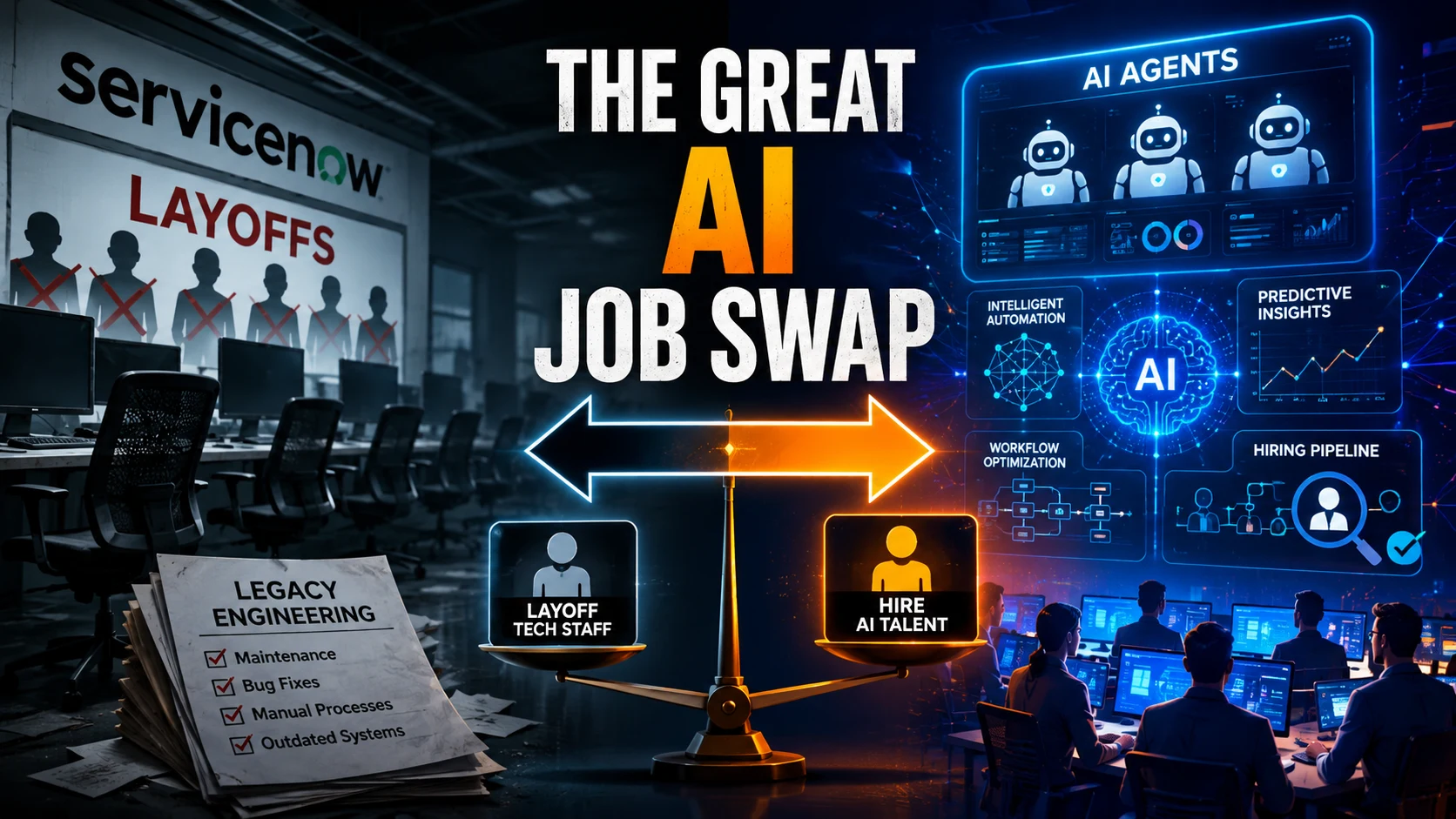
ServiceNow is aggressively slashing legacy engineering roles while racing to recruit specialized artificial intelligence talent in a massive corporate IT restructuring.
Over 124,000 tech workers have already lost their jobs across 247 companies so far this year, while enterprise software giants scramble to reallocate capital toward autonomous platform models. Is this quiet workforce transition a standard downsizing move, or a permanent talent replacement strategy? The urgency is building rapidly across Silicon Valley as enterprise SaaS leaders rewrite their entire human resources blueprint.
The New Workforce Math
ServiceNow confirmed it is restructuring its global workforce to drive operational efficiencies while aggressively hiring for AI-focused skills.
Instead of expanding overall employee headcount, CEO Bill McDermott signaled an attrition-plus-AI strategy. The company is letting non-core roles naturally sunset or eliminating functions like dedicated Quality Engineering (QE) to fund next-generation software development.
| Role Family | Workforce Direction | Core Strategic Driver |
|---|---|---|
| Quality Engineering (QE) | Eliminated / Reduced | Internal AI testing tools replace manual QA workflows. |
| Traditional IT Admins | Unfilled Attrition | Autonomous workflow agents handle routine system administration. |
| Agentic AI Engineers | Aggressive Hiring | Developing autonomous agents for enterprise workflows. |
| AI Governance & Security | Active Expansion | Building enterprise guardrails for platform compliance. |
“Is this really downsizing, or a talent reallocation strategy?”
Why Legacy Jobs Are Exposed
Enterprise software platforms are finding that traditional software engineering tasks are prime candidates for AI-driven automation.
- Automated Testing: Internal AI agents generate and execute unit tests faster than dedicated QA teams.
- Routine Scripting: Workflow creation and flow debugging are shifting from manual developers to conversational prompts.
- Basic IT Ticketing: First-line customer support and employee service requests resolve autonomously via AI agents.
According to reporting by NowBen, ServiceNow confirmed these global organizational updates as part of its long-term talent realignment.
“ServiceNow is committed to having the right talent in the right roles… We are driving efficiencies across the business, actively investing in and hiring for AI-focused skills.” — ServiceNow Official Spokesperson
Why AI Jobs Are Expanding
As ServiceNow slashes traditional roles, demand for high-tier AI architects is soaring. The enterprise focus is moving away from basic text chatbots toward complex, multi-step agentic workflows that operate without human supervision.
- Model Ops Specialists: Engineers needed to deploy, fine-tune, and monitor enterprise LLMs.
- Agent Developers: Programmers who design multi-step AI agents for autonomous execution.
- AI Governance Officers: Experts ensuring autonomous agents comply with enterprise security policies.
Consult open positions on the ServiceNow Careers Portal and review platform data on Layoff Today to explore current hiring priorities across Applied AI engineering.
ServiceNow is laying off more staff as part of changes which are “global in nature”. It comes after the ITSM company let hundreds of employees go earlier this year.
— Salesforce Ben (@SalesforceBen) July 28, 2026
Henry Martin has the details on the new round of layoffs.https://t.co/lY5W6EJjfQ#Salesforce
Bigger Industry Signal
ServiceNow is not an isolated case. Tech giants across the SaaS landscape—including ClickUp and SentinelOne—are executing similar corporate IT restructurings.
They are actively using capital saved from headcount reductions to buy GPU infrastructure and recruit specialized AI research teams.
“Who gets left behind as AI hiring becomes the new prestige strategy?”
What It Means for Tech Workers
This shift represents a fundamental skills pivot rather than a temporary tech slump. Software engineers who adapt by mastering prompt orchestration, model integration, and agentic workflows are commanding record compensation, while traditional roles face dwindling demand.
The broader tech sector is sending an undeniable message: adapting to an AI-native stack is no longer optional for long-term career survival.