
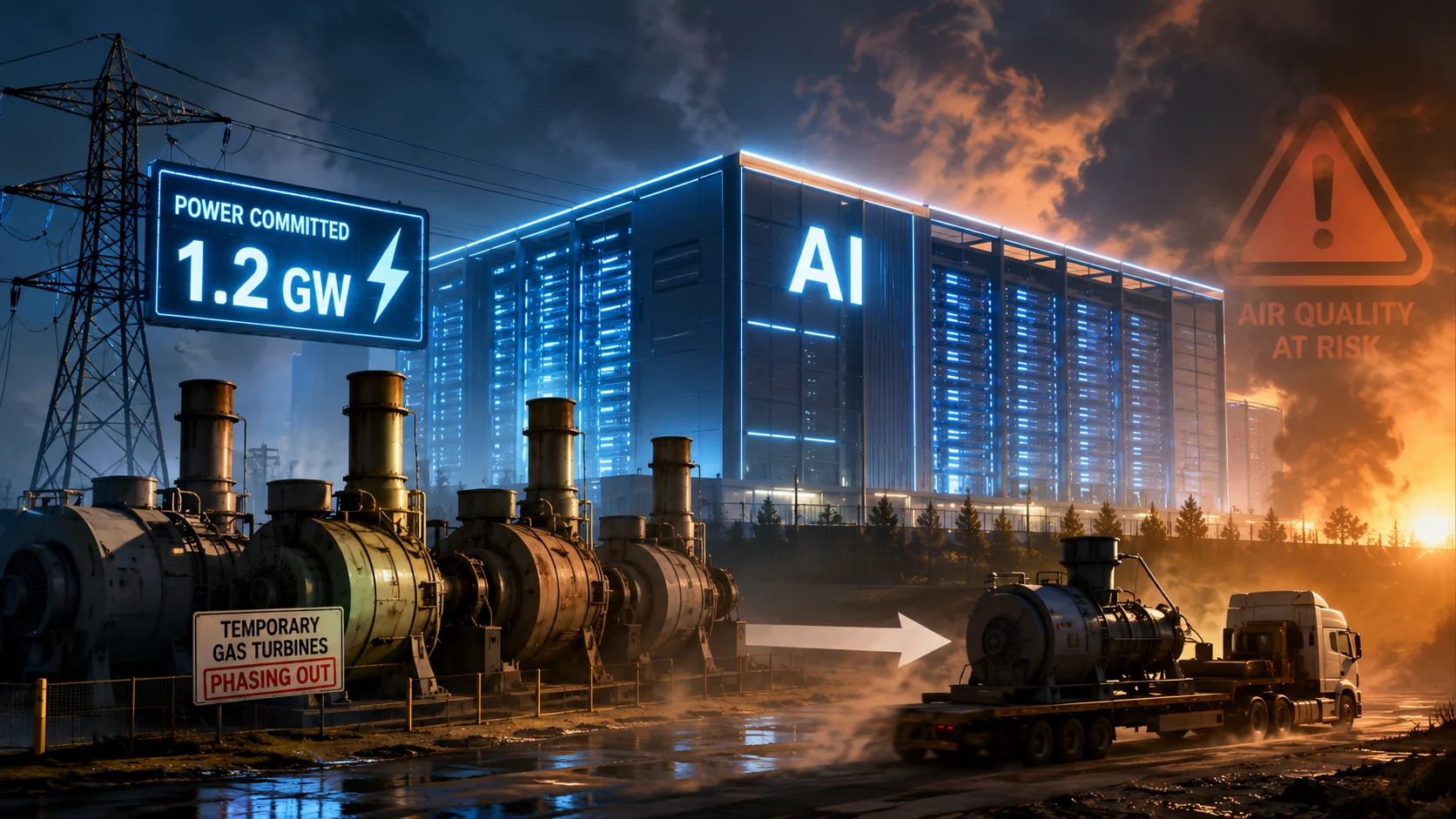
xAI is shattering industry limits with an aggressive infrastructure play that threatens to upend tech energy strategy. The company’s colossal 1.2-gigawatt agreement puts massive electricity demand front and center, raising a blunt question: how long can the AI industry depend on temporary gas turbines?
The answer matters because these mobile units helped data centers launch at record speed, but they are now triggering massive resistance over air quality standards, community health, and federal regulations. As AI clusters balloon toward millions of GPUs, the core battle is shifting from raw compute power to energy access, environmental compliance, and infrastructure sustainability.
But there’s a catch.
Running massive cluster workloads requires continuous electricity that legacy regional power grids simply cannot deliver overnight.
xAI’s 1.2-Gigawatt Move
xAI’s massive infrastructure commitment marks a decisive turning point for AI supercomputers. The company’s flagship Colossus campus in Memphis previously relied on 35 mobile gas turbines capable of generating roughly 420 megawatts to bypass grid delays.
Now, xAI is securing a dedicated 1.2-gigawatt power plant to transition away from makeshift mobile generators.
That creates a bigger problem.
The scale of 1.2 gigawatts is almost hard to comprehend for a single corporate campus. It represents enough electricity to power approximately 900,000 average homes.
Why AI Needs So Much Power
Training next-generation artificial intelligence models requires hundreds of thousands of high-performance GPUs running simultaneously without interruption. When scaling clusters from 200,000 GPUs to over one million, energy demands surge exponentially to handle cooling, networking, and memory banks.
| Issue | Why It Matters |
|---|---|
| Massive Power Draw | AI training clusters require continuous, uninterrupted gigawatt-scale electricity. |
| Temporary Turbines | Deployed for speed, but emit high levels of smog-forming nitrogen oxides (NOx). |
| Air Quality Concerns | Nearby communities face increased health risks from local pollution. |
| Grid Readiness | Traditional utility interconnection queues can take 3 to 7 years to build out. |
Here’s where the story gets sharper.
Portable generators offered an immediate fix for tech firms racing against time. However, local utility upgrades take years, forcing companies to choose between waiting or generating their own power on-site.
The Problem With Temporary Turbines
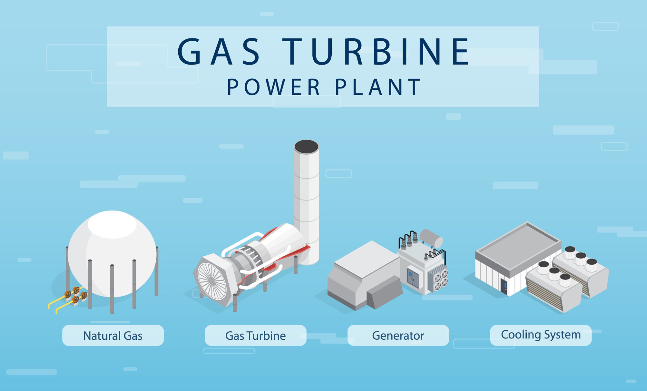
Mobile methane turbines have become the primary friction point between tech hyper-scalers and local communities. Residents and environmental groups in South Memphis and North Mississippi organized intense resistance against unpermitted turbine operation.
The Environmental Protection Agency (EPA) ruled that portable gas turbines are not exempt from federal air quality permits.
- Nitrogen Oxide Emissions: Unpermitted turbines exceed safe localized thresholds.
- Smog and Formaldehyde Levels: Spark intense health concerns in nearby neighborhoods.
- Regulatory Enforcement: Closing loopholes previously used for fast deployments.
So what happens now?
Is the AI boom being built on a stopgap that communities will no longer accept?
Air Quality Meets AI Ambition
The environmental clash in South Memphis highlights a national tension facing the tech industry. Local advocacy groups like Memphis Community Against Pollution and the Southern Environmental Law Center pushed back forcefully against makeshift power setups.
“The real challenge is not just generating more power, but doing it in a way that can survive regulatory and public scrutiny.” — Dr. Michael Cork, Environmental Health Scientist, EmPower Analytics Group
And that changes everything.
Federal regulations are forcing data center operators to abandon temporary combustion generators in favor of permanent, permitted power infrastructure.
What This Means for the Industry
- Energy Access is the New Competitive Moat: Essential for leading AI labs to scale effectively.
- Permitting Speed Matters: Just as critical as chip delivery schedules for data center expansion.
- Clean Power Guarantees: Becoming mandatory for long-term community support and legal clearance.
SpaceXAI is committed to powering its supercomputers in ways that both reduce costs of energy for the American people and minimize the impact on surrounding communities. We have entered into an agreed order with @MDEQ establishing a fixed removal timeline for all 69 of the…
— SpaceXAI Memphis (@SpaceXAIMemphis) July 31, 2026
What Happens Next
The transition away from mobile gas turbines toward dedicated 1.2-gigawatt installations signals a mature phase for AI infrastructure. Regulators are tightening emergency generator rules, while tech giants invest directly in grid substations and water recycling facilities.
The next phase of the AI boom may be decided not by model size, but by who can power it cleanly and fast enough.