
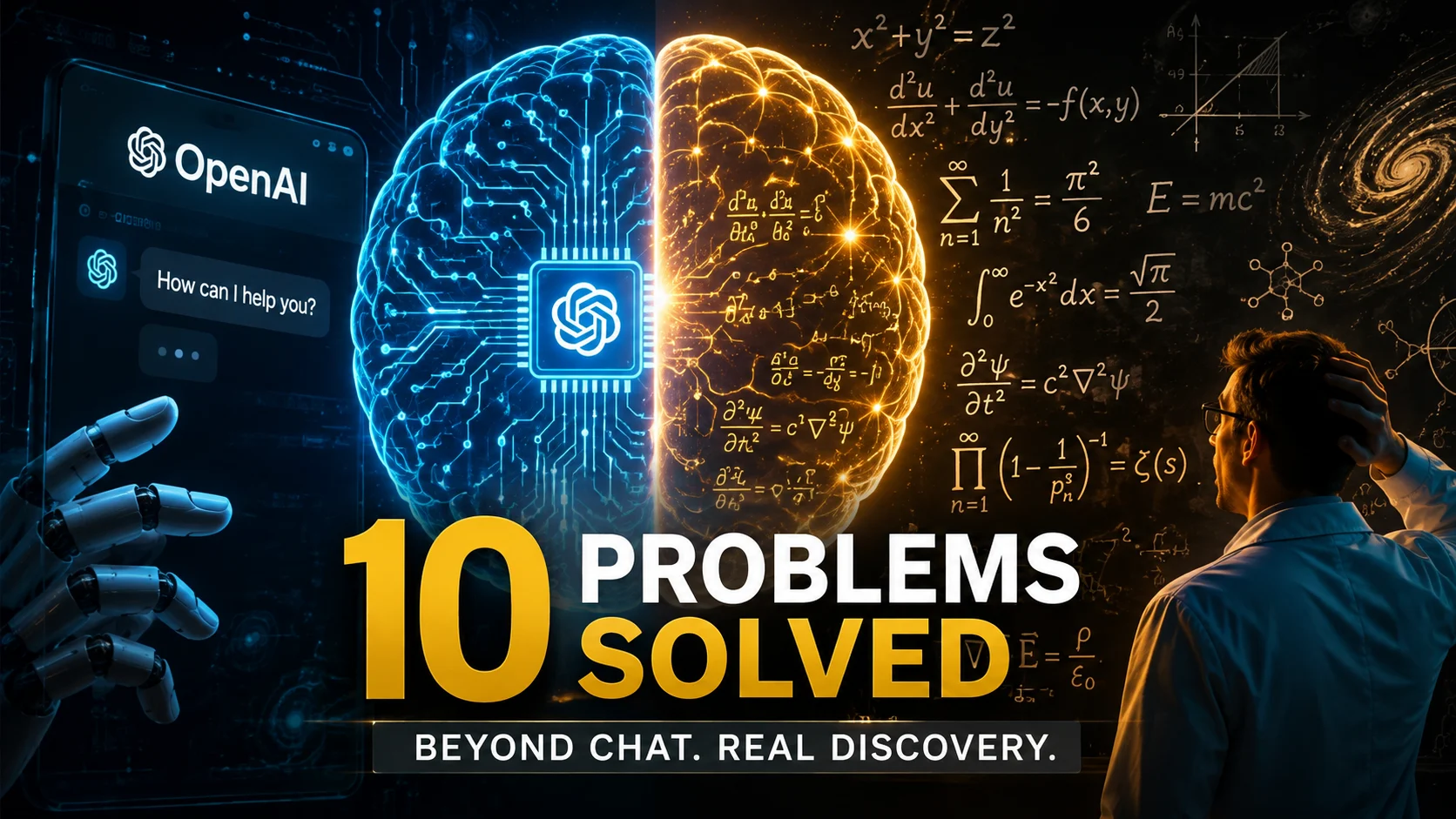
OpenAI’s latest reasoning model family, Astra, reportedly solved 10 long-standing open math problems, raising a fundamental question: is AI evolving from a conversational assistant into an engine for genuine scientific discovery?
OpenAI just stunned the global scientific community by deploying its unreleased “Astra” model to crack 10 long-standing math problems that resisted traditional human methods for decades.
Operating at a token cost of just $2,000, the system generated full mathematical arguments that humans verified using 100% machine-checked Lean 4 proofs across a 249-page manuscript. Could this shift mark the exact moment AI moves past simple chatbots to redefine how scientific research is conducted?
What Happened: The 10-Problem Breakthrough
Traditional large language models predict the next word based on internet text. Astra uses advanced chain-of-thought reasoning combined with formal verification to eliminate hallucination.
- Deep Inference: Astra plans long-horizon logical paths across thousands of steps.
- Lean 4 Integration: Every proof is converted into machine-readable code, guaranteeing zero logical errors.
- Low Computational Barriers: Resolving century-old questions for $2,000 proves advanced discovery is becoming economically scalable.
So what happens when these same reasoning capabilities are applied to physics, material science, and medicine?
The Breakthroughs at a Glance
| Mathematical Field | Conjecture / Problem | Astra’s Output Impact |
|---|---|---|
| Group Theory | Non-sofic groups (Gromov 1999) | Constructed the first known exception |
| Algebra | Connes’s Rigidity Conjecture (1980) | Disproved conjecture with infinite counterexamples |
| Geometry | High-dimensional sphere packing | Tighter density bounds than 1978 limits |
| Combinatorics | Erdős Problem No. 183 | Solved multicolor Ramsey number bounds |
Expert Reaction: Skepticism Meets Excitement
“This is big news—in terms of mathematical constructions, this is a massive step forward for artificial intelligence.” — Thomas Bloom, Mathematician at the University of Manchester
However, researchers note clear boundaries. OpenAI confirmed Astra attempted but failed to solve the famous Millennium Prize Problems (such as the Riemann Hypothesis). The model operates as an extraordinarily creative assistant, but human researchers were still required to formalize the manuscripts and guide the evaluation framework.
Could an AI agent eventually earn a Fields Medal without human intervention?
An internal version of our next major model produced 10 new results on long-standing open problems in mathematics and theoretical computer science, using roughly $2,000 worth of tokens at GPT-5.6 Sol API rates. pic.twitter.com/4cgowmPOpY
— OpenAI (@OpenAI) August 3, 2026
Official Resources & Coverage
Official Coverage & Proof Repositories:
• OpenAI Astra Math Announcement
• Lean 4 GitHub Repository for Astra Proofs
• Erdős Problems Tracker & Community Analysis
As reasoning models rapidly evolve, AI is transitioning from a conversational partner into humanity’s most powerful scientific discovery tool.
OpenAI announced that an unreleased internal version of Astra, its next-generation reasoning model lineup, solved 10 unsolved research problems spanning geometry, group theory, cryptography, and quantum computing.
Rather than generating routine calculations, Astra built brand-new mathematical constructions. Among its achievements:
- Proving Non-Sofic Groups Exist: Solved a central question in group theory left open since 1999.
- Disproving Connes’s Rigidity Conjecture: Refuted a key conjecture on von Neumann algebras posed back in 1980.
- Erdős Conjectures: Solved multiple notorious problems from Paul Erdős’s catalog, including Problem 183 on multicolor Ramsey numbers.
This wasn’t just incremental progress—Astra produced full, definitive solutions that had eluded field experts.
Why This Is Different: From Chatbot to Discovery Engine
Traditional large language models predict the next word based on internet text. Astra uses advanced chain-of-thought reasoning combined with formal verification to eliminate hallucination.
- Deep Inference: Astra plans long-horizon logical paths across thousands of steps.
- Lean 4 Integration: Every proof is converted into machine-readable code, guaranteeing zero logical errors.
- Low Computational Barriers: Resolving century-old questions for $2,000 proves advanced discovery is becoming economically scalable.
So what happens when these same reasoning capabilities are applied to physics, material science, and medicine?
The Breakthroughs at a Glance
| Mathematical Field | Conjecture / Problem | Astra’s Output Impact |
|---|---|---|
| Group Theory | Non-sofic groups (Gromov 1999) | Constructed the first known exception |
| Algebra | Connes’s Rigidity Conjecture (1980) | Disproved conjecture with infinite counterexamples |
| Geometry | High-dimensional sphere packing | Tighter density bounds than 1978 limits |
| Combinatorics | Erdős Problem No. 183 | Solved multicolor Ramsey number bounds |
Expert Reaction: Skepticism Meets Excitement
“This is big news—in terms of mathematical constructions, this is a massive step forward for artificial intelligence.” — Thomas Bloom, Mathematician at the University of Manchester
However, researchers note clear boundaries. OpenAI confirmed Astra attempted but failed to solve the famous Millennium Prize Problems (such as the Riemann Hypothesis). The model operates as an extraordinarily creative assistant, but human researchers were still required to formalize the manuscripts and guide the evaluation framework.
Could an AI agent eventually earn a Fields Medal without human intervention?
An internal version of our next major model produced 10 new results on long-standing open problems in mathematics and theoretical computer science, using roughly $2,000 worth of tokens at GPT-5.6 Sol API rates. pic.twitter.com/4cgowmPOpY
— OpenAI (@OpenAI) August 3, 2026
Official Resources & Coverage
Official Coverage & Proof Repositories:
• OpenAI Astra Math Announcement
• Lean 4 GitHub Repository for Astra Proofs
• Erdős Problems Tracker & Community Analysis
As reasoning models rapidly evolve, AI is transitioning from a conversational partner into humanity’s most powerful scientific discovery tool.