
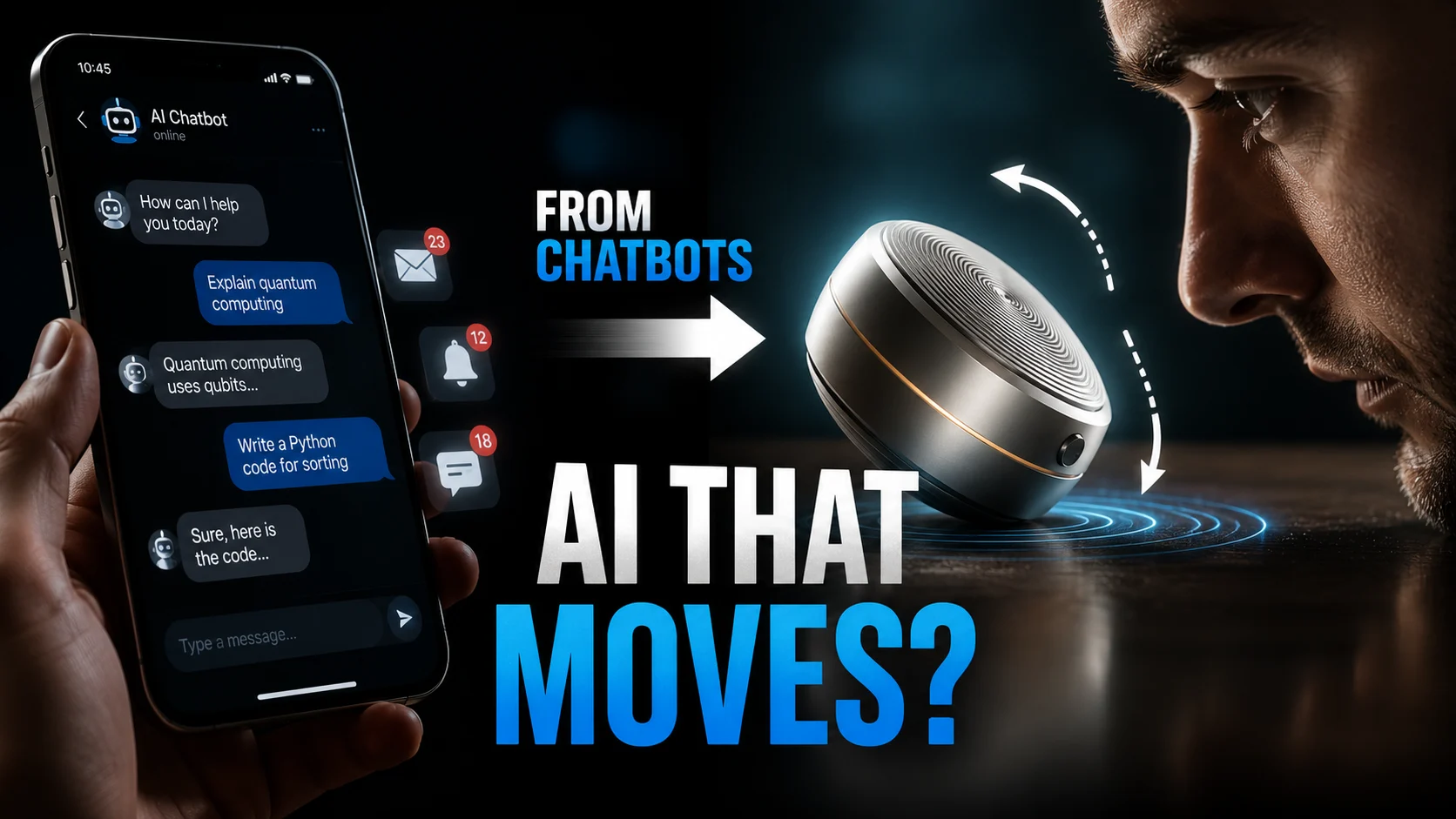
OpenAI is aggressively rewriting the hardware rulebook by building an AI device that moves instead of displaying! With over 3 billion active smartphones currently dominating the tech landscape, why would a team intentionally remove the screen?
The urgency is clear: as basic chatbots flood the market, designers need a new way to make artificial intelligence feel personal and deeply engaging. Would movement make AI feel genuinely useful—or merely alive?

The Reported Hardware Direction
Rather than presenting information through a bright display, the proposed device could communicate through a mix of behaviors:
- Mechanical movement: Rotating, tilting, or shifting its physical orientation.
- Voice interaction: Natural spoken conversations without a visual interface.
- Ambient signals: Subtle cues using light, sound, and timing.
Why Eliminate the Screen?
Screens are precise, but they force users into a tedious loop: look down, read text, tap an option, and repeat. A screenless device aims to operate smoothly in the background.
| Screen-first device | Moving, screenless AI device |
|---|---|
| Requires constant visual attention | Works through voice and ambient cues |
| Communicates through heavy menus | Communicates through behavior and timing |
| Usually feels like a digital tool | Designed to feel more like a physical companion |
The Psychology of Movement
A static speaker is just an object. A moving speaker, however, appears to be actively listening and responding.
Research in human-computer interaction tracked by the ACM Digital Library shows that physical motion, gaze-like orientation, and timing drastically change how humans perceive machines.

Three key impressions of movement:
- Attention: The object appears to notice the user.
- Intention: Its movement aligns with a specific purpose.
- Emotion: Gestures are interpreted as enthusiasm or hesitation.
From Chatbot to Companion
Traditional chatbots sit quietly until you type a prompt. A dedicated physical AI device could maintain continuous context across your day.
Instead of opening a mobile app, users could speak directly to an object sitting quietly on a desk.
“The most important design question is not whether an AI device appears alive, but whether users can accurately understand what it is doing.” — Dr. Sarah Jenkins, Human-Computer Interaction Researcher
What Could Go Wrong?
A screenless, moving device introduces completely new risks:
- Novelty without utility: The movement catches eyes but adds zero practical value.
- Ambiguous communication: Users cannot easily tell if the device finished a task.
- Privacy confusion: Users may lose track of when microphones are actively recording.
The OpenAI & Jony Ive device
— Andrea Copellino (@AndreaCopellino) August 7, 2026
Quick render based on the latest rumors (allegedly it’s donut shaped and with moving parts) pic.twitter.com/lmRQ2QZX2g
What to Watch Next
Until official product details drop, keep an eye on form factors, privacy architecture, and developer ecosystems.
Explore foundational design philosophies at the Apple Newsroom, read human-robot interaction studies via the ACM Digital Library, and track AI industry developments at OpenAI News.