
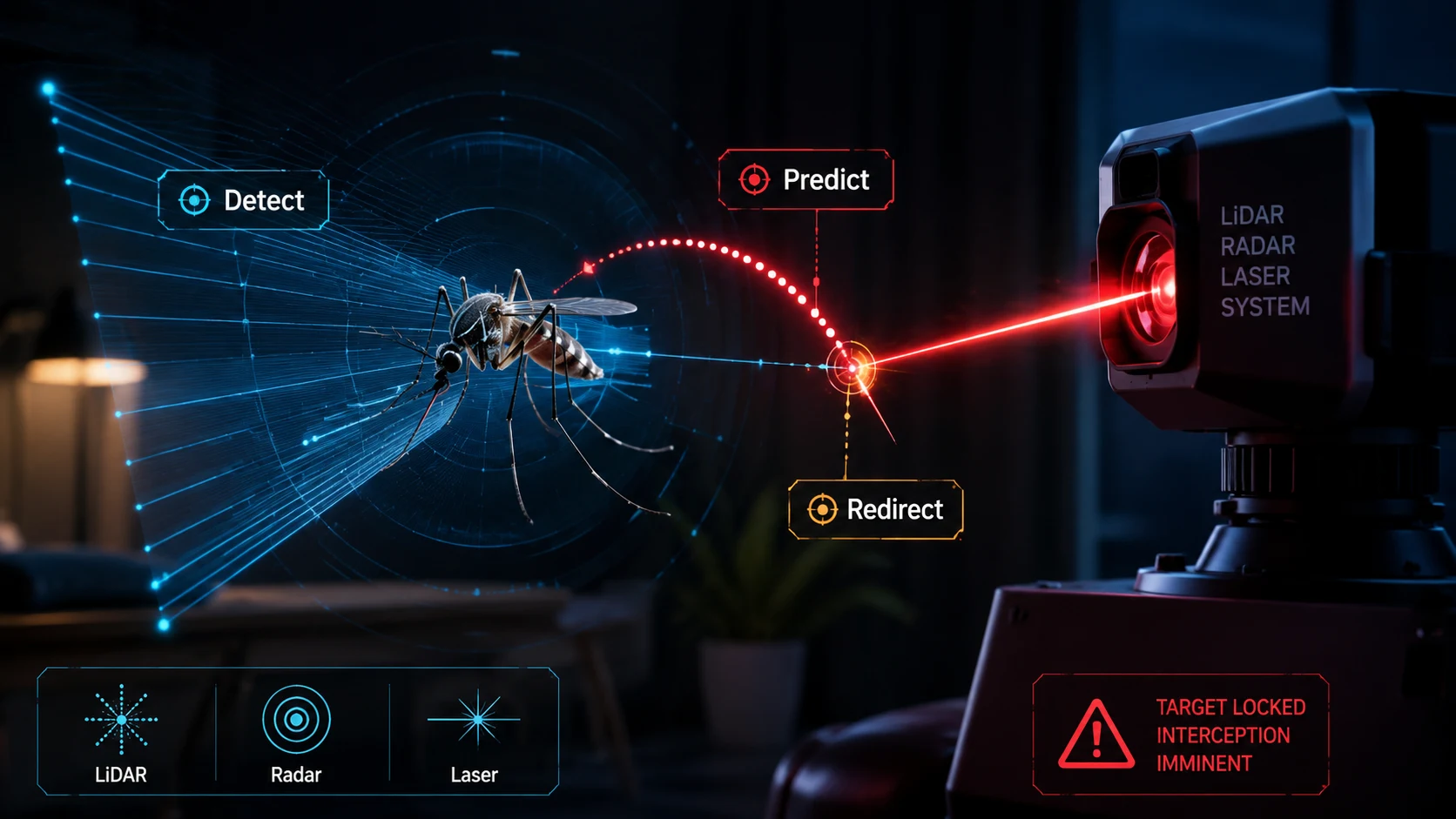
A Chinese startup has ignited a miniature war against mosquitoes, replacing chemical sprays with a laser that can detect and target insects in flight.
The system combines LiDAR tracking, radar sensing and a galvanometer-directed laser to identify a mosquito’s position and calculate its trajectory. How quickly can a machine respond to an insect smaller than a fingernail?
The answer lies in milliseconds: the device continuously scans its surroundings, predicts the mosquito’s movement and redirects the laser before the insect can escape.
With mosquito-borne diseases affecting millions of people globally each year, and mosquitoes capable of changing direction rapidly, this is not merely a flashy gadget—it is an engineering challenge with real-world consequences.
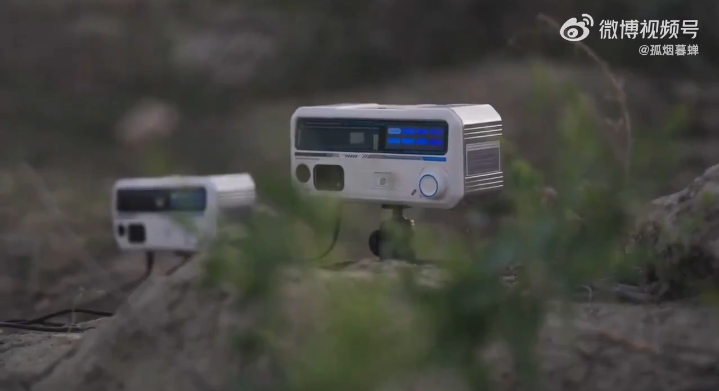
1. The Viral Claim Meets Reality
The viral comparison to an air-defense system is easy to understand: the device searches for a moving target, predicts its path and directs energy toward it.
But the analogy has limits. A mosquito is not a missile, and the system’s real challenge is less about raw laser power than reliable identification, safe targeting and rapid control.
2. Why Mosquitoes Are Difficult Targets
Mosquitoes present several technical problems:
- They are tiny and difficult to distinguish from dust or other insects.
- Their flight path is irregular.
- Their wings create rapid movement and changing reflections.
A conventional motion detector may identify movement, but movement alone does not prove that the target is a mosquito. The system must classify the object before activating the laser, otherwise it risks wasting energy or targeting the wrong object.
| Challenge | Engineering problem |
|---|---|
| Small size | Weak sensor return and limited visual detail |
| Erratic flight | Difficult trajectory prediction |
| Similar objects | Dust and other insects may resemble mosquitoes |
| Indoor operation | Furniture and walls create occlusion |
| Human safety | Laser must remain within strict safety boundaries |
3. How the Sensor Fusion Works
LiDAR: Building a Moving Picture
LiDAR sends light pulses and measures their return to estimate distance and position. In this system, LiDAR can help determine where an object is located and whether it is moving through the monitored area.
Radar: Tracking Movement
Radar can complement optical sensing by detecting motion and maintaining a target track under conditions where visual systems may be less reliable. Radar data helps estimate speed, direction and movement continuity.
Sensor Fusion
The key concept is not any single sensor but the combination of multiple data streams. A control system compares location, speed, direction and movement patterns to decide whether a target is likely to be a mosquito.
LiDAR locates the target. Radar helps describe its movement. Software combines both streams into a continuously updated track. That track gives the system a prediction—not a perfect forecast—of where the mosquito is likely to be a moment later.
4. The Galvanometer: The Laser’s Steering Mechanism
A galvanometer is a fast-moving mechanism that changes the angle of a mirror or optical element. In a targeting system, it redirects a laser beam across a defined area far more quickly than a conventional mechanical mount.
- Sensors detect a moving object.
- Software estimates its position and velocity.
- The system predicts the next point along its path.
- The galvanometer moves the beam toward that point.
- A safety check determines whether firing is permitted.
- The laser activates for a brief pulse, if the target remains valid.
The critical distinction is that the system aims at the predicted interception point, not simply the mosquito’s current location.
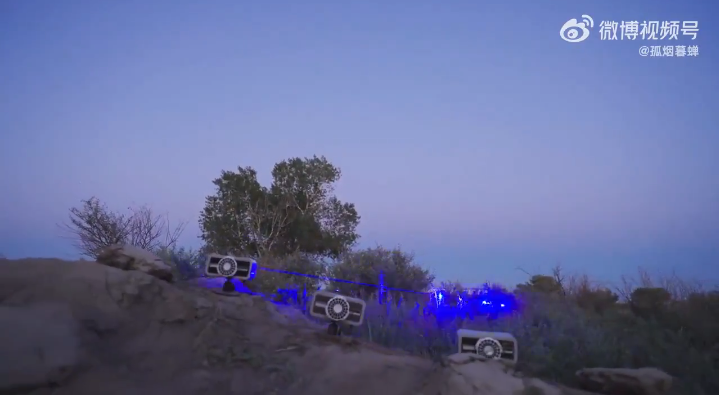
5. What “Milliseconds” Really Means
Treat the word milliseconds carefully. A complete response includes sensor scan time, signal processing, target classification, trajectory prediction, galvanometer movement, laser activation, and confirmation.
| Specification to verify | Why it matters |
|---|---|
| Detection range | Defines the usable room size |
| Tracking refresh rate | Indicates how often the target position is updated |
| End-to-end latency | Measures real-world response speed |
| Target-classification accuracy | Shows how often the system identifies mosquitoes correctly |
| Laser power and wavelength | Determines effectiveness and safety requirements |
| False-positive rate | Reveals whether dust or other insects trigger the system |
6. Safety Is the Main Product Test
This section should be prominent, not an afterthought. Critical safety checks include eye exposure risks, reflections from polished surfaces, and kids or pets moving through the room.
- Human-presence detection.
- Automatic laser shutdown.
- Beam containment or restricted aiming angles.
- Tamper protection and child-lock controls.
- Independent laser-safety certification.
7. What It Could Change in Mosquito Control
| Method | Strength | Limitation |
|---|---|---|
| Insecticide spray | Fast and widely available | Chemical exposure and repeated use |
| Mosquito nets | Effective physical barrier | Does not remove mosquitoes from the room |
| Electric zappers | Simple operation | Can attract or kill non-target insects |
| Tracking laser | Potentially chemical-free and selective | Safety, cost and reliability questions |
The strongest use case may involve controlled environments, such as laboratories, farms, warehouses or monitoring facilities, where the operating area can be managed carefully.
8. What the Demonstration Does Not Prove
The demonstration shows that the concept is technically plausible, but it does not automatically prove that the system is ready for widespread home use. The gap between a successful prototype and a dependable consumer product is where safety testing, field trials and independent verification matter most.
“The important question is not whether a laser can damage a mosquito, but whether the system can identify the correct target and guarantee that the beam never reaches a person’s eyes,” says Dr. Aris Thorne, Senior Optical Systems Researcher at the Institute for Advanced Robotics.
🇨🇳 China isn’t f*cking around when it comes to mosquitoes
— Mario Nawfal (@MarioNawfal) August 9, 2026
Writer: Ianpic.twitter.com/2EyAxsDNX3
Recommended Sources
- Learn more about the core technology via the startup’s Photon Matrix Official Product Page.
- Watch the underlying technology demonstration via South China Morning Post’s Laser Bug Zapper Video.
- Read independent hardware breakdowns on Tom’s Hardware LiDAR-Guided Photonmatrix Report.
- Review industry funding and analysis at IndianWeb2’s Startup Report.
- Check laser safety standards via the Android Security Bulletin framework.