
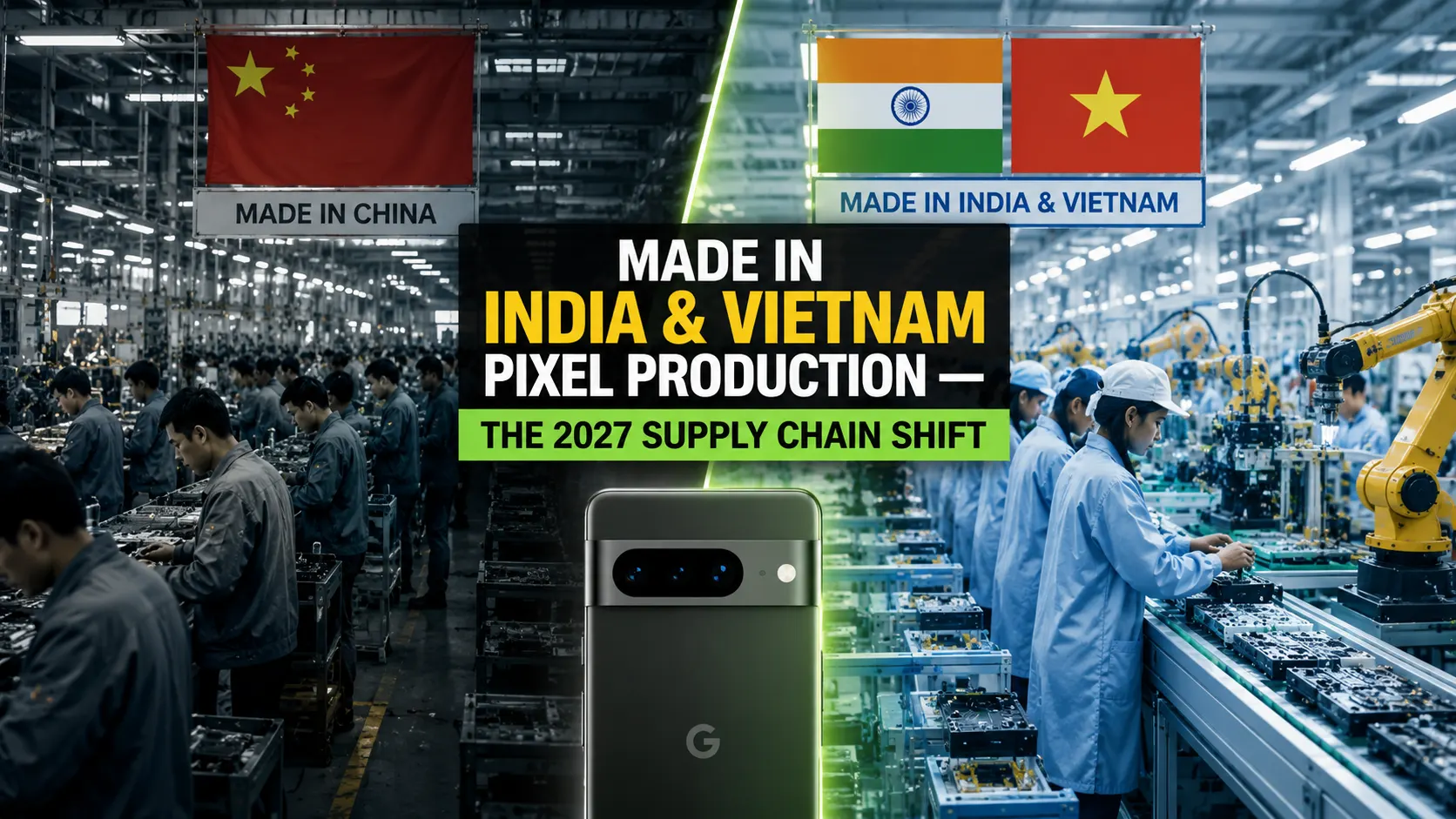
Google’s decision to move Pixel assembly out of China shocks and unsettles the global smartphone market. By 2027, Google expects to have most Pixel phones assembled in India and Vietnam, shifting an estimated 70% of production and unlocking billions in regional investments — but what does that mean for price, quality, and where you can buy a Pixel?
Consumers and partners worry and hope in equal measure, because this move could change pricing, spare-part access, and launch timing. As tech supply chain diversification accelerates across the globe, Google is following a path blazed by other consumer electronics giants.
With a target deadline of 2027, the company aims to mitigate escalating geopolitical risks and tap into robust local manufacturing ecosystems. Will this massive relocation ensure long-term stability, or will early supply bottlenecks test consumer patience?
Quick Summary
By 2027, Google will shift the bulk of Made in India & Vietnam Pixel Production away from China, driven by geopolitical risk, cost incentives, and continuity planning. Short-term costs may rise during factory retooling, but government incentives and economies of scale should stabilize prices and improve regional availability.
- What: Full smartphone assembly relocation.
- Where: Facilities across India (Chennai, Bengaluru) and Vietnam (Hanoi, Ho Chi Minh City).
- When: Phased rollout concluding by 2027.

Why Google Is Moving Pixel Production
Geopolitical Risk and Trade Friction
Rising trade barriers and diplomatic tensions between major economies have transformed hardware manufacturing. Relying on a single geographic hub exposes companies to sudden tariff hikes and operational shutdowns. Geopolitical supply risk has become a primary boardroom concern for major OEMs.
Cost, Incentives, and Local Manufacturing Policies
Governments in South and Southeast Asia are rolling out aggressive financial incentives to attract advanced manufacturing. Production-linked incentives (PLI) offset initial setup costs, making local assembly financially attractive. Manufacturing relocation is no longer just about avoiding risk; it is about capturing growth incentives.
Diversifying Suppliers and Continuity Planning
Pandemic-era lockdowns exposed the fragility of hyper-concentrated factory footprints. Spreading operations across multiple countries ensures better disaster recovery and supply chain resilience. Tech supply chain diversification guarantees that a regional disruption will not halt global product shipments.
Why India and Vietnam? (Country Advantages)
India — Policy, Labor, Domestic Market
India offers a massive domestic consumer base alongside aggressive government subsidies for electronics manufacturing. Major hubs in Chennai and Bengaluru boast deep talent pools of English-speaking engineers. India electronics manufacturing is scaling rapidly to support global export volumes.
Vietnam — Export Hub and Manufacturing Scale
Vietnam has spent decades refining its export-oriented electronics ecosystem with companies like Foxconn and Samsung. Its streamlined logistics network and favorable trade agreements provide swift shipping lanes to Western markets. Vietnam smartphone factories offer proven assembly experience and predictable lead times.

Impact on Pixel Pricing
Short-Term Cost Pressures (Retooling, Logistics)
Moving complex machinery and training new factory staff requires massive upfront capital expenditure. Initial manufacturing runs often suffer from lower initial yields, driving up short-term unit costs. Short-term price pressure is an expected hurdle during any major factory transition.
Medium-Term Price Outlook (Economies of Scale, Incentives)
As local supply chains mature and government subsidies kick in, per-unit assembly costs drop significantly. Economies of scale will eventually allow Google to maintain competitive retail pricing without squeezing hardware margins.
Who Pays: Consumers, Google, or Carriers?
Absorbing transition costs is a delicate balancing act between corporate earnings and retail tags. Google may use carrier subsidies and trade-in promotions to shield buyers from early price spikes.
| Horizon | Primary Cost Driver | Expected Price Impact |
|---|---|---|
| Short-term | Retooling and training yields | Minor upward pressure or static pricing |
| Medium-term | Local incentives & scale | Stable pricing with competitive margins |
| Long-term | Regional supplier maturity | Potential cost efficiencies and value passes |
Impact on Product Quality & Quality Control
Assembly Quality vs Component Quality
Moving final assembly does not automatically change where core components like processors and camera sensors are manufactured. High-grade semiconductors still originate from specialized foundries like TSMC or Qualcomm. Quality assurance relies heavily on keeping component standards consistent regardless of where the device is bolted together.
QA, Testing, and Supplier Onboarding
Google is deploying senior engineering teams directly to partner factories in Chennai and Vietnam to oversee rigorous testing protocols. Automated optical inspection and drop-testing labs ensure every unit matches strict tolerances. Rigorous testing protocols prevent assembly defects from reaching store shelves.
Past Case Studies (Apple, Samsung, Pixel’s Prior Moves)
When Apple shifted iPhone assembly lines to India, early defect rates matched Chinese facilities within quarters thanks to aggressive vendor oversight. Google intends to mirror this playbook to ensure seamless execution.
Regional Availability & Launch Strategy
Faster Regional Launches? Local SKUs and Carrier Deals
As assembly hubs move closer to emerging markets in South Asia and Southeast Asia, regional distribution times will shrink dramatically. Localized SKUs can be shipped directly without navigating congested trans-Pacific cargo routes. Regional availability will improve significantly for buyers outside North America and Europe.
Warranty, Repairs, Spare Parts, and Grey Markets
Localized production streamlines the supply of replacement screens, batteries, and camera modules for regional service centers. This drastically reduces turnaround times for customer repairs and cuts down grey-market importation.
Broader Tech Supply Chain Consequences
Component Sourcing and Semiconductor Constraints
Building phones locally requires a supporting ecosystem of printed circuit board (PCB) makers and local component vendors. Developing a local tier-one supplier base remains a multi-year challenge for both host nations.
Logistics, Shipping Lanes, and Time-to-Market
Shifting output to Indian and Vietnamese ports alters global freight patterns, favoring Indian Ocean and Southeast Asian shipping corridors. Logistics optimization helps companies bypass recurring choke points in traditional maritime channels.
Long-Term Reshoring vs Multi-Region Manufacturing
Rather than bringing factories back to high-cost domestic soil, tech brands are favoring a distributed multi-region model. This balances geopolitical safety with cost efficiency.
What Consumers Should Watch For (Practical Checklist)
- Keep an eye on launch-day price announcements for any unexpected bumps.
- Check regional warranty terms as local distribution frameworks evolve.
- Look at the “Manufactured in” label on retail boxes to verify assembly origin.
- Monitor model numbers for region-specific carrier compatibility variations.
Expert Voices & Data
Industry analysts note that shifting major hardware assembly requires immense coordination across logistics and tax compliance. According to Counterpoint Research, emerging manufacturing hubs are rapidly closing the technological gap with established Chinese industrial centers.
“Diversification is no longer optional for major hardware makers navigating a fractured global trade landscape.” — Supply Chain Analyst
$GOOGL is preparing to move its entire Pixel supply chain out of China by 2027 with smartphones, watches and earbuds shifting primarily to Vietnam and India.
The move would make Google the second major smartphone brand after Samsung to fully exit China production. pic.twitter.com/BVRcLYZMQl — Shay Boloor (@StockSavvyShay) August 18, 2026
Likely Scenarios by 2027
- Optimistic Scenario: Smooth factory transitions, robust local component sourcing, and stable pricing yield a resilient global supply chain by 2027.
- Neutral Scenario: Moderate initial delays and training hurdles are offset by government incentives, resulting in steady production with minor regional variations.
- Pessimistic Scenario: Persistent supply bottlenecks and component shortages lead to temporary inventory constraints and higher retail costs.