
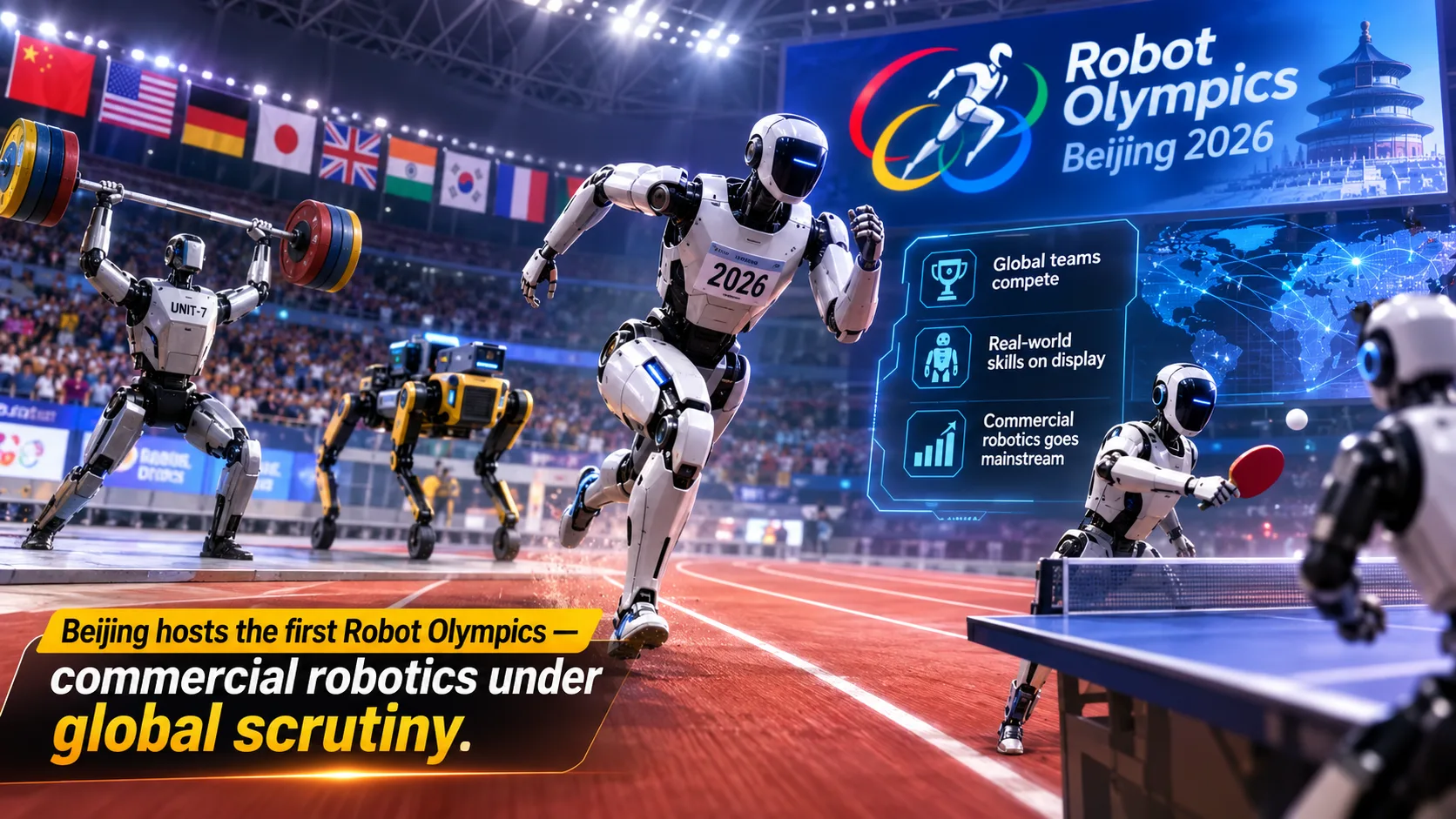
Robots just stole the show — and my breath — at the Robot Olympics Beijing 2026. Over 40 teams from 12 countries entered nine events, with machines sprinting at up to 6 m/s, running endurance trials, and lifting more than 50 kg in proof-of-concept lifts.
What does it mean when commercial robots can match human speed and strength? Investors are rethinking bets, engineers are feverishly analyzing logs, and everyday users are asking whether the robot next door is now real.
What Happened at the 2nd World Humanoid Robot Games
Hosted at Beijing’s iconic National Speed Skating Oval (the “Ice Ribbon”), the second Robot Olympics Beijing 2026 brought together over 2,000 robots and 666 teams from across the globe. Organized to test core mechanical resilience, the games expanded to 51 events spanning both competitive sports and complex real-world scenarios.
- 40+ teams & 666 total squads: A massive expansion from previous exhibition trials.
- 9 core disciplines: Ranging from classic track events to debut trials like weightlifting and tug-of-war.
- 6 m/s sprint benchmarks: Highlighting rapid kinematic strides in bipedal locomotion.
- 50 kg max lifts: Testing upper-limb load capacity under competitive conditions.

Why This Matters: The Commercial-Robotics Coming-Out Party
For years, humanoid robotics lived behind the closed doors of controlled laboratory environments. Events like the Robot Olympics Beijing 2026 transform academic theories into public proof, bridging the gap between flashy demo videos and real-world readiness.
By forcing machines to operate under strict autonomy rules and chaotic physical environments, manufacturers demonstrate how edge computing and on-device AI handle unexpected obstacles. Investors are paying close attention to which startups can survive a collision or power failure without catastrophic damage.
The Competitions
Sprinting
Track events pushed actuator torque to the limit. With time limits heavily compressed compared to past iterations, bipedal bots had to accelerate, maintain balance, and cross finish lines without falling over.
Weightlifting
Making its debut at the 2026 games, the weightlifting division tested robot “strongmen” across lightweight and heavyweight classes, evaluating structural frame rigidity and hydraulic or electric motor strain.
Table Tennis & Dexterity
High-speed perception loops faced off against flying ping-pong balls, testing vision processing latency and hand-eye coordination. Meanwhile, dexterous hand categories challenged bots to sort tiny items like beans and tighten microscopic screws.

How Teams Are Stress-Testing AI Hardware
Underneath the competitive excitement lies rigorous engineering evaluation. Teams relied on advanced sensor fusion combining LiDAR, high-rate IMUs, and stereo cameras processed locally via edge GPUs.
- Reinforcement Learning: Used extensively to help machines adapt dynamically to uneven tracks and sudden impacts.
- Thermal Throttling Checks: Continuous movement exposed weaknesses in heat dissipation, forcing teams to innovate with liquid cooling or passive fin designs.
- Autonomous Control: Stricter rules in 2026 eliminated remote assistance in most track and scenario events, requiring true onboard decision-making.
FAQs
The Future Is Here. 80 T2s, One moment. Welcome to the World Humanoid Robot Games Opening Ceremony.#boosterrobotics #hunanoid pic.twitter.com/uMgGqeWIkB
— Booster Robotics (@boosterobotics) August 22, 2026
Could these robots replace human workers soon? While progress is rapid, hurdles in battery life, cost-per-unit, and general adaptability mean humans remain essential for unstructured tasks.
When will commercial humanoid robots become affordable? Mass production scaling over the next 3 to 5 years is expected to lower components costs, though industrial-grade units remain premium investments.