
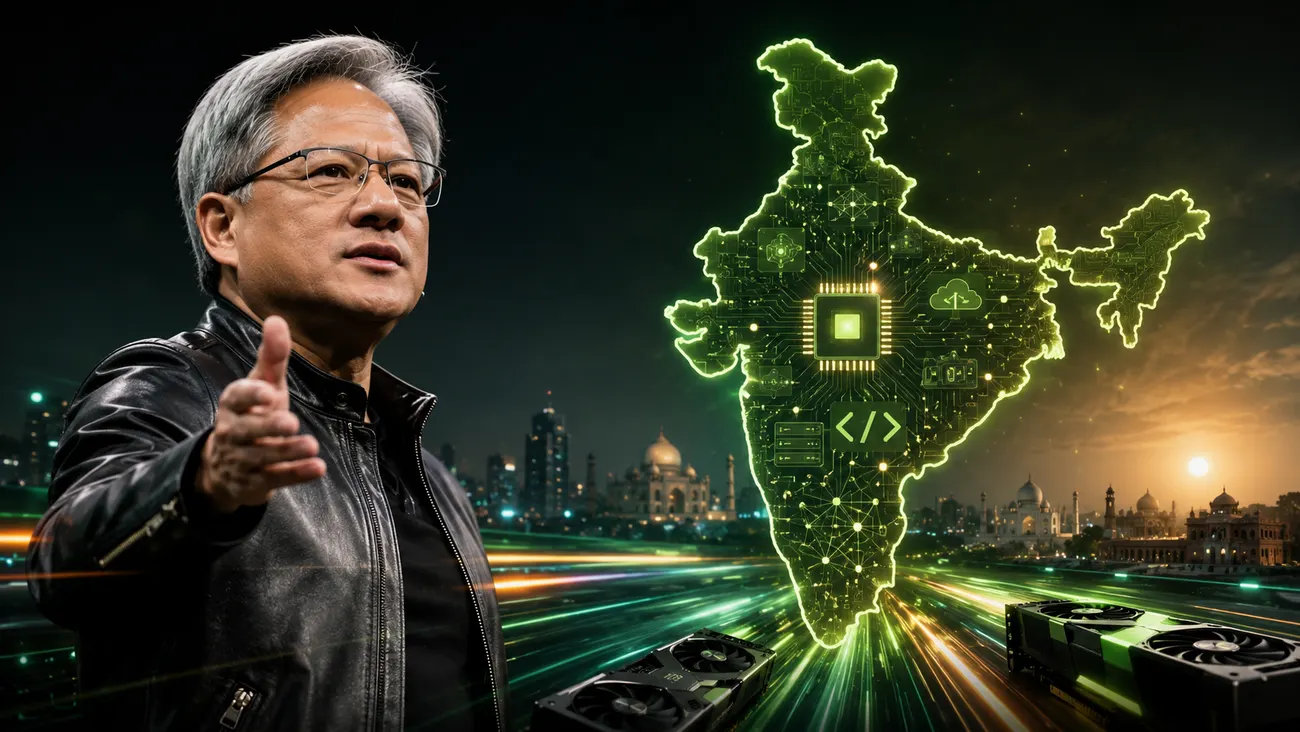
When Nvidia CEO Jensen Huang issues an urgent public warning about artificial intelligence, global tech leaders listen—and his recent message to India carries a stark ultimatum: accelerate execution speed or risk missing the window of a lifetime.
As the global AI race intensifies, Huang points to a critical friction point between India’s immense potential and the actual pace of its artificial intelligence strategy deployment.
What Jensen Huang said about India and AI
During high-profile discussions regarding global technology shifts, Nvidia’s leadership emphasized that India possesses all the raw ingredients to become an AI superpower, but warned that bureaucratic friction and slow infrastructure rollout could stall momentum.
- The Urgency Factor: Technology cycles move at unprecedented speeds, leaving little room for protracted policymaking.
- The Infrastructure Bottleneck: Without rapid deployment of heavy AI infrastructure and cloud GPUs, local innovation will remain constrained.
- The Global Stance: India must transition quickly from being a software service provider to a core creator of sovereign generative AI models.

Why Nvidia believes India has a major AI opportunity
Nvidia views India not just as a consumer market, but as a primary testing ground for next-generation intelligence.
- Massive Talent Pool: Millions of engineering graduates emerge annually from institutions like IITs and IISc, forming a deep reservoir of technical aptitude.
- Digital Public Infrastructure: India’s Aadhaar, UPI, and data systems provide a unique digital foundation for large-scale data processing.
- Vibrant Startup Ecosystem: A rapidly growing cohort of homegrown tech startups is actively experimenting with niche AI adoption models.
The gap between India’s AI ambitions and execution speed
While national policy documents outline grand visions, the practical reality on the ground often lags behind market demands.
- GPU Access Delays: Securing high-performance computing clusters and enterprise-grade GPU access remains expensive and logistically challenging for domestic firms.
- Data Centre Scale: Building out specialized, energy-efficient data centres requires faster clearance frameworks and power grid upgrades.
- Commercialization Cycles: Traditional corporate procurement cycles in India are often too slow to keep pace with rapid machine learning iterations.
Why timing matters in the global AI race
In the technology sector, first movers capture the foundational standards, secure rare supply chains, and lock in global talent networks.
If a nation delays critical infrastructure investments by even two years, international competitors establish deep moats that become exponentially harder to cross.
A delayed rollout means domestic enterprises end up renting foreign intelligence infrastructure rather than owning their proprietary engines.
India’s advantages: talent, population, software ecosystem and digital infrastructure
- World-Class Talent: India houses one of the densest networks of software developers and data scientists globally.
- Unmatched Scale: A massive population base generates diverse, localized datasets crucial for building inclusive language models.
- Robust Software Ecosystem: Mature IT service giants and agile startup hubs understand how to scale digital products globally.
- Advanced Public Systems: Digital-first governance frameworks pave the way for seamless public-sector AI integration.
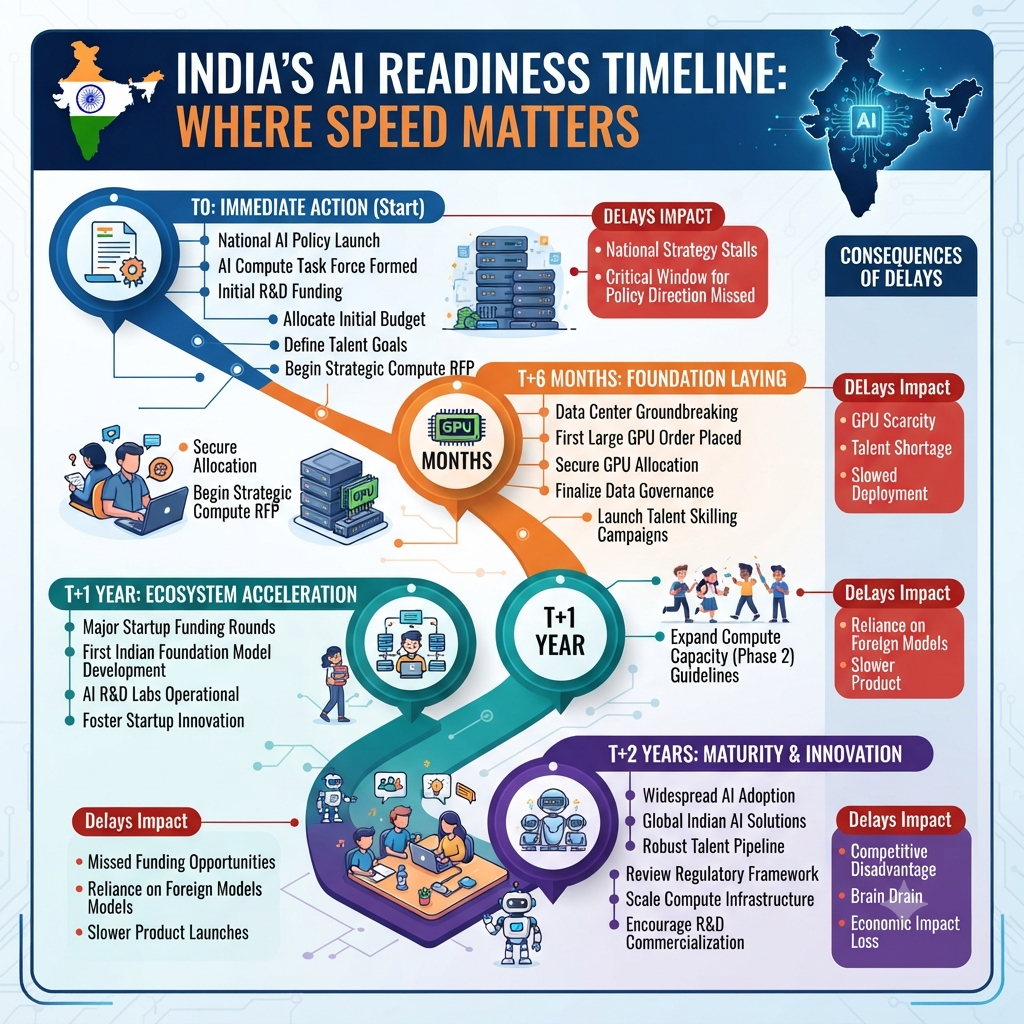
What could happen if India moves too slowly
- Loss of Startups: Promising domestic innovators may migrate to foreign jurisdictions with better compute access.
- Foreign Dependency: Indian enterprises could become entirely reliant on overseas cloud monopolies for core intelligence layers.
- Slower Public Gains: Essential sectors like healthcare, agriculture, and education would miss out on transformative productivity boosts.
Also Read: The hidden reason behind India’s 109.9% AI PC shipment spike
What Jensen’s comments mean for Indian technology companies
- Invest in Compute Early: Firms must prioritize capital allocation toward advanced hardware and dedicated AI talent pipelines.
- Forge Cloud Partnerships: Collaborate closely with major cloud providers (AWS, Azure, GCP) to secure reliable cloud GPUs.
- Accelerate Productisation: Move away from pure service-delivery models toward proprietary IP creation.
- Upsrain Workforce: Scale up internal training programs focusing on practical generative AI deployment.
Some Indian Politicians need to hear this. He is Jensen Huang, President and CEO of NVIDIA. He says, “India is one of the world’s leading IT industries, and this is the beginning of a new IT platform. I had the benefit of seeing Modi ji a decade ago talking about AI. I’m really… pic.twitter.com/Rn8T3Ge9s0
— Kiren Rijiju (@KirenRijiju) September 3, 2026
Sources
- [1] CNBC / Reuters coverage of Jensen Huang’s remarks on global AI adoption and infrastructure speed.
- [2] Official Nvidia Press Releases & Enterprise AI Strategy — Nvidia Newsroom
- [3] NITI Aayog National Strategy for Artificial Intelligence — Government of India Portal
- [4] NASSCOM Reports on India’s Tech and AI Talent Evolution — NASSCOM Research
- [5] Ministry of Electronics and Information Technology (MeitY) Policy Updates — MeitY India