

India’s refurbished smartphone market is gaining momentum
| Type | What it generally means |
|---|---|
| Used smartphone | Previously owned and resold, with varying levels of testing or repair. |
| Refurbished smartphone | A pre-owned device that has been inspected, tested and potentially repaired before resale. |
| Open-box smartphone | A device whose original packaging has been opened, often with little or no previous use. |
The important difference is quality assurance. A professionally refurbished phone should go through checks before reaching another buyer.
Why rising smartphone prices are helping the refurbished market
Price pressure is becoming one of the biggest catalysts for India’s refurbished smartphone market.
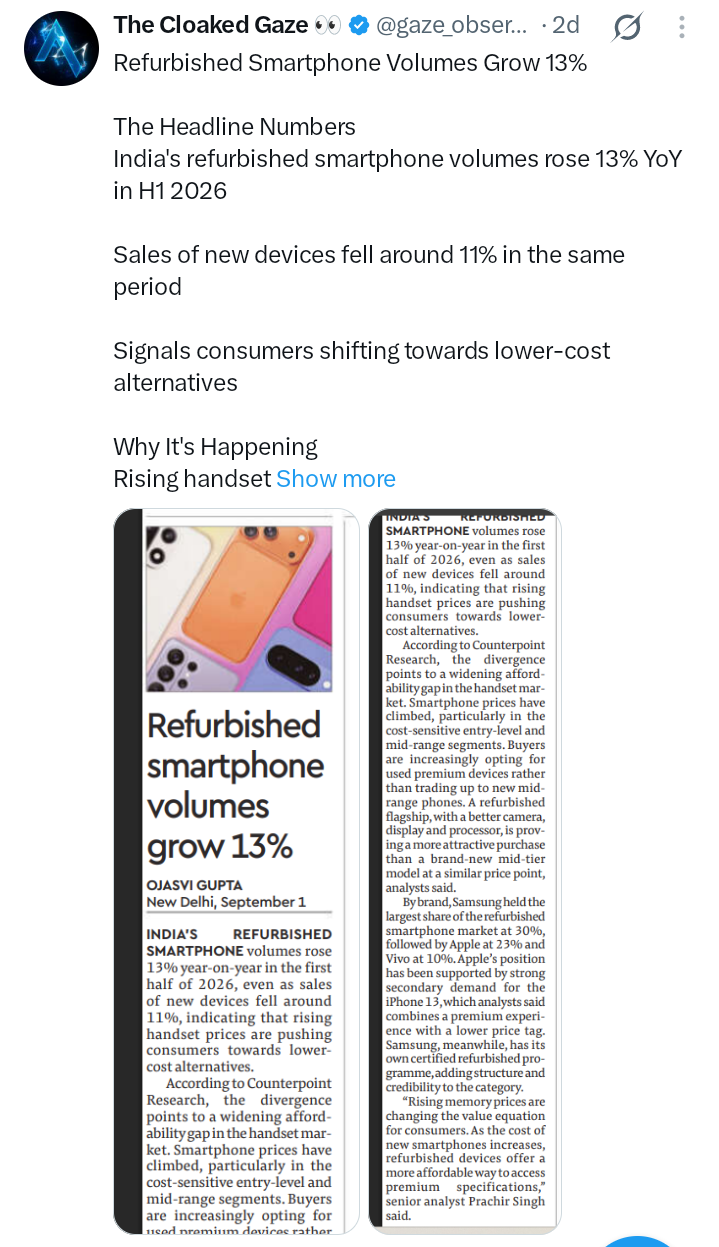
Rising component costs have pushed up the cost of new devices, particularly creating pressure in price-sensitive entry and mid-range categories. That changes the calculation for consumers: rather than simply buying the cheapest new phone, some buyers can move into the secondary market and purchase an older premium model.
A recent Counterpoint survey found that 29% of Indian consumers facing smartphone price increases said they would either stay within their budget or choose a refurbished device.
Inflation and higher device prices therefore don’t automatically mean consumers stop buying smartphones. Some simply change where they buy them.
Budget phones aren’t the only story: premium demand is growing
One of the more interesting developments is the growing appetite for premium refurbished phones.
Apple has benefited particularly strongly. Counterpoint reported that Apple had the highest growth among brands in India’s refurbished market in H1 2025, while demand was shifting from basic iPhones toward Pro and higher-storage variants.
In H1 2026, Samsung held a 30% share of India’s refurbished smartphone market, followed by Apple at 23%. The iPhone 13 was among the preferred refurbished models.
That means refurbished demand isn’t simply about finding the cheapest possible phone. For many buyers, it is about getting a premium experience at a more manageable price.
Online marketplaces, offline retailers and the trust problem
India’s refurbished ecosystem has two very different sides.
Organized companies, OEM programs, recommerce platforms and established retailers are increasingly offering professional testing, grading, warranty coverage and return policies.
At the same time, India’s unorganized refurbishment market remains huge. Counterpoint estimated that unorganized sellers accounted for 77% of refurbished smartphone sales in 2024, although the organized ecosystem has been gaining ground.
This creates a major opportunity—but also a major challenge.
Consumers still worry about:
- Battery health
- Hidden defects
- Fake or replaced components
- Cosmetic condition
- Device authenticity
- Warranty support
- Return policies
Better warranties, transparent grading and quality checks can therefore be just as important as price.
Trade-ins are feeding the refurbished smartphone ecosystem
A refurbished market needs a steady supply of devices, and trade-in and buyback programs are becoming an important source.
When someone exchanges an older smartphone while purchasing a new one, that device can potentially enter the refurbishment ecosystem rather than sitting unused in a drawer.
This creates a simple cycle:
- New phone purchase
- Trade-in or buyback
- Device collection
- Inspection and testing
- Refurbishment
- Warranty-backed resale
- Purchase by a second owner
India’s smartphone replacement cycle therefore has an important role in determining how many recent-generation devices become available for resale.
Urban buyers aren’t the whole market
Demand isn’t limited to India’s biggest cities.
Organized retailers increasingly serve consumers online and through physical stores, while smaller retailers and local refurbishers remain important in Tier 2 and Tier 3 markets.
Smaller sellers can also revive lower-grade devices and sell them in smaller cities where affordability remains important.
This gives the market a broad potential customer base: urban consumers looking for premium value as well as smaller-city consumers looking for affordable smartphones.
How India compares with other major markets
India is one of the more important growth markets within the global secondary smartphone ecosystem.
Counterpoint’s H1 2025 data showed mature markets such as the US, Europe and Japan growing only modestly, while emerging markets—including India—continued to provide stronger momentum.
India’s combination of a large smartphone user base, price-sensitive consumers, growing premiumization and expanding trade-in activity gives its refurbished market considerable room to develop.
Also Read: Why Dell’s uDaan Initiative Could Shape India’s Tech Talent Pipeline
Is India’s refurbished smartphone market entering a bigger growth phase?
Several indicators point in that direction:
- Refurbished volumes are growing faster than new-device volumes.
- New smartphone prices are increasing, making used premium devices more attractive.
- Premium refurbished demand is expanding, particularly around recent flagship models.
- Trade-in and buyback programs are improving device supply.
- Organized refurbishment is becoming more professional, with stronger warranties and quality checks.
- Consumer acceptance is improving, although trust remains a significant barrier.
The biggest question now isn’t whether Indians will buy refurbished smartphones. The more interesting question is how quickly the market can move from an informal, fragmented business into a trusted mainstream smartphone channel.
If prices for new smartphones remain elevated and organized players continue improving quality, warranties and transparency, the refurbished smartphone could increasingly become a smart-value choice, rather than simply a cheaper alternative.
Sources
- Counterpoint Research — India refurbished smartphone market, H1 2026
- Counterpoint Research — India refurbished smartphone growth, H1 2025
- Counterpoint Research — India consumer smartphone price survey
- Counterpoint Research — India’s unorganized refurbished market
- Business Standard — Costlier new phones drive refurbished demand in India