
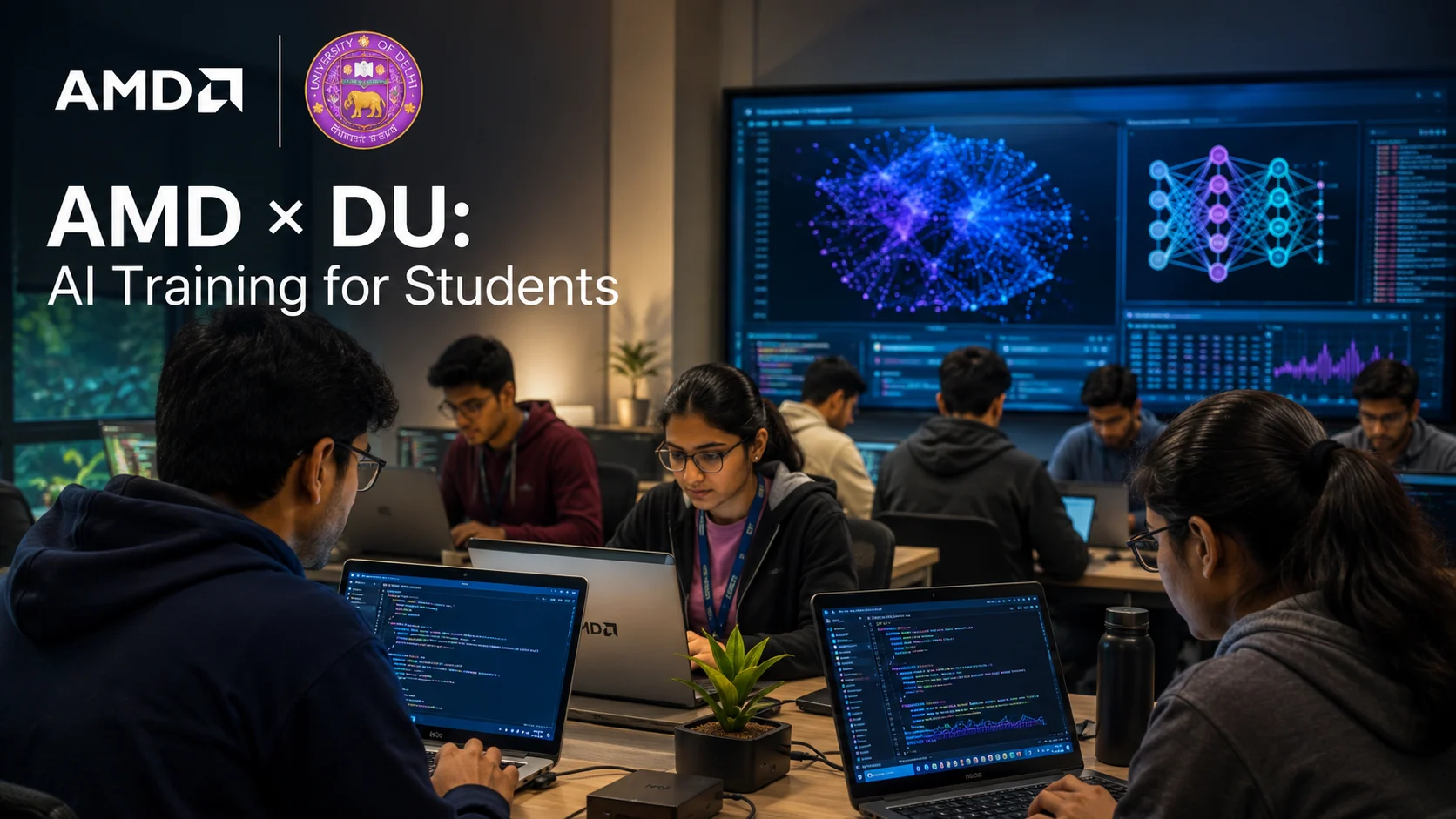
If you are a student wondering what you can actually learn from the AMD × DU AI training program curriculum, the answer goes beyond simply studying artificial intelligence theory.
The real value of AI training is learning how different pieces fit together — from preparing data and training a model to running an AI application on computing hardware. AMD’s developer ecosystem supports frameworks such as PyTorch, TensorFlow and JAX, alongside tools for training, inference and AI optimization through ROCm.
Core AI Concepts Students Need to Understand
The foundation starts with understanding how AI systems work.
Students should become familiar with concepts such as:
- Artificial intelligence and machine learning
- Neural networks and deep learning
- Training versus inference
- Models, datasets and parameters
- Generative AI and large language models (LLMs)
Think of an AI model like a student preparing for an exam: training is the study process, while inference is using what was learned to answer a new question.
Machine Learning Fundamentals
Machine learning provides the practical foundation for building AI applications.
Students should understand how data is divided for training and evaluation, how models learn patterns, and how performance is measured.
| Area | What students learn |
|---|---|
| Data | Preparing and organizing datasets |
| Models | Selecting an appropriate ML approach |
| Training | Teaching a model from examples |
| Evaluation | Measuring model performance |
| Improvement | Adjusting the workflow to improve results |

Generative AI and Large Language Models
Generative AI introduces students to models capable of producing text and other content.
The learning path can include understanding LLMs, embeddings, model training and inference, along with how AI applications use these models.
The important distinction is that students should not only learn what an LLM is, but also understand the workflow behind actually using one in an application.
AI Development and Programming Skills
AI development requires programming, not just theory.
Students should build familiarity with:
- Python programming
- Jupyter notebooks
- AI frameworks
- Git and version control
- Data-processing workflows
- Experimentation and debugging
These skills turn an AI concept into something that can actually run.
AI Model Training and Inference
One of the most important concepts is understanding the complete AI lifecycle.
Data → preprocessing → model → training → evaluation → inference
AMD’s ROCm ecosystem provides tools and documentation covering AI training, inference and optimization on supported AMD hardware.
Data Preparation and AI Workflows
A good AI model starts with useful data.
Students should understand the importance of:
- Collecting relevant data
- Cleaning and preparing it
- Organizing data for training
- Running experiments
- Evaluating the results
- Improving the workflow
This is where AI theory starts becoming practical development experience.
AI Development Frameworks and Software Ecosystem
Modern AI development depends heavily on software frameworks.
Students can encounter technologies such as PyTorch, TensorFlow, JAX and ONNX, while AMD’s ROCm ecosystem provides support and development resources around AI workloads.
AMD’s Role in AI Compute
Why does AMD hardware matter?
AI models require substantial computing power, particularly during training and inference. AMD’s ecosystem includes AMD Instinct accelerators, Radeon GPUs and Ryzen processors, with ROCm providing the software foundation for GPU-accelerated AI development.
The basic idea is simple: different AI workloads need different levels of computing power.
AMD CPUs, GPUs and AI Accelerators
Students can understand the different roles of AMD hardware:
- AMD CPUs: General-purpose computing and supporting AI workloads
- AMD Radeon GPUs: Local AI development and inference on supported hardware
- AMD Instinct accelerators: Larger-scale AI training and inference
How AI Workloads Run on AMD Hardware
ROCm connects AMD hardware with the AI software stack. For example, AMD provides documentation for running PyTorch with ROCm on supported AMD GPUs and platforms.
Students can therefore understand the journey from writing AI code to actually executing that workload on accelerated hardware.
Developer Tools in AMD’s Ecosystem
AMD’s developer ecosystem includes ROCm, AI Playbooks, PyTorch integrations, inference tools and optimization resources. Its documentation also covers technologies such as vLLM, ONNX Runtime and model-optimization techniques.
Hands-On Projects Students Could Undertake
The biggest difference between learning AI theory and developing AI applications is practice.
Possible training projects can include:
- Machine-learning model development
- Generative-AI applications
- LLM-based applications
- Data-processing pipelines
- AI performance experiments on AMD hardware
Students should aim to turn these projects into GitHub repositories, demonstrations and technical documentation.
The Difference Between AI Theory and Deploying AI Applications
Learning theory tells you how AI works.
Deploying an application teaches you how to make AI work in the real world.
That means understanding data, code, hardware, inference and the complete workflow rather than stopping at textbook concepts.
Skills That Can Help With Internships and Entry-Level AI Roles
The most transferable skills include:
- Python and AI programming
- Machine-learning fundamentals
- Generative AI and LLM concepts
- Model training and inference
- Data preparation
- AI frameworks
- Hardware-aware AI development
- Project documentation
How Students Can Build an AI Portfolio
Every meaningful training project can become a portfolio piece.
A strong project should ideally include:
- Clear problem statement
- Dataset explanation
- Model and development approach
- Results and evaluation
- Source code
- Short explanation of what was learned
This gives recruiters something more useful than simply seeing “AI course completed” on a résumé.
What Students Should Learn Alongside the Program
To become more job-ready, students should continue practising AI development independently and strengthen their programming, project-building and deployment skills alongside the training.
Bottom Line
The real advantage of an AI training program is not simply learning AI terminology. It is learning how data, models, software and computing hardware work together to build an actual AI application.