

Most healthcare AI agents don’t fail because they can’t write a good answer. They fail because they’ve forgotten the patient. The agent doesn’t know about last month’s admission, the medication that was changed two weeks ago, the allergy a nurse noted in a different system, or the follow-up that never got scheduled. Every conversation starts from zero, and the patient has to start over with it.
Good memory architecture can fix that, but only if it’s built with care. In healthcare, the goal isn’t to turn an EHR into an endless prompt history. It’s a governed, patient-centered layer that gives the right context to the right person at the right moment.
Two things shape everything below. First, healthcare context is longitudinal and high-stakes: a detail from three years ago can change what happens today. Second, a chat transcript is not a memory system. A transcript is a log, while a memory layer is curated, sourced, permissioned, and auditable.
The central tension is continuity of care versus privacy, security, and auditability. HIPAA doesn’t carve out an exception for AI. PHI is still PHI, and any vendor that creates, receives, maintains, or transmits it on your behalf may need a Business Associate Agreement. The minimum-necessary principle matters here too: organizations should limit the PHI they use or disclose to what’s reasonably needed for the purpose, not pull an entire record by default.
So the thesis is simple. Healthcare agents need purpose-built memory, not a generic vector store bolted onto an EHR.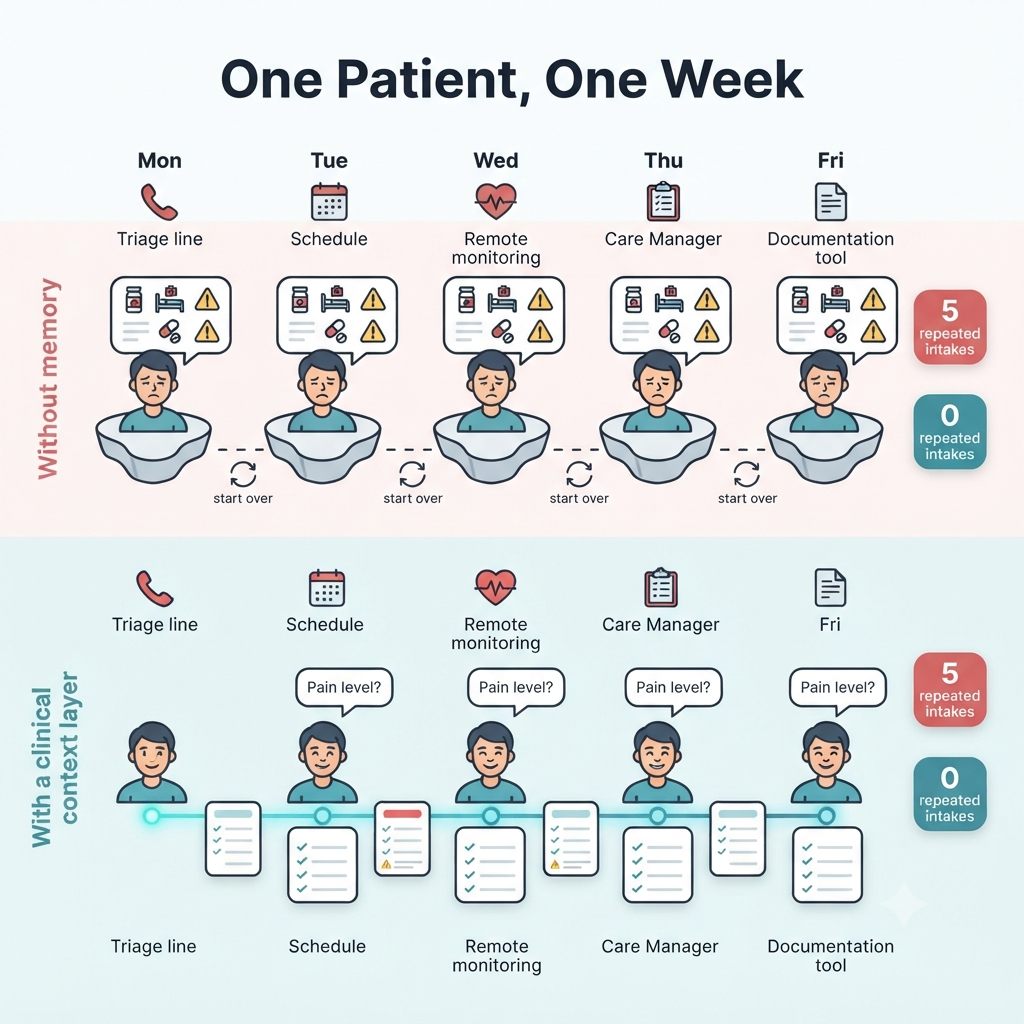
Why Healthcare AI Agents Need Persistent Memory
Think of the “cold-start clinician.” A patient talks to a triage line, a scheduling assistant, a remote monitoring program, a care manager, and a documentation tool. Each one holds a fragment of the story, and none of them hold all of it.
Without persistent memory, you get:
- Fragmented context spread across the EHR, patient portal, call center, remote monitoring, and care-management platforms.
- Repeated intake questions that frustrate patients and burn staff time.
- Missed longitudinal signals, like medication changes, prior escalations, social needs, and care-plan adherence.
The point is continuity of care, not just continuity of conversation. An agent that remembers you said “my knee hurts” last Tuesday is mildly useful. An agent that knows you were discharged after a hip procedure, have a pending physical therapy referral, and are on a new anticoagulant is genuinely helpful.
That’s why it’s better to think of memory as a clinical context layer. It assembles authorized, task-specific patient context when needed. It is not a permanent store of everything a patient has ever said.
Short-Term Context vs. Long-Term Patient Memory
Let’s pin down the vocabulary, translated into healthcare terms.
| Memory type | Healthcare equivalent | Typical retention horizon | Examples |
|---|---|---|---|
| Short-term / working context | Current encounter context | Minutes to the active session | Current symptoms, triage answers, active chat, current order set |
| Episodic memory | Time-stamped care events | Days to years | ED visit, medication change, hospital discharge, care-team call |
| Semantic memory | Consolidated clinical knowledge | Persistent, versioned | Allergies, chronic conditions, preferred pharmacy, care plan |
| Working memory / task state | Active workflow state | Until task closure | Pending referral, incomplete prior authorization, follow-up task |
Episodic Memory: Tracking Events Across the Care Journey
Episodic memory is event-based and time-ordered. It covers encounters, admissions, discharges, lab results, medication changes, patient-reported outcomes, and care-team interactions.
Sequence matters enormously in medicine. A medication change followed by an adverse event tells a different story than the same two facts with no order attached. Episodic records also power handoffs, readmission-risk review, and follow-up workflows.
One warning: a raw event log is not automatically a safe, searchable patient memory. Without access controls, it’s just a large pile of PHI that happens to be easy to query.
Semantic Memory: The Patient’s Durable Clinical Profile
Semantic memory is the distilled version: diagnoses, allergies, care preferences, chronic conditions, risk factors, and longitudinal care goals. Storing a raw clinical note is not the same as maintaining a governed clinical profile.
A few rules make semantic memory trustworthy:
- Provenance. Every item should link back to its source encounter, author, timestamp, and confidence level.
- Conflict resolution. If a newer clinician note contradicts an older patient-reported preference, the system should record the update and keep an audit trail. It should never silently overwrite.
What Should Never Become “Memory”
This is where healthcare departs from every other industry.
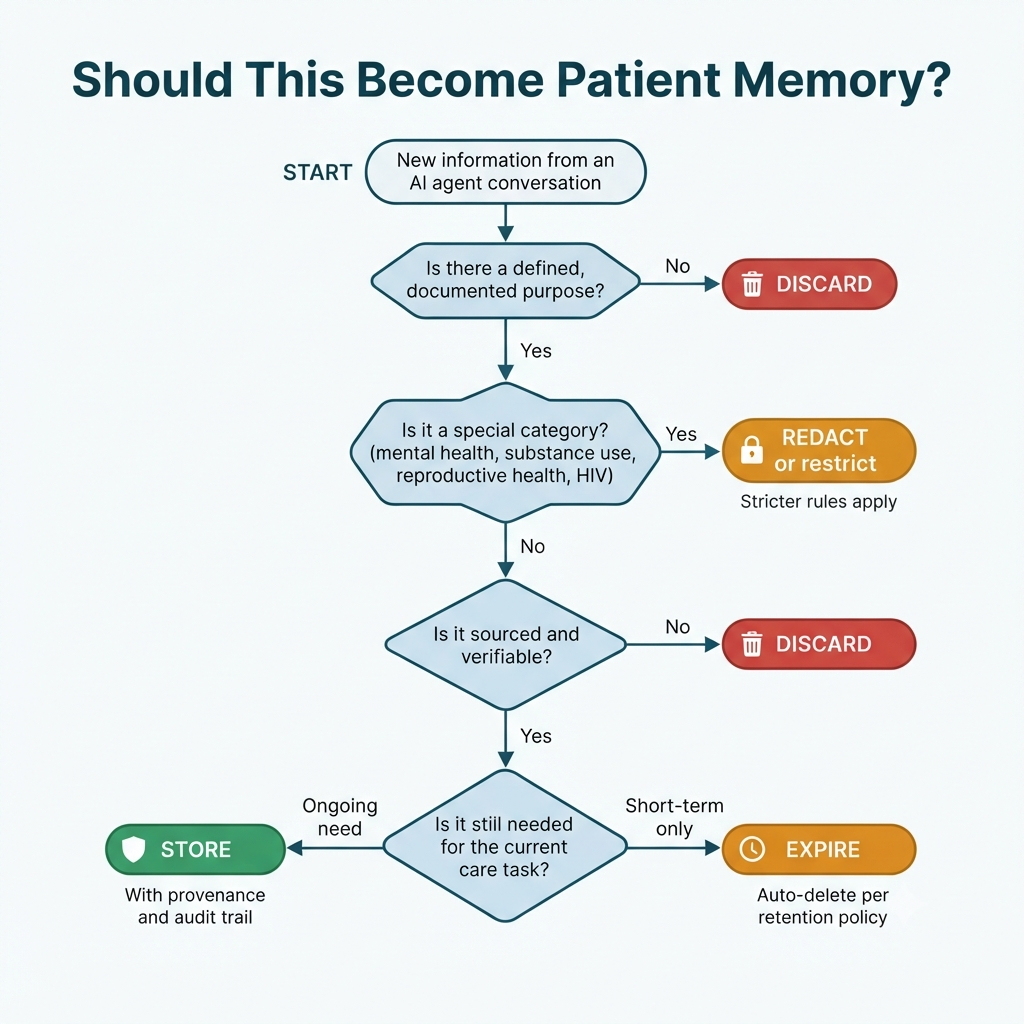
- Sensitive PHI shouldn’t be retained broadly just because a model happened to see it.
- Psychotherapy notes, reproductive-health information, substance-use records, HIV status, and other special categories can trigger stricter state or federal requirements beyond baseline HIPAA.
- Transient conversation content should be minimized, redacted, or kept only under a documented purpose and retention policy.
- Model prompts, traces, and vector embeddings can contain PHI themselves, so they need the same governance as source records.
A note on de-identification: HIPAA recognizes two routes, Safe Harbor (removing specified identifiers) and Expert Determination (a qualified expert concludes re-identification risk is very small). A vendor saying its data is “anonymized” doesn’t establish compliance on its own.
A HIPAA-Aligned Memory Architecture for Healthcare Agents
Here’s a reference architecture in seven layers.
- Clinical source systems. EHR, patient portal, scheduling, pharmacy, lab, remote monitoring, and care management.
- Ingestion and normalization. FHIR-based extraction, terminology normalization, event time-stamping, and source-of-truth mapping.
- PHI protection. Tokenization or pseudonymization where appropriate, field-level encryption, de-identification for secondary analytics, and purpose-based access.
- Memory stores. A short-term session store, an episodic event store, a semantic patient profile, and a workflow/task-state store.
- Retrieval and context assembly. Role-, purpose-, and consent-aware retrieval, with minimum-necessary filters and provenance attached.
- Agent orchestration. Triage, care coordination, documentation support, scheduling, and follow-up.
- Governance plane. Audit logging, retention policies, access reviews, human-in-the-loop controls, and breach response.
The most important rule in the whole stack: enforce privacy at retrieval time, not just in the database. A clinician, a care manager, and a billing user may each be authorized for different slices of the same patient record. If your controls only live at the storage layer, the agent can still assemble a view nobody should see.
Memory Design Pattern: Patient-Centered, Not Chat-Centered
Organize memory around:
- Patient identity and authorized care relationship
- Encounter and episode of care
- Clinical task and purpose
- Care team and role
- Consent, jurisdiction, and data-sharing boundaries
This keeps the agent from treating a patient’s whole history as one undifferentiated blob of context.
Clinical Workflows That Benefit From Memory
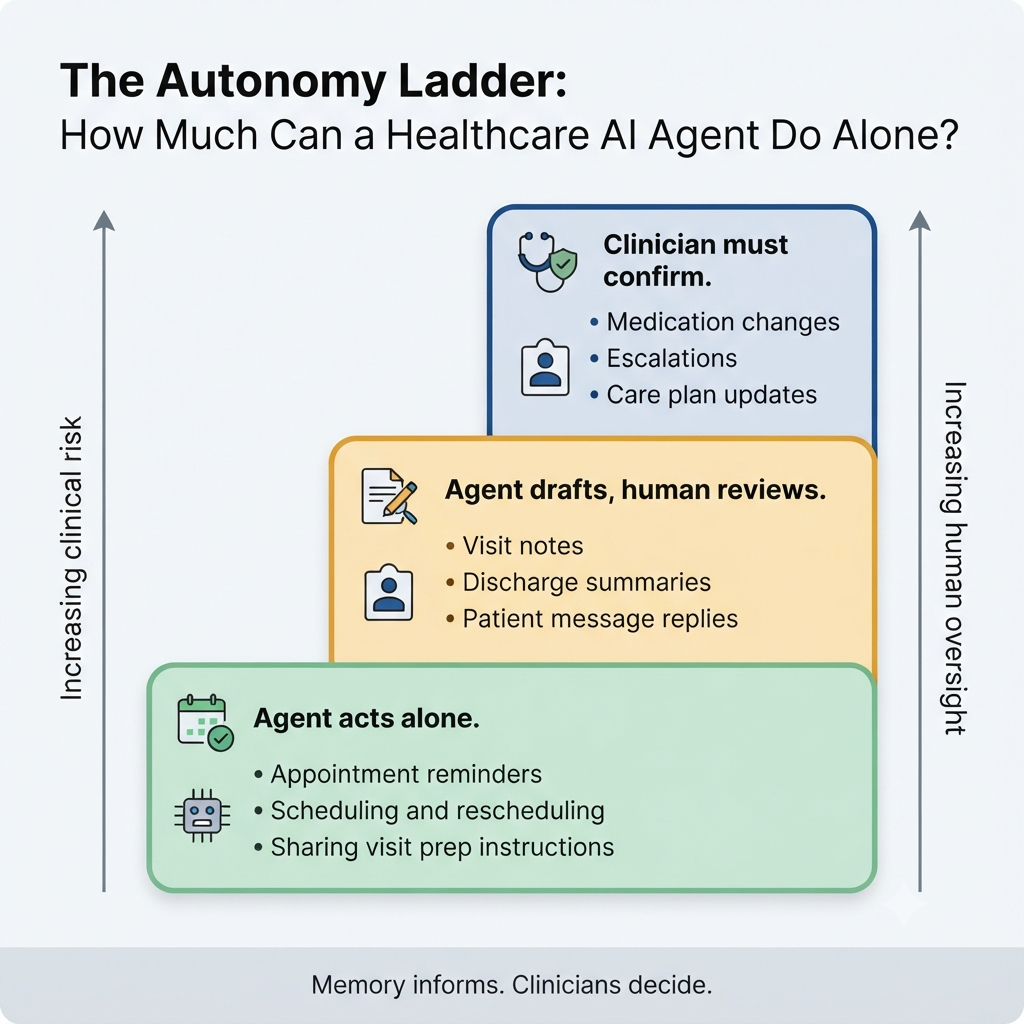
Not every healthcare AI use case needs memory. These are the ones where it creates measurable value.
Intelligent Triage and Intake
An agent can recall prior triage interactions, recurring symptoms, medications, allergies, and preferred communication channels, then route the patient appropriately. That means smarter follow-up questions and far less repeated intake.
Escalation rules and clinician review need to be explicit. Memory informs triage support. It does not autonomously diagnose.
Care Coordination and Transitions of Care
Episodic memory helps an agent pull discharge summaries, pending follow-ups, medication changes, and outstanding referrals into a usable handoff. That supports post-discharge outreach, care-gap identification, and medication reconciliation. Clinical actions still need human confirmation.
Chronic Care and Remote Monitoring
Semantic and episodic memory together can track adherence signals, symptom patterns, device readings, and care-plan changes without making the patient restate their history. Outreach can be personalized to the care plan and risk trajectory, and escalation thresholds should come from clinical protocols. Keep a clear line between monitoring insights and diagnostic conclusions.
Clinical Documentation and Ambient Support
Memory can cut documentation burden by recalling relevant prior context and drafting notes with source attribution. But generated notes need clinician review and versioning, and they shouldn’t be treated as the authoritative record by default. An agent should never silently update the legal record from its own inferred memory.
Privacy, Security, and Governance by Design
If you take one section of this article to your security team, make it this one.
PHI Boundaries and Business Associate Agreements
A BAA is required before a covered entity discloses PHI to a business associate, and it must define permitted uses and disclosures. The obligation can reach subcontractors in your AI stack, including hosting, model, tracing, and vector-database providers.
A practical vendor checklist:
- Explicit permitted purposes (treatment, payment, healthcare operations, or another lawful authorized purpose)
- A clear position on model training, product improvement, benchmarking, and secondary use
- Coverage for subcontractors and hosting providers
- Breach-notification duties
- Audit rights
- Data return or destruction at termination
- Retention limits and deletion workflows
Minimum Necessary Retrieval
The agent should request only the context a defined task needs. A scheduling agent may need appointment history and communication preferences, not the full behavioral-health record.
The minimum-necessary standard applies to uses and disclosures outside treatment contexts, and organizations should be able to justify any request for an entire record.
Tenant Isolation and Access Control
- Patient-level and tenant-level isolation
- Role-based and attribute-based access control
- Purpose-based access, separating treatment, operations, and research
- Break-glass access with justification and alerting
- Separate development, evaluation, and production environments
- No cross-tenant semantic memory or shared embeddings that could allow inference across organizations
Auditability and Provenance
An audit-ready memory event should capture:
- Patient or pseudonymous identifier
- Actor, role, and care relationship
- Purpose of access
- Data sources retrieved
- Memory item created, updated, or expired
- Model and prompt version
- Human review or override
- Retention and deletion action
Retention, Deletion, and Patient Rights
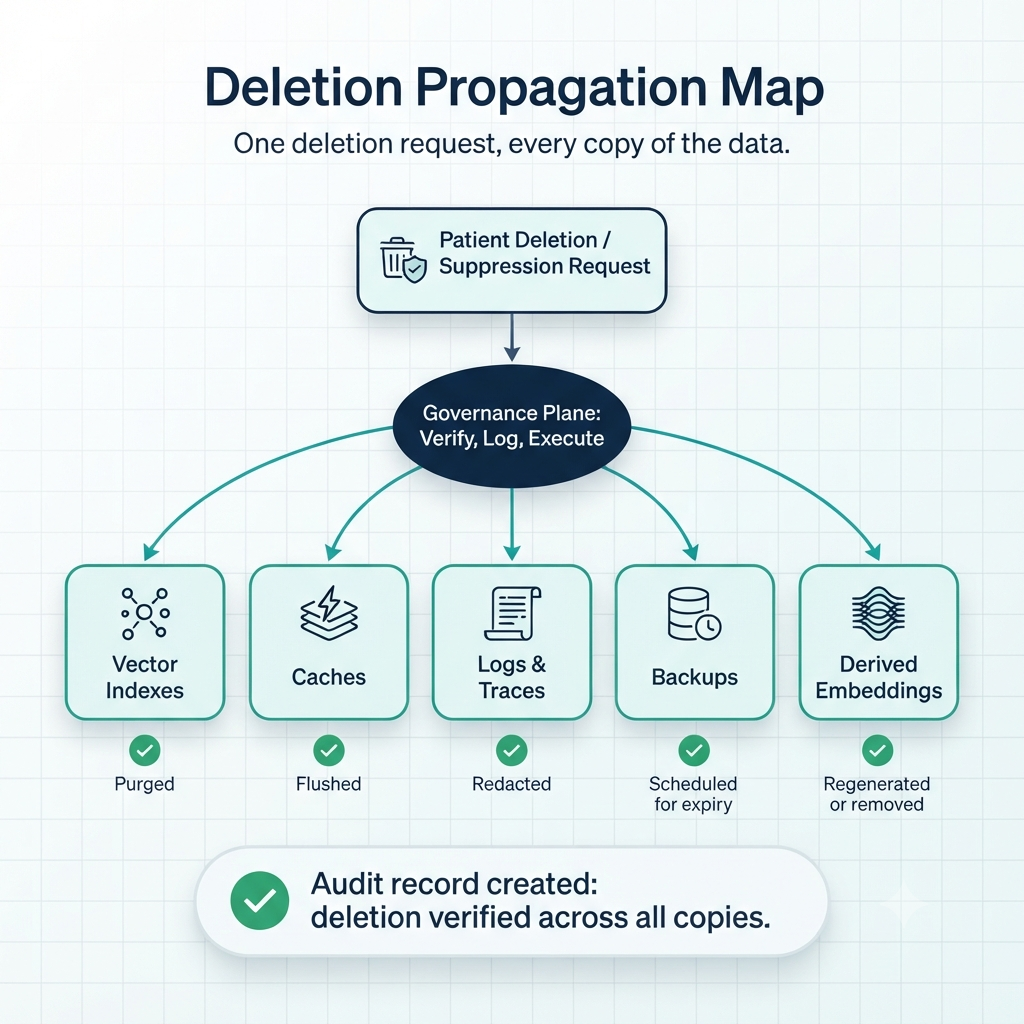
- Tie retention to clinical, legal, and organizational policy, not “keep it forever because it might improve the model.”
- Support right-of-access and amendment workflows.
- Make sure deletion or suppression propagates across vector indexes, caches, logs, backups, and derived embeddings.
- Review re-identification risk for de-identified datasets.
- Account for state-law overlays and stricter protections for sensitive health categories.
Evaluation: How to Know the Memory Layer Works
Decision-makers need a measurement framework before scaling anything.
| Dimension | Example metric |
|---|---|
| Clinical relevance | Percentage of retrieved context rated useful by clinicians |
| Safety | Escalation accuracy, hallucination rate, unsafe recommendation rate |
| Privacy | Unauthorized-access attempts, over-retrieval rate, PHI exposure incidents |
| Workflow impact | Intake time, documentation time, follow-up completion rate |
| Memory quality | Context precision/recall, staleness rate, conflict-resolution accuracy |
| Governance | Audit completeness, retention-policy adherence, access-review completion |
Don’t promise clinical outcomes you haven’t validated. Plan for prospective evaluation, clinician review, and ongoing monitoring before you scale.
Implementation Roadmap
Phase 1: Governed context foundation
- Map PHI flows and authorized use cases.
- Establish the BAA, data classification, retention, and access policies.
- Build a FHIR-aligned clinical context layer.
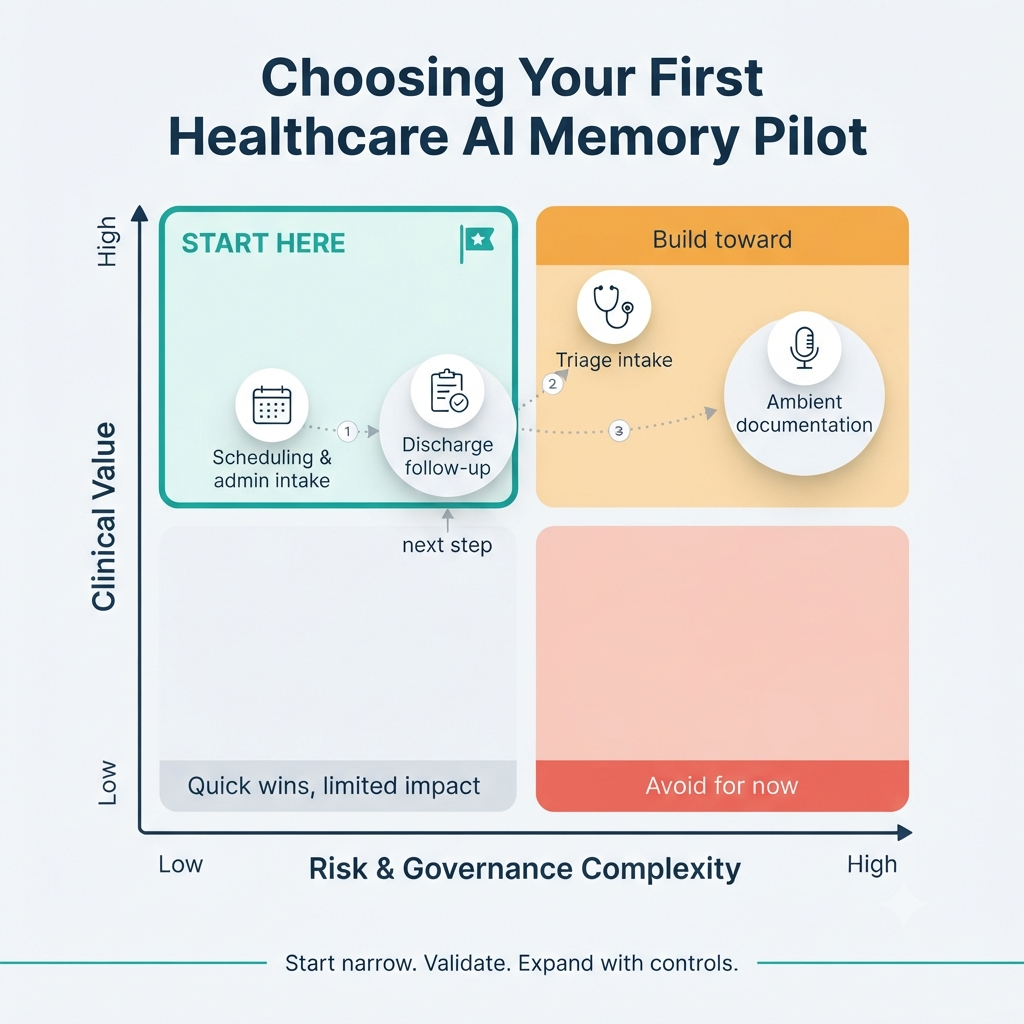
- Start with a narrow, low-risk workflow like scheduling or administrative intake.
Phase 2: Episodic and semantic memory
- Add event memory for encounters, medications, and care transitions.
- Create a versioned patient profile with provenance.
- Implement purpose-aware retrieval and audit logging.
Phase 3: Workflow orchestration
- Deploy triage, care-coordination, or documentation-support workflows.
- Add human-in-the-loop checkpoints.
- Measure clinician trust, safety, and operational impact.
Phase 4: Scale with controls
- Expand to chronic-care and remote-monitoring use cases.
- Introduce automated policy tests, red-team evaluations, and continuous monitoring.
- Stand up a clinical AI governance committee.
Common Failure Modes
- Treating a chat transcript as a clinical memory system
- Storing raw PHI in prompts, traces, or vector databases without governance
- Retrieving the full chart when a narrow task needs a few fields
- Letting memory persist after a care relationship, consent, or retention policy changes
- Relying on de-identification claims without validating the method or the re-identification risk
- Letting agent-generated content into the legal record without clinician review
- Building memory before defining access roles, audit trails, and breach-response procedures
FAQ
Is an AI agent automatically a HIPAA business associate?
Not automatically. But if it creates, receives, maintains, or transmits PHI on behalf of a covered entity, a BAA is generally required before PHI flows to it.
Can healthcare agents store patient conversations?
Yes, but only under a defined lawful purpose, a retention policy, access controls, and security safeguards. Retention shouldn’t be the default.
Does de-identification make data risk-free?
No. HIPAA recognizes Safe Harbor and Expert Determination, but you should still assess re-identification risk, especially with rich longitudinal datasets.
Can memory improve diagnosis?
It can surface relevant longitudinal context, but diagnosis and treatment decisions should stay with qualified clinicians under appropriate oversight.
What’s the first use case to pilot?
Start with a bounded administrative or care-coordination workflow. Move toward clinical decision support only once governance and validation have matured.
In healthcare, memory isn’t about remembering more. It’s about remembering the right clinical context, for the right authorized person, for the right purpose, with provenance and an audit trail. Build for that, and you get agents that clinicians can trust and compliance teams can defend.