

The next big fight in computing won’t be about app-store commissions or search rankings. It will be about something more basic: who controls an app’s memory, context, and data once an operating system’s AI agent walks into the room.
Signal recently decided to block OS-level AI agents from capturing its messages. Most people will read that as a privacy update. I think it’s closer to an architectural rebellion. Signal is pushing back on the idea that Apple, Google, and Microsoft can treat every app as raw material for their platform-wide AI, just because that AI happens to live at the operating-system layer.
The Invisible Landlord
For most of the smartphone era, the operating system was plumbing. It handled permissions, display, storage, notifications, and distribution. Apps lived inside that environment, but they still controlled their own interfaces, workflows, and data.
AI agents are changing that arrangement.
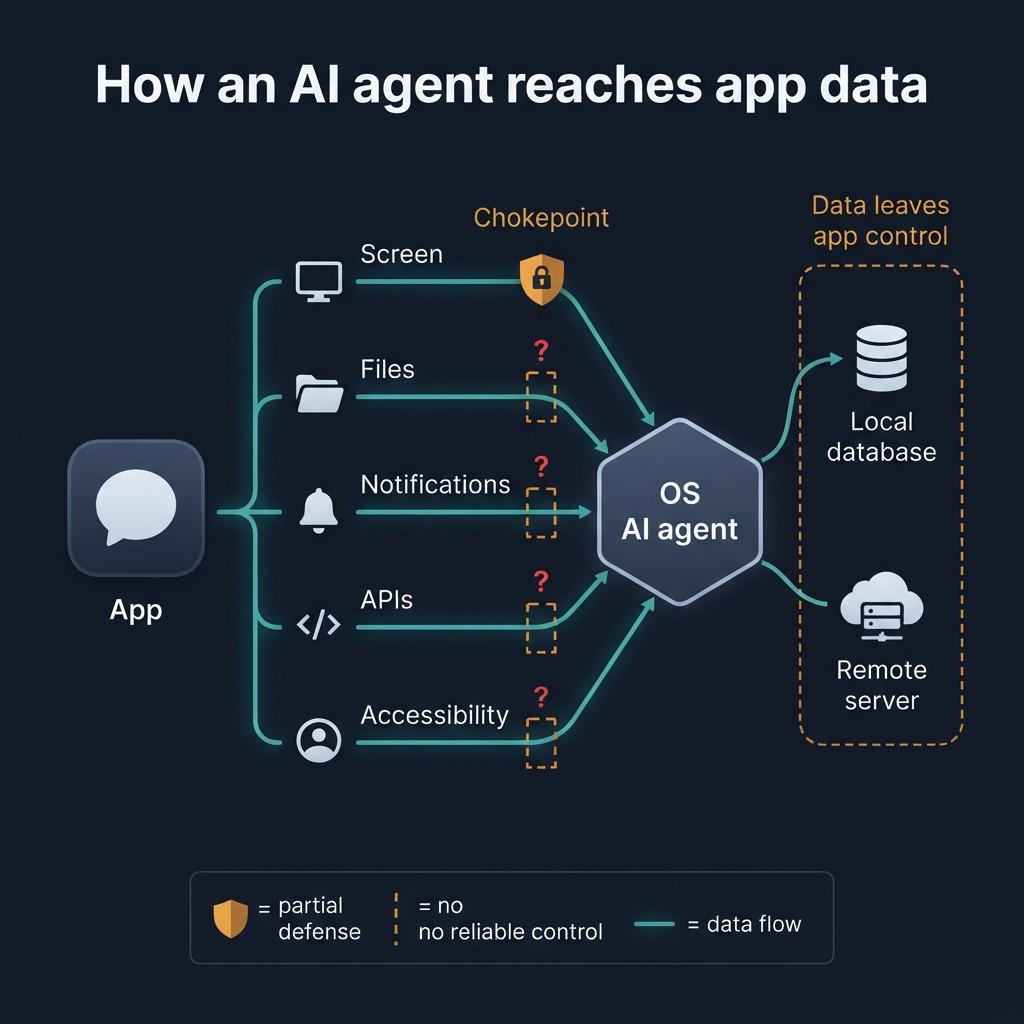
Apple, Google, and Microsoft are building agentic features deeper into their operating systems. These agents are designed to see what’s on screen, answer questions, automate tasks, and act across apps. According to Signal, they can scan on-screen information, capture it, and pass it to local databases or remote servers used by the AI system.
That adds a new layer of power between the user and the app. You might think you’re only talking to Signal, your bank, a health tracker, or a work tool. Meanwhile an OS-level agent may be able to read what’s visible, hold on to it, and use it later.
This is the heart of device sovereignty. If the platform can watch an app’s runtime context, does the app still really own its product experience?
Signal’s Rebellion
Signal isn’t just adding a privacy toggle. It’s trying to hold a boundary that the platform itself doesn’t clearly provide.
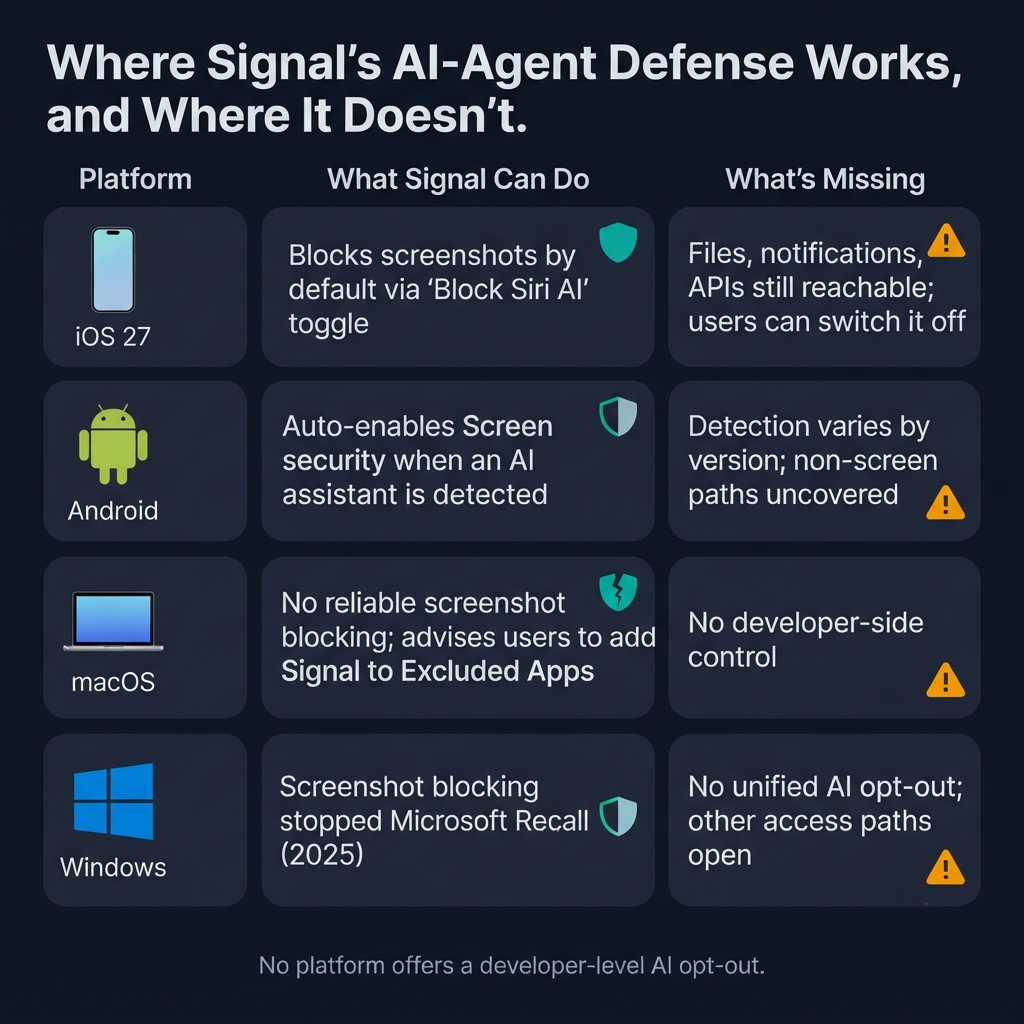
On iOS 27, Signal blocks AI agents from capturing its messages by default through a “Block Siri AI” setting. On Android, it switches on its existing Screen security protection whenever it detects an AI assistant trying to read the Signal screen. Users can turn these off, but Signal warns that doing so could expose both their own content and their contacts’ content to AI agents.
This isn’t new territory for the company. In 2025 it used screenshot blocking to stop Microsoft Recall from capturing and storing images of Signal messages on Windows 11.
Signal is also candid that these defenses have holes. Blocking screenshots doesn’t necessarily stop an AI agent from reaching data through the filesystem, notifications, APIs, or other operating-system frameworks.
So Signal is asking Apple, Google, and Microsoft for two things:
- A simple, well-documented way for developers to opt their apps out of AI data access and processing, covering screen reading, filesystem access, notifications, APIs, and other OS frameworks, without breaking core app functionality.
- Better documentation and technical specifications explaining how AI agents access and process data.
That isn’t a plea for one more permission dialog. It’s a demand for something like a constitutional right inside the operating system: the right to say, “This app is not raw material for your agent.”
The Developer’s Dilemma
Right now developers have an awkward choice. They can build crude defensive walls, or accept that a platform-level agent may swallow their app’s context.
| Developer defense | What it may protect | Why it is inadequate |
|---|---|---|
| Screenshot blocking | Rendered on-screen content | Does not cover files, notifications, APIs, or other access paths |
| Screen-security flags | Visual capture and screen reading | Platform-specific, incomplete, and sometimes unavailable |
| Permission restrictions | Selected system resources | No unified “no AI agent” boundary |
| Encryption | Data at rest or in transit | Cannot prevent an agent from reading content displayed on screen |
| Policy requests | Transparency and future change | Useful, but not an enforceable technical control |
Signal’s experience shows why this is a structural problem and not a settings problem. On macOS, it says it can’t reliably block screenshots because the available APIs aren’t good enough. All it can do is recommend that users exclude Signal from Siri’s proactive access in system settings.
Put plainly, developers are being asked to protect their products with DRM flags, screenshot blocks, and a lot of reverse-engineering, while the platform owns the deeper layer where the access actually happens.
Who Owns App Memory?
The hardest question isn’t whether AI agents are useful. It’s whether an app’s context belongs to the app that created it, the platform that hosts it, or the user who generated it.
The developer’s view: an app’s interface, messages, workflows, and contextual state are part of the product. A messaging app should be able to promise that a private conversation stays private. A banking app should be able to protect transaction details. A health app should be able to protect medical information.
The platform’s view: an AI agent needs broad context to be worth using. It can’t summarize a trip, organize files, answer “what did I miss today?”, or automate a workflow if it only ever sees one isolated app.
The user’s view: the device is theirs. But many users may not realize that “helpful AI” can mean constant observation, a searchable history of their screen, or access to sensitive content inside their apps.
Signal’s argument is that once an OS-level agent captures data, that data can leave the app’s control and end up in whatever local database or remote server the agent is using at the time.
That’s the real stake. It’s not just a privacy setting. It’s ownership of app memory.
Why Platforms Want Access
It would be easy to paint Apple, Google, and Microsoft as villains, but that would miss something. OS-level agents are appealing because they solve a genuine fragmentation problem.
Nobody enjoys copying a receipt out of an email, opening a budgeting app, pasting the total, and categorizing it by hand. An agent that sees across apps could do all of that from one instruction. It could find a flight confirmation, pull out the itinerary, set reminders, and answer questions about the trip.
That’s the promise of ambient computing: the operating system stops being a passive app launcher and becomes an intelligent coordinator.
But broad access creates a serious imbalance. The platform designs the agent, sets its permissions, writes the documentation, controls the consent experience, and decides what developers are allowed to restrict. If the agent becomes the main way people use their device, the platform is no longer just an OS vendor. It becomes the gateway to every app.
Three Futures for the Ecosystem
You can think of the conflict as a contest between three architectural models.
| Model | Who controls context | What developers get | Likely outcome |
|---|---|---|---|
| Platform-first agent | OS and AI provider | Limited controls; broad agent access | Powerful automation, weaker app sovereignty |
| App-first sovereignty | App developer | Explicit opt-outs and granular boundaries | Stronger privacy, more fragmented AI experiences |
| User-mediated consent | User, with enforceable choices | Clear disclosure and per-app, per-action permissions | More complexity, but potentially the most balanced model |
Signal’s demands point toward the second model, while platform AI strategies naturally lean toward the first. The most durable answer is probably the third: consent that is meaningful, revocable, technically enforced, and visible, rather than a buried preference people toggle once and forget.
What a Real Opt-Out Must Include
If Apple, Google, and Microsoft want developers to trust AI agents, a generic “limit ads” or “prevent cross-app tracking” switch won’t cut it. They need a real developer sovereignty API.
A credible opt-out system would include:
- A single documented declaration that an app excludes itself from AI-agent data access.
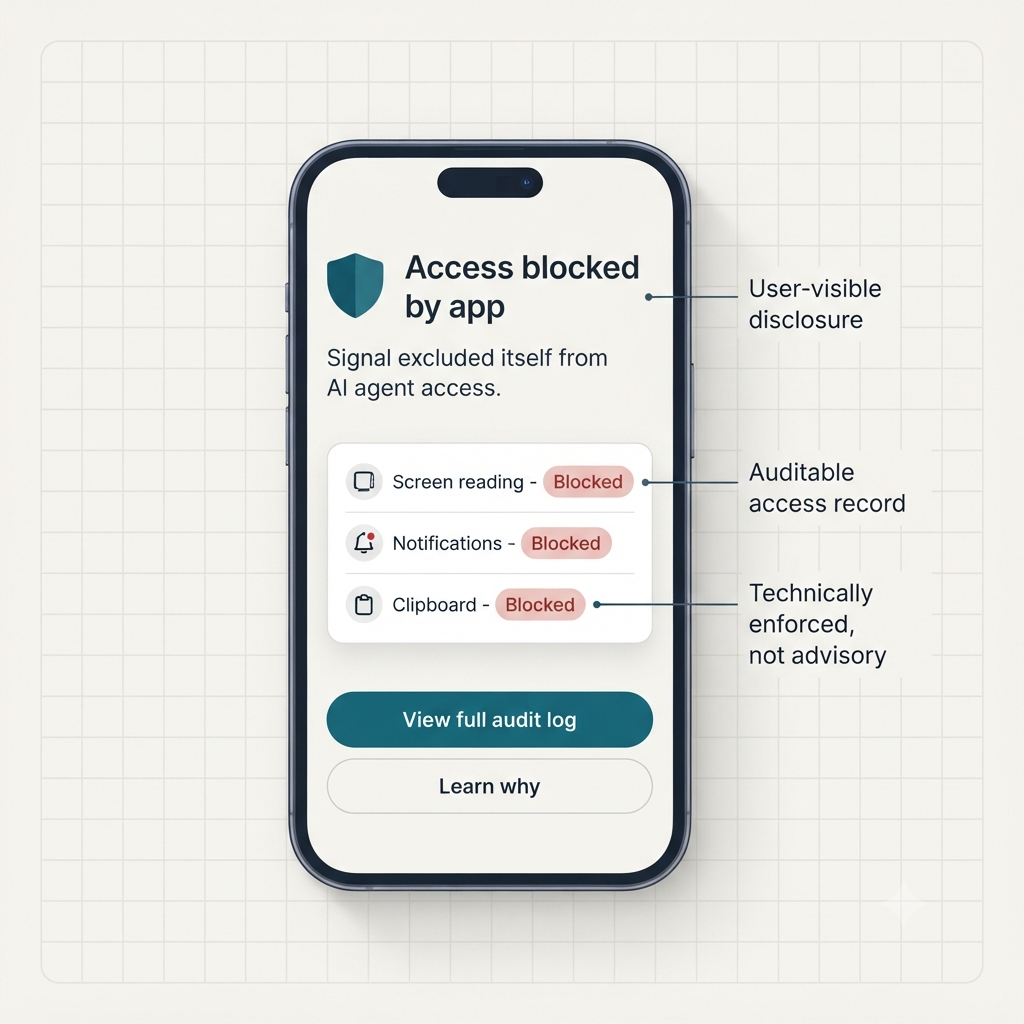
- Granular scopes covering screen reading, screenshots, filesystem access, notifications, clipboard data, accessibility data, and API-mediated context.
- Technical enforcement, not an advisory preference an agent is free to ignore.
- User-visible disclosure when an agent tries to get in and is blocked.
- Auditability, so developers and users can see what was accessed, when, and under what permission.
- No punitive trade-off, meaning opting out shouldn’t hurt an app’s core functionality, discoverability, or platform distribution.
Signal is clear that the problem isn’t only that agents can reach data. Developers simply lack robust tools to stop it without making drastic compromises to the core user experience.
The Business Stakes
This isn’t just a privacy-policy debate. It’s a business-model issue.
For Signal, privacy is the product. If an OS agent can capture private conversations, the app’s central promise falls apart. For banks, healthcare providers, HR platforms, legal software, and enterprise tools, uncontrolled agent access could be commercially fatal.
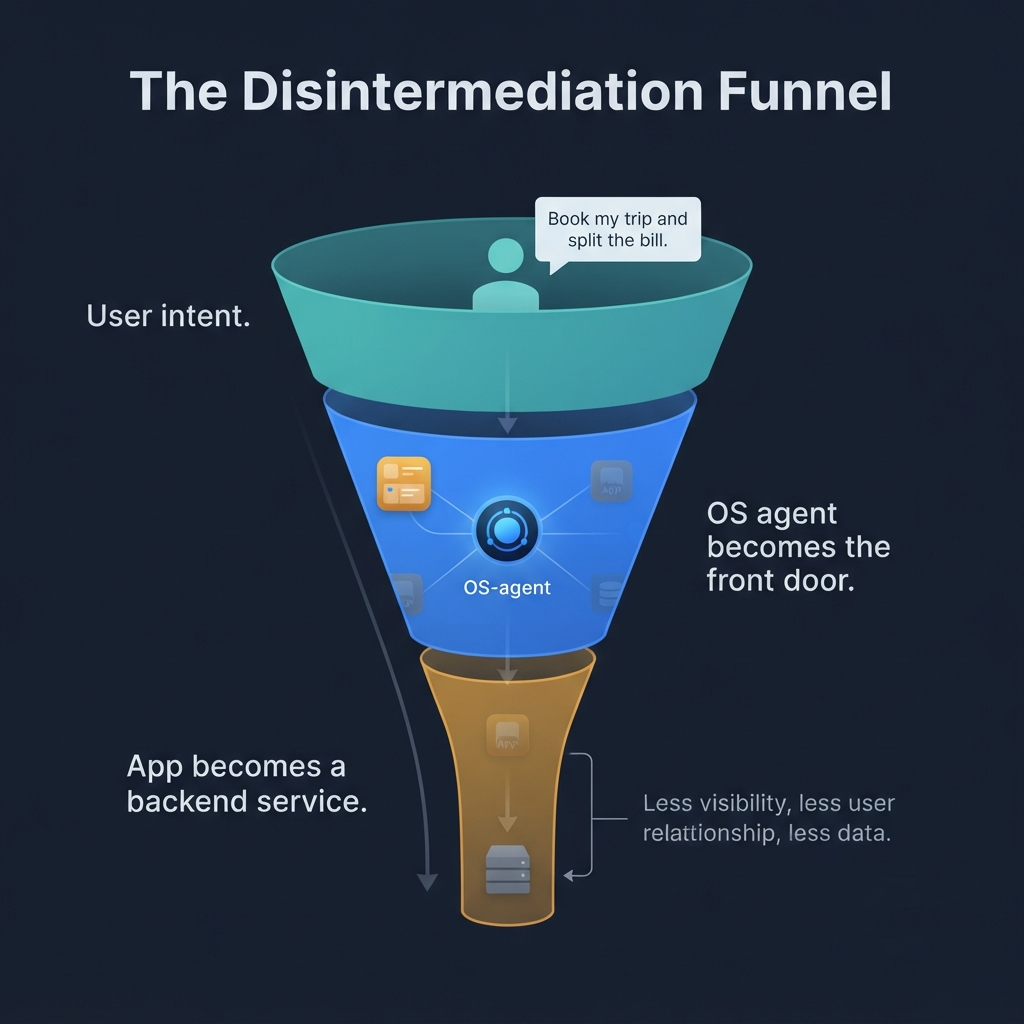
There’s a distribution risk too. If people increasingly ask the operating system instead of opening an app, the app risks becoming a backend service. Still important infrastructure, perhaps, but no longer the place where the user starts.
And there’s a data advantage. An agent that observes behavior across apps can build a richer picture of a person than any single developer can. The company that controls the agent may eventually know more about a user’s intentions, habits, and relationships than the apps that user deliberately chose.
Is Opt-Out Anti-Innovation?
The strongest counterargument is that universal opt-outs would fragment the AI experience. If every sensitive app walls itself off, agents become less capable, less useful, and worse at cross-app automation.
That’s a fair concern. But the fix can’t be to push developers into opaque access arrangements or leave them leaning on screenshot blocking in place of real architecture.
A better approach is opt-out with accountability:
- Developers can exclude sensitive contexts.
- Platforms must document how agents work.
- Users must get clear, informed consent.
- Access must be auditable and revocable.
- Consent must not work as a blanket license for indefinite data retention.
Signal isn’t arguing that AI agents shouldn’t exist. It’s arguing that their access should be explicit, documented, and controllable.
The OS Is Becoming a Political System
The smartphone is turning into a political system. The platform writes the rules, the AI agent enforces access, and developers are expected to operate inside a system they didn’t design and can’t fully inspect.
Signal calls itself the “canary in the coal mine,” and the metaphor fits. Its fight isn’t only about encrypted messages. It’s about whether independent developers will keep real sovereignty over their own software in an agent-first operating system.
If the next computing interface is an AI agent, then the most important question is no longer what can AI do?
It’s this: who gets to decide what AI is allowed to know?