
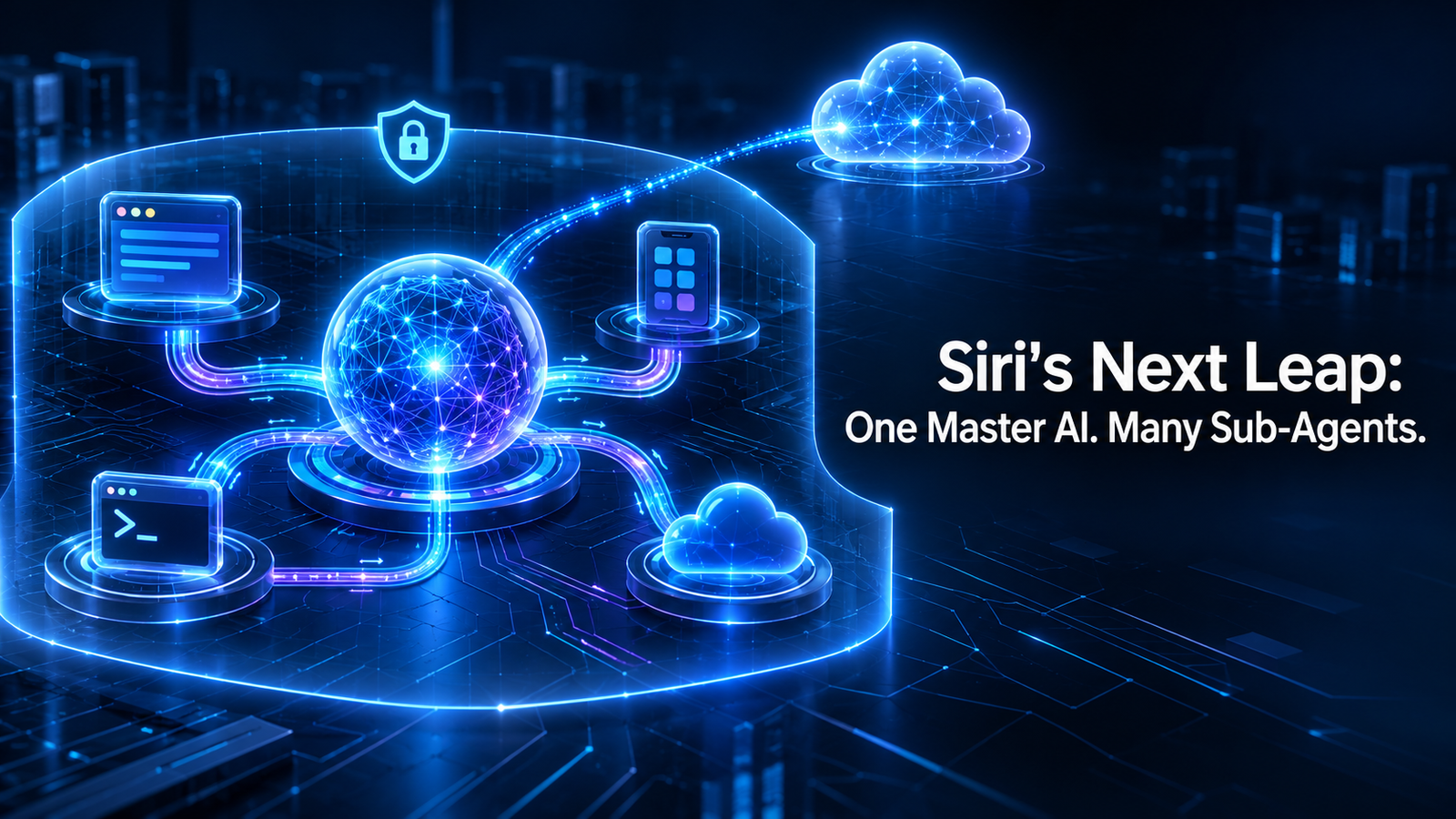
Apple’s next big AI move may not be one all-knowing Siri model. It may be something with more reach: a master coordinator agent that takes a goal, breaks it into pieces, hands those pieces to specialized sub-agents, keeps an eye on their progress, and comes back with a finished result.
Apple’s own job postings are surprisingly direct about this. One senior engineering role describes “general-purpose computer-use agents” that plan and carry out multi-step tasks across apps, browsers, command lines, code, and APIs, and that can “coordinate specialized sub-agents along the way.” Another posting asks for multi-agent orchestration systems with task delegation, hand-offs, shared context, role specialization, and conflict resolution.
Nobody writes that about a voice assistant that just needs a tune-up. This is the language of a company building an agentic operating layer for personal computing.
Siri Is Getting a Workforce
Picture telling your device:
“My meeting moved to Thursday. Find a better flight, rebook it if the fare is reasonable, update my calendar, and send my team a short update.”
A traditional assistant might answer a question or do one thing. An orchestrated agent system treats the request like a small project:
- Understand the goal and its constraints.
- Build a plan with dependencies.
- Send a browser agent off to research flights.
- Use a service agent to check booking rules and fares.
- Ask permission before spending any money.
- Have an app agent update Calendar.
- Draft a message for your approval.
- Check that every step worked, and recover if one didn’t.
Apple’s job description imagines agents that browse the web, move across apps, run commands, write and debug code, and call services, picking the right tool for each step. In that picture, Siri stops being just the voice at the front. It becomes the foreman of a digital crew.
The Signal Hidden in Apple’s Hiring
Job listings are imperfect clues about product plans. Still, they tell you far more than a vague keynote promise does, because they show which problems a company is actively trying to solve and what architecture it expects to need.
Apple is hiring across several connected areas:
- Agent platform leadership: A role focused on the technical direction of an agent platform, covering orchestration, simulation, evaluation, safety, privacy, and the limits of on-device models.
- Multi-agent systems: A role that explicitly asks for experience with agent collaboration, delegation, hand-offs, shared context, role specialization, and conflict resolution.
- Agent execution infrastructure: Apple describes an “Agent Harness” that runs the agent loop, carries context and tools to the model, executes tool calls, and streams results back reliably.
- Security and permissions: A separate role centers on security foundations for agentic, tool-using AI, including trust boundaries between models, orchestrators, tools, third-party content, local apps, cloud services, and user data.
- Evaluation at scale: Apple is building platforms to test multi-turn, context-heavy Siri conversations, including tool-calling loops, multi-agent evaluation, and dynamic state exploration.
Put together, the pattern is hard to miss. Apple isn’t only hiring for better language models. It’s hiring for the machinery that makes autonomous agents dependable enough to act on someone’s behalf.
What Is a Sub-Agent Master Mind?
Think of it as a coordination layer. It doesn’t have to do every task itself. Its job is to decide what needs to happen, assign the right specialist, track the work, settle conflicts, and know when the task is actually done.
| Layer | What it does | Example |
|---|---|---|
| Master coordinator | Interprets intent, plans, delegates, monitors, and verifies | “Rebook the flight and update my calendar” |
| Browser agent | Searches, reads pages, compares options, fills forms | Finds alternative flights |
| App agent | Operates native applications and system features | Updates Calendar or Mail |
| Code agent | Writes, runs, tests, and debugs code | Fixes a broken automation script |
| API/service agent | Calls permitted external services | Checks fares, sends messages, retrieves documents |
| Memory/state layer | Preserves goals, preferences, intermediate results, and context | Remembers that the meeting moved to Thursday |
| Safety layer | Enforces permissions, sandboxing, and human approval | Blocks an unauthorized purchase or file deletion |
The difference from a regular chatbot is important. A chatbot gives you an answer. An orchestrated agent changes something in the world: a booked flight, an updated calendar, a finished report, a fixed codebase.
Why “Local” Matters
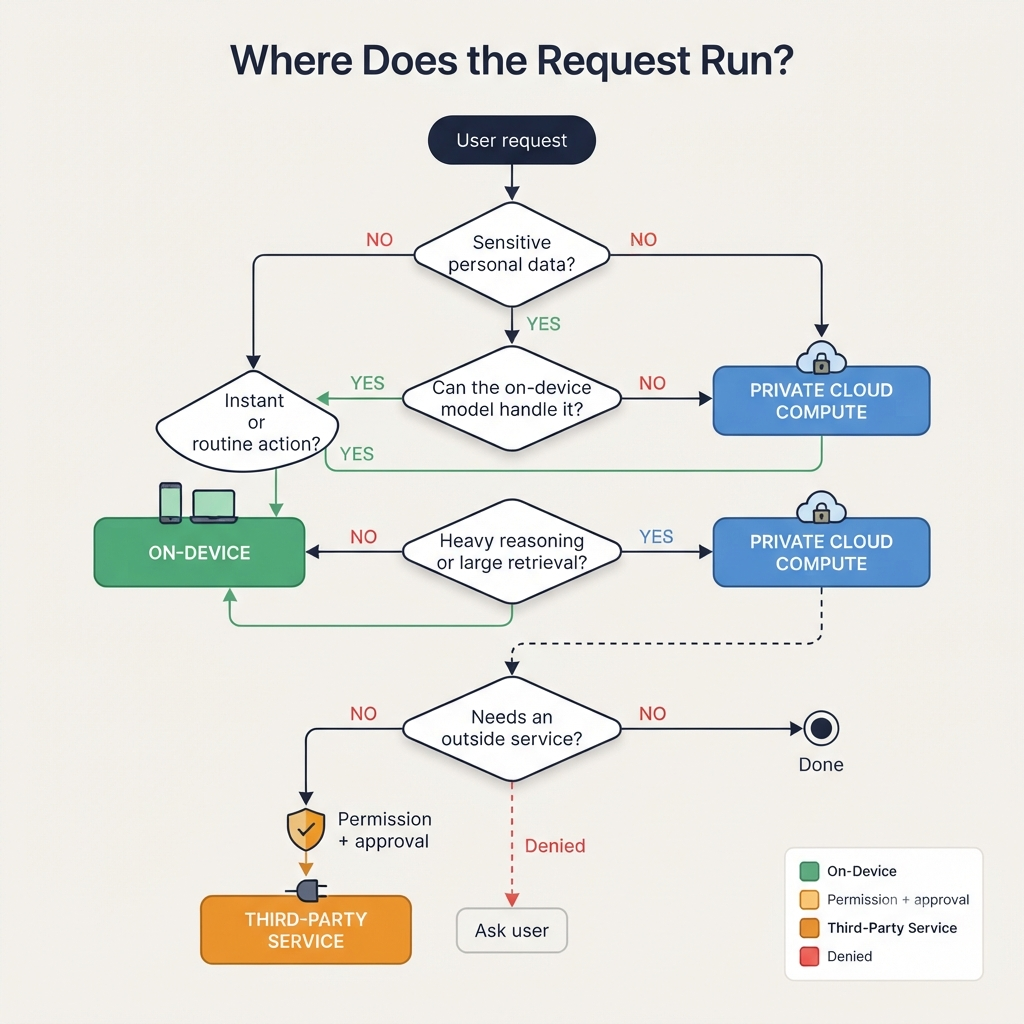
“Local” doesn’t have to mean every model and every action runs entirely on an iPhone or Mac. What it suggests is an architecture where sensitive context, routine actions, and user control stay close to the device, while heavier work gets routed elsewhere when needed.
Apple’s Intelligence Orchestration role mentions on-device inference, routing to Private Cloud Compute, document-processing scheduling, and on-device reporting. The agent-platform role, meanwhile, stresses getting capable, efficient models onto devices despite tight limits on latency, memory, and power.
Together, that points to a hybrid setup:
- On-device: Fast intent recognition, UI understanding, simple app actions, local file work, and privacy-sensitive context.
- Private Cloud Compute: More complex reasoning, large-scale retrieval, or specialized model work when it’s required.
- Third-party services: Reached only through tightly defined permissions and tool contracts.
If Apple pulls this off, privacy becomes more than a marketing line. It becomes a structural advantage. The agent can know enough to be useful without pushing every detail of your digital life to a distant server.
The Architecture Apple Seems to Be Building
Read the disclosed roles side by side and the stack looks less like “Siri with better answers” and more like an agent runtime.
1. Intent and planning
The system has to turn a fuzzy human request into a series of concrete steps. “Plan my trip” isn’t a single command. It’s a tree of tasks: search, comparison, booking, calendar updates, notifications, and handling whatever goes wrong.
Apple’s senior agent role calls out agents that can plan and carry out long-horizon, end-to-end work.
2. Tool and capability registry
An agent has to know what it’s able to do: open an app, search the web, read a file, call an API, run a script, edit a calendar event. Apple’s agent-development posting describes tool and function-calling layers that expose internal APIs and services as things an agent can execute, including through MCP servers or custom tool registries.
3. Sub-agent dispatch
This is the heart of the idea. The coordinator hands work to specialists, manages hand-offs, and stops agents from tripping over each other.
Apple’s listing names the exact patterns: collaboration, task delegation, hand-offs, shared context management, role specialization, and conflict resolution. These aren’t casual phrases. They’re the basic requirements of any production multi-agent system.
4. Shared memory and context
A multi-agent system falls apart if each agent forgets the mission. The coordinator has to hold on to the original goal, the constraints, the finished steps, and the intermediate results.
Apple’s role asks for episodic, semantic, and working memory, built on vector stores and hybrid retrieval, so agents can reason over past interactions and keep state between sessions.
5. Execution harness
The harness is the bridge between intention and action. It carries context and tools to the model, runs the tool calls, and returns the results. In practice, it’s what turns “I should check flights” into a real browser action or API request.
6. Safety, permissions, and observability
Autonomy without control is a liability. Apple’s postings keep coming back to permission models, sandboxing, transparency, prompt-injection defenses, output-schema contracts, input validation, tracing, replay, debugging, and regression detection.
That’s the gap between a flashy demo and something you’d trust in real use.
From Reactive Assistant to Agent Runtime
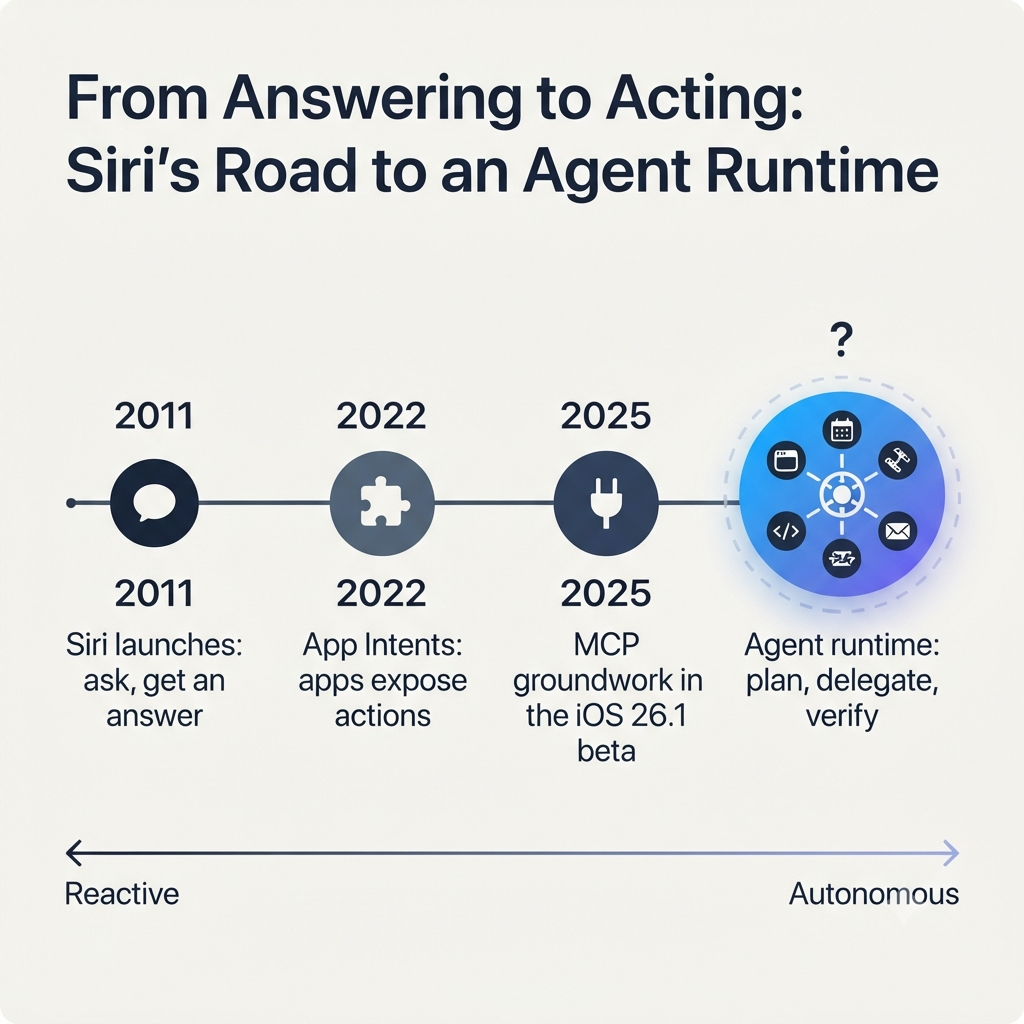
Siri has always been reactive. You ask, it responds. The emerging model works differently. An agent runtime can hold a goal over time, operate tools, manage state, recover from errors, and coordinate several workers at once.
Apple’s hiring language backs this up. One role describes “distributed frameworks for agentic orchestration” that coordinate autonomous, multi-step workflows across different kinds of services. Another describes an asynchronous engine that orchestrates thousands of parallel agent simulations and validation tests.
That’s why the framing matters. Apple may be building:
- A consumer assistant that feels effortless.
- A developer platform where apps expose actions to agents.
- An enterprise-grade runtime where complex workflows can run safely.
- A privacy-preserving execution layer that separates local control from cloud-scale intelligence.
The most important product might not be a new chat window at all. It might be the invisible layer that lets an agent safely use the whole Apple ecosystem.
A Practical Example: Rebooking a Trip
Here’s how a realistic workflow could go.
- User intent: “My Thursday meeting moved. Rebook my flight if the new option is under $800, update my hotel, and tell my team.”
- Master agent planning: The coordinator maps the dependencies: flight availability, fare rules, hotel policy, calendar access, and messaging permissions.
- Browser agent: Searches alternate flights and pulls out the options.
- Service agent: Checks fare rules, cancellation terms, and booking eligibility.
- Approval checkpoint: The system asks before spending money.
- App agent: Updates Calendar and Mail once you confirm.
- Messaging agent: Drafts a short team update for your review.
- Supervisor verification: The coordinator confirms that the booking, the calendar update, and the message draft all went through.
No single model has to be world-class at everything. The browser agent can specialize in navigation, the code agent in execution, the app agent in Apple-native interfaces. The coordinator’s specialty is judgment, sequencing, and oversight.
That division of labor is what “multi-agent” really means.
The Hard Problems Apple Must Solve
The vision is appealing, but agentic AI is hard exactly because it acts in the real world.
- Permissions: Users need precise control over what an agent can read, buy, send, delete, install, or run.
- Sandboxing: An agent working for a user must never become a route for malware, data theft, or destructive actions.
- Prompt injection: A malicious webpage, email, or app could try to trick an agent into doing something nobody intended.
- State consistency: If a sub-agent fails halfway, the system has to recover without double-buying or corrupting files.
- Verification: “The agent said it did it” isn’t good enough. Apple needs proof that the action really happened.
- Cost and latency: Running several agents gets expensive and slow unless Apple carefully manages model routing, caching, and on-device optimization.
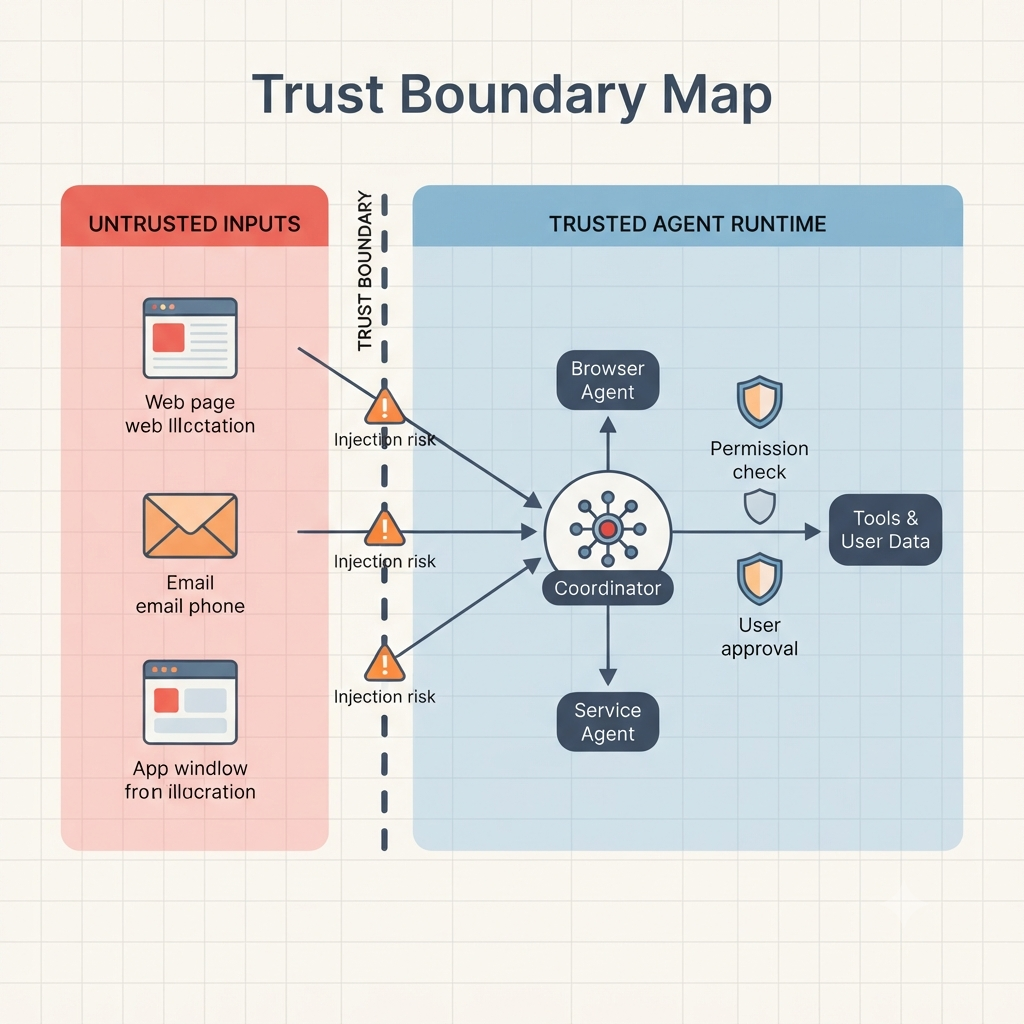
Apple’s job posts admit these risks openly. The senior agent role says agents that run code, use credentials, and act for a user need strong permission models, sandboxing, and transparency. The agent-development role asks for prompt-injection defenses, output-schema contracts, and sandboxed code execution.
Apple’s Potential Advantage
Apple may not win the AI race with the flashiest standalone chatbot. Its edge could be trusted integration.
Apple controls an ecosystem where an agent could work across Safari, Mail, Calendar, Files, Photos, Messages, and third-party apps. It also has hardware built for efficient local inference and a privacy architecture centered on on-device processing and Private Cloud Compute.
The opportunity is to make agents genuinely useful without making people feel watched. If Apple can deliver strong automation while keeping sensitive context local and giving users clear control, it could set the consumer standard for agentic AI.
The flip side is just as clear. An agent that can browse, buy, code, and message, but can’t be trusted, isn’t a productivity breakthrough. It’s a liability with a voice interface.
What to Watch Next
The best signals probably won’t arrive in a single announcement. Keep an eye out for:
- More Apple roles mentioning sub-agent coordination, delegation, hand-offs, and shared context.
- A visible permission model for agent actions in iOS, iPadOS, macOS, or visionOS.
- Developer APIs for app actions, tool registration, and agent hand-offs.
- Siri features that finish multi-step workflows instead of just answering questions.
- Clear documentation of what runs on-device versus on Private Cloud Compute.
- Security disclosures covering sandboxing, action logs, prompt-injection defenses, and user approval.
The Real Product
Apple may be quietly building less of a “super Siri” and more of a local agentic workforce: a coordinator that understands what you want, dispatches specialists, supervises their work, and hands back a finished result.
The job listings are the clearest public evidence of that ambition. Apple is describing agents that plan across apps, browsers, terminals, code, and APIs; coordinate specialized sub-agents; hold on to context; execute tools; and work under strict safety and privacy limits.
If Siri becomes the manager and specialized sub-agents become the workers, then Apple’s real product may no longer be an assistant.
It may be an operating system for getting things done.