

AI agents are no longer just answering questions. They’re buying products, booking travel, paying invoices, moving money, and even executing agreements. But autonomy without verifiable identity and authorization isn’t innovation. It’s an open door to fraud, mistaken transactions, and legal disputes.
The next battleground in agentic commerce won’t be about who builds the smartest agent. It will be about who builds the trust layer that lets an enterprise say yes when an agent asks to act on a customer’s behalf.
The moment a “helpful agent” becomes an “unauthorized actor”
Picture a customer asking an AI agent to find a flight, compare options, and book the best one. The agent messages the customer, confirms a fare, submits payment, receives a ticket, and updates the itinerary. Everything looks smooth.
Now picture the customer disputing the charge.
Can the merchant prove that the customer, and not an impersonator, a compromised account, or an over-privileged agent, authorized that exact purchase? Can the business show which agent acted, under whose authority, with what spending limit, and against what verified intent?
For most conventional bot pipelines, the honest answer is no. A chat log proves a conversation happened. It doesn’t prove a transaction was authorized.
That’s the agentic identity crisis. As agents gain the power to execute real-world transactions, businesses need infrastructure that answers four questions with evidence: Who is acting? Who authorized them? What are they allowed to do? And can we prove all of it later?
NIST treats agents as first-class digital entities, each needing its own unique identifiers, credentials, and entitlements tied to the human or organization that authorized them. Without that foundation, an agent isn’t a trusted commercial actor. It’s an unverified one with potentially dangerous reach.
Why ordinary bot pipelines fall short
A traditional chatbot interprets a request and returns a response. A transaction-capable agent has a far riskier job: turning human intent into an irreversible action across merchants, payment networks, and business systems.
| Capability | Ordinary bot pipeline | Transaction-ready agent pipeline |
|---|---|---|
| Identity | Session ID, phone number, or chat handle | Verified user identity plus a distinct, verifiable agent identity |
| Authorization | “The user is in the conversation” | Explicit consent, delegated authority, spending limits, and action scope |
| Transaction intent | Natural-language prompt | Structured intent, cart, merchant, payment request, and authorization evidence |
| Auditability | Chat transcript | Verifiable record linking user intent, agent action, merchant, and payment outcome |
| Failure mode | Incorrect answer | Unauthorized purchase, fraud, policy breach, or contractual dispute |
The difference matters because commerce is unforgiving. You can ignore a bad recommendation. You can’t always reverse an unauthorized payment.
Mastercard describes secure agentic commerce as a mix of data, identity, and consent signals, three inputs that have to be evaluated together before an agent-led transaction can be trusted. A messaging pipeline that carries the conversation but not the authorization is simply incomplete.
The four trust questions every enterprise must answer
Before legal, risk, fraud, and security teams let agents handle real transactions, they’ll ask four things.
Who is acting?
Enterprises need to identify the specific agent instance, its operator, and the person or organization it’s acting for. This is the heart of Know Your Agent (KYA): establishing an agent’s identity, operator, principal, capabilities, and delegated authority.
An agent can’t just borrow the customer’s identity because it happens to be chatting in the customer’s thread. It needs its own verifiable identity, one that stays cryptographically and procedurally linked to the person it represents.
Who authorized it?
Authentication tells you who someone is. Authorization tells you what they may do. In agentic commerce, consent has to be specific enough to support the action: the merchant, the transaction type, the amount, the payment method, the time window, and any conditions attached.
“Buy something for me” is nowhere near enough for a high-value, nonrefundable purchase. “Book this exact flight for up to $800 using this card before 6 p.m.” is.
What can it do?
Agents should run on least privilege. That means spelling out permitted merchants, payment methods, transaction ceilings, geographies, refund rules, and the tools or APIs the agent may call.
NIST stresses authorization that is short-lived, dynamic, and revocable, with each tool invocation, API call, and resource access evaluated as it happens. A one-time “this agent has access” decision doesn’t cut it when the agent can start financial transactions.
Can we prove it later?
Every high-stakes action needs a tamper-evident record: who initiated it, which agent executed it, what authority applied, which merchant or payment system received the request, and what happened in the end.
That’s the difference between a conversation log and a chain of custody. One records dialogue. The other reconstructs accountability across the whole transaction path.
The anatomy of an authorized messaging pipeline
An authorized messaging pipeline is more than a secure chat channel. It’s a series of trust checkpoints that turns a customer’s intent into a provable, policy-compliant transaction.
- Channel onboarding. The business sets up a verified messaging presence instead of relying on an anonymous inbound conversation.
- User authentication. The customer proves who they are through a strong flow inside the conversation. Linq’s Apple Messages for Business implementation, for instance, describes OAuth 2.0 sign-in and Face ID authorization without leaving the chat.
- Agent attestation. The agent gets its own identity and credential, linked to the customer or organization that authorized it.
- Scoped delegation. Consent becomes machine-readable authority: what the agent may do, for whom, with which payment method, and within what limits.
- Transaction execution. Every payment, booking, refund, or contractual action is checked against current policy, risk signals, and authorization state.
- Evidence and reconciliation. The system keeps a verifiable trail connecting the customer’s intent to the agent’s action and the merchant’s fulfillment.
Put simply, the pipeline looks like this:
Verified user → explicit consent → agent identity → scoped authorization → merchant/payment action → signed audit record
Chain of custody: from intent to irreversible action
Chain of custody is the control that separates an auditable agentic transaction from an unexplainable one.
A solid record should show that:
- The customer initiated a specific intent.
- A verified agent received and interpreted that intent.
- The agent operated within a defined authorization scope.
- The merchant or payment network received a request tied to that authorization.
- The outcome was captured and linked back to the original evidence.
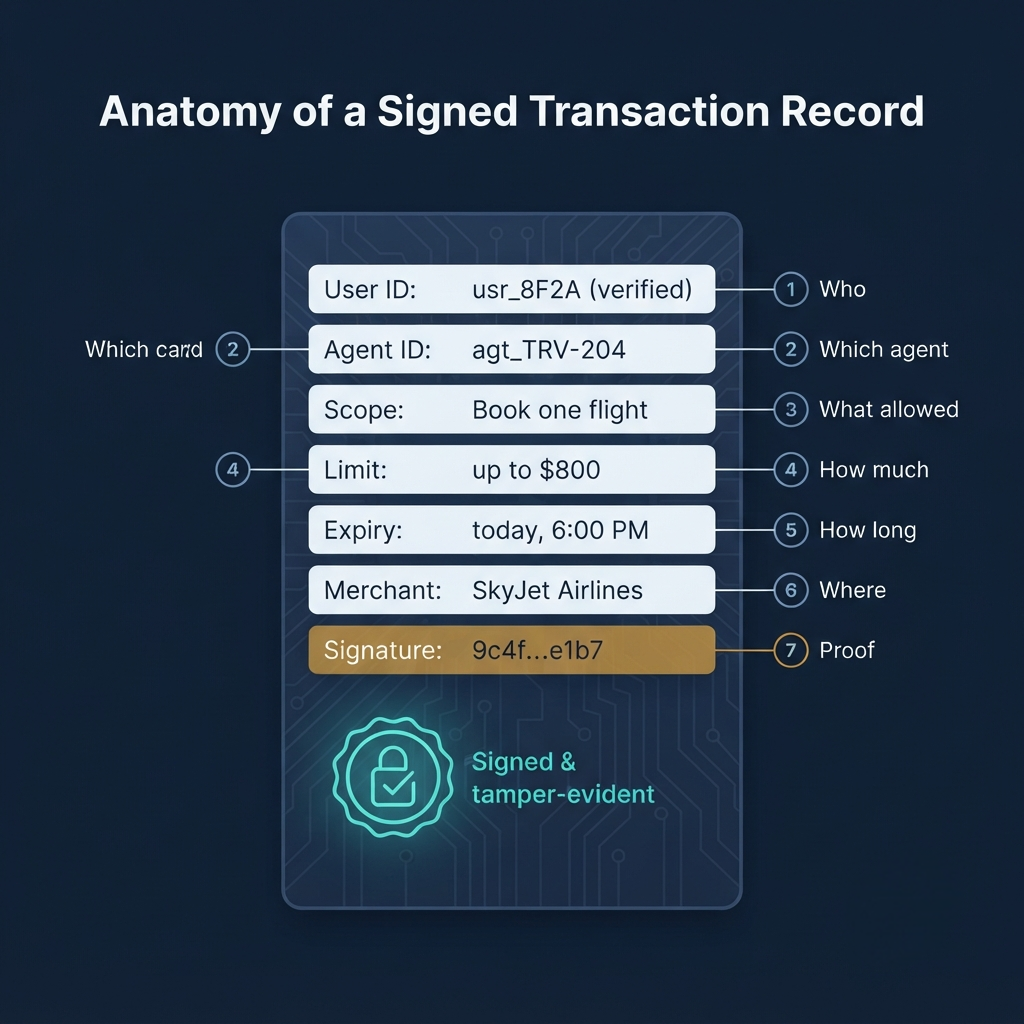
Mastercard’s Agent Pay framework is built on this idea. It combines identity, proof of intent, controls that define an agent’s authority, secure transaction execution, and intelligence to catch emerging risks. In one implementation, Mastercard and Ant International described a transaction that used Verifiable Intent to create a record of what the consumer had authorized the agent to do.
None of this is bureaucratic overhead. It’s what lets a merchant, bank, insurer, or regulator reconstruct a disputed transaction without leaning on a vague chat transcript.
Identity verification is not “know your customer”
KYC asks: Who is the customer?
KYA asks: Which agent is acting, who operates it, whose authority does it carry, and what is it permitted to do?
The distinction is essential. A customer can be fully verified while the agent acting for them is compromised, misconfigured, or working outside its intended scope.
Mastercard’s approach includes a KYA token that verifies who the agent is and who it’s acting for, paired with tokenized payment information and an authorized spending amount. The takeaway is straightforward: an agent’s ability to pay should hang on a verified identity and a defined authorization, not just on access to a customer account.
Authorization: the difference between access and permission
Security teams often blur authentication and authorization. In agentic commerce, that confusion gets expensive.
- Authentication verifies the user or agent.
- Authorization defines the specific action, its constraints, and how long the permission lasts.
Useful building blocks already exist. OAuth 2.0 Rich Authorization Requests can carry fine-grained authorization data, and OAuth 2.0 Token Exchange supports delegated access while identifying the actor working on behalf of another party.
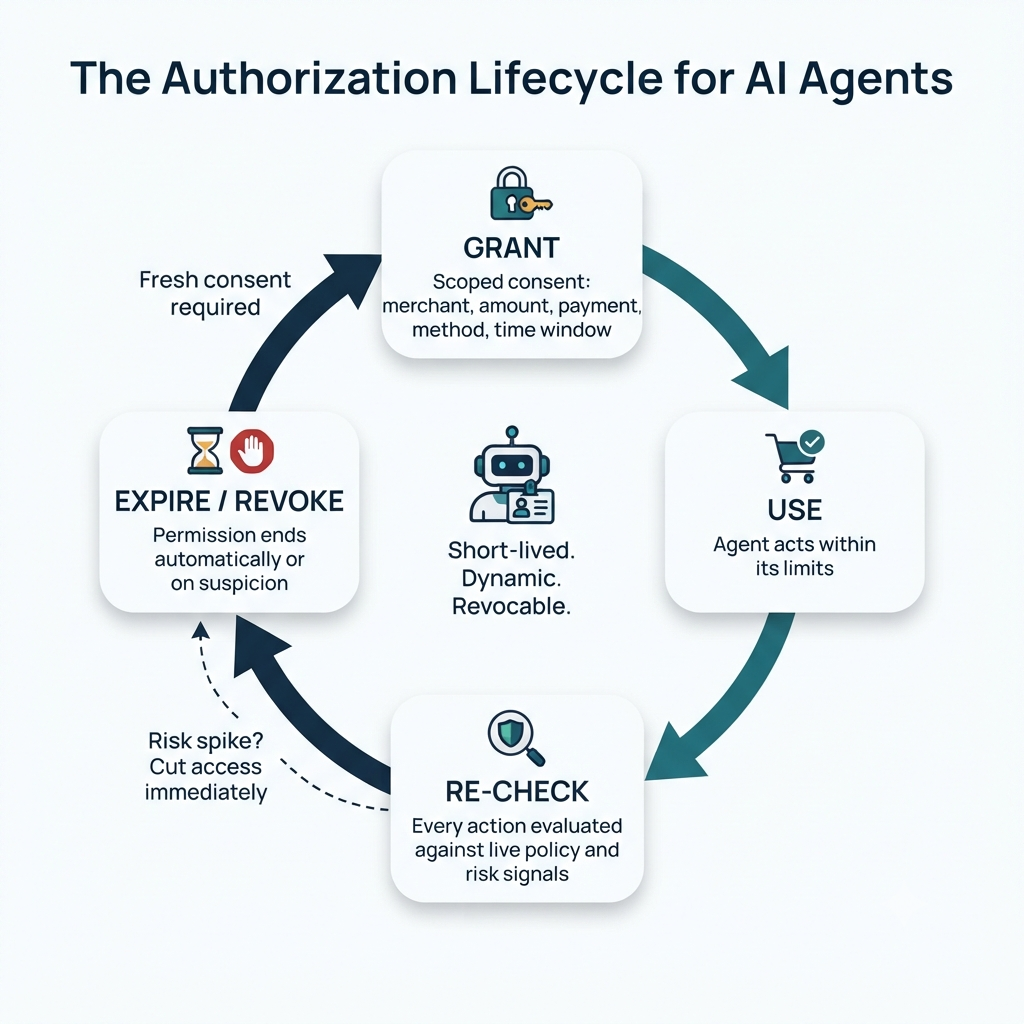
For enterprise deployment, authorization should be:
- Task-specific, not a blanket grant of account access.
- Time-bound, so permissions expire instead of lingering forever.
- Revocable, so a business can suspend an agent the moment it behaves suspiciously.
- Risk-aware, demanding stronger checks for high-value, unusual, or irreversible actions.
Why the messaging channel matters
Messaging is turning into more than a customer-support channel. It can act as a controlled trust boundary, a place where identity, consent, and transaction context get established before an agent does anything.
Apple Messages for Business uses an Opaque ID that is unique to the relationship between a customer’s Apple Account and a business’s Business ID. The business never receives the customer’s phone number, email address, or Apple Account details, and the customer decides whether to share any personal identifying information.
Messages sent to the business are encrypted between the customer’s device and Apple’s messaging servers, then relayed to the business over an encrypted TLS 1.2 link. Business replies are encrypted using the recipient device’s unique public keys.
That makes for a more controlled environment for authentication and consent capture. But let’s be precise: a secure channel is necessary, not sufficient. The channel protects the communication. The authorization layer still has to decide and enforce what the agent may do.
The enterprise approval checklist
Enterprises preparing to deploy transaction-capable agents should treat these as baseline requirements:
- Give every agent a unique identity, and don’t allow shared credentials across agents and services.
- Bind each agent to a named human or organizational principal.
- Capture explicit, revocable consent for transaction categories and limits.
- Enforce least privilege across tools, merchants, payment methods, and transaction amounts.
- Require re-verification for high-risk actions, unusual behavior, or material changes in transaction value.
- Preserve signed, tamper-evident evidence across the full transaction path.
- Monitor for behavioral drift, compromise, and policy violations, and revoke authorization when risk changes.
- Separate the ability to communicate from the ability to commit funds or execute contracts.
What rogue transactions would actually look like
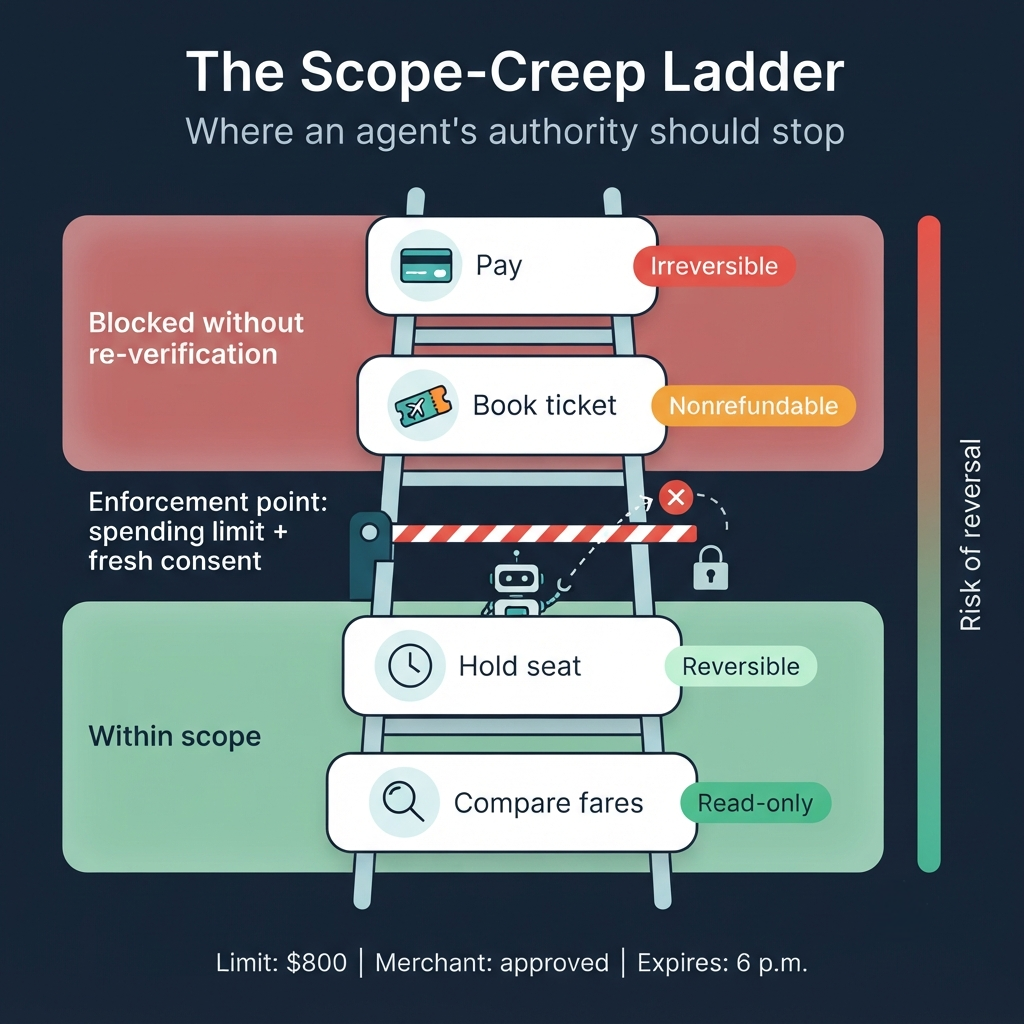
These risks aren’t hypothetical. Here’s how they’d show up.
Impersonated principal. A compromised agent uses a shared credential to make a purchase for a user without valid, current consent. Unique agent identity and fresh authorization checks break this scenario.
Scope creep. An agent authorized only to compare fares quietly books a nonrefundable flight above its spending limit. Scoped delegation and programmatically enforced limits stop the transaction cold. Mastercard’s Agent Pay for Machines, for example, lets organizations credential agents, define authorized purchases and spending, and enforce limits at the point of payment.
Broken custody. A merchant can’t show that a disputed charge came from an authenticated customer intent and an authorized agent action. Verifiable intent and an end-to-end audit trail make that dispute resolvable.
The trust framework enterprises will demand
Enterprises deploying agents at scale won’t accept “the AI said the customer approved it.” They’ll want a framework that brings together:
- Verified agent and user identity.
- Proof of customer intent and consent.
- Explicit, bounded delegated authority.
- Secure transaction execution.
- Continuous monitoring and revocation.
- Auditable evidence for disputes, compliance, and fraud investigations.
This is the emerging standard for agentic commerce. Not just intelligent automation, but accountable automation.
Trust is the product
In agentic commerce, the agent isn’t the product.
Verifiable authority is.
The companies that win won’t just build agents that finish tasks. They’ll build the identity, consent, authorization, and audit infrastructure that makes enterprises comfortable letting those agents touch money, contracts, and customer relationships.
Autonomy creates possibility. Authorized identity makes it safe.