
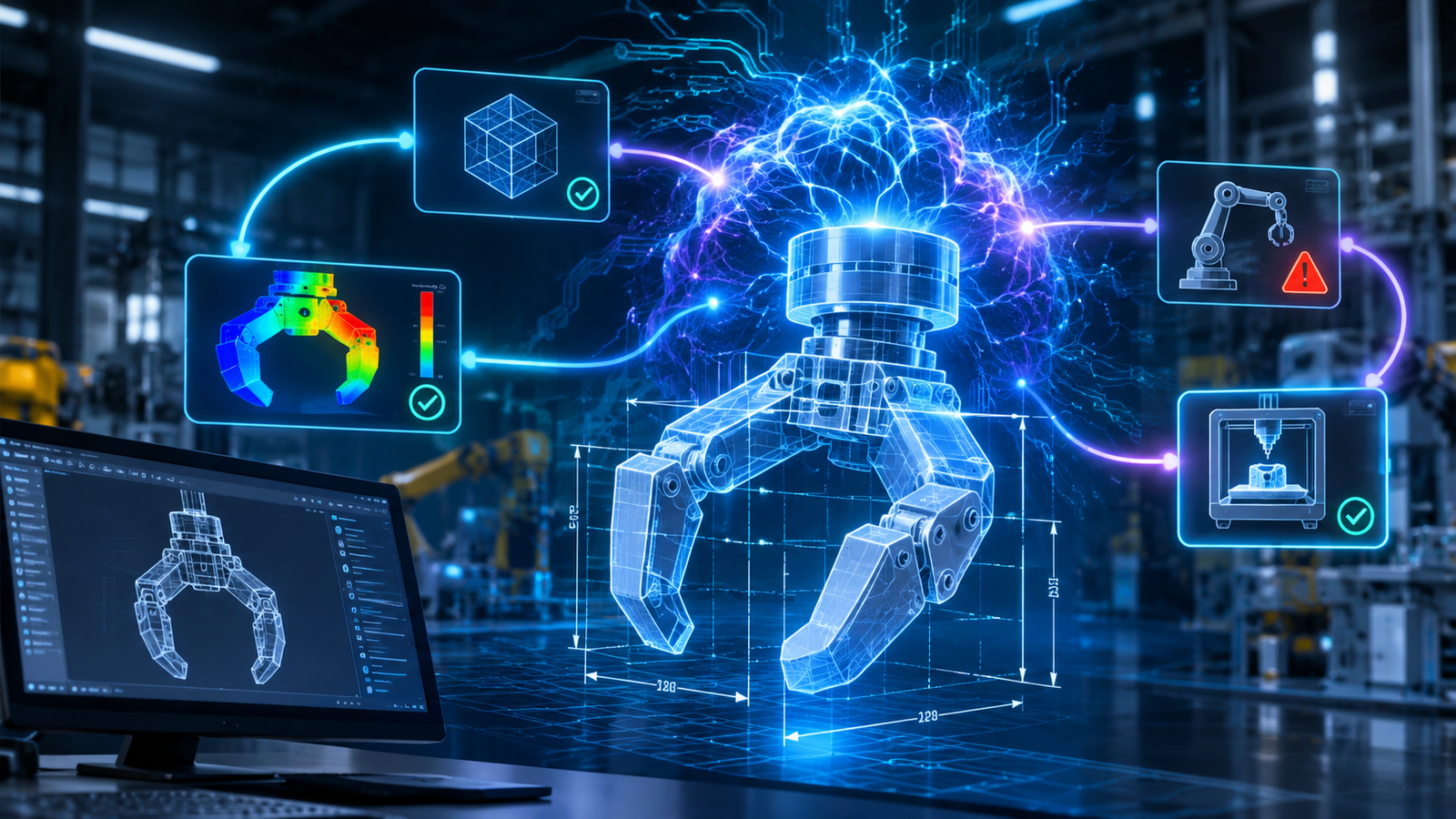
The most interesting part of Siemens’ new agentic AI demonstration isn’t that someone can describe a robotic gripper and get a 3D-printable design back. It’s everything that happens in the middle. An AI agent calls functions in engineering software, changes CAD geometry, runs a simulation, checks the robot interface, and gets the part ready for additive manufacturing. That moves AI from being something you talk to toward something that works inside industrial software on your behalf.
Siemens, working with AGIBOT, EOS, and AM Solutions, uses a humanoid-robot gripper to show how the Model Context Protocol (MCP) can link agentic AI to a full digital thread, from adapting the design, through virtual validation, to preparing for manufacture.
The interface is changing again
For the last few years, most people have met generative AI through a chat window. You type a request, the model gives you text, code, an image, or a suggestion, and then a human does the actual work in specialized software.
Siemens’ demo points to something different. Instead of asking an AI to describe a gripper, the user explains the object to be handled and the job the gripper has to do. The agent then runs the engineering workflow needed to produce a task-specific, additively manufactured part.
The difference matters. A chatbot can write a believable design brief. An MCP-connected agent can step into the engineering environment, call the right functions, put the work in order, and pass the result along to the next stage.
Why “prompt-to-part” misses the point
It’s tempting to call this “prompt-to-3D-print.” The headline is easy to grasp: describe a gripper, eventually hold one.
But that label undersells what’s new architecturally. The notable thing isn’t that AI can produce a shape. It’s that AI can coordinate a chain of specialized engineering actions across different software systems.
In Siemens’ workflow, the agent does the following:
- Picks a suitable gripper type.
- Adapts the geometry in Siemens Designcenter.
- Simulates the design.
- Validates the robot interface and how it handles the object.
- Prepares the data for additive manufacturing.
Each step leans on the one before it. The agent isn’t handing back a static answer. It’s running a process where design choices, simulation results, validation checks, and manufacturing readiness all feed into each other.
MCP, explained for engineers
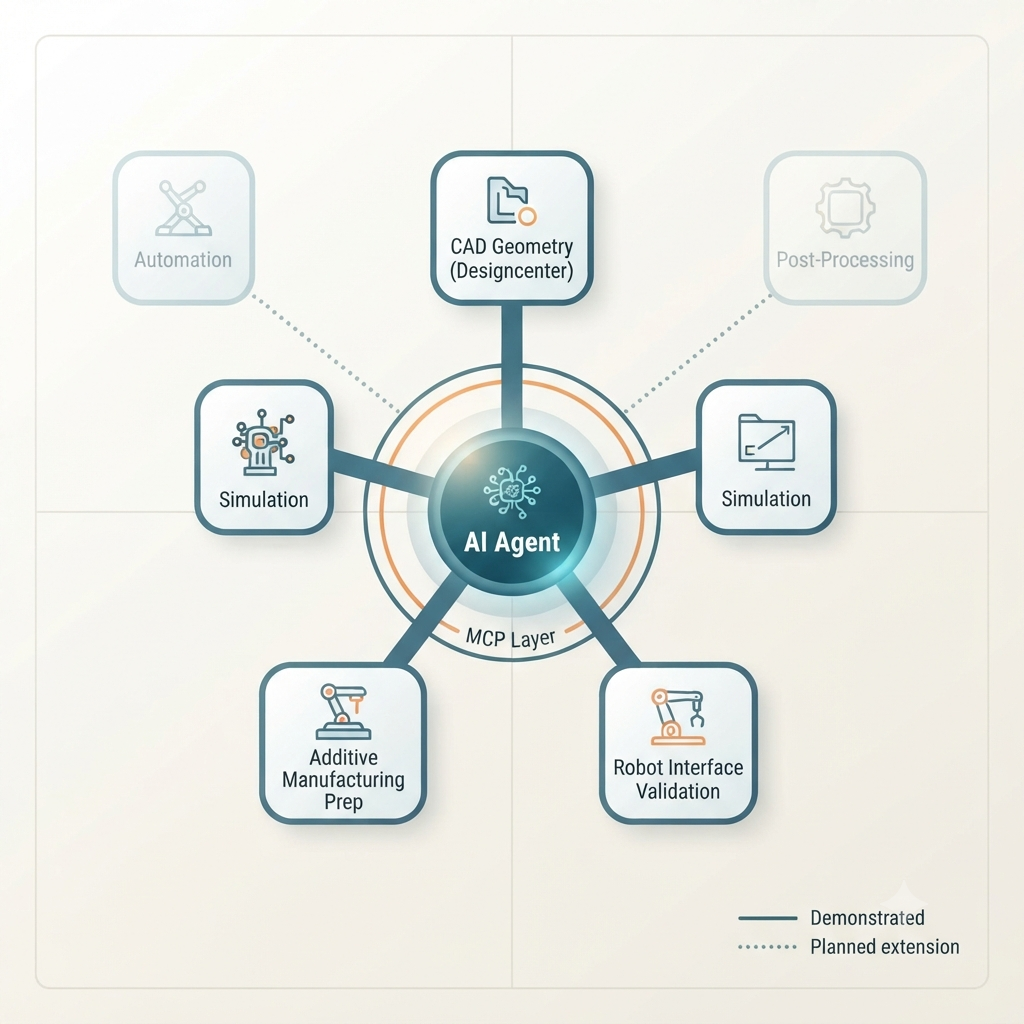
MCP is the connective tissue here. Through the integration, Siemens says its agent can reach functions of the engineering software and orchestrate the work steps required.
A handy way to think about MCP is as a controlled bridge between an AI agent and professional tools. Rather than treating CAD, simulation, validation, and manufacturing prep as separate islands, MCP lets the agent use their capabilities as part of one larger process.
That doesn’t mean the agent replaces the CAD kernel, the simulation solver, or the engineering rules built into those systems. It means the agent can run them in sequence.
| AI interaction model | What the user gets | What the system does |
|---|---|---|
| Prompting | A recommendation, description, or generated asset | Produces content based on a prompt |
| Tool-calling | An executed workflow and usable engineering output | Calls software functions and coordinates steps |
| MCP-enabled agentic workflow | A validated, production-ready digital thread | Orchestrates CAD, simulation, validation, and manufacturing preparation |
The phrase to remember is tool-calling over prompting. An agent’s value isn’t limited to what it can say. It’s defined by what it can reliably do across connected systems.
Inside Siemens’ agentic workflow
The example starts with a practical problem. A humanoid robot needs a gripper for a particular object and task. Traditionally, engineers adapt the gripper by hand for every new use case.
In the demonstration, the user states the object and the task, and the agentic system takes over the engineering sequence.
1. Understand the task
Everything begins with intent. What is being picked up, and what does the gripper need to do with it? This turns a plain-language requirement into an engineering problem.
2. Select the gripper type
Instead of opening a blank CAD file, the agent chooses a suitable gripper type. That’s a real design decision, since the form, the gripping strategy, and the mechanical constraints all depend on the application.
3. Modify geometry in Designcenter
Next the agent adapts the geometry inside Siemens Designcenter. This is where the demo goes beyond content generation. The AI is working within a professional design environment, not just proposing a concept.
4. Simulate and validate
The adapted design is simulated, and the workflow checks the robot interface and the handling. That creates a feedback loop. A gripper isn’t finished because it looks plausible. It has to perform in the context of the robot and the object it’s holding.
5. Prepare for additive manufacturing
Last, the workflow gets the design data ready for additive manufacturing. The outcome is a gripper tailored to its application, virtually validated, and ready for production before any manufacturing starts.
The real shift: workflow orchestration
The deeper story is the move from single-tool AI to workflow orchestration.
In a conventional AI-assisted design process, a model might help brainstorm concepts, write a script, or summarize requirements. The engineer still hops by hand between CAD, simulation, validation, and manufacturing tools.
In Siemens’ setup, the agent becomes the coordination layer. It reaches engineering-software functions through MCP and carries out the required steps in order.
That changes what the engineer does. Rather than operating every interface and process step personally, the engineer can concentrate on defining requirements, reviewing the critical decisions, handling exceptions, and staying responsible for safety and final release.
Siemens frames this as a move away from manual design toward prompt-based engineering, where agentic workflows orchestrate engineering tasks based on specific requirements.
Why industrial CAD is a hard test
CAD is far more demanding than a creative canvas or a text editor.
A robotic gripper has to satisfy several constraints at once:
- It must grip the intended object reliably.
- Its geometry must be manufacturable with additive manufacturing.
- It must withstand the physical demands of the task.
- It must connect correctly to the robot interface.
- It must handle the object in a way that fits the wider robotic workflow.
That’s why this demo carries more weight than a typical AI design showcase. The agent isn’t working somewhere low-stakes where a mistake just gives you a strange picture. It’s in a domain where design decisions can affect physical production, robot performance, and everything downstream in manufacturing.
What this means for engineering teams
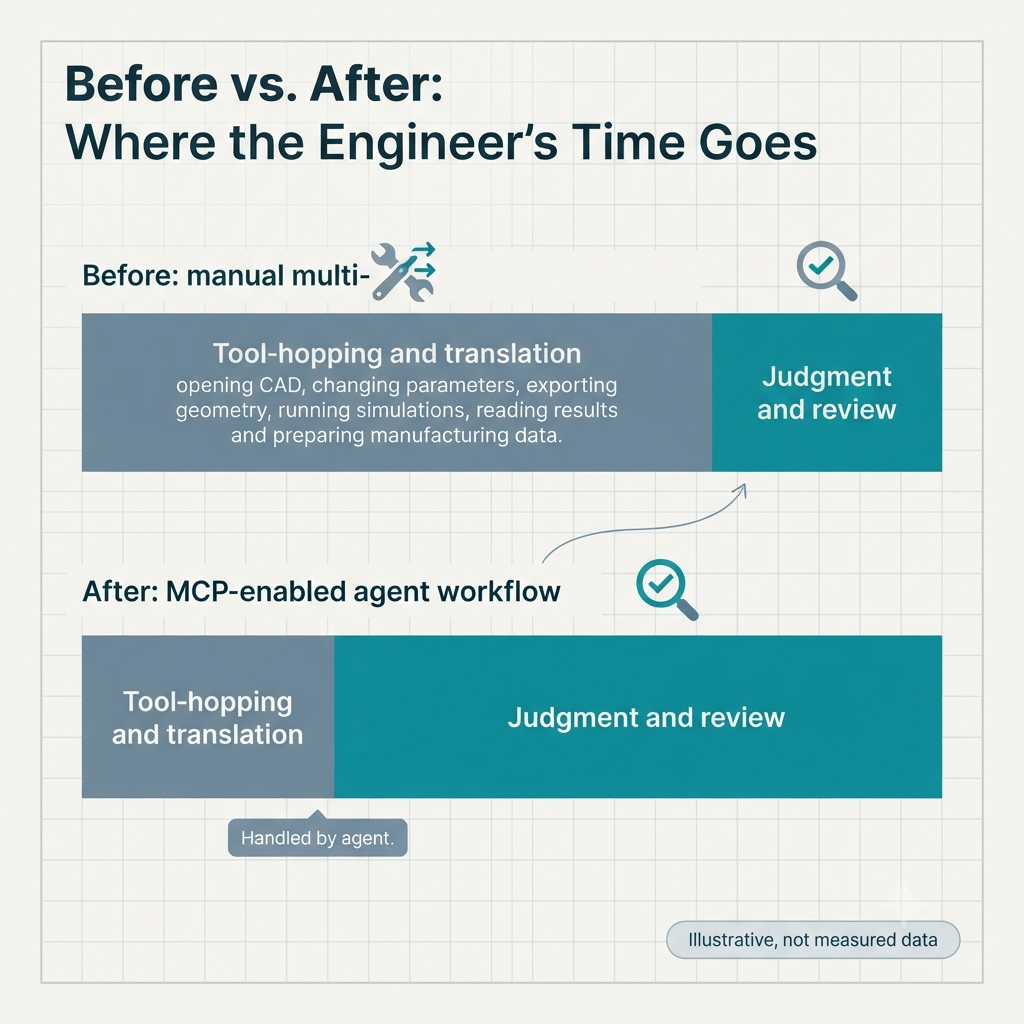
For engineering organizations, the near-term opportunity isn’t to replace the engineer. It’s to cut the coordination tax.
Engineers often lose time not because they lack expertise, but because they have to translate intent into tool-specific actions by hand: open the CAD system, change parameters, export geometry, run a simulation, read the results, revise the model, validate interfaces, and prepare manufacturing data.
An MCP-enabled agent can shrink that loop. Siemens says the approach can open complex engineering workflows to a wider group of users, since they no longer need to work directly in every individual tool and process step.
The likely operating model looks like this:
- Humans define intent, constraints, acceptance criteria, and risk boundaries.
- Agents run repeatable, tool-driven workflows.
- Engineers review exceptions, validate critical outcomes, and approve release.
- Connected systems keep traceability across design, simulation, production, and operations.
Why MCP matters for industrial software
MCP matters strategically because it turns specialized software into a set of callable capabilities.
For Siemens, that means Designcenter is no longer just a CAD application a human designer sits in front of. It becomes part of an environment an agent can reach. The same logic can stretch across the industrial stack: design, simulation, manufacturing preparation, automation, production, and post-processing.
This also changes the competitive question. It’s no longer only “Which company has the best AI model?” It becomes “Which company has the most useful, trustworthy, and well-connected ecosystem of industrial tools for an agent to operate?”
The limits and open questions
None of this is a story about fully autonomous engineering. Siemens itself names quality, traceability, security, and human responsibility as requirements for industrial deployment.
Several questions will decide whether the approach scales:
- How are design constraints, tolerances, materials, and safety margins encoded?
- What happens when a simulation exposes a failure or an invalid interface?
- Which decisions need human approval before production?
- How does the system stop incorrect tool calls, invalid geometry, or unsafe designs?
- How is every agent action recorded for auditability and traceability?
The answer won’t be “let the agent decide everything.” It will be a governed workflow: agents execute, systems validate, and humans stay accountable for high-consequence decisions.
From adaptive engineering to adaptive production
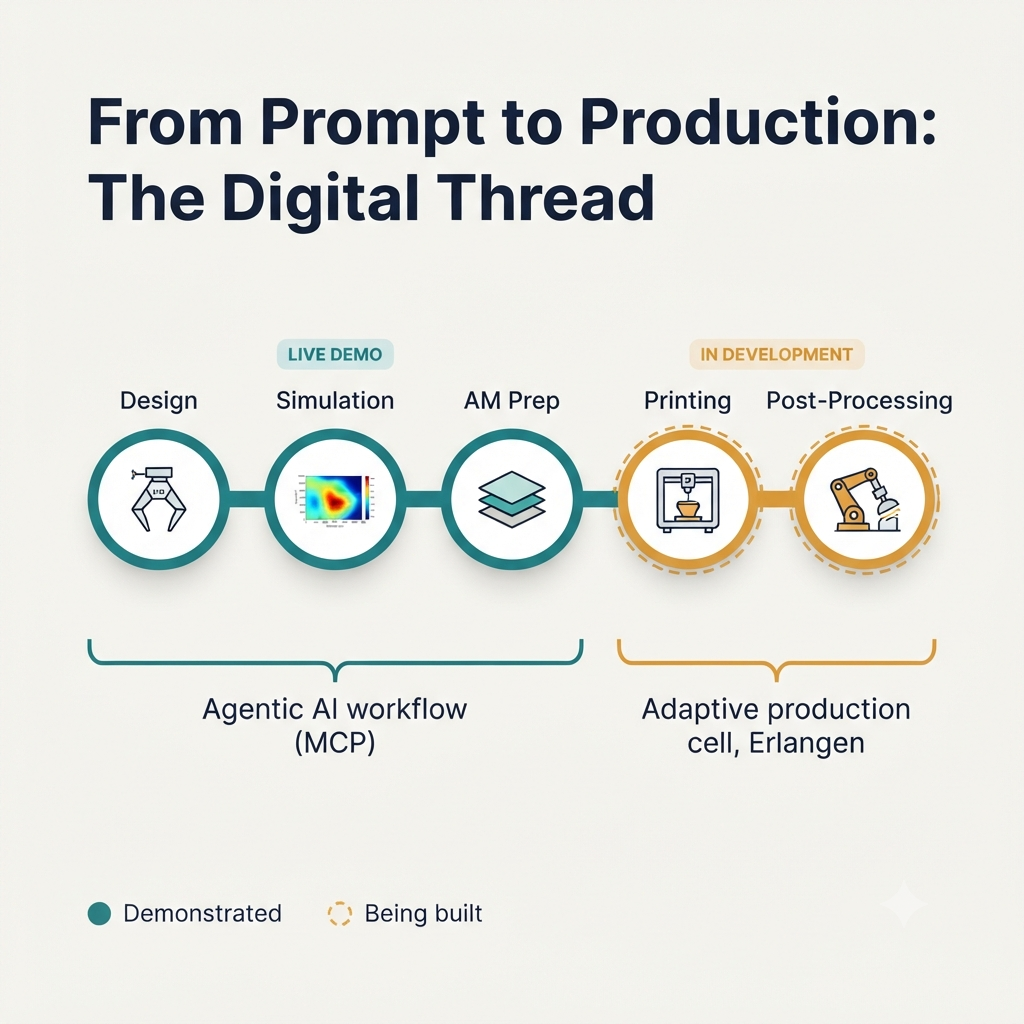
Siemens is taking the idea past engineering, too. Together with EOS and AM Solutions, it’s building an adaptive production cell at its Electronics Factory in Erlangen. The cell combines additive manufacturing, automation, post-processing, and software in one integrated process chain.
That matters because growing product variety puts pressure on everything downstream. A system that can quickly adapt a design has to be paired with production processes that can flexibly handle different components and different process requirements.
Siemens describes this as the next stage of Industry 4.0, moving from connected, automated factories to intelligent, adaptive manufacturing.
The bigger implication
The gripper demo is a narrow, concrete use case. But it points at a much larger direction.
AI is shifting from a system that answers questions to a system that operates software. In industrial settings, that means agents may increasingly sit between human intent and the specialized tools that turn intent into physical products.
The chatbot era asked AI what it knew. The MCP era asks what it can operate.
And Siemens’ demonstration suggests that, in engineering, the most valuable agents won’t be the ones that write the most impressive text or generate the flashiest images. They’ll be the ones that can reliably orchestrate CAD, simulation, validation, and manufacturing, while keeping humans in command of the decisions that matter.