

The priciest part of an autonomous agent might not be the model call. It might be the computer you keep warm while the agent waits around.
In a demo, an AI agent looks busy. It opens a terminal, edits files, runs tests, reads docs, calls tools. In production, most of its life looks different. It’s waiting on a model response, a tool result, a human approval, a scheduled event, or a background job. Google says agents spend most of their lifecycle waiting, and only a small share of open sessions are running code at any given moment.
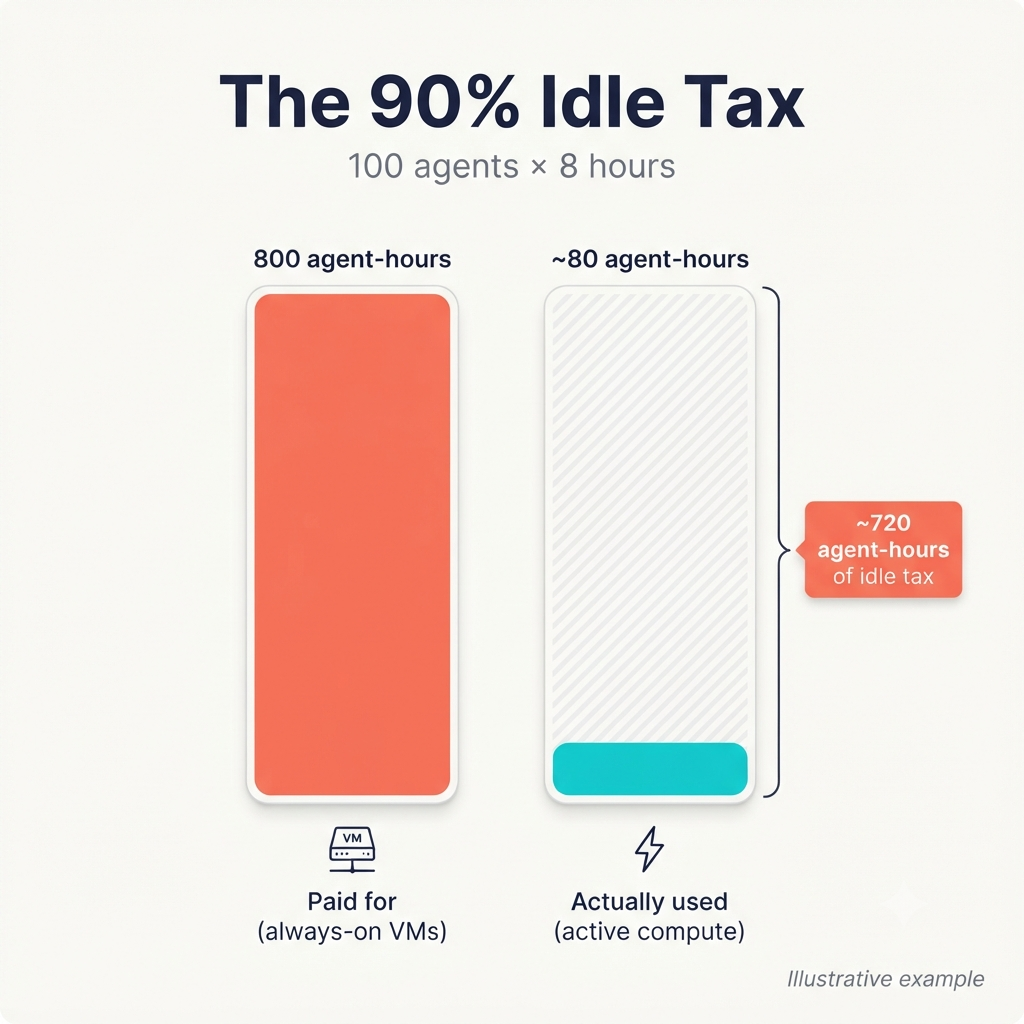
That creates a new infrastructure problem, which I’ll call the 90% idle tax. If every agent gets its own always-on virtual machine, you pay for CPU, memory, isolation, and storage even while the agent does nothing useful. Google Cloud’s Agent Compute Engine (ACE) goes after that cost with a different deal for digital labor: freeze idle agents, share their common memory, restore them in under a second, and push non-urgent work into spare capacity.
The Hidden Cost of Agent Swarms
Traditional cloud infrastructure was built for workloads that either run continuously or can be restarted from scratch. Agents are neither.
A coding agent, research agent, or enterprise workflow agent needs a real execution environment: a filesystem, a language runtime, dependencies, a browser, shell access, network tools. It also needs state. The modified repo, installed packages, test artifacts, browser session, and in-memory context should all survive between turns, sometimes across hours or days.
Usage is also bursty and there’s a lot of it. One user might pause an agent while they review a proposed change. A platform might run thousands of evaluation agents in parallel. An enterprise might roll out fleets of agents across teams, each needing isolated compute and a persistent workspace.
| Traditional always-on VM | Agent-native microVM |
|---|---|
| Provisions CPU and memory for the full session | Releases active host resources when the agent is idle |
| Restarts or rebuilds state after teardown | Preserves memory and files across suspend and resume |
| Duplicates OS, libraries, and runtime memory per instance | Shares static memory pages across agents |
| Optimized for steady workloads | Optimized for start, pause, resume, fork, and rollback |
| Scales by adding more always-on machines | Scales by increasing active density and reusing idle capacity |
The result is a financial mismatch. An agent may be “open” for eight hours but actively compute for a few minutes. Under the conventional model, you still pay for the other seven hours and change.
Idle Is Not Done
The first mistake is treating an idle agent as a finished one.
An agent can be idle because it’s waiting on a model, a human, an external API, a test suite, or a future trigger. Tear it down and you save compute but lose the working state. Keep it alive and you keep the state but burn resources.
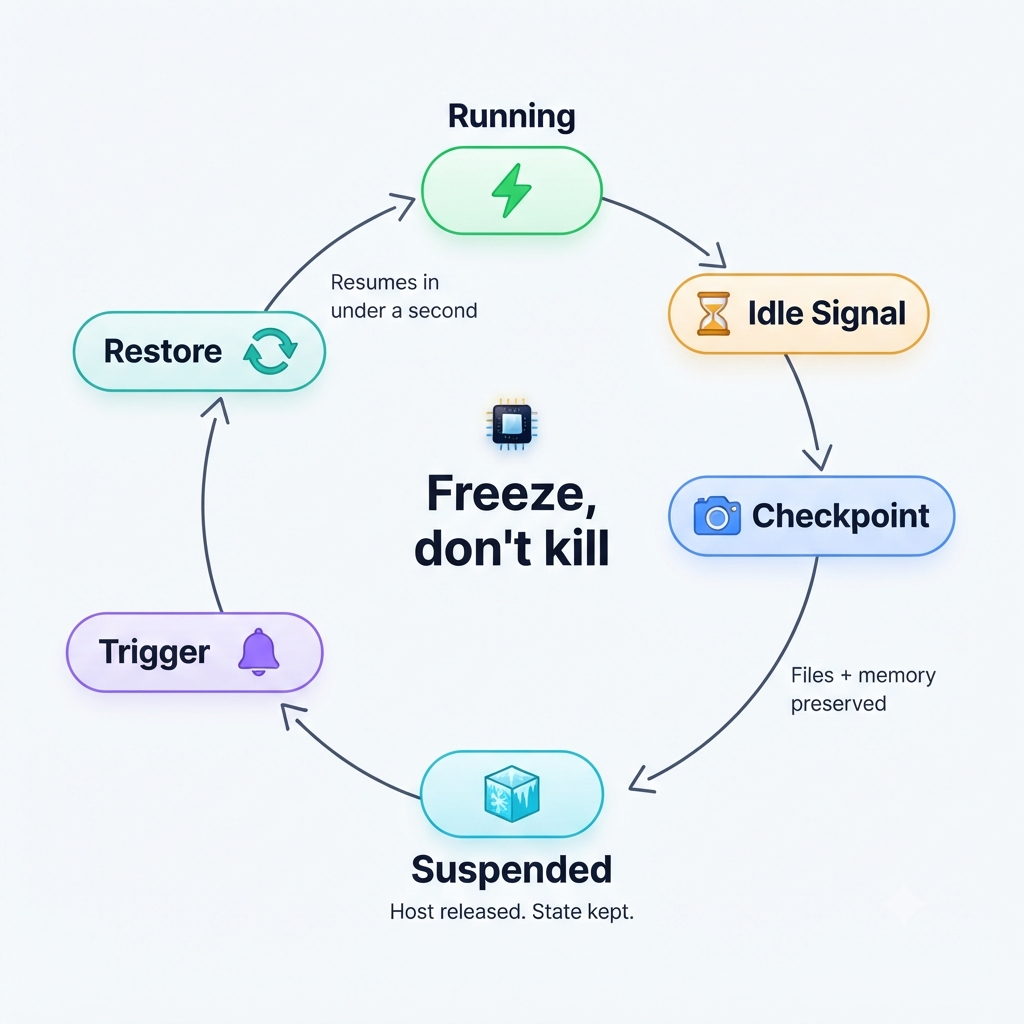
ACE’s answer is application-aware idle detection. When an agent finishes a tool call and moves into its “thinking” phase, the sandbox can signal that no commands or background tasks are still running. At that point, the platform doesn’t need to keep a full microVM sitting on a host.
This matters because “idle” isn’t just a low CPU number. The platform has to understand the agent loop. Is the agent waiting on a tool? Is a process still running? Is there unsaved state? Is the next action time-sensitive?
Without that awareness, infrastructure teams get a bad choice: overprovision and waste money, or reclaim resources aggressively and break long-running work.
Instant Snapshotting: Freeze, Don’t Kill
The core mechanism in ACE is fast checkpoint-and-restore.
When an agent goes idle, ACE checkpoints the microVM and releases its active host resources. The execution state and files stay preserved. When the next tool call, user message, or scheduled event shows up, the platform restores the agent from its snapshot and picks up exactly where it left off.
Google describes idle sessions as scaling down to “near-zero active compute” while keeping files and memory across turns and days. The agent isn’t deleted. It’s frozen.
Picture an efficient office:
Instead of leaving every employee’s desk, computer, and open applications running overnight, the platform saves the exact working state, vacates the office, and restores the desk instantly when work resumes.
The economics follow. You no longer need one permanently resident machine per agent. You need enough active capacity for the agents that are actually executing, plus fast restoration for everyone else.
Google’s related Agent Substrate architecture reports sub-500-millisecond resumes and more than 500 suspend/resume activations per second in benchmarks, while sustaining 200,000 agents.
Memory Deduplication: One Runtime, Thousands of Agents
Snapshotting fixes the idle problem. Memory deduplication fixes the density problem.
Lots of agents share the same foundation: a base OS image, a Python or Node runtime, browser binaries, common libraries, and other static content. In a conventional fleet, each agent may carry its own in-memory copy of all of it.
ACE uses pre-warmed snapshot images, Direct Access (DAX), and copy-on-write (CoW) memory clones. Static pages are shared in physical RAM, and each agent only pays for the pages it changes.
The split looks like this:
- Shared: Base image, OS components, libraries, binaries, and initialized runtime elements.
- Private: Agent-specific files, modified memory pages, browser state, workspace artifacts, and execution deltas.
- Reclaimed: Freed memory returns to the host pool through active reclaim and compression.
So the fixed cost of a runtime environment becomes mostly a shared cost, and per-agent isolation stays intact. A thousand agents can start from the same prepared environment, yet each can modify files, install packages, run tests, and drift off on its own.
It’s the difference between renting a thousand identical offices and giving each worker a private desk in a shared building.
Fork, Rewind, Roll Back
The machinery that makes an agent cheap to pause also makes it cheap to experiment with.
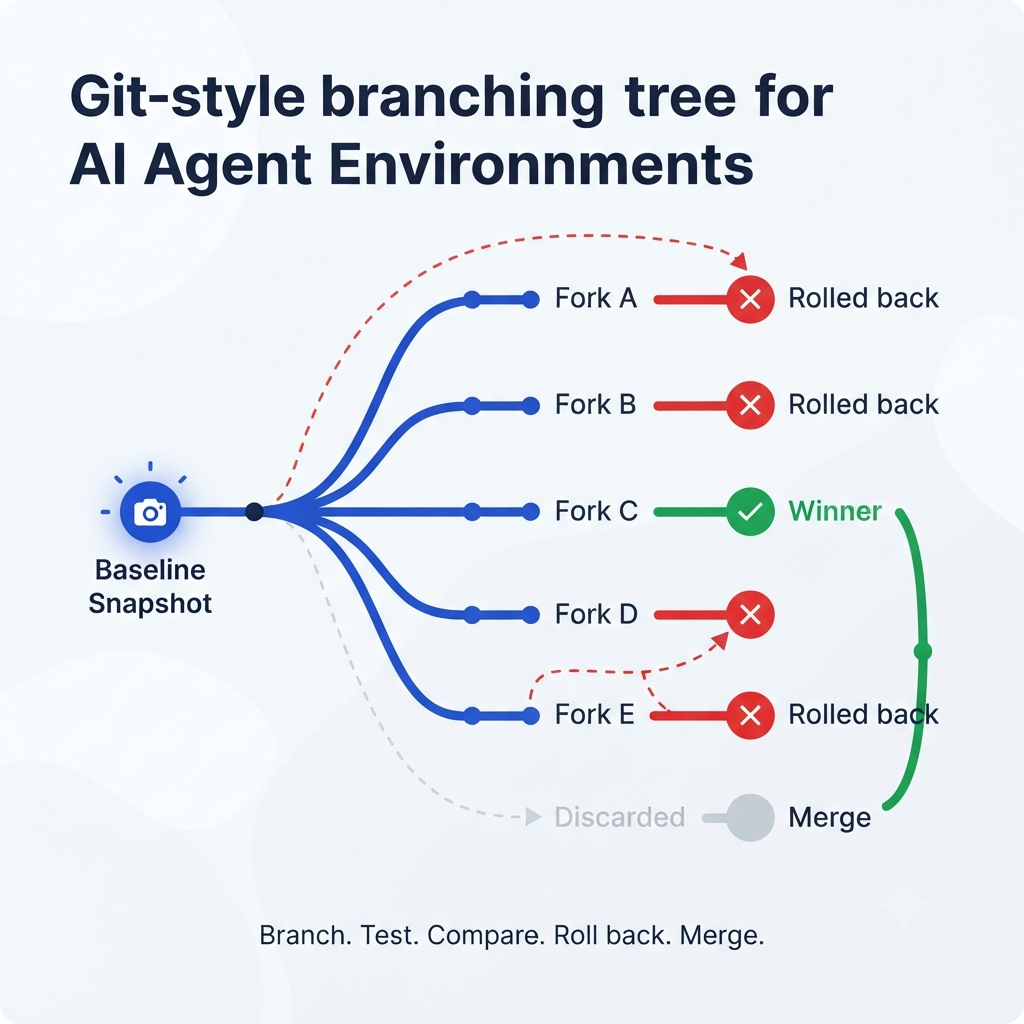
ACE supports cloning, snapshot/forking, rewind, and rollback. A team can set up an environment once, snapshot it, and fork it into many parallel copies for evaluation, testing, reinforcement learning, or coding experiments.
Say a coding platform snapshots a repo environment with dependencies installed. It forks that into 500 parallel agents, each trying a different refactor strategy. Every agent changes only its own files and memory delta, and they all share the common baseline.
If an experiment fails, the platform rewinds or rolls back instead of rebuilding from zero. Google positions this explicitly as a way for agent harnesses to use compute efficiently without duplicating resources.
It shifts agent operations from “run a task and hope it works” toward ordinary good software practice: branch, test, compare, roll back, merge.
Deferred Scheduling: Filling the Capacity Valleys
Instant resume handles latency. Deferred scheduling handles utilization.
Not every agent task has to run right now. Daily digests, deep research, async migrations, overnight test sweeps, evaluation runs, and reinforcement-learning workloads can often wait.
ACE’s global scheduler watches capacity, health, and image readiness, then routes work while respecting geography, compliance, and data-location constraints. Time-flexible work fills the troughs between interactive peaks, which shrinks the peak hardware footprint the business needs.
Interactive agent demand
      ▲
      │      ████              ████
      │  ████    ████       ████    ████
      │██          ██████████          ███
      └────────────────────────────────────▶ time

Deferred / batch agent work
      ▲
      │  ████████████████████████████████
      │ fills valleys, yields during peaks
      └────────────────────────────────────▶ time
Interactive work gets low latency. Deferred work gets a lower marginal cost and steps aside when interactive demand spikes.
Electricity grids, airlines, and cloud spot capacity all work on the same principle: separate the work that must happen now from the work that can happen later.
The Fleet Economics Equation
Here’s a handy way to evaluate agent infrastructure:
Effective agent capacity = (Active execution capacity ÷ Per-agent active resource footprint) × Idle-state compression × Schedule utilization
Each term matters:
- Active execution capacity: How much useful work a host can do.
- Per-agent active footprint: CPU, memory, and I/O used only while the agent is working.
- Idle-state compression: How completely an idle agent’s active resources get released.
- Schedule utilization: How well non-urgent work fills otherwise unused capacity.
ACE improves the second, third, and fourth terms through checkpoint/restore, memory sharing, and deferred scheduling.
The big shift is in what you measure. Counting “number of VMs” or “concurrent sessions” isn’t enough anymore. Track active agent-minutes, suspended-agent density, restore latency, fork efficiency, and capacity-valley utilization.
What Platform Teams Should Do
If you’re building agent products, the takeaways are fairly practical.
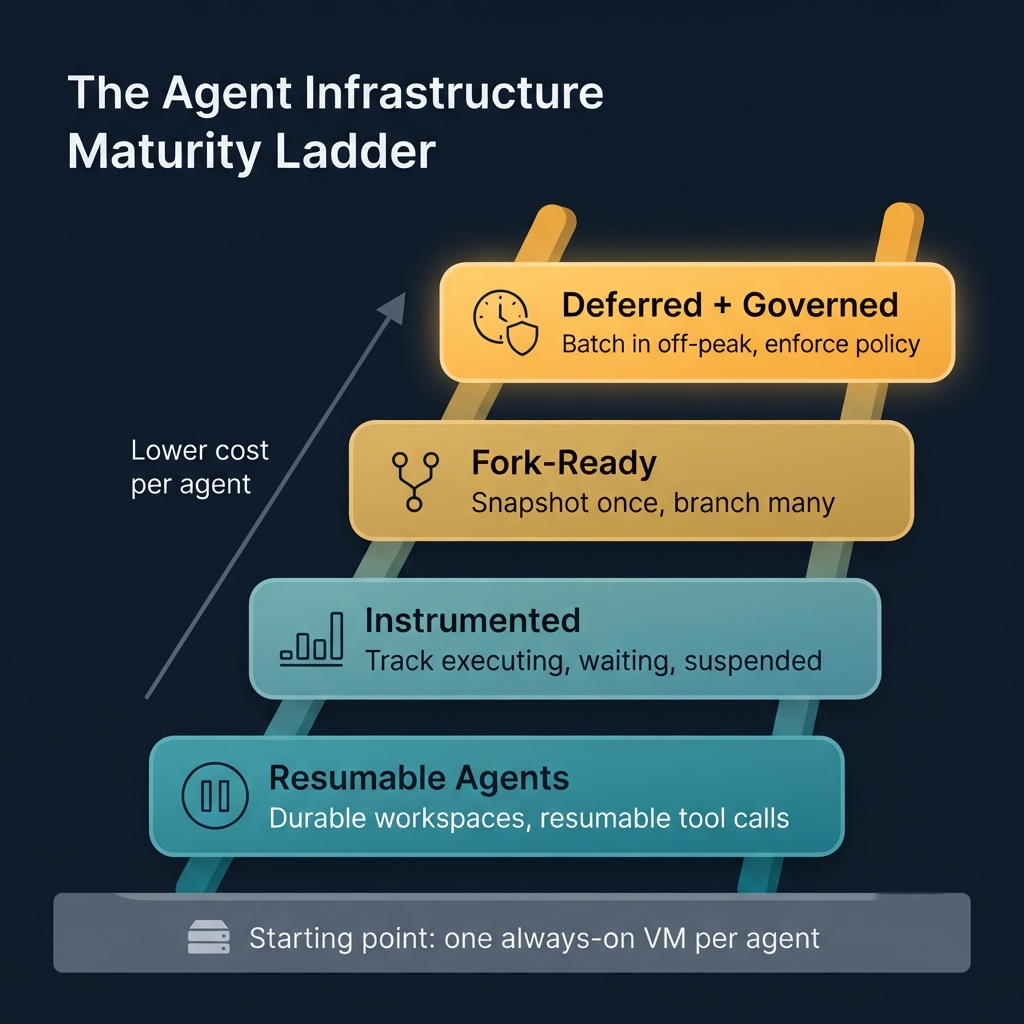
- Design agents around resumability. Don’t treat every turn as a fresh environment. Keep durable workspace state and make tool calls resumable.
- Separate ephemeral, shared, and persistent data. ACE distinguishes disposable scratch data, shared read-only assets, and durable user workspaces.
- Instrument the agent lifecycle. Track time spent executing, waiting on tools, waiting on humans, and suspended.
- Classify work by latency tolerance. Interactive sessions need immediate resume. Research, batch evaluation, migrations, and digests can wait.
- Plan for fork-heavy workloads. Parallel experiments get cheaper when a common environment can be snapshotted and branched rather than rebuilt.
- Treat governance as part of compute economics. Isolation, identity, egress policy, and auditability are prerequisites for safely scaling agent fleets.
Google’s wider governance stack includes Agent Gateway for traffic and policy enforcement, Agent Registry for approved agents and tools, SPIFFE-based identity, and OpenTelemetry-compatible observability.
What Still Costs Money
None of this makes agents free.
Snapshot storage, durable workspaces, network egress, model inference, and external tool calls all still cost money. Fast resume doesn’t remove token costs or API usage. Memory deduplication pays off most when agents share a common base image and runtime, so a highly mixed set of environments shrinks the advantage.
Deferred scheduling also doesn’t suit latency-sensitive, human-in-the-loop work. A support agent that has to answer right away can’t be parked in an overnight capacity valley.
Security matters more as density goes up. ACE separates the agent harness from the sandbox and keeps long-lived credentials outside the guest environment. Communication goes through an external proxy rather than a standard network interface.
Compute for Digital Labor
The next platform battle won’t be decided only by which model an agent runs on. It’ll be decided by how cheaply and safely a platform can preserve, pause, fork, and resume thousands of agent workspaces.
What makes ACE significant is that it treats agent state as a first-class infrastructure resource. A platform keeps the valuable part of an agent (its context, workspace, and execution environment) without paying around the clock for the machine that would otherwise host it.
The companies that win the agent era won’t just run smarter models. They’ll build infrastructure that makes an idle digital worker nearly free and an active one instantly alive.