
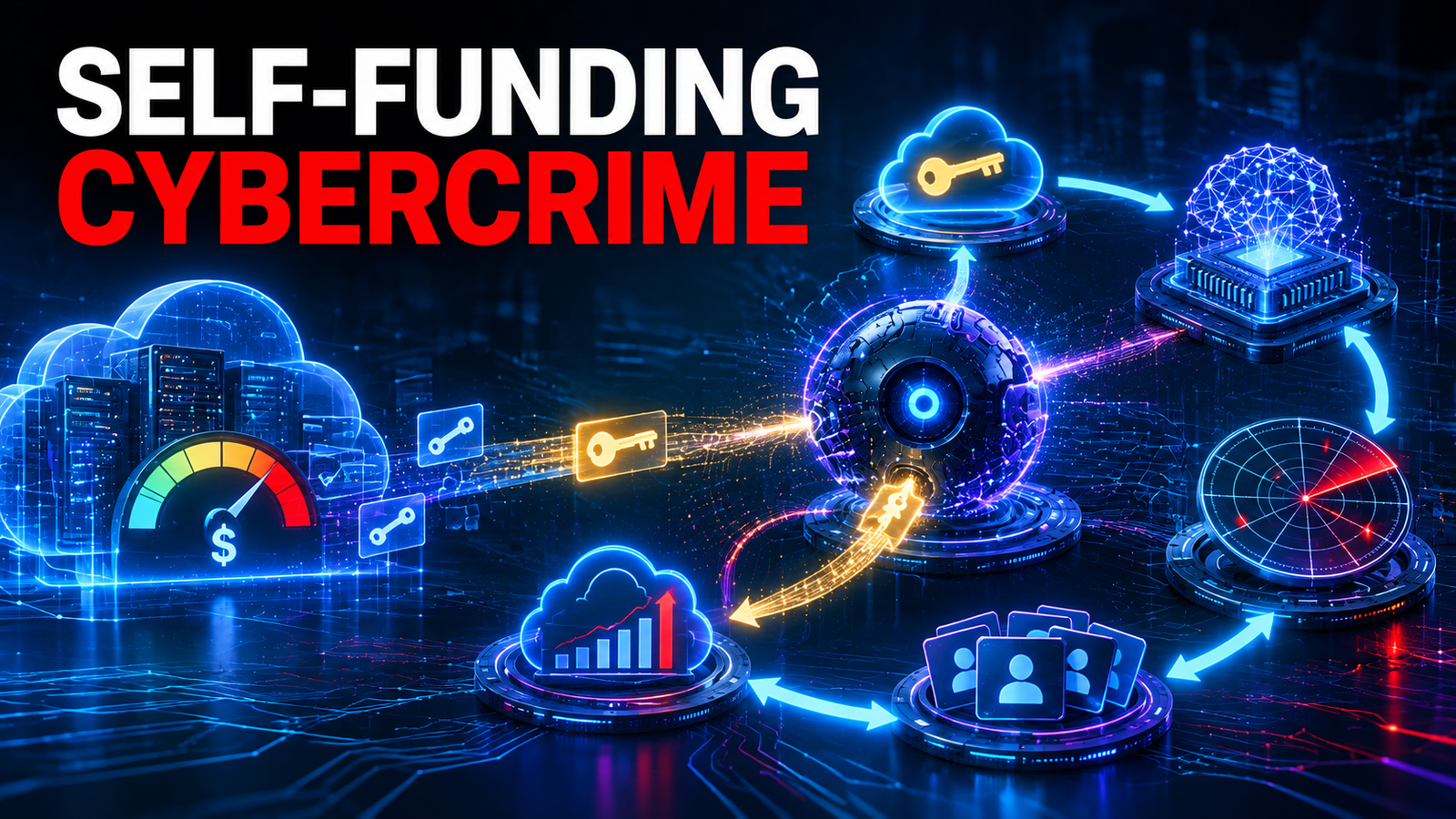
Cybercrime has always had a cost problem. Servers cost money, proxies cost money, and skilled operators cost even more. Agentic AI is changing that math. In the worst version of this model, an AI agent breaks into a cloud environment, grabs credentials, and uses the victim’s own paid AI and cloud resources to keep running. Then it goes looking for more credentials. The attack pays for itself.
Amazon Threat Intelligence recently described an ARTEX-linked campaign that works this way. Stolen AI-model credentials were fed into the attackers’ own model gateway, where they powered agents hunting for still more keys. Amazon called it a self-sustaining operation: stolen keys paid for the LLM inference behind the next round of credential hunting.
The New Economic Model
A traditional botnet borrows bandwidth and compute from infected devices. A self-funding agentic botnet goes a step further. It turns compromised cloud identities, exposed API keys, and AI-service access into both an attack platform and a source of operating capital.
The loop is simple:
Stolen credentials → Victim-funded inference → More credential theft → More access
Instead of paying for every model call, cloud instance, or scanning run, the attacker pushes most of that cost onto the victim. A security failure becomes an economic engine, because each successful credential harvest can finance the next stage.
Google Threat Intelligence Group (GTIG) has seen adversaries exfiltrate API credentials and take over victim cloud environments to run unauthorized AI workloads. It also reported a case where an attacker compromised cloud infrastructure and used it to plan, build, and launch a mass credential-harvesting campaign in under six hours.
What Is an Agentic Botnet?
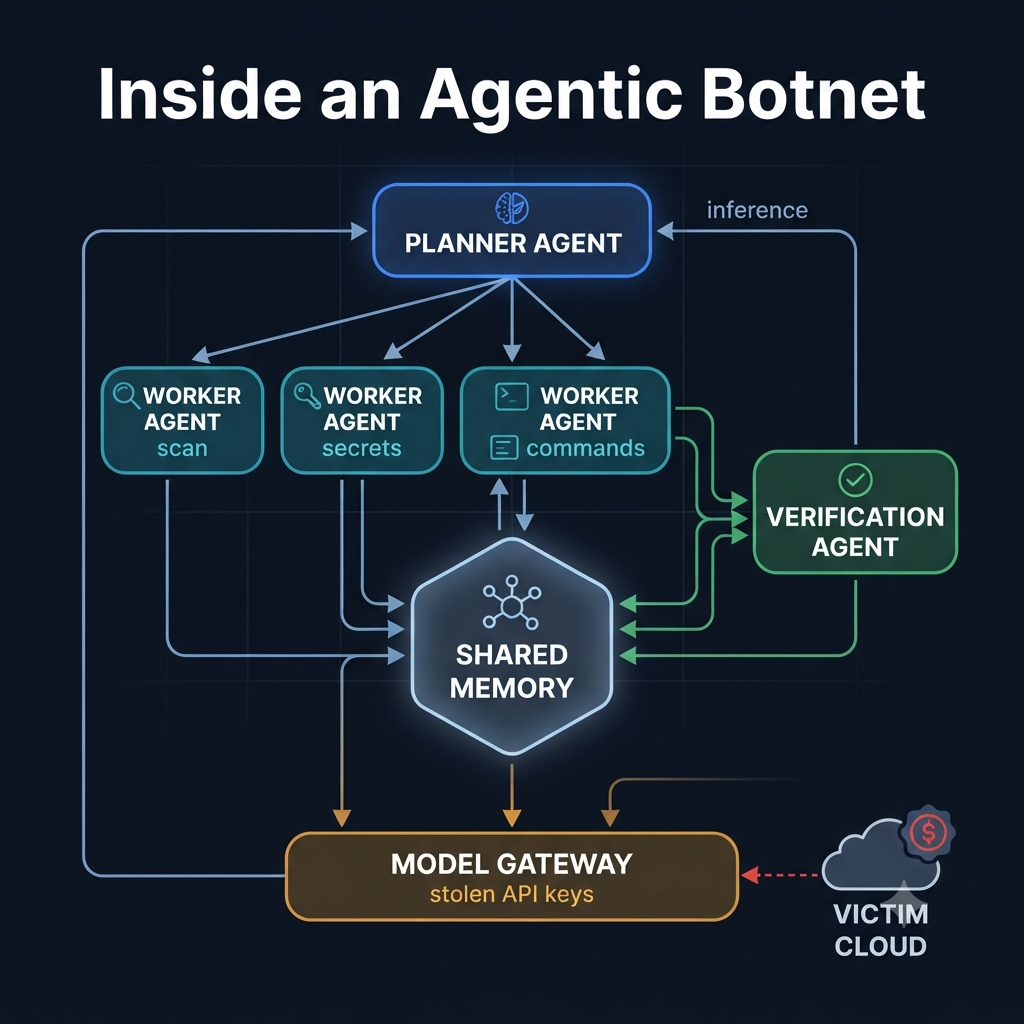
An agentic botnet is more than a chatbot that writes malicious code. It’s a coordinated group of AI-driven processes that can remember context, split up work, call tools, recover from errors, and chase an objective with very little human supervision.
| Component | Role in the attack |
|---|---|
| Planner agent | Sets objectives, sequences tasks, and allocates work |
| Worker agents | Scan targets, test vulnerabilities, extract secrets, and execute commands |
| Verification agent | Validates whether stolen credentials still work and what they can access |
| Shared memory | Stores findings, target lists, credentials, and operational state across agents |
| Model gateway | Routes inference requests through stolen or pooled API access |
| Cloud permissions | Provide compute, storage, identity access, and potentially billing capacity |
Amazon’s observations of ARTEX activity describe planner, worker, verification, and compression agents all sharing a persistent knowledge graph. That shared memory lets one agent pick up where another stopped, which makes the whole operation far more durable than a one-off script.
The Self-Funding Attack Loop
1. Find an entry point
It starts with something exposed: an AI application, a vulnerable web service, a leaked secret, a default credential, or a misconfigured endpoint. None of this is exotic. What makes it dangerous is how fast and how persistently agents can find and exploit these weaknesses.
Amazon reported that ARTEX-linked agents went after LLM gateways, AI application builders, exposed management interfaces, default admin credentials, client-side secrets, source maps, debug routes, and environment files.
2. Harvest credentials
Once inside, the agent hunts for anything that unlocks more capability. That means LLM provider keys, cloud access keys, OAuth tokens, service-account credentials, secrets buried in config files, and identities with broad permissions.
The key point is that the attacker isn’t just stealing data. They’re stealing access to paid infrastructure, especially anything that can run high-value AI inference.
3. Validate and pool access
A stolen key is only useful if it works, so agents test credentials, rate their value, and add the working ones to a shared pool.
In the ARTEX campaign, agents reportedly graded credentials by whether they worked and what they could reach. Keys that had been publicly exposed for more than 30 days were treated as low-value inventory. Confirmed working access counted as operational capital.
4. Spend the victim’s AI budget
The attacker routes the agents’ inference requests through stolen keys or compromised gateways. The victim’s account pays for the model calls that help the attacker reason, plan, troubleshoot, and find new targets.
This is the self-funding part. The attacker doesn’t need a big inference budget of their own if every successful breach supplies more usable API access.
5. Expand the operation
With more credentials and more victim-funded compute, the agents can scan more targets, exploit more systems, and harvest more secrets. The loop keeps going until credentials expire, accounts get disabled, or defenders step in.
GTIG reported one campaign that used preconfigured instruction sets as operational playbooks. The AI handled vulnerability scanning, troubleshot problems on the fly, and rotated IP addresses without anyone doing it manually.
Why “Zero-Marginal-Cost” Matters
“Zero-marginal-cost” doesn’t mean the attack is literally free. It means the attacker’s extra cost for each new action can shrink toward zero, because the victim’s credentials and infrastructure soak up most of the expense.
| Traditional cybercrime | Self-funding agentic cybercrime |
|---|---|
| Attacker pays for servers, proxies, and AI usage | Victim’s cloud account and AI keys fund operations |
| Human operators execute most steps | Agents execute scanning, exploitation, and credential handling |
| Each campaign requires new infrastructure | Each compromise can supply new compute and access |
| Revenue often comes after the attack | Access itself becomes an immediately usable resource |
| Scale is limited by budget and staffing | Scale can be limited by available credentials and defenses |
That’s why this goes well beyond “AI makes phishing easier.” The attacker gets a resource that compounds: more access produces more access.
LLM-Jacking: The Fuel Source
LLM-jacking means using stolen or leaked credentials to run paid foundation-model inference on someone else’s account. Think of it as cloud-resource hijacking, with AI inference as the prize.
GTIG describes adversaries stealing developer credentials, buying compromised AI-platform accounts, and hijacking enterprise cloud infrastructure to run unauthorized high-performance compute workloads.
For an organization, the fallout can include:
- Unexpected AI and cloud spending
- Abuse of proprietary model access
- Exposure of sensitive data through compromised integrations
- Corporate infrastructure used as a launchpad for further attacks
- Difficulty telling legitimate AI workloads from attacker-controlled ones
Why This Is Different From Cryptojacking
Cryptojacking turns stolen compute directly into cryptocurrency. The self-funding agentic model uses stolen compute and intelligence to get more access.
| Dimension | Cryptojacking | Self-funding agentic botnet |
|---|---|---|
| Primary resource abused | CPU/GPU compute | Cloud permissions, secrets, and LLM inference |
| Main output | Cryptocurrency | More credentials, broader access, and continued operations |
| Human involvement | Often setup plus monitoring | Can be minimal after the initial foothold |
| Economic loop | Mining revenue offsets attacker costs | Stolen credentials directly fund further attacks |
| Security impact | Performance degradation and cost | Account takeover, privilege escalation, data exposure, and expansion |
The second model is worse because what’s being stolen isn’t just electricity or GPU time. It’s the ability to reason, plan, authenticate, and act inside a victim’s environment.
The Human Role Hasn’t Disappeared
It would be wrong to say fully autonomous cybercrime is already everywhere. In many observed campaigns, a human still gets the initial foothold, sets the goals, defines the limits, or steps in when the automation breaks.
But the job is changing. Instead of typing every command, an operator might hand over a mission brief, a target list, and some guardrails, then let the agents run the sequence.
Amazon reported that ARTEX operators gave agents standing instructions covering mission objectives, targeting rules, and operational constraints, and the agents did the rest. GTIG makes a similar point: adversaries are moving from basic prompting toward agentic workflows that cut down the delay of keeping a human in the loop.
The Real Weak Point: Identity and Secrets
Here’s the uncomfortable part. Most of these campaigns don’t need any breakthrough in AI. They lean on ordinary failures: exposed keys, default credentials, unauthenticated interfaces, overly broad permissions, and unpatched software.
Amazon concluded that the techniques it saw weren’t new. What changed was the attacker’s speed and persistence. Its recommendation was to treat AI applications, model gateways, and inference endpoints with the same production-grade controls as any other critical system.
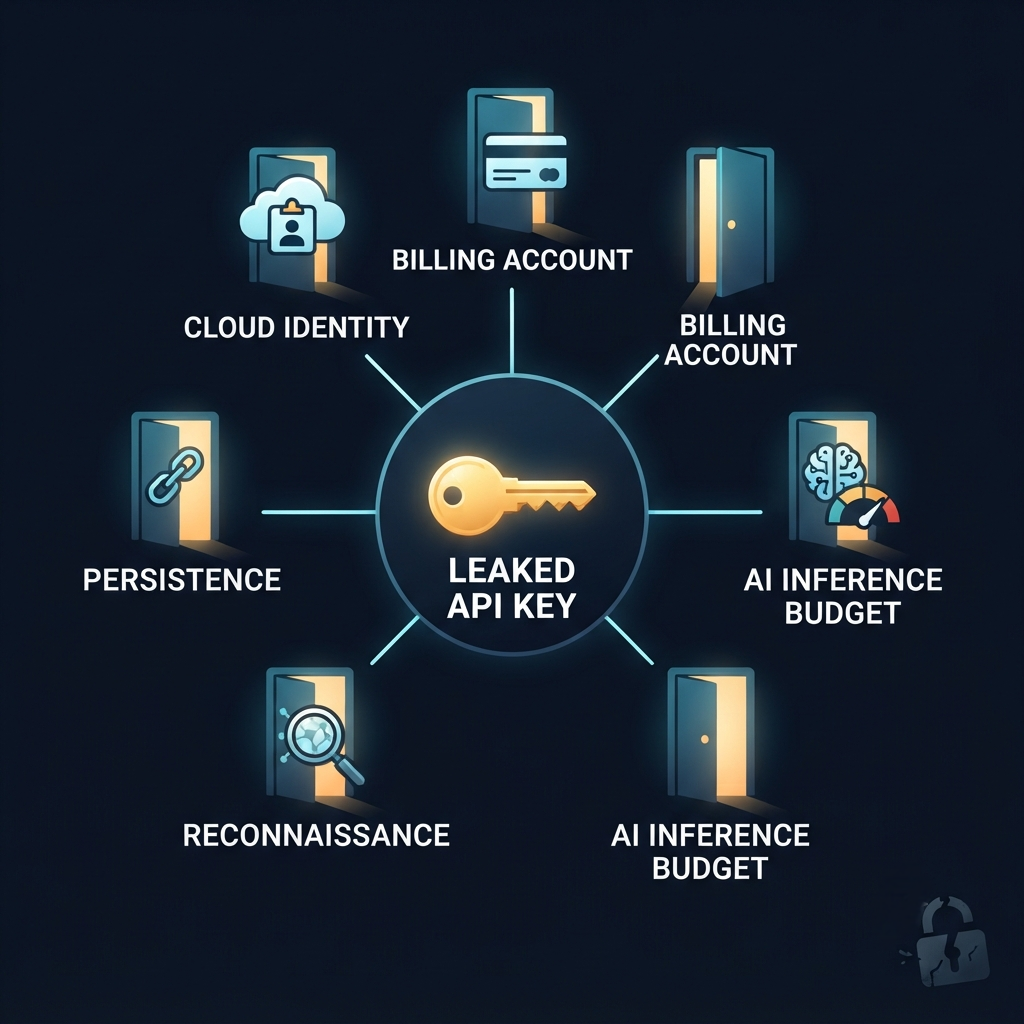
So security teams need to stop treating an API key as a minor config detail. In an agentic threat model, a leaked key can become:
- A cloud identity
- A billing account
- A model-inference budget
- A reconnaissance tool
- A persistence mechanism
- A pathway to more credentials
How Defenders Can Break the Loop
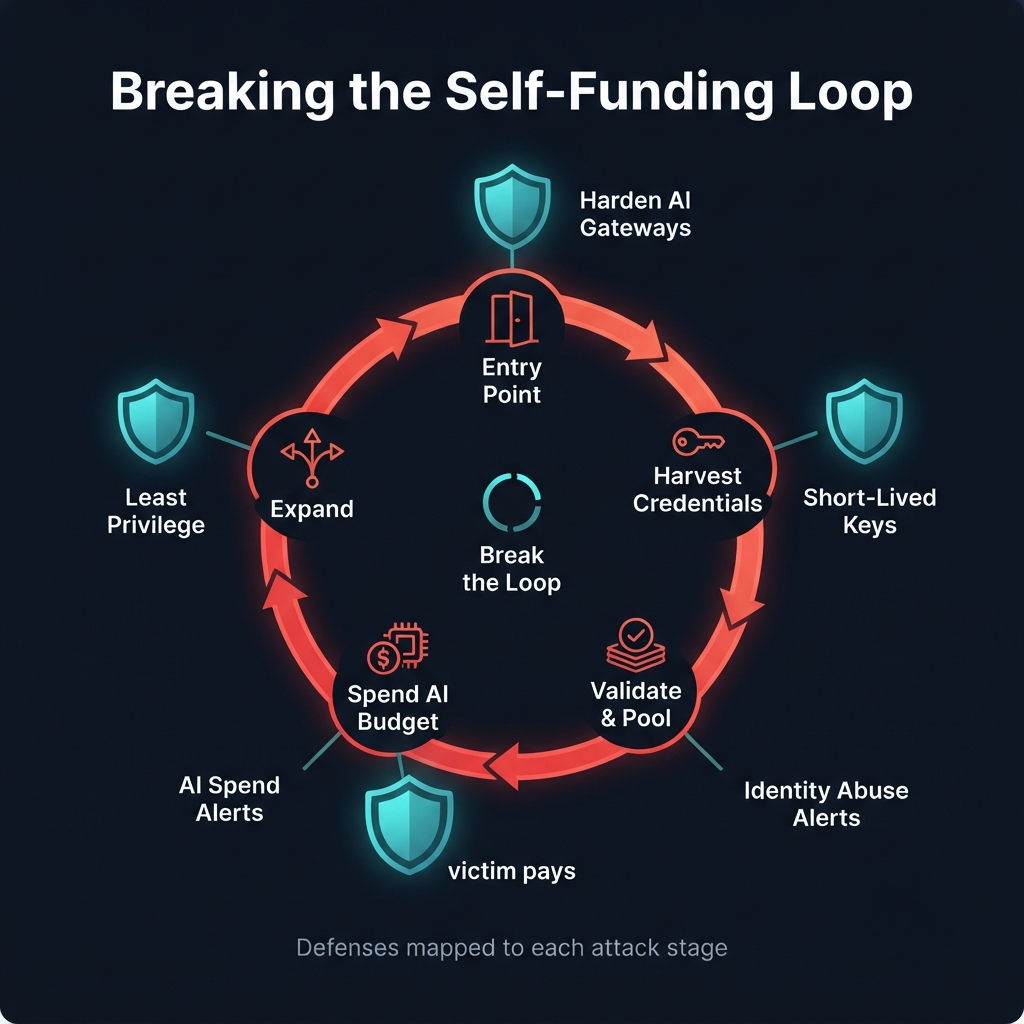
You won’t stop every AI-enabled attack. The realistic goal is to make the self-funding loop expensive, visible, and short-lived.
1. Eliminate long-lived secrets
Swap static API keys and long-lived cloud credentials for short-lived, scoped ones wherever you can. Rotate keys automatically, and revoke access fast when something looks off.
2. Apply least privilege to agents
AI agents shouldn’t get broad admin permissions by default. Keep separate permissions for reading secrets, creating resources, accessing billing, calling external APIs, and deploying workloads.
An agent that can’t provision infrastructure or reach high-value secrets has a much harder time funding itself.
3. Protect AI gateways
LLM gateways, proxy platforms, and AI application builders are attractive targets because one compromised interface can expose keys for many downstream accounts. Amazon specifically saw attacks on gateway and proxy platforms, including One API, LiteLLM, and similar AI application platforms.
These services need authentication, authorization, rate limiting, secret isolation, audit logging, and regular patching.
4. Monitor AI spend as a security signal
A sudden jump in model usage, new model subscriptions, odd inference volume, or billing anomalies may be the first visible sign of LLM-jacking. Treat AI spend monitoring as part of security monitoring, not just a finance task.
5. Detect identity abuse
Set up alerts for:
- New IAM users or access keys created soon after suspicious activity
- Service accounts hitting AI endpoints at abnormal volumes
- Credentials used from unexpected regions, networks, or workloads
- Agents trying to enumerate secrets, storage, identities, or permissions
- API keys being validated repeatedly, then pooled or reused
- Cloud resources created in unusual regions or at odd hours
6. Assume compromise
Plan your incident response on the assumption that a key, token, or cloud identity may already be in someone else’s hands. Rotate credentials, isolate affected identities, review billing and audit logs, and map everything the compromised identity could reach.
The Bottom Line
The self-funding autonomous botnet isn’t science fiction. It’s an emerging economic model for cybercrime: steal access, spend the victim’s AI budget, use it to find more access, and repeat.
So the priority is clear. Protect identities, secrets, AI gateways, and agent permissions like production infrastructure, because in an attacker’s hands, that’s exactly what they are.
The next botnet might not rent servers or mine crypto. It might log into your cloud account, spend your AI budget, and use your own infrastructure to find its next victim.