
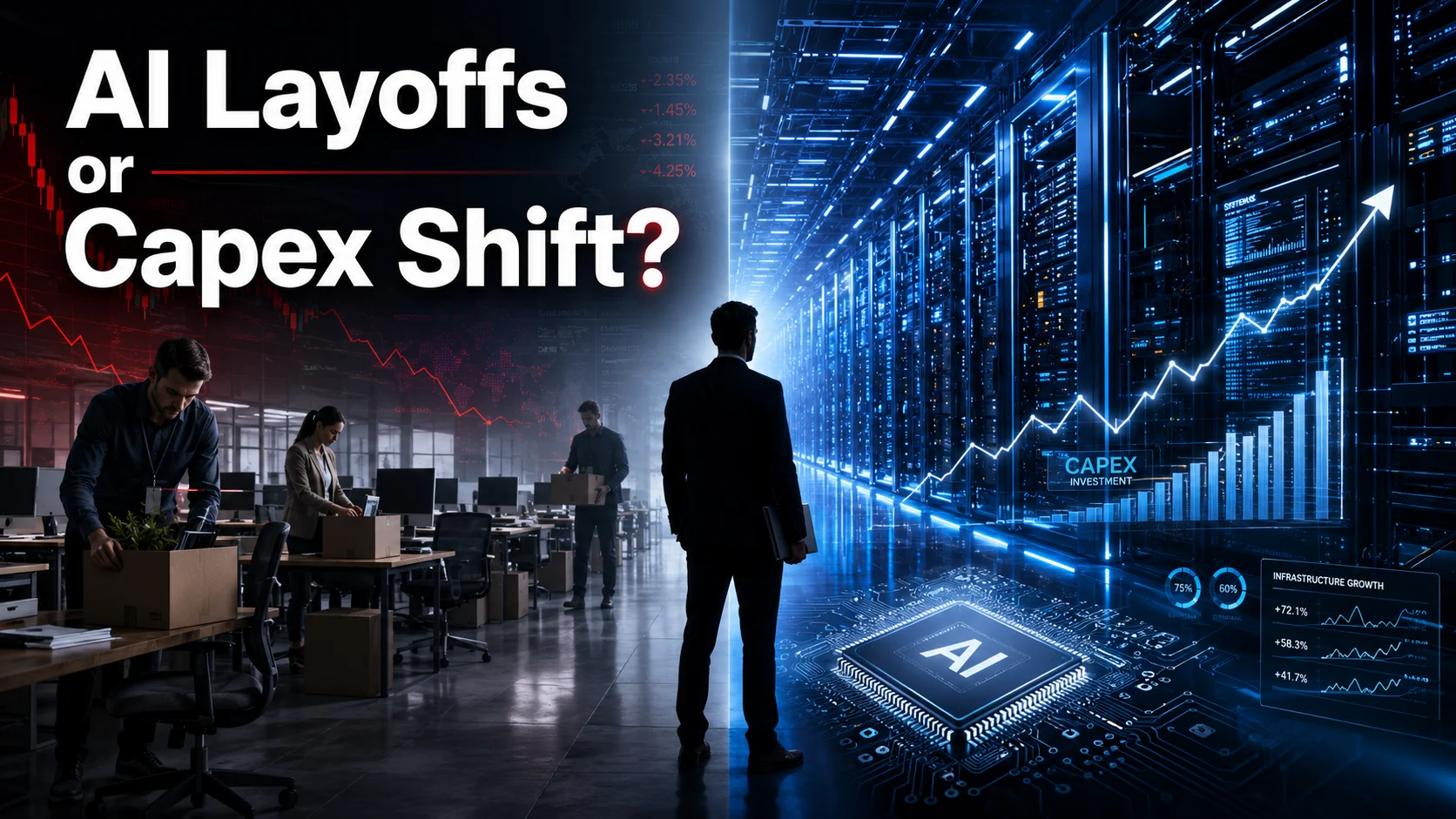
Tech giants are slashing jobs and calling it “AI efficiency,” but Wall Street is punishing companies for something far bigger: a massive capital spending spree that is draining cash flows.
With Big Tech on track to slam over $700 billion into AI capex, tech workforce reductions surging past 140,000 workers in 2026, and major tech indices lagging following recent earnings reports, is automation really replacing workers—or are companies scrambling to fund data centers before margins crack? So why are investors suddenly turning on the industry’s biggest spenders? Are investors being sold a false efficiency story while tech leaders quietly reallocate payroll straight into server racks?
The market is drawing a line: labor cuts will no longer distract from ballooning, unproven infrastructure costs.
So why are investors suddenly turning on the industry’s biggest spenders? Are investors being sold a false efficiency story while tech leaders quietly reallocate payroll straight into server racks?
The market is drawing a line: labor cuts will no longer distract from ballooning, unproven infrastructure costs.
What the Market Is Actually Pricing
When executive teams announce job cuts, the official narrative attributes the shift to AI-driven productivity gains. However, institutional investors see a much simpler financial reality: companies are trimming payroll to offset unprecedented server, chip, and facility expenditures. The hyperscalers—Microsoft, Alphabet, Meta, and Amazon—are directing a record portion of operating cash flow toward compute infrastructure.| Signal | What It Suggests |
|---|---|
| Layoffs labeled as “AI-driven” | Management wants to frame cuts as strategic modernization. |
| Rising data center capex | The real cash need is hardware, not pure workforce automation. |
| Stock lag vs broad indices | Investors doubt the immediate ROI of the efficiency narrative. |
| Margin pressure | Wall Street is pricing in heavy capital burn before revenue materializes. |
Why the AI Layoff Story Isn’t Convincing Everyone
Wall Street is not rejecting artificial intelligence itself; it is rejecting the specific story tech executives are telling about it. Labeling standard corporate belt-tightening as an “AI transformation” worked when capital was cheap, but investors now demand clear monetization metrics.- Preserving Free Cash Flow: Cutting salaries instantly frees up liquid capital to pay for GPU clusters and land agreements.
- Displaced Productivity: Replacing experienced staff with AI tools faster than the technology can perform introduces operational risk.
- Skepticism over Blanket Claims: Analysts are discounting corporate claims that AI tools alone justify headcount reductions.
Oracle just cut 21,000 jobs. Amazon cut 16,000. Dell, Meta, Microsoft, PayPal, and Cisco all followed — same excuse every time: “AI.” 120,000+ tech jobs gone in 2026 so far. Record profits too. Wild coincidence. pic.twitter.com/CeHF8iJdzV
— Scorpioeyes (@Retailplanning) July 27, 2026
The Capex Problem Investors Are Watching
The fundamental conflict centers on cash allocation. As hyperscaler capital expenditures soar, the sheer scale of investment is compressing margins across the entire software and cloud sector.“People are really focused on capex, obsessed with it. It used to be the more the better, but now it is the less the better,” noted Jason Lemire, Chief Investment Officer at Bold Wealth Partners. “We’re seeing capital raises, negative cash flows, rising debt. All that adds risk to the picture.”Financial analyses from The Motley Fool and institutional research by Goldman Sachs show that hyperscalers are spending out of fear of falling behind, rather than guaranteed short-term profits. Additional reporting by PYMNTS underscores how markets are punishing companies whose capital outlays eclipse actual earnings.