
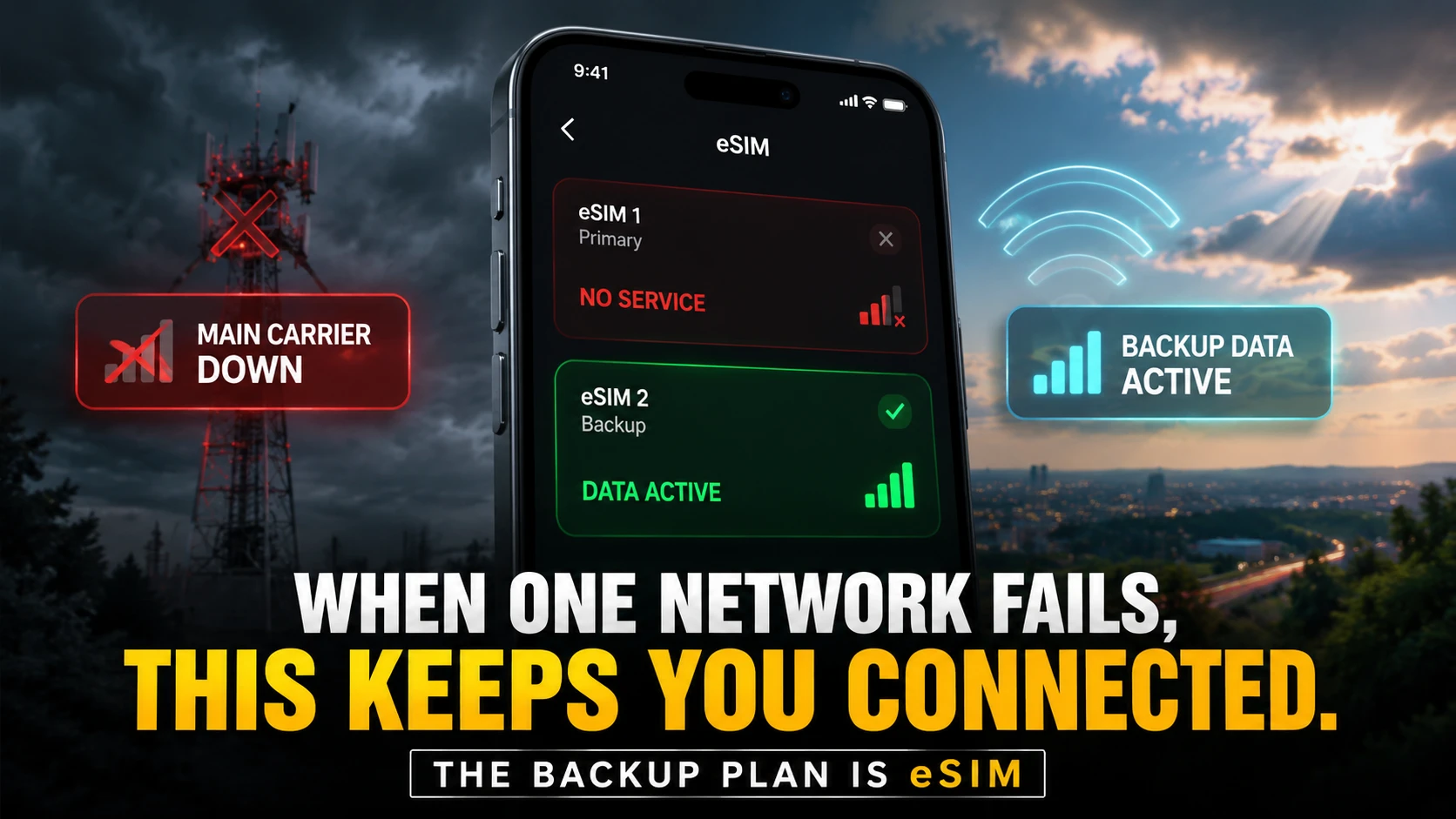
Major network outages recently stranded over 125 million devices, exposing how fragile phone loyalty has become. When primary cell towers go dark, over 92 million voice calls drop, leaving everyday users completely cut off from navigation, mobile payments, and critical emergency services.
If one carrier goes dark, what happens to your calls, maps, and safety? With modern smartphones fully equipped with dual-eSIM hardware, proactive consumers are rejecting traditional carrier lock-in and activating digital backup lines before disaster strikes.
Why the Outage Changed the Conversation
The conversation around telecommunications failures is no longer about waiting for carrier bill credits; it is about taking immediate personal control over device connectivity.
Millions of users were affected, but very few had a backup plan. Modern daily life relies entirely on cellular data for everything from authenticating work logins to scanning transit passes. While single-carrier users sat helpless during recent infrastructure blackouts, multi-eSIM adopters simply toggled their settings to stay online.
Why eSIM Makes Backup Plans Easier
Activating secondary cellular service used to require visiting a store and swapping tiny plastic SIM cards, but over-the-air provisioning has eliminated that hassle entirely.
- Zero Physical Friction: Users can install a secondary carrier profile in seconds simply by scanning a digital QR code.
- Low-Cost Insurance: Non-expiring backup data plans allow users to keep a secondary profile resting dormant without paying recurring monthly fees.
- Instant Failover: When the primary signal drops, modern smartphones let users switch data routing to the secondary line in under 10 seconds.
That sounds simple — until you realize how many people still rely on a single tower. A secondary eSIM acts like a digital spare tire for your smartphone, ensuring you are never left stranded.
How Consumers Are Setting Up Redundancy
Building a multi-carrier safety net no longer requires expensive enterprise service contracts.
- Verify Unlocked Hardware: Ensure your smartphone is network-unlocked and supports dual active eSIM profiles.
- Select an Alternative Infrastructure: Pick a secondary carrier that operates on entirely different physical cell towers than your primary provider.
- Install a Pay-As-You-Go Profile: Add a non-expiring backup eSIM data package directly onto your device.
- Test the Toggle Feature: Turn off fixed Wi-Fi and manually force your phone to route data over the secondary carrier to ensure seamless operation.
- Configure Auto-Data Switching: Enable cellular data switching in your phone’s network settings for automatic failover.
“For many users, a second eSIM is becoming what a spare charger used to be — a basic, essential backup rather than a luxury tech gimmick.” — Mobile Connectivity Analyst
And that’s where the real market shift begins.
What This Means for Carrier Loyalty
Consumer expectations around mobile service are shifting rapidly from brand loyalty to functional redundancy.
| Old Habit | New Habit |
|---|---|
| Pledge loyalty to one single carrier | Keep a backup eSIM installed and ready |
| Wait for customer support during outages | Switch carriers instantly on-device |
| Demand small refunds after service drops | Prevent downtime entirely with redundancy |
| Treat connectivity as a fixed contract | Treat cellular access as a flexible tool |
If network failures are inevitable, why leave your connection up to a single company?
T-Mobile’s giving away Bose and JBL gear for $0 right now
— Glitched (@glitchtoriches) July 30, 2026
I grabbed the Ultra Headphones, Ultra Earbuds and a Waterproof Speaker
check your T-Mobile app before it’s gone pic.twitter.com/9Wcil0kcqw
The Bigger Shift in Mobile Behavior
Major cellular outages will continue to happen due to misconfigured updates, extreme weather, and unexpected infrastructure strain.
- Proactive Protection: Consumers are treating cellular resilience as a personal habit rather than relying on telecom promises.
- Enterprise-Level Security for Everyone: Features once reserved for corporate failover routers are now sitting directly in consumer pockets.
- Decoupled Connectivity: The era of tying your entire digital life to a single network operator is officially coming to an end.
The main lesson of the outage is clear: multi-carrier eSIMs are turning personal mobile resilience into the new standard.
Official investigation details and technical guides are available via the FCC Wireless Outage Report and Backup eSIM Connectivity Analysis.