
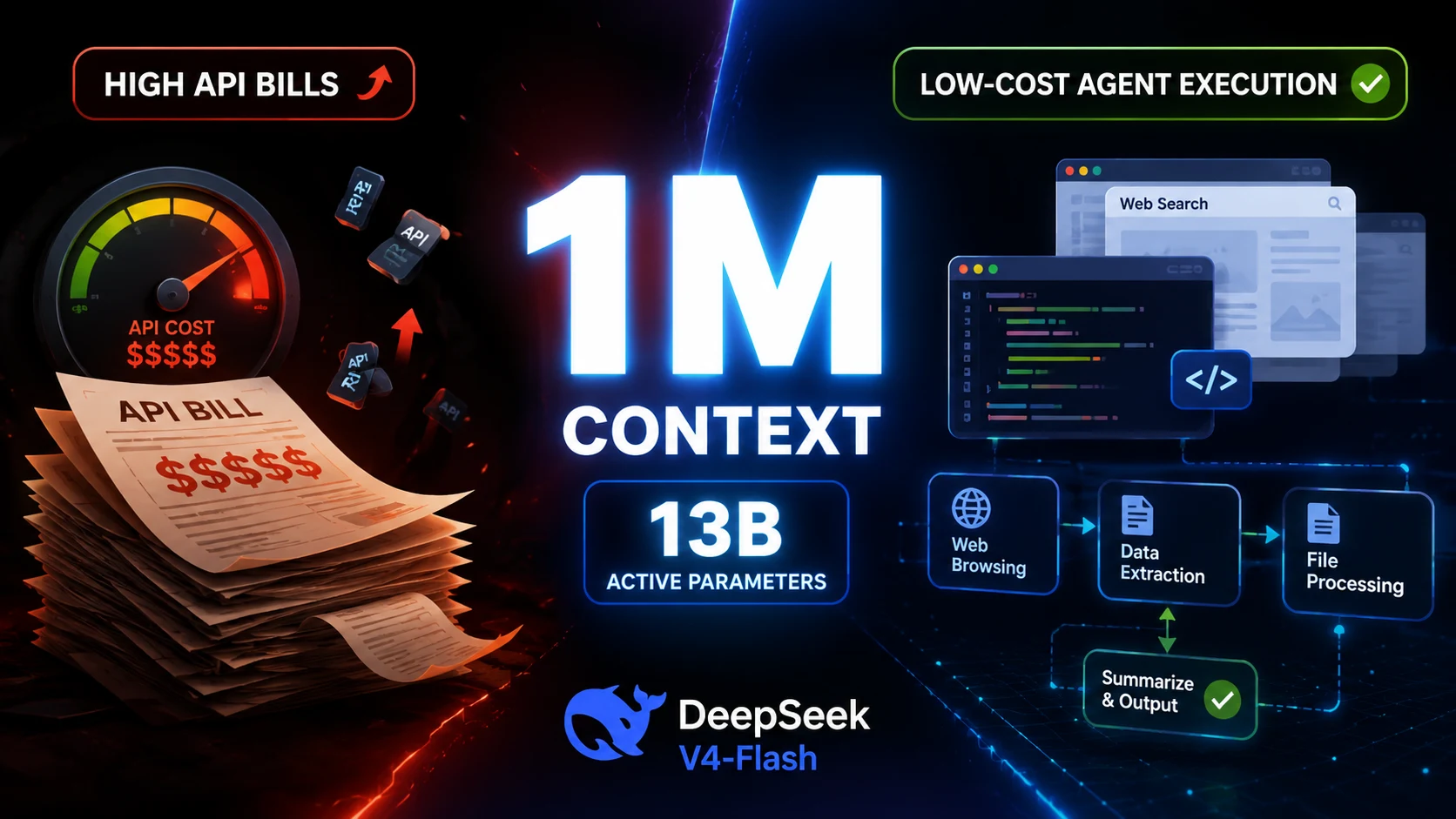
DeepSeek V4-Flash is shaking up AI development by promising massive context and enterprise-grade agent execution at prices that could gut today’s API bills!
It pairs a 1M-token context window with 13B active parameters while charging a jaw-dropping $0.09 per million input tokens—so if high-cost API usage was the main barrier to building autonomous software, what happens when that wall suddenly collapses?
The race to unlock persistent web-browsing and multi-file coding agents just got fiercely aggressive.
What DeepSeek V4-Flash Claims to Do
Building autonomous agents used to require deep pockets to handle giant token loops and memory overhead.
- 1M-token context window: Allows agents to ingest entire codebases, legal libraries, or historical logs without truncating data.
- 13B active parameters: Routes queries through a massive 284B Mixture-of-Experts (MoE) model while only activating 13B parameters per token for ultra-fast processing.
- Hybrid attention design: Reduces Key-Value (KV) cache memory constraints by up to 90% compared to legacy architectures.
- Extreme throughput: Delivers high token speeds so agents can execute long-running loops without timing out.
Is this the moment AI agents stop being a luxury and start becoming a default tool for startups?
| Factor | Why It Matters |
|---|---|
| 1M context | Enables long workflows and large task memory without losing context. |
| 13B active params | Delivers top-tier speed and low latency without full-model cost overhead. |
| Hybrid attention | Shrinks KV cache to drastically lower inference costs. |
| Low token cost | Makes high-frequency agent deployment financially viable. |
Why Developers Should Care
Long-context tasks typically drag down performance and skyrocket costs, but low-cost token execution changes the math for production software.
- Customer support agents: Process entire customer histories and continuous conversation logs without dropping context.
- Research assistants: Parse dozens of long PDFs simultaneously to cross-reference data points automatically.
- Coding copilots: Read and modify entire repositories in a single agent loop.
- Browser automation: Maintain state across hundreds of multi-step web actions without running out of tokens.
- Document processing pipelines: Extract structured insights from thousands of legal or financial pages seamlessly.
The Hardware Efficiency Angle
How does DeepSeek deliver such low pricing? The secret lies in architectural optimization rather than raw compute spending.
By activating only 13 billion parameters out of 284 billion total parameters, inference servers consume far less energy and VRAM per request. This hybrid approach slashes the memory footprint, allowing hosting providers to run multi-tenant agent workloads at scale without hitting hardware bottlenecks.
If agents cost pennies to run, which workflows get automated first?
What It Changes Commercially
Startups no longer need millions in venture funding just to cover their monthly model inference bill.
“The real shift is not just longer context, but whether long-context agents can run at a cost that makes daily production use practical.” — AI Infrastructure Analyst
With lower execution costs, engineering teams can run hundreds of iterative agent steps in the background. Will startups gain an edge over larger teams by shipping faster and cheaper?
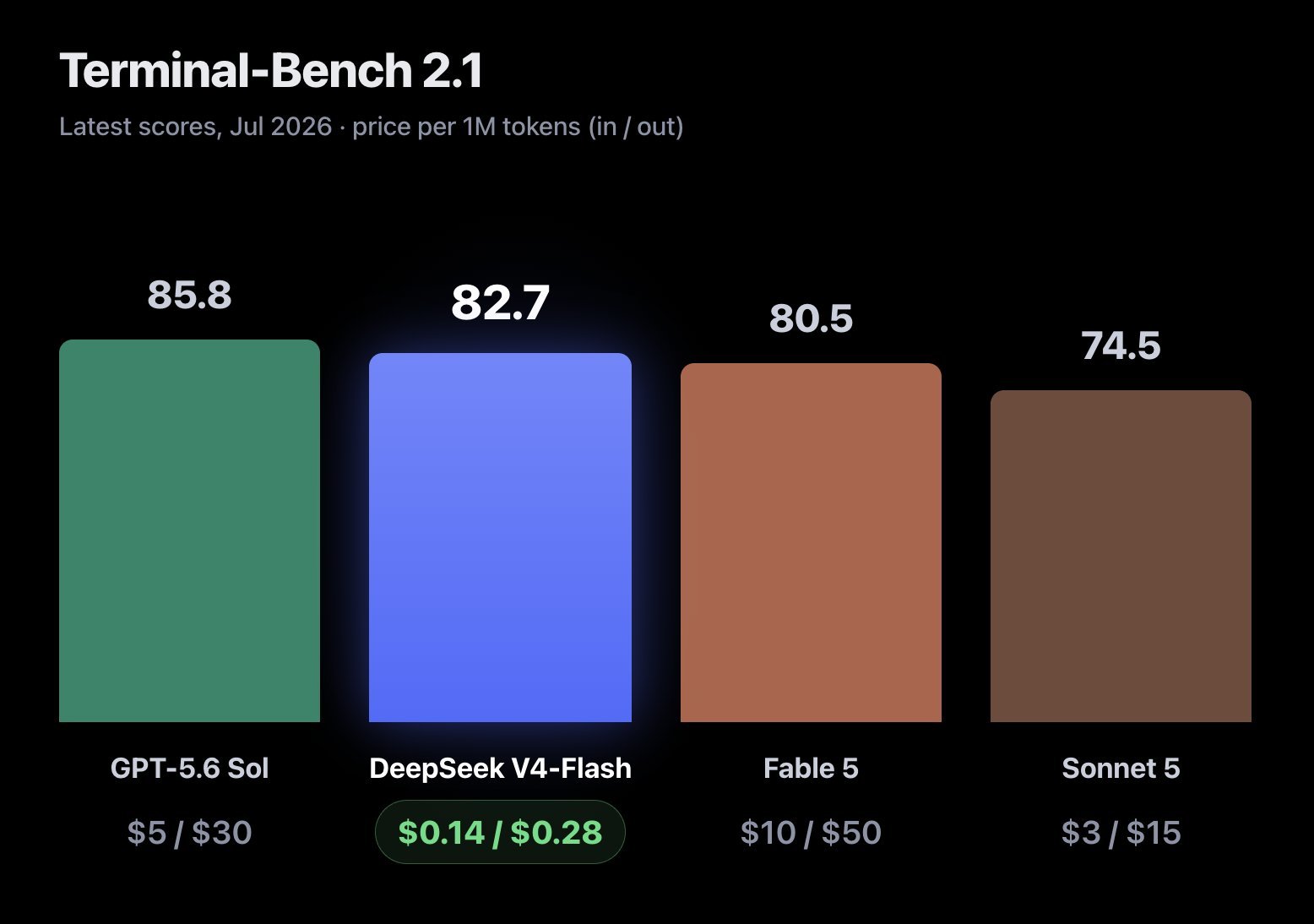
🚀 DeepSeek-V4-Flash Official API is now LIVE in public beta! 🔷 We’ve massively upgraded its Agent capabilities—benchmark scores are now far surpassing the V4-Pro-Preview. Check out the massive performance leap below! 👇 🔷 The official V4-Flash now natively supports the… pic.twitter.com/NUzOyxza2f
— DeepSeek (@deepseek_ai) July 31, 2026
The Catch
While benchmark numbers look incredible, production readiness requires careful testing:
- Real-world reliability: Synthetic context benchmarks don’t always mirror real-world tool execution.
- Developer tooling: Widespread adoption depends on framework integrations like LangChain and LlamaIndex.
- Provider availability: Low prices depend on stable public API uptime across third-party hosts.
Check out official documentation on the DeepSeek API Documentation, explore benchmarks via OpenRouter DeepSeek V4-Flash Specs, or review model deployment guides on Unsloth AI Docs.