
A massive pricing reset could make AI startups faster, leaner, and far more aggressive about how they build, ship, and scale.
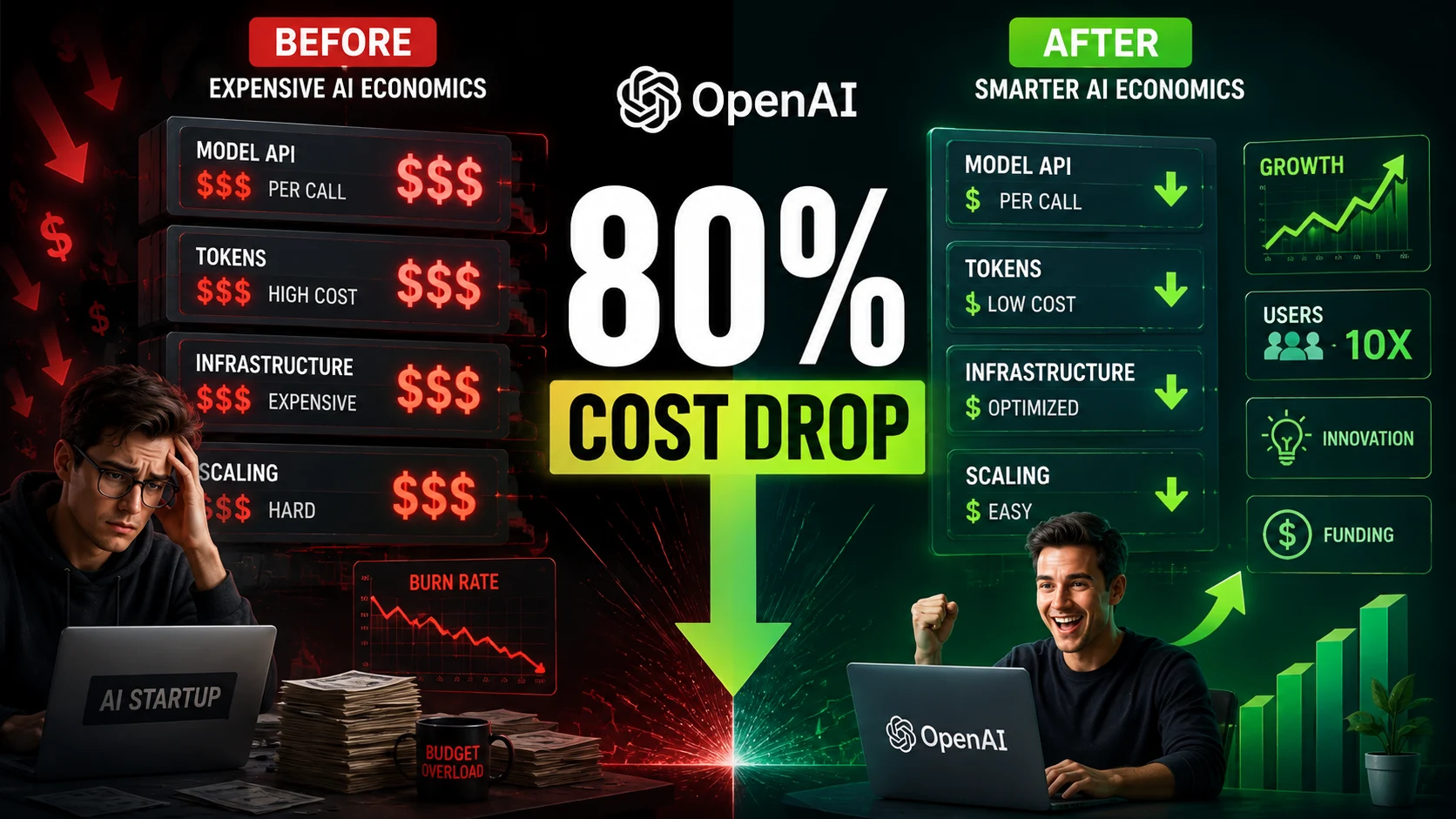
OpenAI’s sudden pricing shift has shattered traditional AI startup economics overnight. The API price for GPT-5.6 Luna dropped by 80% down to just $0.20 per million input tokens and $1.20 per million output tokens. With inference costs crashing, how fast will founders rewrite their unit economics before competitors undercut them?
Mid-tier GPT-5.6 Terra also fell 20% to $2.00 per million input tokens. Multi-agent task execution costs have effectively plummeted by up to 5x across production pipelines. As gross margins surge past 85%, software builders are rushing to reshape their entire product roadmaps.
Why Startup Margins Change First
For years, high-volume API costs acted as a tax on AI software margins. Running complex multi-step agents or processing long documents meant choosing between thin profits or high subscription fees.
- Lower Variable Costs: High-volume user requests now consume a fraction of previous operational budgets.
- Faster Experimentation Loops: Engineers can run thousands of parallel evaluation runs without risking massive bill shock.
- Broader Freemium Tiers: Companies can afford to offer richer free trials to acquire enterprise leads.
Which startups benefit first from cheaper inference? Companies building automated workflows, customer support platforms, and code-generation agents gain an immediate margin boost.
The New Unit Economics
The fundamental math of building on foundation models has been rewritten. Lower token prices allow founders to convert high variable costs into predictable profit margins.
| Cost Area | Before | After | Why It Matters |
|---|---|---|---|
| High-Volume API Calls | High variable cost ($1.00/1M) | $0.20 / 1M tokens | Expands margins on usage-based software |
| Fine-Tuning Iterations | Expensive test cycles | 5x cheaper execution | Accelerates product-market fit |
| Multi-Agent Systems | Costly in production | Economical at scale | Unlocks complex autonomous agents |
| Customer Support Bots | Compressed margins | Surging gross margins | Increases ROI on automated ops tools |
That structure gives lean teams a direct advantage over legacy software vendors.
Where Multi-Agent Systems Get Cheaper
Autonomous agents usually make dozens of internal API calls behind the scenes to complete a single user task. When every sub-agent call costs 80% less, multi-agent systems move from expensive research prototypes into scalable production software.
- Parallel Task Routing: Developers can route simple sub-tasks to GPT-5.6 Luna at $0.20 per million input tokens while reserving flagship models for synthesis.
- Longer Context Execution: Agents can repeatedly read, edit, and verify long codebases without exhausting API credits.
- Automated Quality Checks: Self-correcting loops that verify outputs are now cheap enough to run continuously.
Does this make AI agents finally economical at scale? By lowering the cost per completed task, developers can deploy complex multi-agent workflows without destroying gross margins.
Who Wins, Who Gets Squeezed
Market shakeups create clear winners and vulnerable incumbents across the software landscape.
“When the cost base drops this sharply, product strategy changes faster than most teams expect.” — AI Infrastructure Analyst
- Big Winners: Wrapper startups that can now expand profit margins, vertical AI agents, and high-frequency data extraction pipelines.
- Squeezed Incumbents: Proprietary model providers selling legacy middle-tier models at inflated price points.
- Under Pressure: Startups that competed solely on being a “cheaper alternative” to OpenAI now face fierce price pressure.
What Founders Should Change This Week
To capitalize on this pricing shift, founders must adjust their go-to-market and technical architecture immediately.
- Rerun Evaluation Suites: Re-evaluate model routing to see if GPT-5.6 Luna can handle tasks previously reserved for heavier models.
- Reprice Customer Packages: Introduce usage-based tiers or larger free allowances to outpace slower competitors.
- Bundle Multi-Agent Features: Add automated verification and background processing loops that were previously too expensive.
We are committed to pushing the model frontier across cost efficiency, capability, and speed. Starting today, we are reducing prices for GPT-5.6 Luna by 80% and GPT-5.6 Terra by 20% , and offering a faster option for GPT-5.6 Sol in the API. Luna and Terra’s lower prices are… pic.twitter.com/rFhK7XKedp
— OpenAI (@OpenAI) July 30, 2026
Market Impact
Official announcements and developer analyses outline how this price crash is altering the ecosystem:
Official Announcements & Industry Reports: • OpenAI Official Announcement: Advancing the Price-Performance Frontier • MindStudio Analysis: How Model Self-Optimization Cut Prices • Build Fast with AI: GPT-5.6 Price Cut Analysis & Benchmarks • VentureBeat: AI Price Wars Shift Toward Cost Efficiency
Will lower prices trigger a new wave of AI app launches? As developer costs continue to drop, the barrier to building high-margin AI software has never been lower.