
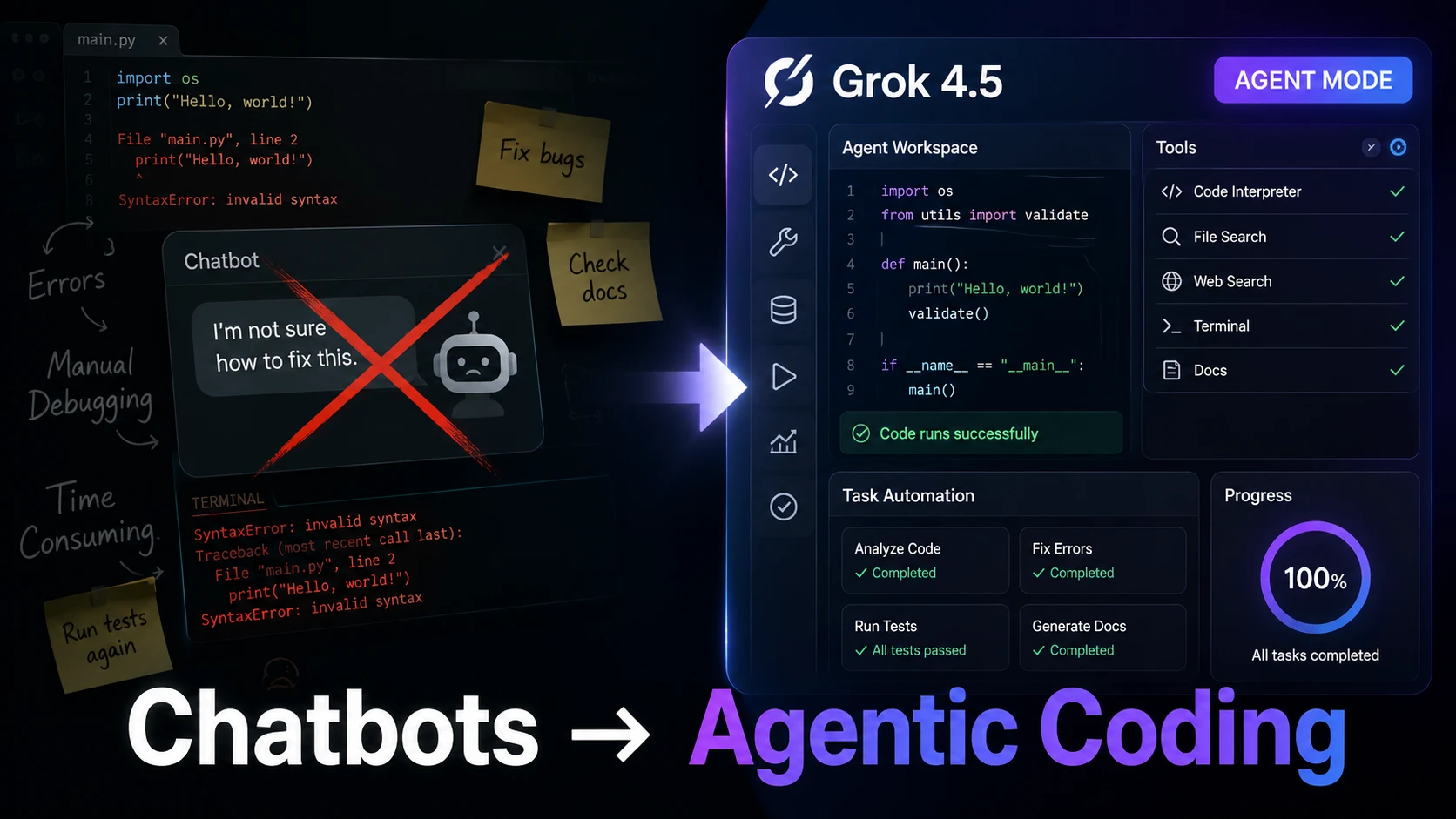
Grok Build just changed the developer playbook—and the old chatbot model may already be losing relevance. On July 16, 2026, xAI rolled out Grok 4.5 as its default agentic engine, delivering a 54 score on the Artificial Analysis Intelligence Index and resolving SWE-bench Pro tasks using 4.2x fewer output tokens than competing models.
Does this token-efficient model actually translate into faster production code, or is it just benchmark hype? Engineers who rely on speed and cost are rethinking their daily pipelines as agentic tools disrupt traditional coding workflows.

Why This Matters
Chatbots that output one-off snippets without reading your entire repository are quickly becoming obsolete. The integration of Grok 4.5 into terminal tools like Grok Build shifts software engineering toward task-oriented execution.
| Old Chatbot Era | Grok Build-Style Agent Era |
|---|---|
| One-off code answers | Multi-step task execution |
| Generic, uncontextual responses | Developer-focused repository workflows |
| Manual prompt-and-paste loops | Tool orchestration and shell automation |
| Back-and-forth debugging | Faster, plan-first coding cycles |
Is this real progress or just benchmark theater?
Benchmarks Section
On agentic benchmarks, Grok 4.5 stands out for tool use and efficiency—but not every coding test tells the same story.
- SWE-bench Pro: Hits a 64.7% resolve rate, proving its capability on complex real-world codebases.
- Terminal Bench 2.1: Hits an 83.3% score, demonstrating strong command-line tool orchestration.
- Token Efficiency: Resolves complex tasks using an average of 15,954 output tokens, significantly reducing output bloat compared to larger frontier models.
- API Pricing: Priced aggressively at $2.00 per million input tokens and $6.00 per million output tokens.
But does that benchmark actually matter in production?
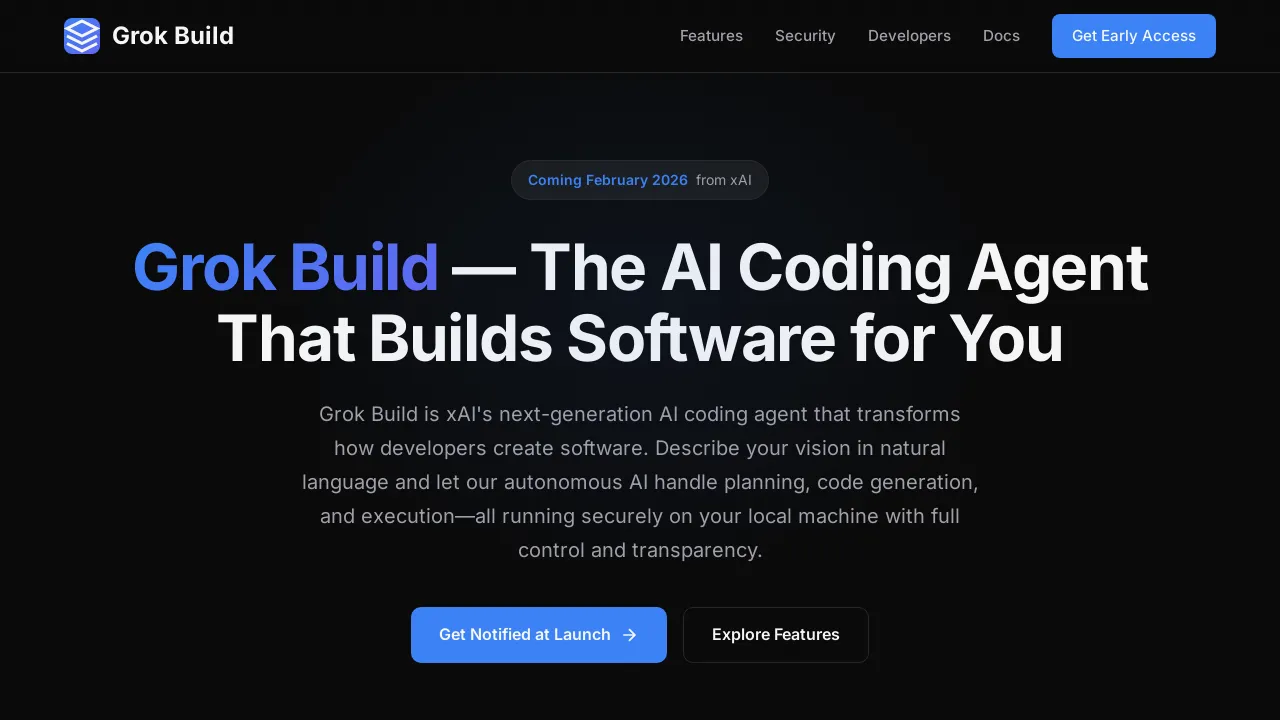
Pricing and Access
For indie hackers, startups, and enterprise dev teams, running autonomous agents can get expensive quickly. Grok 4.5 targets cost per completed task rather than raw parameter size.
- Best For: High-volume agentic pipelines, automated test creation, and headless CI/CD integrations.
- Less Ideal For: Casual one-off prompt queries where simple code completion suffices.
- Watch Out For: Comparing models purely on single-prompt leaderboards without accounting for output token costs.
Real-World Developer Use Cases
So what changes for engineers using it daily? Grok Build leverages parallel sub-agents to divide work across Git worktrees.
| Use Case | Value |
|---|---|
| Refactoring | Faster restructuring across multiple files simultaneously |
| Debugging | Deep context tracking across complex dependency graphs |
| Repo Review | Analyzes full codebase histories using large context windows |
| Tool Orchestration | Executes terminal commands and runs test suites autonomously |
- Refactoring Legacy Code: Generates structural plans before modifying files, reducing accidental regressions.
- Debugging Multi-File Projects: Scans dependencies and applies targeted patches without breaking existing builds.
- Terminal-Heavy Automation: Runs shell commands, verifies test outputs, and iteratively fixes errors.
Expert Insights
“The real shift isn’t better chat — it’s better execution. Developer tools now need to complete tasks, not just explain them.” — AI Tooling & Infrastructure Lead
Grok Build improvements https://t.co/lOJK57wDP5 https://t.co/YVvNgqqXlv
— Elon Musk (@elonmusk) August 3, 2026
Official Documentation & Benchmarks
Developer Resources: • xAI Grok 4.5 Official Announcement • Grok Build Terminal CLI Documentation • SWE-bench Official Leaderboard & Benchmarks • Artificial Analysis AI Benchmark Comparison
If you build software for a living, Grok 4.5 is worth watching not because it talks well, but because it may work more like a teammate than a chatbot.