
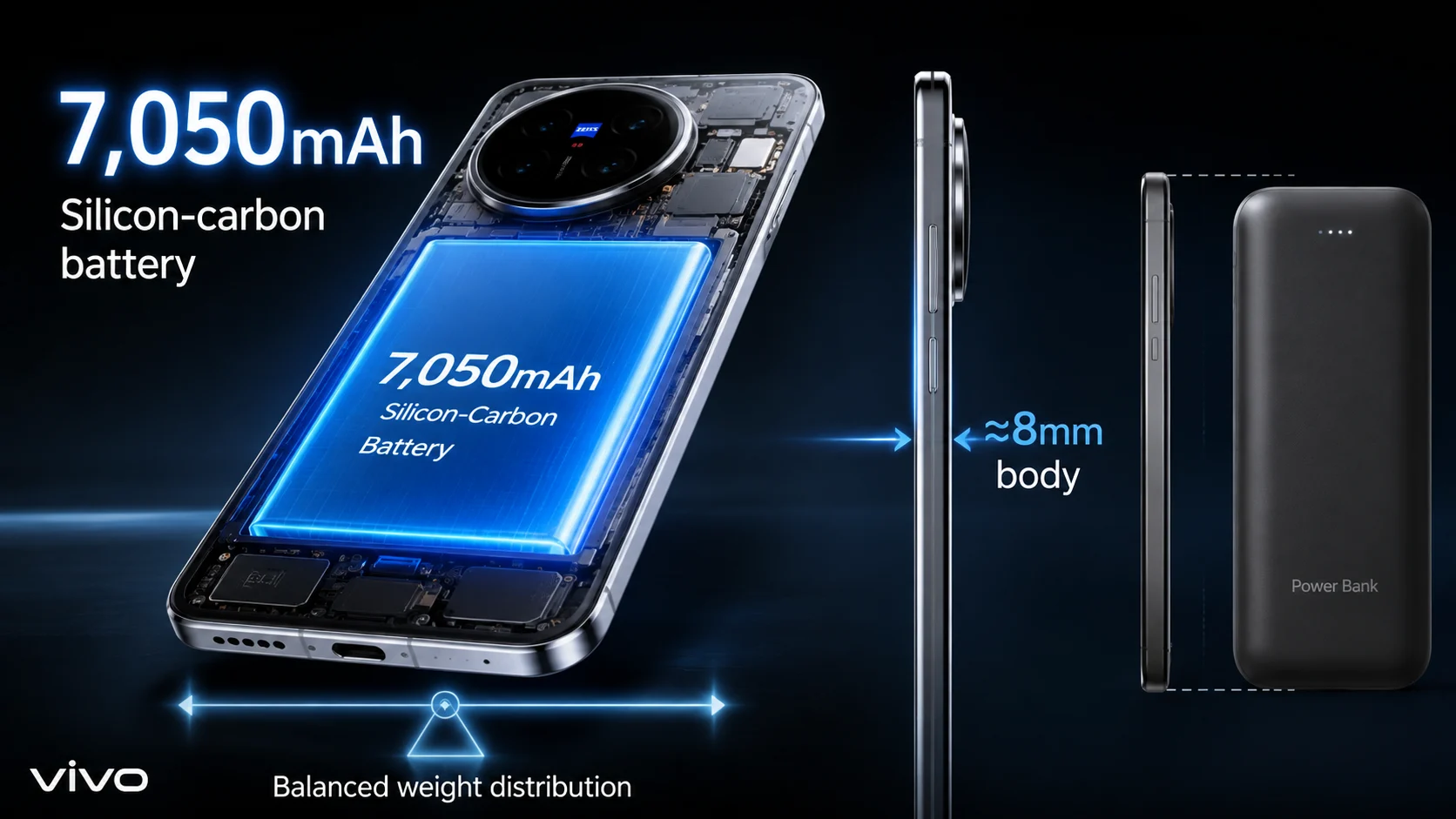
Vivo has brilliantly shattered one of the oldest rules in smartphone design by packing a massive 7,050mAh battery into an astonishingly thin, approximately 8mm chassis!
Can a phone deliver tablet-like battery capacity without feeling like a heavy brick in your hand? With extreme heat waves and heavy daily use draining our phones faster than ever, the race for all-day power has reached a critical boiling point.
The Battery Contradiction
For years, smartphone buyers have had to choose between slim styling, long endurance, and hand comfort. Vivo’s new engineering approach proves that advanced silicon-carbon battery technology can loosen that frustrating trade-off.
Can a phone this thin really carry a battery that large while remaining comfortable for one-handed use? The answer depends on energy density, internal stacking, and weight distribution.
The real test isn’t just the spec sheet; it’s how the phone actually feels when you carry it all day.
Why 7,050mAh Is Significant
A 7,050mAh battery instantly grabs attention, but capacity alone doesn’t tell the whole story. The real secret is how much electrical energy Vivo stores in a tight physical space.
| Measure | What it means |
|---|---|
| 1 gigawatt | Power delivered at a specific moment |
| Battery capacity | The total electrical charge stored, measured in mAh |
| Energy density | How much energy fits into a given volume |
Would you rather have a super-thin phone that dies by afternoon, or a slightly thicker phone that lasts two full days?
The Silicon-Carbon Battery Advantage
The core engineering trick is shifting away from traditional graphite anodes toward silicon-carbon composite materials. Silicon can store substantially more lithium than graphite, though it also expands during charging.
- Silicon-carbon materials help increase overall energy density.
- Special carbon structures manage silicon’s natural expansion.
- Manufacturers must strictly control cycle life and cell swelling.
“Silicon-carbon anodes can improve energy density, but the practical challenge is managing expansion, cycle life and manufacturing consistency,” notes battery materials research from U.S. Department of Energy Storage Grand Challenge.
How the Battery Fits Inside an 8mm Body
A massive battery has to share space with high-resolution displays, multi-lens cameras, and cooling systems. Vivo solved this through clever internal packaging:
- Higher energy density: More stored energy in the exact same cell volume.
- Thin cell construction: Removing unnecessary padding around active layers.
- Internal stacking: Placing components cleverly to wipe out wasted space.
According to specifications from Vivo Official Announcements, the approximately 8mm measurement refers strictly to the main body profile, excluding the camera module bump.
The Real Test: Does It Feel Heavy?
The most compelling angle isn’t just the massive battery spec—it’s whether the device feels balanced during daily scrolling and typing.
- One-handed reading for extended periods.
- Taking quick photos or casual pocket carry.
- Comparing grip comfort with standard 5,000mAh phones.
Cliffhanger: If a slim phone feels top-heavy because of a huge camera module, does the thin frame actually make daily use better?
What the Capacity Does—and Does Not—Guarantee
While a 7,050mAh cell promises great endurance, real-world battery life depends heavily on your daily habits and screen settings.
| Test scenario | What to measure |
|---|---|
| Video streaming | Battery percentage drained per hour |
| 5G browsing | Endurance under active mobile data load |
| Gaming | Heat generation and frame stability |
| Standby | Overnight idle percentage loss |
For verified efficiency benchmarks and real-world testing results, check independent reviews hosted by TechRadar Smartphone Reviews and GSMArena Specifications.
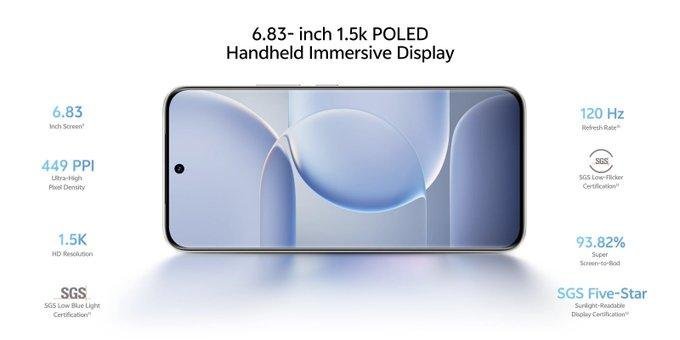
Vivo S2’s officially confirmed specs: – 6.83-inch 3D curved AMOLED display – 1.5K resolution, 120Hz RR, up to 3,000nits peak brightness, 449ppi – 50MP Sony IMX852 main camera – 32MP front camera – 4K video recording (front and rear) – Aura Light Portrait pic.twitter.com/xJXIkzpxXQ
— AD TECH UPDATES (@ADTechUpdates02) August 4, 2026
Resources
To explore further technical documentation and global launch details, visit these official sources: