
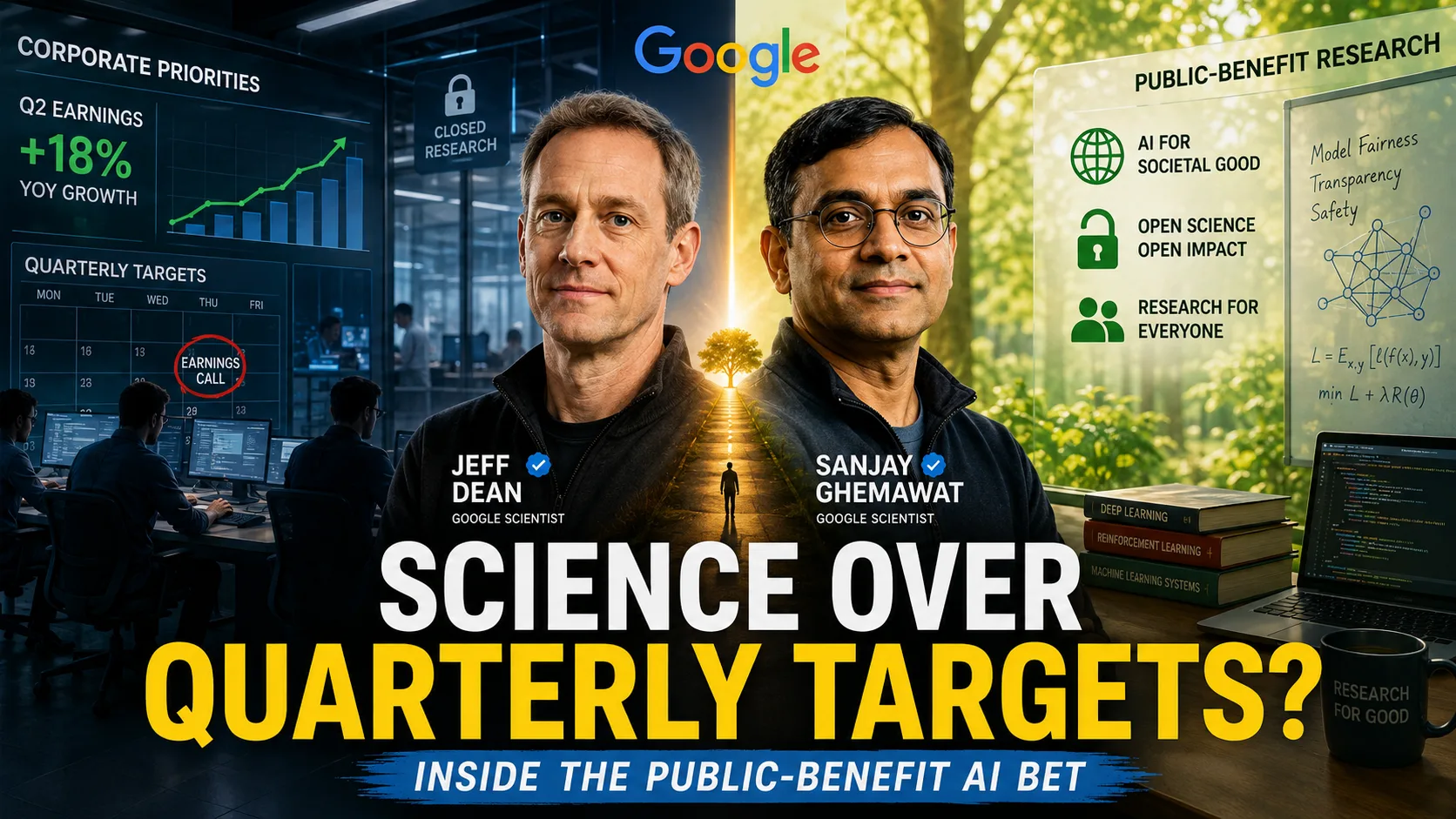
Google’s AI establishment has been dramatically shattered as longtime Chief Scientist Jeff Dean and veteran engineer Sanjay Ghemawat announced they are leaving the tech giant after 27 years!
Can foundational artificial intelligence research truly thrive when it is tied down by corporate quarterly targets and strict product roadmaps?
With tech heavyweights pouring billions into commercial chatbots, a massive industry shift is underway. Elite researchers are starting to walk away from corporate safety nets to prioritize long-term scientific independence.

The Shocking Exit of AI Pioneers
Google’s foundational infrastructure was built by legends like Jeff Dean and Sanjay Ghemawat, whose decades of work powered everything from Google Search to modern neural networks. Now, alongside colleagues Oriol Vinyals and Quoc Le, they have officially departed to launch Discovery Loop—a brand-new venture structured as a Public Benefit Corporation (PBC).
Why would elite architects walk away from the world’s most powerful computing clusters? The move signals that scientific freedom and institutional independence may matter more to top researchers than endless corporate resources.
Important editorial note: Google is participating as a founding investor and cloud partner in Discovery Loop, ensuring a collaborative bridge remains between the tech giant and its departing pioneers.
The Founders’ Legacy at a Glance
| Pioneer | Former Google Role | Venture Contribution |
|---|---|---|
| Jeff Dean | Chief Scientist | Co-founder, guiding large-scale systems architecture |
| Sanjay Ghemawat | Senior Fellow | Co-founder, core systems design lead |
| Oriol Vinyals | DeepMind Research VP | Co-founder, advancing machine learning models |
| Quoc Le | Research Scientist / Co-founder of Google Brain | Co-founder, driving frontier neural network research |

Why Choose a Public-Benefit Corporation?
Unlike standard for-profit tech startups, a public-benefit corporation legally balances financial returns with a defined public mission. Discovery Loop aims to automate machine learning, science, and engineering to speed up global discoveries.
Corporate labs can move at lightning speed, but their priorities are often tied to immediate business products. Can a public-benefit model successfully protect long-term scientific breakthroughs from the pressures of investors?
Traditional Startup vs. Public-Benefit Corporation
- Primary Pressure: Revenue and rapid growth versus balanced public progress.
- Governance: Accountable strictly to shareholders versus obligated to respect a public mission charter.
- Research Horizon: Bound tightly to product release cycles versus open to deep scientific uncertainty.
“The key issue is not whether an agent can see a page; it is whether the platform has clearly authorized that use and can enforce the limits it has set,” notes corporate governance framework studies from organizations like the Electronic Frontier Foundation (EFF).
Scientific Freedom Versus Quarterly Targets
Advanced AI requires massive compute power, but the sharper question is who decides the research agenda? When commercial deadlines collide with complex scientific exploration, product features usually win inside major corporations.
- Commercial Speed: Companies need immediate products and measurable revenue.
- Scientific Uncertainty: Real breakthroughs require a high tolerance for failure and long time horizons.
- Public Accountability: Powerful systems deeply affect society, safety, and information quality.
Could this trend inspire a broader talent migration across Silicon Valley? According to insights from Google Search Central Official Guidelines and tech analysts, transparency and clear governance will define the next era of AI labs. Technical infrastructure details are also closely tracked by platforms like Cloudflare Bot Management Overview and OpenAI Computer Use Announcements.
Announcing Discovery Loop!
— Jeff Dean (@JeffDean) August 5, 2026
I am very excited to announce that, along with my longtime friends and collaborators @Sanjay_Ghemawat, @OriolVinyalsML and @quocleix, we are founding Discovery Loop (@DiscoLoopAI), a Public Benefit Corporation whose mission is to automate machine… pic.twitter.com/ancoplyNvN
What Happens Next for AI Research?
If Discovery Loop succeeds, it could prove that elite scientists do not need to stay inside traditional monopolies to build world-changing technology. If it struggles, the industry may conclude that frontier AI is simply too expensive to research anywhere outside of big tech.
If artificial intelligence is becoming the core infrastructure of modern society, who should truly control the laboratories that create it?