
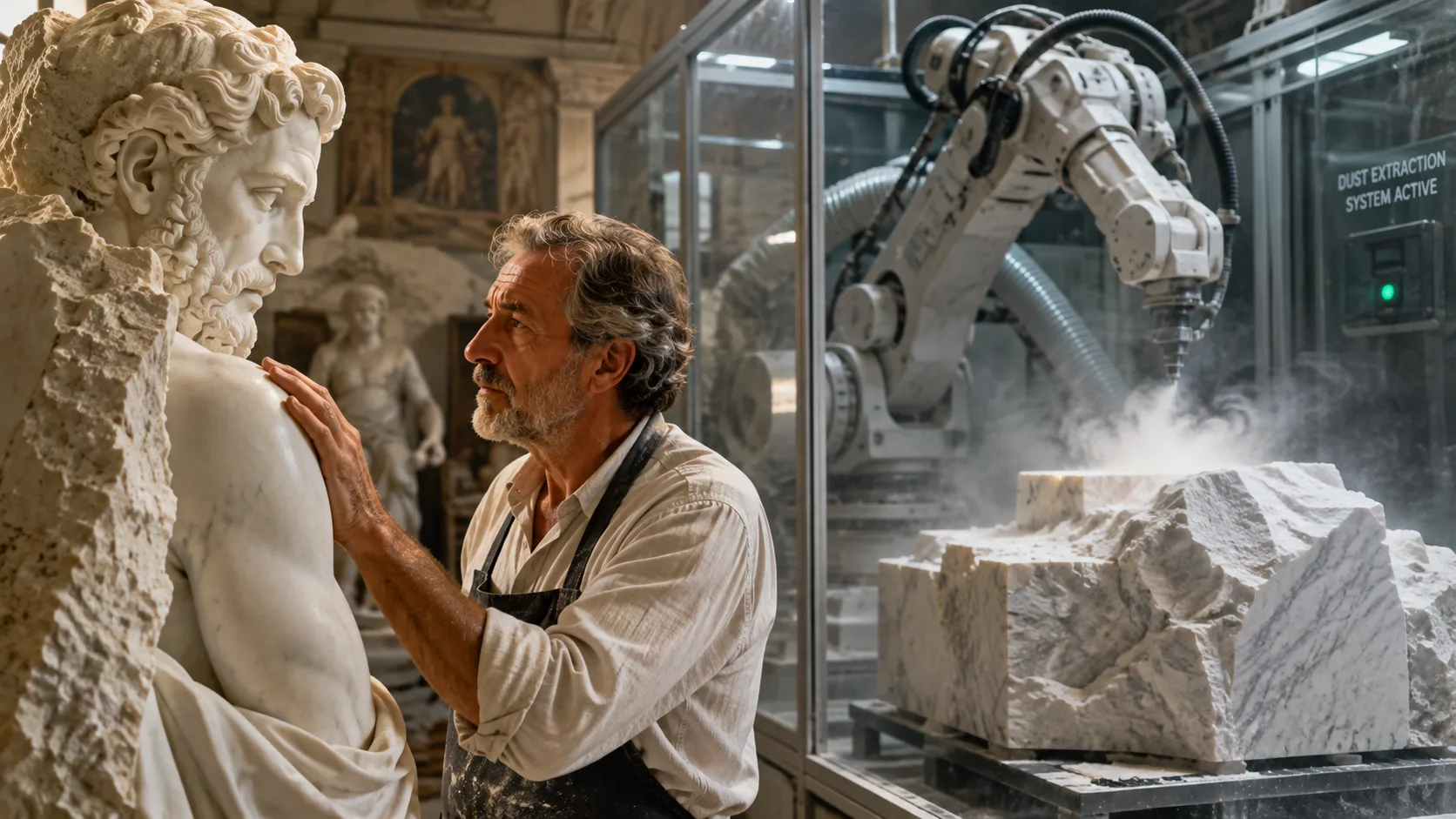
Robots are transforming the most punishing stage of Italy’s stone-carving tradition. In historic quarries and workshops, automated systems handle as much as 99% of heavy rough-cutting, shifting workers away from the stone dust linked to silicosis, an incurable lung disease.
Would you expect an ancient art like stone-carving to be saved by modern robots? As demand for precision sculpture rises, quarry operators face urgent pressure: should master masons still perform the dangerous work that puts their health at risk?
1. The Work Humans Should Not Have to Do
The air inside a traditional stone workshop rings with the deafening roar of diamond saws. Fine white dust settles on every surface, coating the clothes and skin of workers.
The physical difference between rough-cutting and detailed carving is stark. The artistic decisions belong to the mason, while the heaviest cuts increasingly belong to the machine.
| Stage | Traditional Approach | Robotic Approach | Worker Benefit |
|---|---|---|---|
| Rough-cutting | Manual handling | Automated shaping | Less heavy lifting and vibration |
| Dust-producing cuts | Worker operates close to the cut | Robot performs programmed passes | Lower direct dust exposure |
| Fine finishing | Skilled handwork | Human-led detailing | Craft expertise retained |
| Inspection | Manual measurement | Digital scanning | Less physical strain |
2. Why Silica Dust Is the Central Story
Inhaling respirable crystalline silica—the tiny dust particles whipped up during cutting—poses severe health risks. Repeated exposure damages lung tissue, leading to irreversible silicosis.
Because silicosis has no cure, stopping dust exposure matters far more than relying solely on dust masks. Proper ventilation, wet cutting, and complete isolation remain vital even when robots arrive.
According to guidelines from the OSHA Crystalline Silica Overview, engineering controls are the primary line of defense for industrial workers.
“Automation can reduce the time workers spend at the point of dust generation, but it is not a substitute for exposure monitoring, engineering controls, and proper respiratory protection.” —Dr. Marco Bellini, Industrial Hygienist at the Italian National Institute for Insurance against Accidents at Work (INAIL)
3. What “99% Automated” Really Means
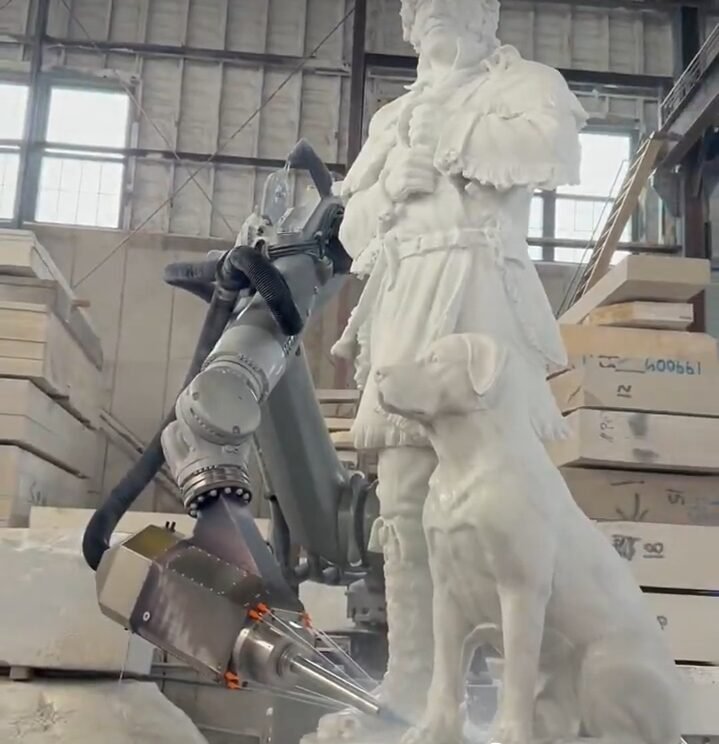
Overstating robotic capabilities helps no one. The 99% figure usually refers specifically to the bulk material removal phase of rough-cutting, not the entire artistic creation.
Workers still supervise, program, maintain, and finish the stone. Does a robot eliminate dust completely, or does it just change where the dust settles?
Important distinction: A robot removes the worker from the immediate cutting action, but dust control still depends entirely on enclosed workspace design, ventilation systems, and verified air-quality measurements.
4. The Human Touch Moves Upstream
The old narrative of “robots versus artists” misses the mark entirely. The robot does not replace the master mason; it changes where human judgment matters most.
Masons now focus on higher-value artistry:
- Reading the natural grain and flaws in marble.
- Choosing final proportions and surface textures.
- Executing delicate, expressive details.
- Translating an architect’s vision into reality.
| Human Expertise | Machine Capability |
|---|---|
| Artistic interpretation | Repeatable rough cuts |
| Material judgment | High-volume material removal |
| Surface finishing | Programmed tool paths |
| Craft correction | Digital measurement |
5. The Joint-Strain Problem
While silicosis grabs headlines, musculoskeletal damage remains a quiet crisis. Masons face years of repeated heavy lifting, awkward postures, and violent tool vibration.
Robots absorb much of that physical punishment. Can machines finally give aging artisans a career free from chronic joint pain?
While robots eliminate heavy lifting, they can also introduce new ergonomic challenges involving computer programming, machine maintenance, and close-quarters equipment monitoring.
6. Italy’s Craft Tradition Meets Industrial Automation
Italy’s stone industry represents a delicate balance between heritage and survival. Famous quarry regions across Tuscany and Carrara rely on specialized labor that is increasingly difficult to recruit.
Automation helps historic workshops preserve their production capacity as older workers retire. Can technology protect a centuries-old cultural heritage from dying out?
“Preserving the craft may require changing the work.”
To explore how advanced manufacturing intersects with cultural heritage, visit the Carrara Trade Fairs and Marble Technology Hub.
7. What Workers and Operators Say
Conversations inside the quarries reveal a pragmatic shift in attitude. Younger workers welcome the reduction in physical injuries, provided traditional apprenticeship programs survive.
- Has dust exposure dropped? Yes, inside enclosed robotic cutting cells.
- Has physical fatigue decreased? Operators report significantly less back and shoulder strain.
- What tasks remain human-led? Final detailing, quality control, and artistic expression.
8. The Limits of the Robotic Fix
Robots are not a magical cure-all. Small family-owned workshops often lack the capital or physical space required for massive robotic cutting arms.
Poorly maintained ventilation systems can still leak hazardous dust into the wider workshop. If a machine performs the cut but workers breathe floating dust nearby, has the job truly become safe?
- Worker training: Artisans must learn digital coding and machine supervision.
- Independent checks: Air quality must be measured continuously, not just assumed.
We’ve barely scratched the surface of what can be done with AI + Robotics.
— LayoffHedge (@LayoffAI) August 5, 2026
This CNC robot in Italy just completed a full-size marble Tyche statue in only 15 days of continuous work.
What used to take master sculptors years… now takes two weeks. pic.twitter.com/Fi5QfIgP25
9. What Comes Next
The future of stone-carving relies on deeper integration between human artistry and machine safety.
Innovations on the horizon include fully sealed robotic cutting pods, advanced laser scanners that minimize stone waste, and wearable air-quality monitors for workshop staff.
Italy’s stone tradition is not choosing between craftsmanship and automation. It is using automation to ensure that great art never again comes at the cost of a worker’s lungs.
Primary Resources
Explore official research and safety frameworks through these trusted links: