
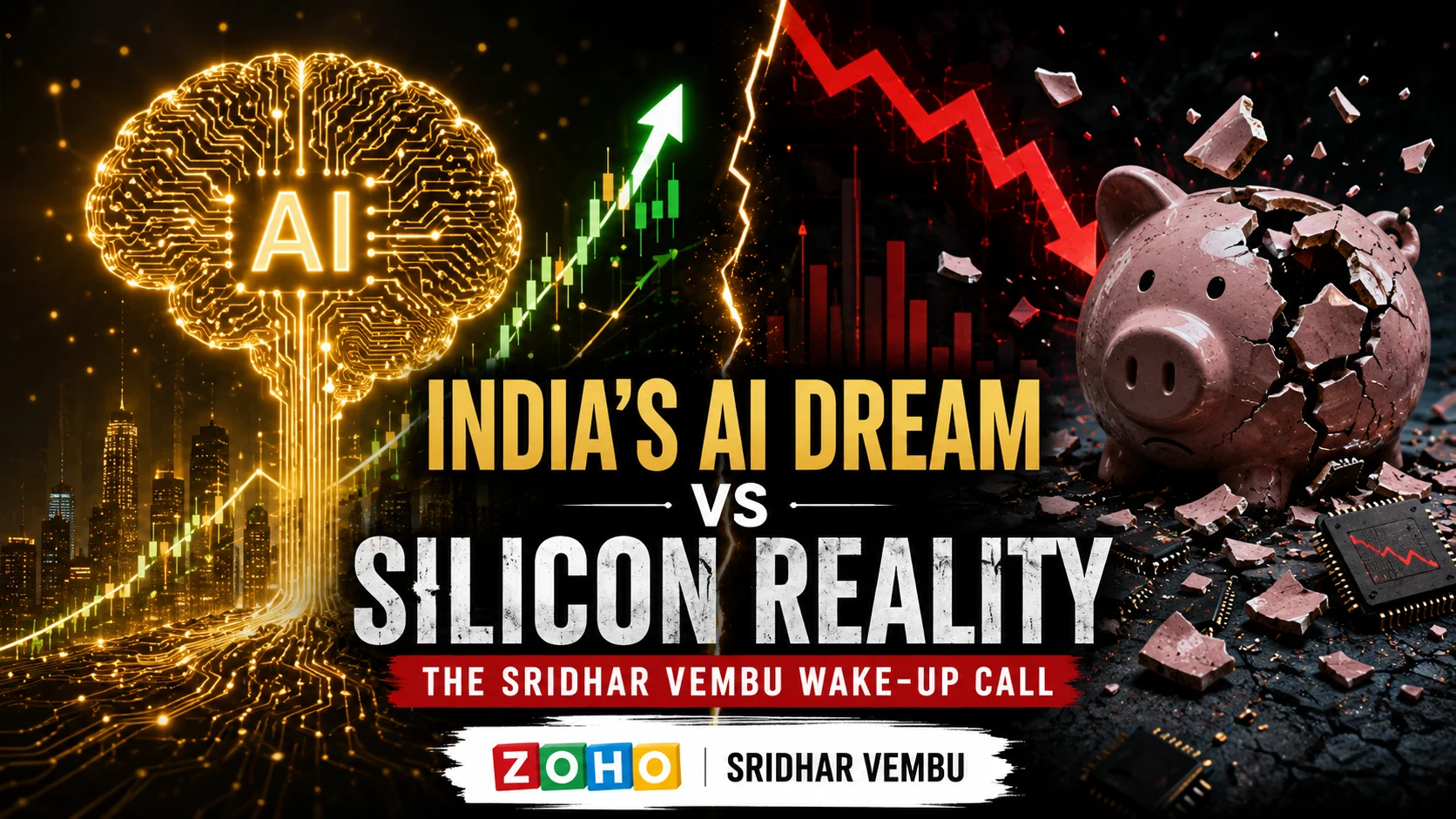
The AI investment bubble is popping — and it terrifies investors. Venture funding into AI startups fell roughly 45% in 2024, leading AI equities dropped about 30% year-to-date, and cloud GPU prices have jumped significantly over two years. Can the tech industry survive this kind of capital shock? Act quickly — founders and VCs must reassess runaway AI spending before valuations implode.
Zoho founder Sridhar Vembu has sounded a sharp alarm, comparing current market valuations to an “insane bubble” that could surpass the 1999 dot-com era. With massive data center capex and complex LLM economics dominating tech headlines, market participants are being forced to look closely at structural sustainability. Do not ignore the writing on the wall — navigate the shifting tech correction before it impacts your portfolio.

Why Vembu Is Warning
- Vembu argues AI is driving unsustainable capital spending on data centers and high-end GPUs.
- He warns that high capex, poor unit economics, and speculative valuations create classic bubble conditions.
- He emphasizes focusing on profitability over growth, leveraging lean engineering, and serving real customer needs.
Breaking Down the Financial Reality
Buying chips and constructing infrastructure changes the baseline metrics for modern tech companies. Startups and major players alike face intense financial pressure regarding how they manage cash and scale operations.
Capex vs. Opex
Capital expenditure (Capex) involves multi-year data center buildouts and heavy upfront hardware purchases, while operational expenditure (Opex) covers recurring cloud compute bills and electricity. Data center buildouts require immense long-term commitments that strain corporate balance sheets.
The Cost of Training and Inference
Running massive models requires incredible computing power. Cost-per-inference metrics dictate whether consumer-facing products can ever turn a profit without continuous venture subsidization.
Unit Economics & ROI
Many early enterprise AI pilots have struggled to prove a definitive payback window within 18 to 36 months, leaving investors questioning future cash flows.
| Cost Type | Example | Impact |
|---|---|---|
| Capex | GPUs, Data Centers | Long-term debt and heavy cash outflow |
| Opex | Cloud GPU hours, Energy | Gross margin pressure and cash burn |
| Valuation | Revenue multiples | Downside risk during market corrections |
Evidence of a Slowdown
Market signals increasingly align with Vembu’s cautionary outlook on the AI hype cycle.
- Venture funding to early-stage AI startups has faced sharp quarterly contractions compared to peak hype periods.
- Tech giants are balancing strategic layouts with targeted hiring freezes and restructuring.
- Public market corrections have hit over-leveraged infrastructure plays hard.

Counterarguments: Why Some Say the Boom Is Justified
- Proponents argue that continuous productivity gains across global industries justify high long-term TAM (Total Addressable Market) projections.
- Deep-pocketed tech giants (Microsoft, Google, Amazon) can absorb short-term infrastructure losses to lock in market share.
- Emerging commercial models like specialized AI-as-a-Service are gradually improving product-level unit economics.
Will There Be A Major Correction? Scenarios
- Mild Correction: Valuations reprice by 20% to 40%, cleaning out over-hyped startups while long-term infrastructure consolidation takes place.
- Market Correction: A sharper contraction hits speculative technology equities, leading to capital scarcity, though core data pipelines and cloud frameworks survive.
- Systemic Crash (Unlikely): Severe credit tightening causes sudden liquidity crunches, triggering wider tech market contagion.
What Founders and Investors Should Do Now
- Tighten unit economics: Closely monitor your cost-per-inference, Customer Acquisition Cost (CAC), and Lifetime Value (LTV).
- Extend runway: Cut discretionary opex and negotiate flexible cloud pricing agreements.
- Prioritize revenue: Build sustainable, paying customer bases before scaling raw compute workloads.
- Hedge infrastructure risk: Mix hybrid cloud setups with localized resources to avoid vendor lock-in.
Policy, Macro, and Infrastructure Risks
- Elevated interest rates make massive upfront capital expenditures significantly more expensive to finance.
- Rising local energy grid costs and data-center environmental regulations squeeze operational margins.
- Emerging global antitrust scrutiny and AI compliance mandates could slow enterprise deployment velocity.
Quick Checklist for Investors
- Ask portfolio teams: What is the explicit path to positive gross margins?
- Demand transparent unit-economics reporting and cost-per-inference data tracking.
- Watch out for heavy customer concentration and rigid enterprise contract structures.
- Plan realistic exit strategies accounting for potential down-rounds.
“Memory prices up 500% in 12 months and 10x the lowest level” Memory prices, along with AI token prices have made business very difficult. We have held back from raising prices but it is becoming hard. A techncial note: for a long time, programming languages were designed with…
— Sridhar Vembu (@svembu) August 17, 2026
Vembu’s warning isn’t just rhetoric — it’s a financial reminder: if the massive spending behind artificial intelligence lacks solid underlying unit economics, the market can reprofile overnight. Prepare your strategies now.
Do you think the broader tech sector is headed for a sharp correction? Share your take below.