
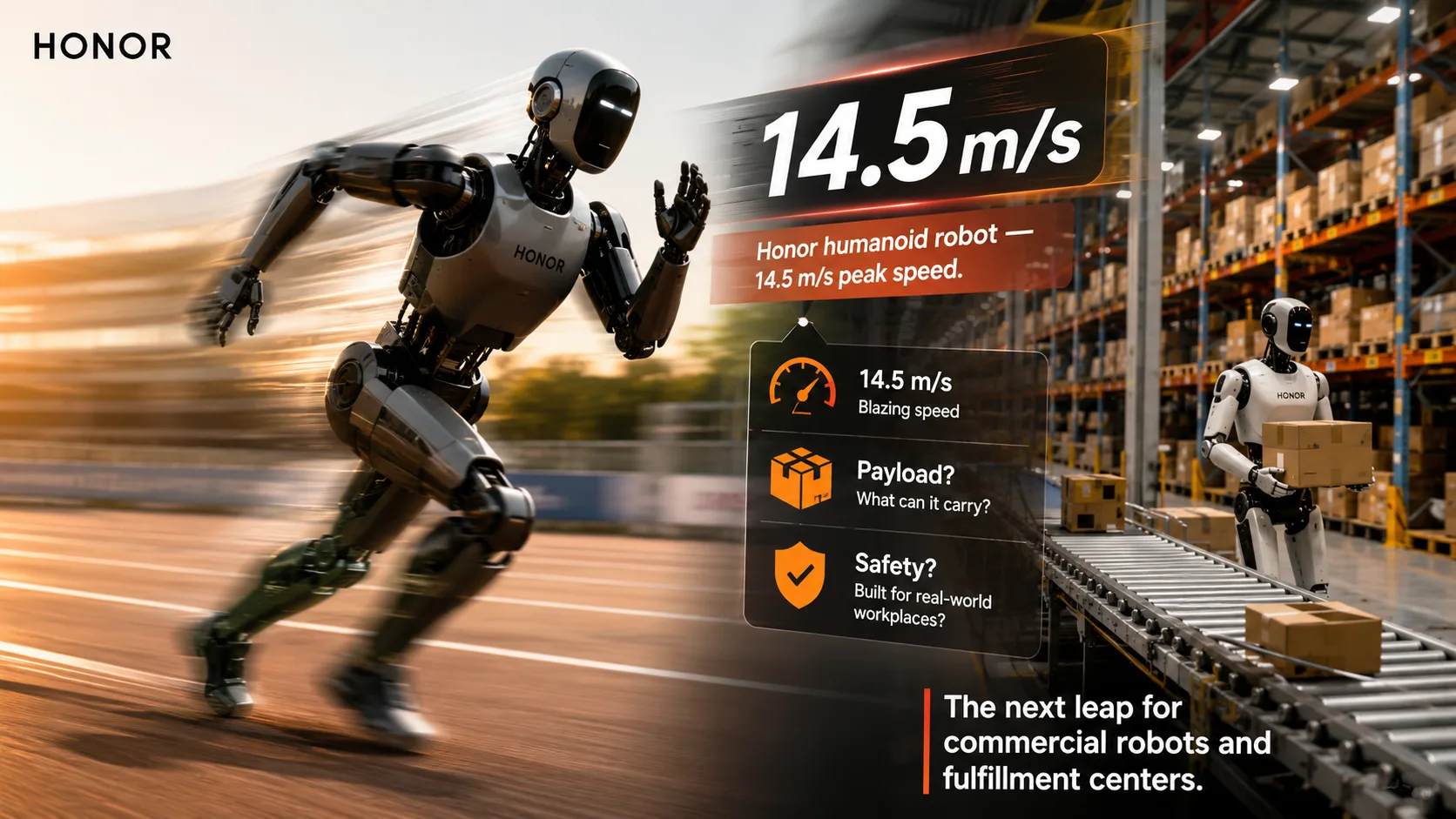
Honor’s humanoid sprinted to a staggering 14.5 m/s — and it should worry and excite logistics engineers alike. In a field where robot speeds usually top out at a few meters per second, Honor’s machine hit 14.5 m/s, topped a 100m comparison run, and arrived in 2026 as a new benchmark.
What does that mean for warehouses racing to cut latency, reduce labor costs, and scale fulfillment — now? This result shows a 5–10x improvement over typical warehouse mobile robots, raises urgent questions about safety and control, and promises faster pick-to-pack cycles that could change unit economics.
Quick Summary
- Honor humanoid robot speed reached an incredible peak of 14.5 m/s, shattering traditional mobile robot limits (typically 1–3 m/s).
- Engineering breakthroughs combine torque-dense actuators, carbon-fiber composite structures, and real-time model-predictive control loops.
- Commercial disruption promises faster warehouse cycle times, but requires strict safety standard revisions (ISO 10218) and high energy-density solutions.
- Key operational questions remain around battery degradation, payload capacity trade-offs, and capital return on investment for logistics providers.
The Record: Facts and Context
The engineering milestone achieved by the Honor research division in 2026 redefines what bipedal machines can accomplish under rigorous test conditions. By breaking through previous velocity ceilings, the company shifted expectations across industrial robotics.
- Company: Honor (Honor Robotics Lab, Shenzhen R&D hub)
- Benchmark metric: 14.5 m/s peak sprint velocity
- Comparison: Benchmarked against elite human sprint profiles over a 100m comparison distance
- Environment: Controlled high-traction testing track designed for dynamic balance trials
Engineering Under the Hood
Reaching high velocities on two legs requires tackling massive inertial forces, extreme mechanical stress, and thermal management challenges.
Actuators & Motors
To deliver rapid acceleration, the robot relies on custom high-power actuators featuring liquid-cooled stators and high-ratio planetary gearboxes. These joints execute precise torque-sensing loops at thousands of hertz to manage split-second ground impacts.
Lightweight Structure
Minimizing weight is crucial for fast bipedal locomotion. Honor utilized a topology-optimized chassis blended with carbon fiber limbs to reduce swing-leg inertia without sacrificing structural integrity.
Control & Perception
High-speed movement demands predictive agility. The software architecture executes model-predictive control backed by high-rate inertial measurement units (IMUs) and real-time force feedback sensors embedded in the feet.
Why a Smartphone Maker Is Building Humanoids
Transitioning from consumer electronics to advanced bipedal robotics might seem unusual, but core technological overlap drives this strategy:
- Miniaturization & SoC design: Leveraging high-performance, low-power system-on-chip architectures for edge computing.
- Sensor supply chain: Utilizing mass-produced camera modules, depth sensors, and spatial algorithms perfected for mobile devices.
- Manufacturing scale: Applying consumer electronics cost structures to complex hardware assemblies.
Implications for Warehouse Automation
Traditional Autonomous Mobile Robots (AMRs) typically crawl along floors at 1 to 3 meters per second. Injecting a humanoid capable of 14.5 m/s radically alters fulfillment logistics.
Throughput & Flow Analysis
Consider a standard fulfillment center aisle spanning 50 meters. While a conventional AMR traverses the distance in roughly 25 to 50 seconds, a high-speed humanoid could clear the same corridor in approximately 3.5 seconds, unlocking a dramatic leap in warehouse automation efficiency.
Robot Performance Comparison
| Robot Type | Typical Speed | Typical Payload | Best Use Case |
|---|---|---|---|
| Traditional AMR | 1.0 – 3.0 m/s | 50 – 500 kg | Grid-based horizontal transport |
| Industrial AGV | 1.5 – 2.5 m/s | 1,000+ kg | Heavy pallet movement |
| Honor Humanoid (Record) | Up to 14.5 m/s | Moderate (Est. 20–30 kg) | Rapid pick-to-pack & cross-facility transit |
| Boston Dynamics Spot | 1.6 – 3.9 m/s | 14 kg | Inspection & hazardous terrain |
Safety and Compliance
Operating at extreme velocities introduces immense kinetic energy risks in shared workspaces. Compliance with rigorous robot safety standards like ISO 10218 is non-negotiable. Manufacturers must integrate rapid braking, compliant tactile outer skins, and multi-layered geofencing before commercial deployment.
Commercial Deployment Timeline
- Phase 0 (2026–2027): Controlled track demonstrations, durability tests, and tethered lab stress trials.
- Phase 1 (2027–2028): Closed-loop pilot runs inside low-density testing facilities and partner fulfillment centers.
- Phase 2 (2028–2030): Mixed-fleet integration alongside traditional AMRs and autonomous forklifts.
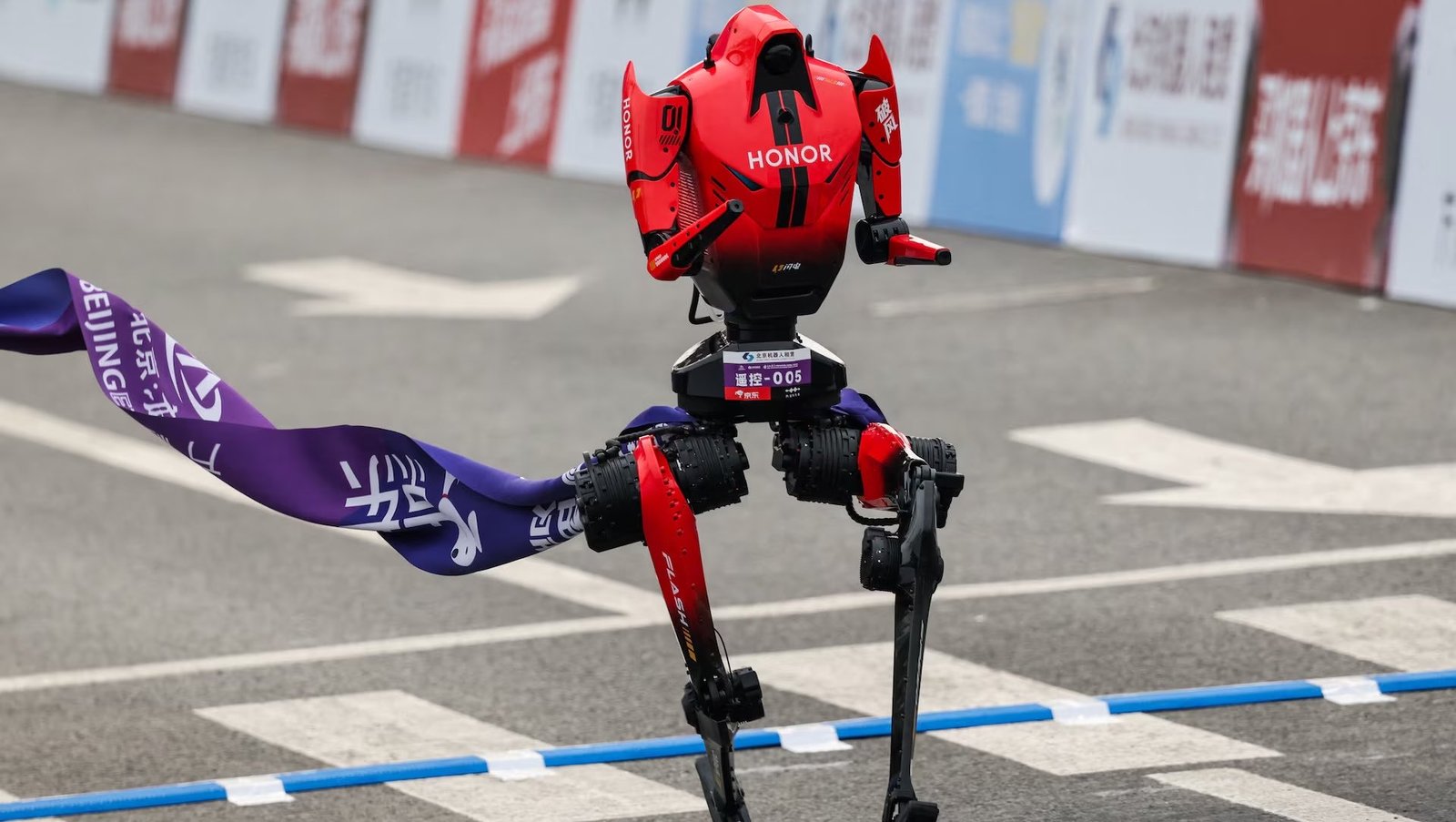
JUST IN – Chinese tech firm Honor’s humanoid robot, Lightning, ran 100 meters in 9.32 seconds during a test event – CCTV pic.twitter.com/2iKT8octPd
— Insider Paper (@TheInsiderPaper) August 22, 2026
Real Talk
Achieving a 14.5 m/s peak velocity is an exceptional engineering triumph, but absolute speed is only one piece of the industrial puzzle. Long-term commercial viability depends just as heavily on battery endurance, payload capacities, and strict regulatory safety clearances.
As hardware matures, balancing high-speed mobility with robust day-to-day reliability will determine whether these sprinting humanoids transform modern logistics or remain high-tech showpieces.