
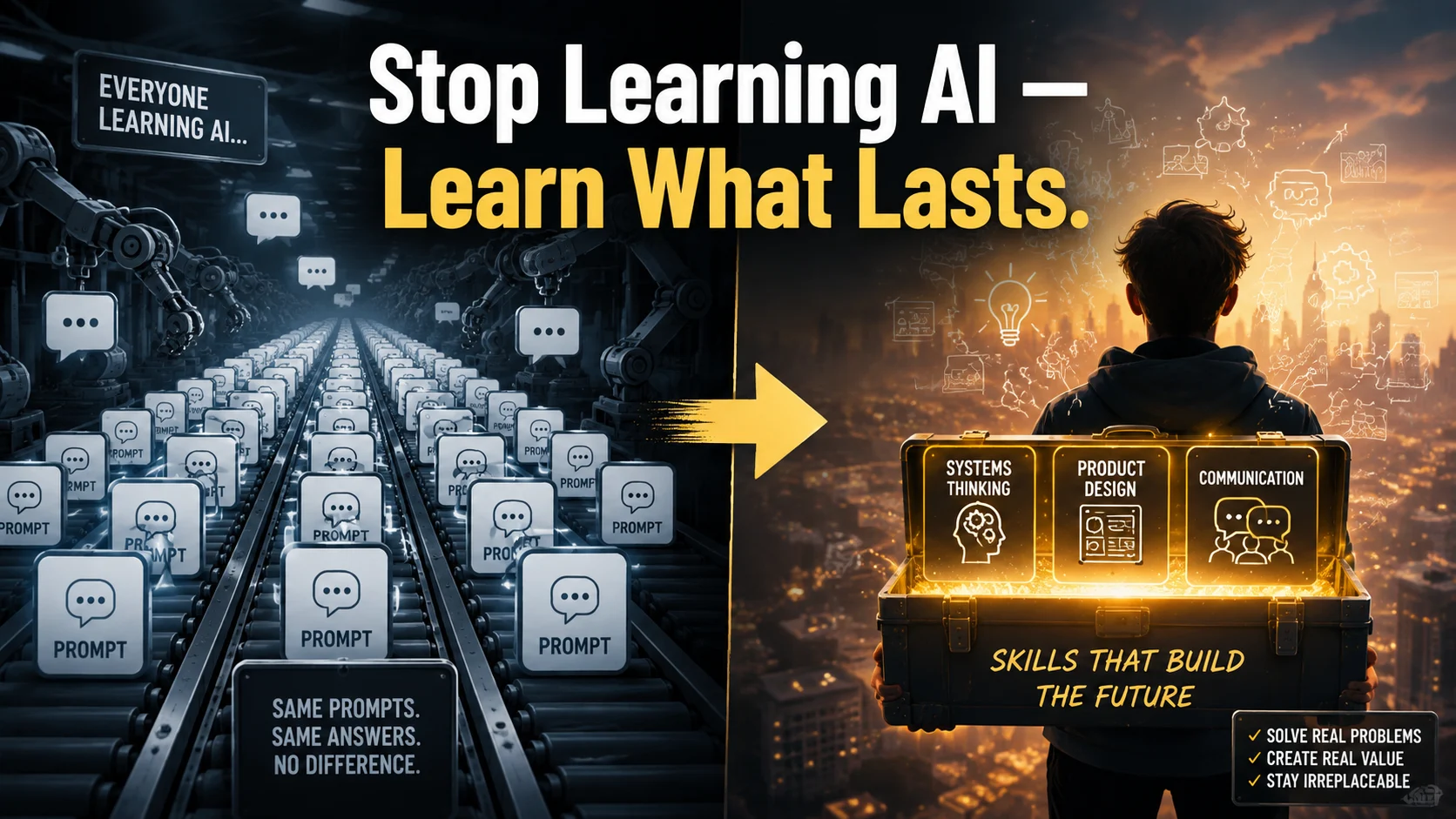
Stop — your future career could be slipping away as you chase flashy AI tricks. Eighty percent of hiring managers now list basic AI tool familiarity as table stakes, while prompt-only contract rates have dropped by over 22% in past quarters.
Are you still pouring months into mastering chatbot prompts instead of building systems that scale? If prompt-engineering is fast becoming a commoditized trap, you need a different plan before the job market leaves you behind.
Why Prompt-Engineering and Surface-Level AI Skills Are Commoditizing
The barrier to entry for typing instructions into a chatbot is effectively zero. Because millions of young professionals can learn basic syntax in an afternoon, prompt marketplaces and template libraries have saturated the freelance economy with cheap labor.
- Low barrier to entry: Anyone with an internet connection can write a prompt, stripping away any unique technical moat.
- Proliferation of templates: Automated prompt libraries and UI wrappers now handle what used to be specialized work.
- Rapid abstraction: Tool builders are actively burying prompt engineering beneath simpler, point-and-click user interfaces.
Commoditization happens when a skill becomes so easy to replicate that employers stop paying premium wages for it.

Hard Signs From the Market
Recent economic indicators prove that surface-level tool mastery no longer guarantees job security. While overall job postings mentioning AI have surged by over 45% year-over-year, specialized roles demanding only prompt design have seen flat or declining compensation packages.
- Over 60% of junior freelancers report fierce pricing competition for basic text-generation gigs.
- Major tech companies are shifting budgets toward deep infrastructure rather than surface-level wrappers.
- GitHub Copilot and similar assistants have turned code generation into a commodity rather than a rare skill.
What problem would you solve if you had to ship an AI feature with zero downtime?
What Silicon Valley Veterans Actually Recommend
Seasoned engineering leaders and product veterans are telling Gen Z to pivot away from fleeting software fads and toward durable human skills. These foundational abilities remain valuable regardless of which model dominates the market next year.
- Systems thinking and software architecture: Understanding how data flows across an entire distributed system gives you leverage over any single tool.
- Product sense and human-centered design: Knowing what to build for real human needs is far more valuable than letting an algorithm guess.
- Domain expertise: Deep knowledge in finance, healthcare, or logistics allows you to apply technology to genuine, complex constraints.
- Rigorous problem-solving: Breaking down ambiguous technical bottlenecks separates senior builders from tool operators.

A 12-Month Roadmap to Future-Proof Your Career
Moving away from shallow AI mastery requires a structured, intentional learning path. Use this quarterly roadmap to build deep, non-commoditized expertise.
| Phase | Core Focus | Key Milestone |
|---|---|---|
| Months 0–3 | Foundations & Systems | Master basic data structures, networking, and systems thinking. |
| Months 3–6 | Hands-On Engineering | Build API integrations, data pipelines, and error-handling mechanisms. |
| Months 6–9 | Product & Domain Work | Ship a complete, user-tested feature in a specific industry domain. |
| Months 9–12 | Infrastructure & Scale | Learn MLOps basics, system monitoring, and reliability engineering. |
How to Show Durable Skills to Employers
When applying for competitive roles, hiring managers look past resume buzzwords to examine concrete artifacts. Your portfolio should prove you can solve messy real-world problems.
- Include system design documents that outline trade-offs, bottlenecks, and scaling strategies.
- Share postmortem write-ups of broken applications you successfully debugged and refactored.
- Publish reproducible data pipelines with comprehensive automated tests and clear documentation.
System design and architectural judgment are impossible for current AI models to fabricate without deep human guidance.
Also Read: Google’s Top AI Engineers Are Betting on Public-Benefit Research
Common Counterarguments — and Rebuttals
“But AI is everywhere — shouldn’t I become an expert in prompts?” Prompts are merely user interfaces, equivalent to knowing how to type on a keyboard. True leverage comes from understanding what happens underneath the interface.
“I want quick money freelancing with prompts.” Chasing short-term freelance trends guarantees a career plateau as automation advances. Building durable skills takes more upfront effort, but it compounds over decades.
Which of these durable skills scares you the most — and why?
Jeff Dean, on his first day out of Google, says Gemini’s focus on coding was lagging and the company is working to catch up.
— Fireside Alpha (@firesidealpha) August 19, 2026
“I think we had a little bit, we wanted to make the model good at lots of things.”
“So I think maybe our focus on making it amazing at coding was lagging… https://t.co/ZZFSH7g5G1 pic.twitter.com/gfOSGgS9VW
Practical Resources to Start Today
To build real engineering and problem-solving depth, turn to foundational academic and industry standards rather than quick-fix tutorial sites.
- Read Designing Data-Intensive Applications by Martin Kleppmann to master scalable system architecture.
- Explore free computer science curricula from MIT OpenCourseWare and Stanford HCI research groups.
- Practice infrastructure tools like Docker, Airflow, and basic cloud monitoring pipelines.