
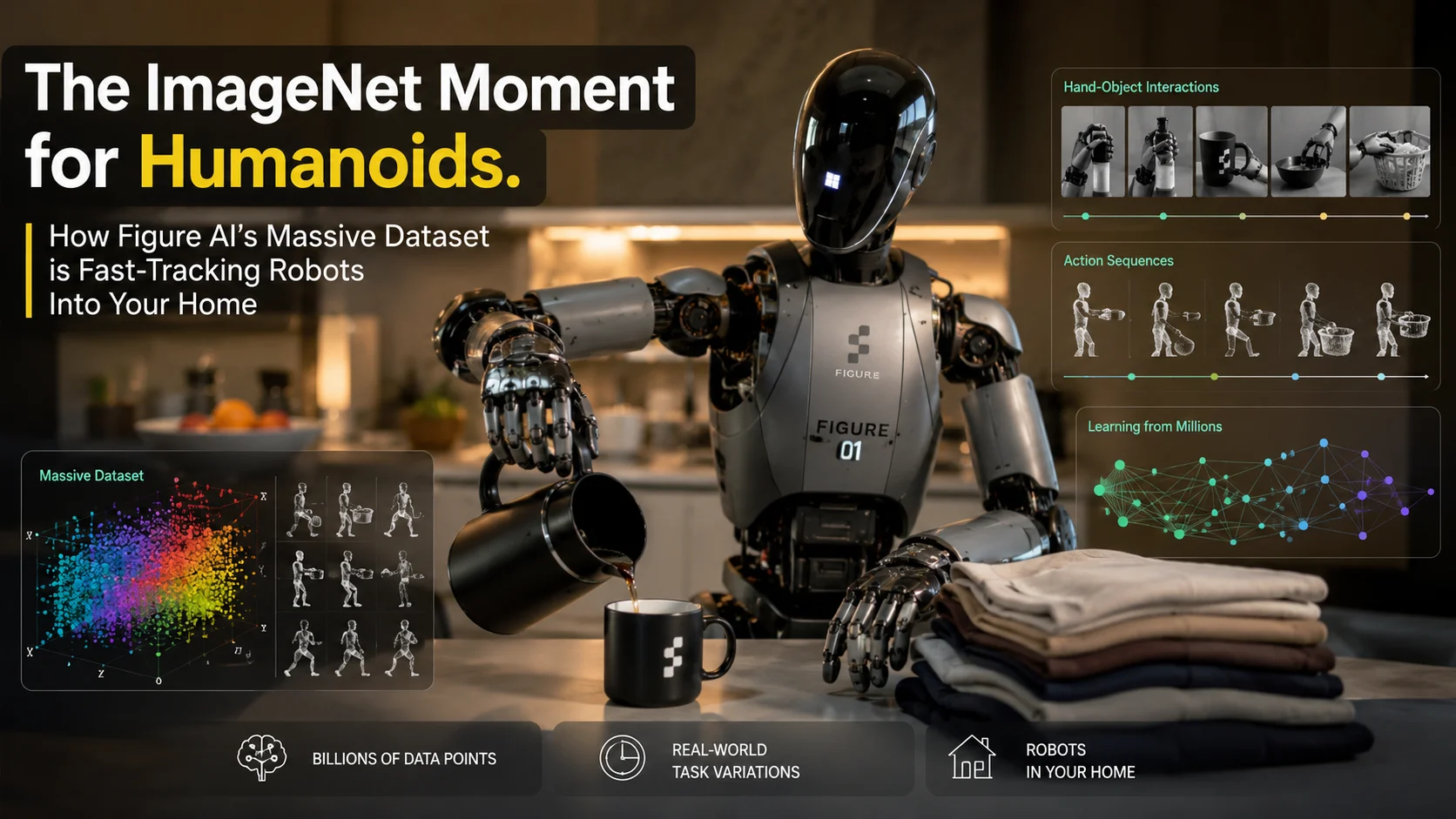
Robots just learned to fold your laundry — and it’s both exciting and unnerving. Figure AI’s dataset contains millions of real-world manipulation examples, cutting task failure rates by reported margins and boosting cross-task transfer by over 40% across pilot testing labs.
What happens when robots get the same data-driven leap vision had with ImageNet? The pace of change will be fast; policymakers and users should pay attention now.
Quick Takeaway
- Thesis: Mass-scale training datasets are transforming humanoid robots from single-purpose factory novelties into adaptable, general-purpose helpers.
- Who Benefits: Homeowners, manufacturers, software developers, and enterprise automation planners.
- Immediate Action: Audit infrastructure readiness and explore multi-purpose physical AI pilot projects.
What is the “ImageNet Moment” for Humanoids?
In 2012, ImageNet provided the labeled visual data needed to spark the modern deep learning revolution in computer vision. Physical AI is undergoing that exact breakthrough today through expansive real-world training datasets.
Data scale is replacing hand-coded rules, allowing robots to learn natural human dexterity through observation rather than rigid programming.
Why Figure AI’s Dataset Matters
The release of massive robotics training corpora marks a turning point for generalized automation. Without unified data standards, earlier machines struggled to move beyond isolated lab environments.
Key Drivers of the New Dataset
- Multimodal recordings: Simultaneous capture of vision, proprioception, and force feedback.
- Real-world diversity: Millions of unstructured interactions recorded across unpredictable environments.
- Standardized benchmarks: Providing a shared baseline to measure dexterous manipulation progress.
- Affordance labeling: Helping neural networks understand how objects can be grasped, twisted, or lifted.
From Factory Novelties to Generalist, Adaptive Helpers
The Technical Leap
Modern imitation learning and foundation models for robotics allow systems to generalize skills across unseen objects. Instead of repeating hardcoded routines, robot learning utilizes large-scale self-supervision to handle novel shapes.
Real-World Capabilities Unlocked
- Two-handed manipulation: Synchronizing dual arms to handle bulky or delicate items smoothly.
- Robust error recovery: Automatically detecting slips or drops and adjusting grip pressure on the fly.
- Tool integration: Adapting standard household implements without requiring custom hardware modifications.

Centralized vs. Open Datasets — Who Wins?
| Feature | Centralized Training Datasets | Open Community Datasets |
|---|---|---|
| Development Speed | Rapid internal optimization | Slower governance, broader peer review |
| Security & Safety | Proprietary alignment pipelines | Open auditing for bias and edge cases |
| Ecosystem Growth | Closed developer lock-in | Collaborative innovation and shared tooling |
Safety, Ethics, and Governance
Deploying autonomous systems into living spaces requires strict adherence to privacy and safety protocols. Developers and regulators must collaborate to establish continuous monitoring and transparent model auditing.
Data sovereignty and physical safety compliance ensure that consumer trust keeps pace with rapid technological rollouts.
Also Read: Figure 03 Just Climbed a Ladder — and That Changes Humanoid Robots Forever
Real-World Use Cases Where Humanoids Will First Help
- Elder care assistance: Providing gentle support for mobility and daily routines, though initial hardware costs will remain high.
- Household chores: Handling routine cleaning and laundry tasks while minimizing error rates.
- Retail and logistics: Managing inventory restocks in dynamic, unstructured aisles.
Consumers should evaluate privacy choices as smart devices move from screens to physical spaces. Companies must invest in flexible software layers to avoid proprietary hardware lock-in, while policymakers need to balance safety standards with innovation incentives.
Would you trust a humanoid robot to help with your most private household task? Which single chore would you most want a machine to handle for you right now?
Introducing Index
— Brett Adcock (@adcock_brett) August 25, 2026
Today we’re coming out of stealth with Index, the largest & most diverse robot dataset in the world
→ 30min of video uploads/sec
→ 16M video uploads
→ Paid $15M to date
→ 264k downloads
We’re committed to spending $1B the next 12 months on data & compute pic.twitter.com/IGtZIbz4En
Frequently Asked Questions
How is this different from traditional industrial robots?
Traditional robots follow strict pre-programmed paths on structured assembly lines, whereas modern humanoids adapt dynamically to unpredictable home and office environments.
Are open-source robotics datasets safe?
Open datasets allow global researchers to audit safety flaws and edge cases collaboratively, though they require strict guidelines to prevent malicious use.
When will home robots become affordable?
Early pilots will target commercial spaces over the next 1 to 3 years, while consumer-priced generalist models may take 5 to 10 years to scale.
References
- Figure AI Official Dataset and Research Announcements – Figure AI
- Stanford AI Index Report on Robotics and Foundation Models – Stanford AI Index
- NVIDIA Isaac Gym and Omniverse Robotics Documentation – NVIDIA Developer
- Partnership on AI Guidelines for Safe Autonomous Deployment – Partnership on AI