
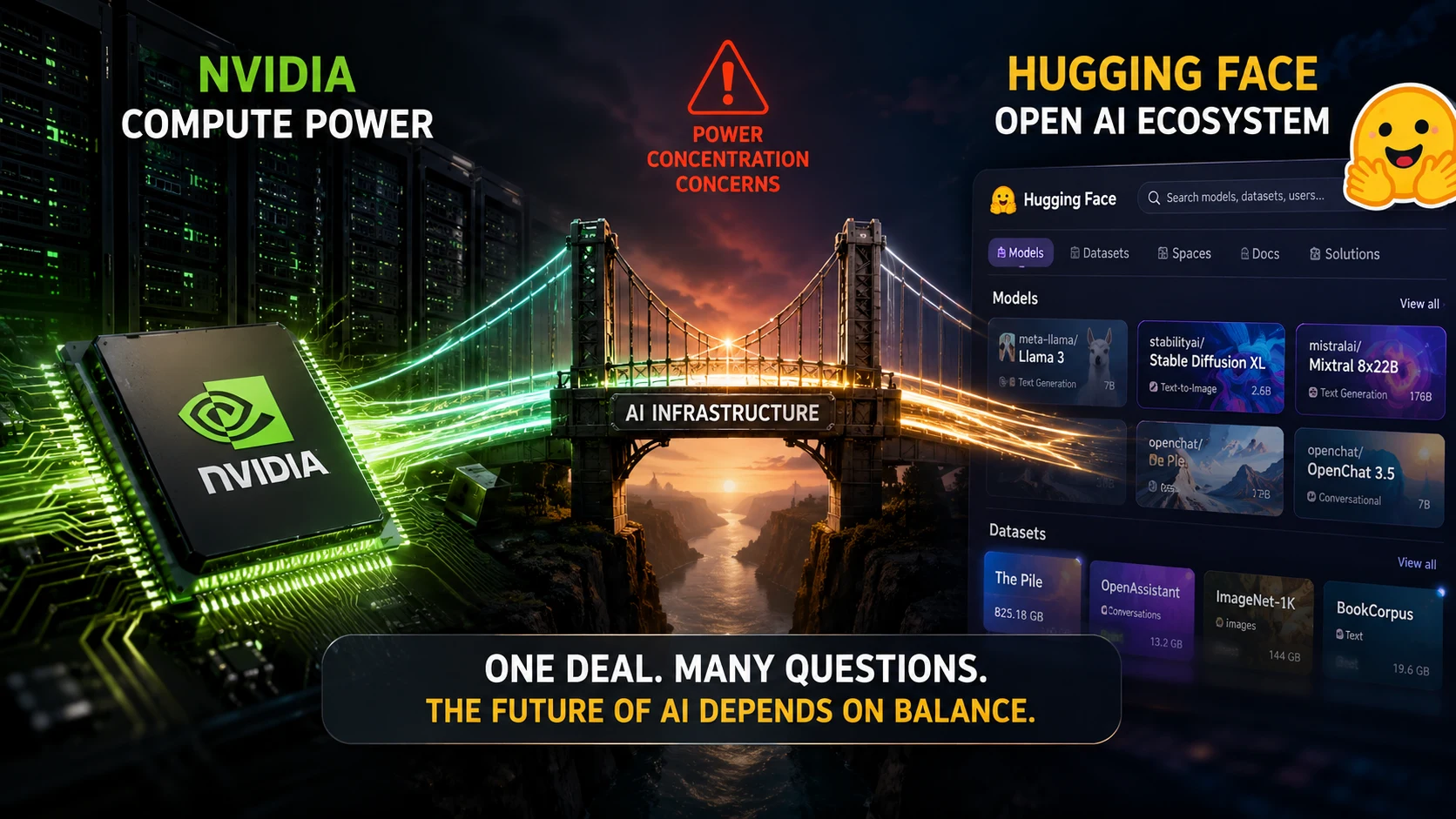
Nvidia’s reported $12.9 billion move has stunned the AI world, and the bigger story is not the price tag but the underlying power shift.
If the world’s top chipmaker also controls the biggest hub for open-source models and datasets, who really owns the future of artificial intelligence? That question is urgent because developers now depend on both the compute layer and the distribution layer more than ever.
Quick Takeaway
- Thesis: The Nvidia Hugging Face acquisition merges hardware dominance with model distribution, reshaping the open-source AI ecosystem.
- Who Benefits: Enterprise infrastructure planners, hardware giants, and developers seeking streamlined deployment tools.
What the Nvidia Hugging Face Acquisition Really Changes
When tech giants make multi-billion-dollar bets, market dynamics shift overnight. Hugging Face hosts millions of open-source large language models and datasets, acting as the digital town square for modern developers. By absorbing this community hub, Nvidia bridges the gap between raw hardware manufacturing and software distribution.
Vertical integration allows a single enterprise to influence everything from the silicon powering a server to the model repository where developers discover code.
Why Model Hosting Matters as Much as Chips
Graphics processing units provide the raw compute required to train advanced networks, but software repositories dictate how those networks are shared and deployed. Owning both layers creates a powerful feedback loop.
Key Integration Vectors
- Ecosystem lock-in: Streamlining model deployment specifically for proprietary hardware architectures.
- Discovery advantages: Prioritizing optimized frameworks within the primary developer marketplace.
- Resource pooling: Fast-tracking model training pipelines directly through unified cloud interfaces.
How Independent Developers Could Feel the Impact
Independent creators have long relied on open platforms to build and distribute lightweight applications without gatekeepers. A consolidated infrastructure introduces new variables regarding neutrality and access.
Developer dependence deepens when the tool provider and the marketplace belong to the same parent organization.
Also Read: Bypassing the Grid: How SpaceX and NVIDIA Could Move AI Compute Into Orbit
The Hidden Risk Behind a More Integrated AI Stack
As closed-model competitors like OpenAI and Anthropic develop custom silicon alternatives, hardware diversification is accelerating. Consolidating open-source distribution under a hardware titan changes the competitive landscape significantly.
What happens when the same company influences both AI compute and AI distribution? Can open-source AI stay truly open if its primary infrastructure becomes centralized? Will developers embrace the operational efficiency, or worry about vendor lock-in?
Frequently Asked Questions
What makes the Nvidia Hugging Face acquisition different from past tech deals?
It bridges physical semiconductor manufacturing with digital software distribution, merging hardware control with the world’s largest open-source model repository.
How does this affect closed-source competitors?
Rivals building custom chips to bypass hardware monopolies now face an adversary deeply embedded in community-driven software distribution.
Will open-source models remain freely accessible?
While core models remain open, platform governance, default toolsets, and optimization paths may increasingly favor native infrastructure hardware.
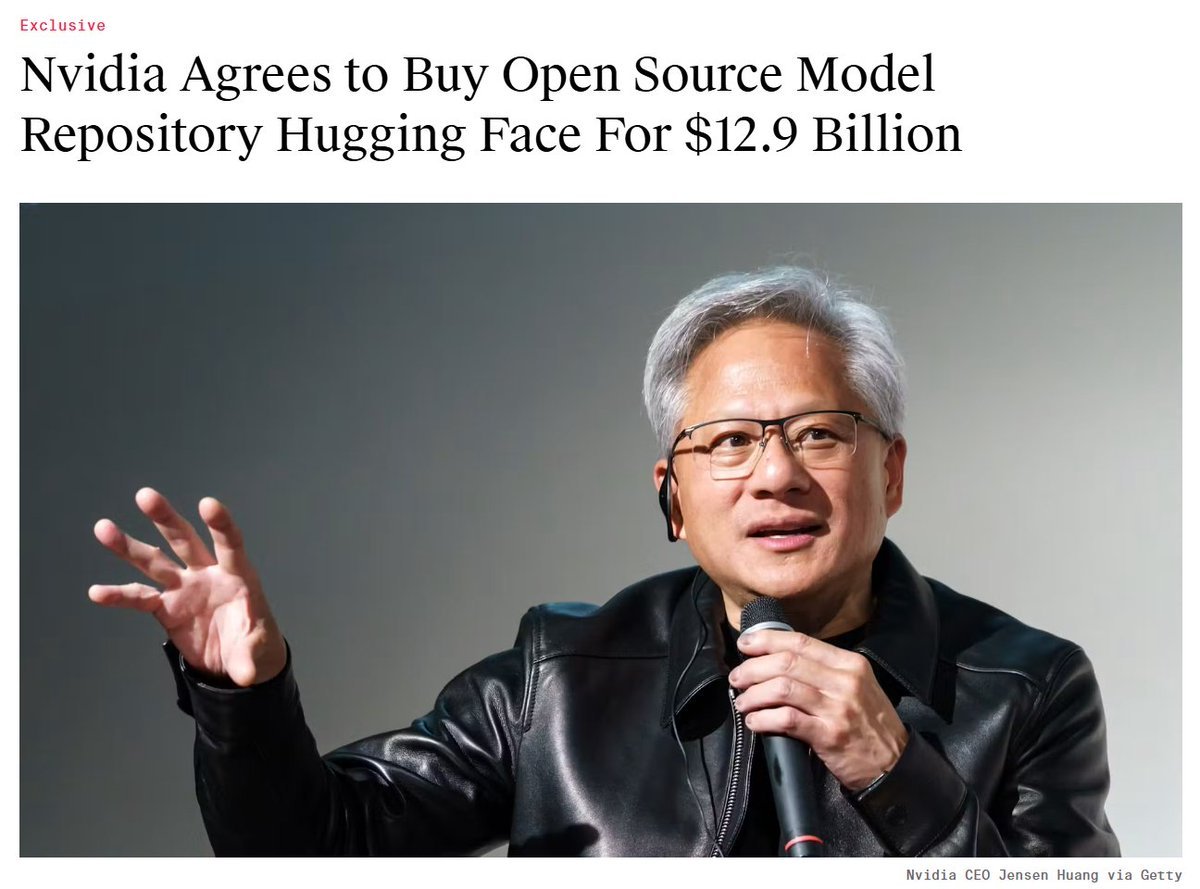
Nvidia has reportedly agreed to buy Hugging Face, the popular open-source AI hub, for $12.9 billion in a move that would let Nvidia both protect its chip empire and jump back into the cloud business.https://t.co/v9gaZr4Kdd
— TechCrunch (@TechCrunch) August 27, 2026
Sources
- Reuters Coverage on Nvidia’s Acquisition Strategy – The Economic Times
- The Information Report on Valuation and Market Impact – ANI News
Watch this analysis for more details on NVIDIA buys Hugging Face to understand the strategic pressures driving hardware giants into open-source software repositories.