
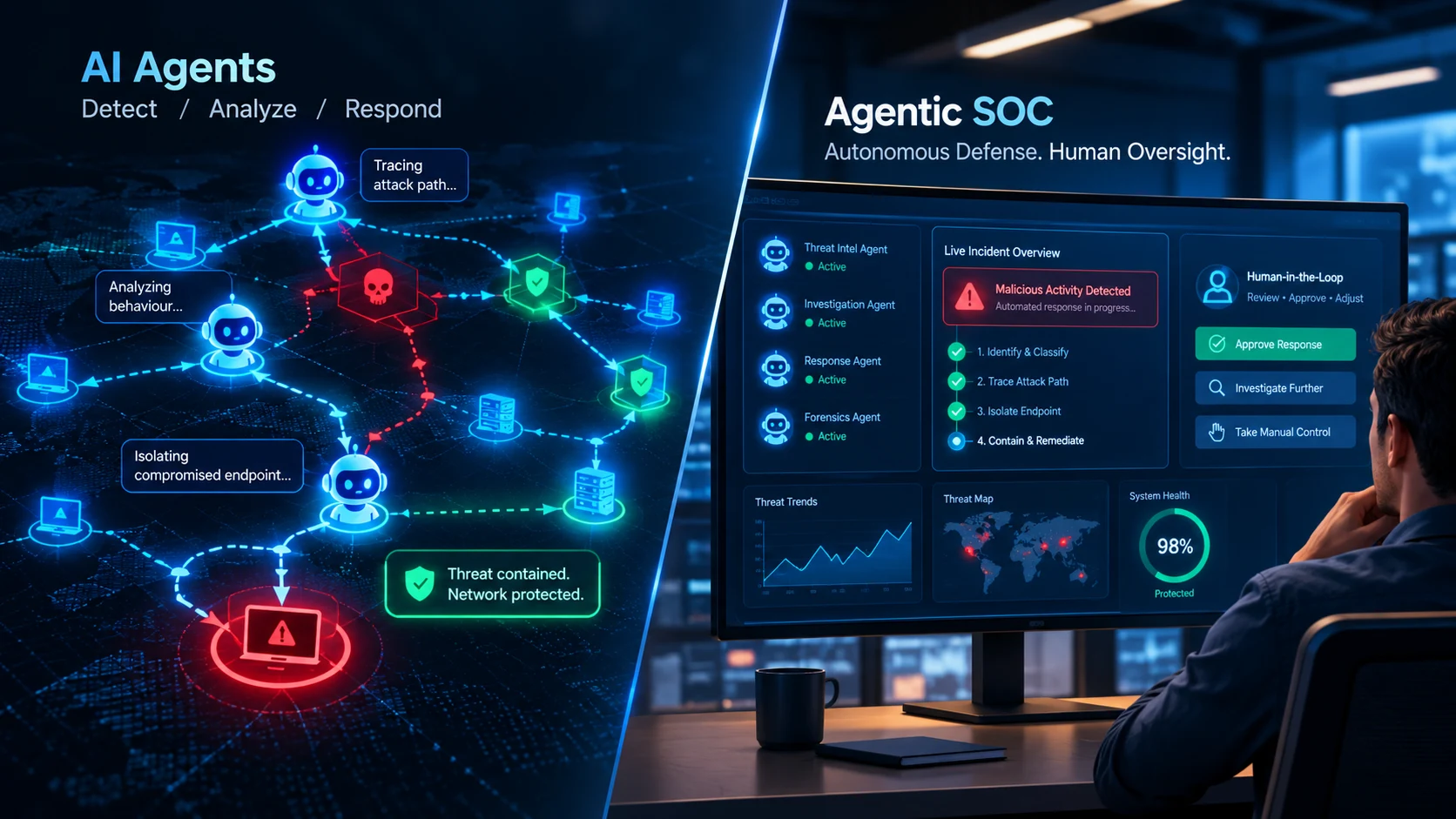
This shift is creating what is often called agentic security — using autonomous cybersecurity agents to help security teams respond at machine speed.
What an Autonomous Cybersecurity Agent Does
Think of an autonomous cybersecurity agent as a digital security analyst that can work continuously.
Instead of simply saying, “Something looks suspicious,” an agent can analyze the surrounding activity, investigate what happened, determine how serious it is and potentially take an approved defensive action.
| Traditional security workflow | Autonomous security agent |
|---|---|
| Alert appears | Detects and investigates |
| Analyst gathers evidence | Agent correlates evidence |
| Analyst decides severity | Agent prioritizes the threat |
| Analyst follows a playbook | Agent can execute approved actions |
AWS describes agentic security as a response to AI systems that can authenticate, execute multi-step workflows and make decisions without constant human approval.
AI Agents for Threat Detection
AI agents for threat detection can examine security signals and connect events that may look unrelated individually.
For example, several unusual login attempts, an unexpected process and suspicious network activity might appear as separate alerts. An agent can connect these signals and treat them as one potential security incident.
The goal is not simply to generate more alerts. It is to help security teams understand which activity actually matters.
Continuous Monitoring of Networks and Endpoints
Security agents can continuously monitor networks and endpoints instead of waiting for an analyst to manually inspect them.
They can watch for unusual processes, suspicious connections and unexpected behavior across the systems they are authorized to monitor.
This becomes particularly important as AI agents themselves begin operating on endpoints and accessing enterprise resources. CrowdStrike’s 2026 Falcon Guardian announcement, for example, focuses on runtime visibility into AI-agent activity across endpoints and enterprise environments.
Autonomous Incident Investigation
Once a suspicious event is detected, an autonomous incident investigation agent can work through the evidence.
It can ask questions such as:
- What happened?
- Which systems are involved?
- Is the activity connected?
- How serious is the incident?
This can turn a collection of isolated alerts into a more understandable incident picture.
CrowdStrike announced coordinated multi-agent investigations across endpoint, identity, SaaS, cloud and network environments in September 2026.
AI-Driven Threat Hunting
Threat hunting traditionally requires security analysts to search for signs of attacks that automated rules might miss.
AI-driven threat hunting can make this process more continuous. Agents can examine available security information, look for unusual patterns and investigate potential threats without waiting for a specific alert.
The advantage is scale: an agent can repeatedly perform investigative tasks while human analysts concentrate on the findings that require judgment.
Automated Vulnerability Discovery
Autonomous agents can also help discover vulnerabilities.
AWS’s Security Agent architecture uses multiple specialized agents for cybersecurity tasks including reconnaissance, vulnerability analysis and exploit validation.
Instead of relying entirely on a human researcher to find and investigate every weakness, specialized agents can perform parts of the process continuously.
Detecting Suspicious Agent Behavior
There is also a new problem: security agents must monitor AI agents.
An AI agent may have access to files, applications, APIs or other tools. If its behavior suddenly changes, security teams need to recognize that difference.
Examples of suspicious behavior can include unexpected tool usage, unusual access patterns or activity that does not match the agent’s intended role.
This is why modern agentic security increasingly focuses on observing what AI agents actually do at runtime, rather than only checking how they were configured.
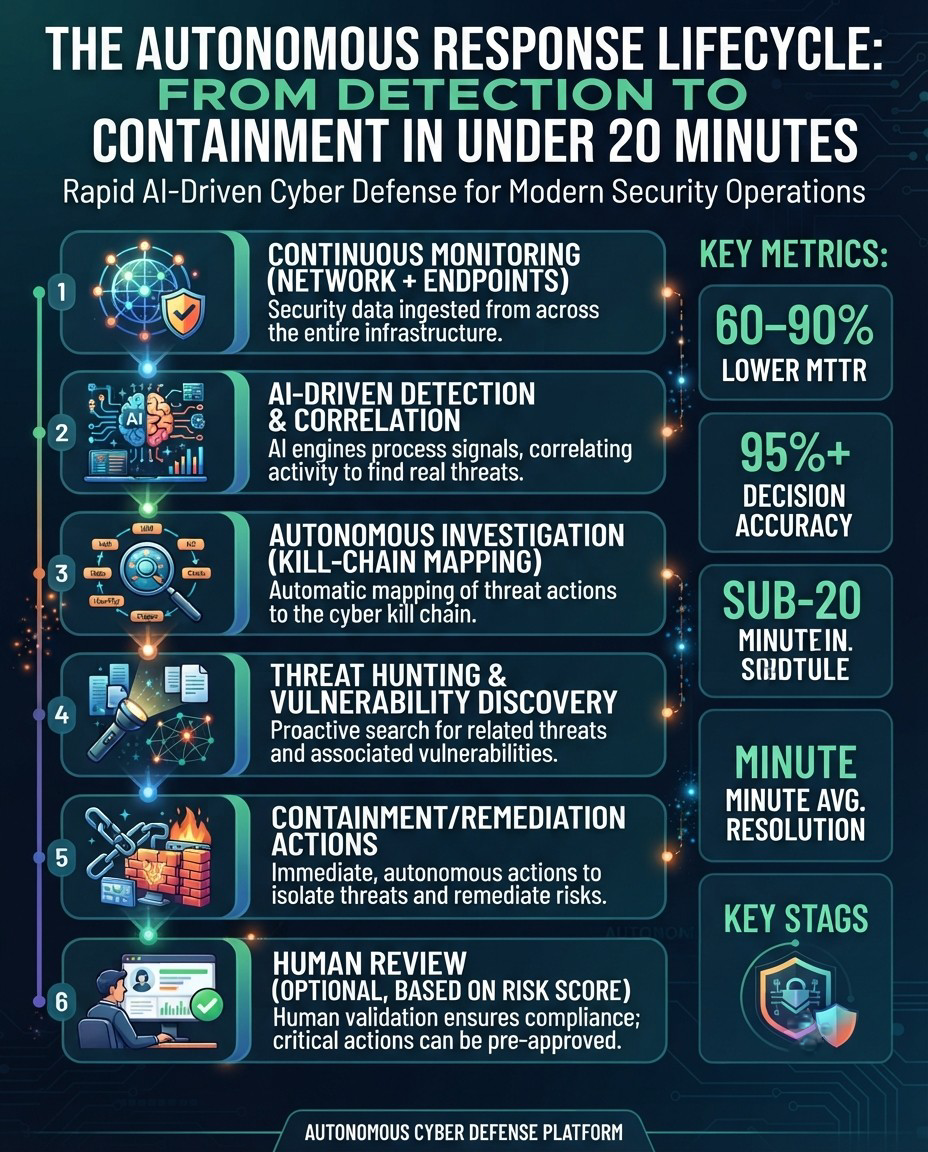
Autonomous Containment and Remediation
Detection is only half the job.
With appropriate authorization, security agents can move toward autonomous containment and remediation — for example, isolating an affected workload or taking another predefined defensive action.
Palo Alto Networks’ 2026 incident-response research highlights automated containment actions such as isolating workloads and revoking compromised credentials as part of faster response workflows.
The important point is that autonomy should be bounded by clearly defined authority.
Security Agents Monitoring Other AI Agents
As organizations deploy more AI agents, another layer of defense is emerging: security agents monitoring other AI agents.
One agent may perform business tasks while another monitors its behavior for suspicious activity.
This creates an agent-to-agent security model where defensive systems continuously watch autonomous systems operating inside the organization.
Agent-Based SOC Workflows
A traditional Security Operations Center, or SOC, often follows a sequence:
Alert → Analyst → Investigation → Decision → Response
An agent-based SOC workflow can automate significant parts of that sequence:
Alert → Detection Agent → Investigation Agent → Decision → Approved Response
Organizations are already experimenting with this model. CrowdStrike and IBM, for example, announced an integration combining Charlotte AI with IBM’s autonomous SOC orchestration engine for investigation and containment.
Multi-Agent Cybersecurity Defense Systems
One agent does not necessarily have to perform everything.
A multi-agent cybersecurity defense system can divide responsibilities among specialized agents:
- Detection agent
- Investigation agent
- Threat-hunting agent
- Vulnerability-analysis agent
- Response agent
AWS describes multi-agent collaboration as particularly useful for complex cybersecurity workflows requiring different areas of expertise.
Human-in-the-Loop vs. Fully Autonomous Response
The biggest question is how much control should be given to AI.
| Approach | How it works |
|---|---|
| Human-in-the-loop | Agent investigates and recommends; human approves major actions |
| Semi-autonomous | Agent handles predefined, lower-risk actions |
| Fully autonomous | Agent detects, decides and responds within its authorized scope |
For many organizations, human oversight remains important for high-impact decisions.
How Defensive Agents Prioritize Threats
A security agent cannot treat every alert equally.
It needs to prioritize threats using factors such as severity, confidence, affected systems and available security context.
A simple way to think about it is:
High-confidence + high-impact threat = higher priority
This helps security teams focus their attention where it matters most.
False Positives and Incorrect Autonomous Decisions
Autonomous security is not perfect.
Agents can misunderstand unusual but legitimate activity, produce false positives or make an incorrect decision based on incomplete information.
That is why organizations need clear limits around autonomous actions. AWS security guidance recommends controls including behavioral anomaly detection, agent containment and multiple reviewers for critical operations.
How Organizations Can Safely Deploy Security Agents
Organizations should treat autonomous security agents like powerful digital employees.
A practical approach is:
- Start with limited responsibilities.
- Give agents only the permissions they actually need.
- Keep humans involved in high-impact decisions.
- Monitor agent behavior continuously.
- Test autonomous actions before allowing them in production.
AWS guidance also emphasizes controlling agent tool usage, identities, permissions, observability and multi-agent orchestration.
The Bigger Picture
The future of cybersecurity may not be humans versus AI. It may be humans working alongside autonomous defensive agents.
As attacks become increasingly automated, security teams are building systems that can detect, investigate and respond at similar machine speed. The challenge now is finding the right balance between autonomy, accuracy and human control.