
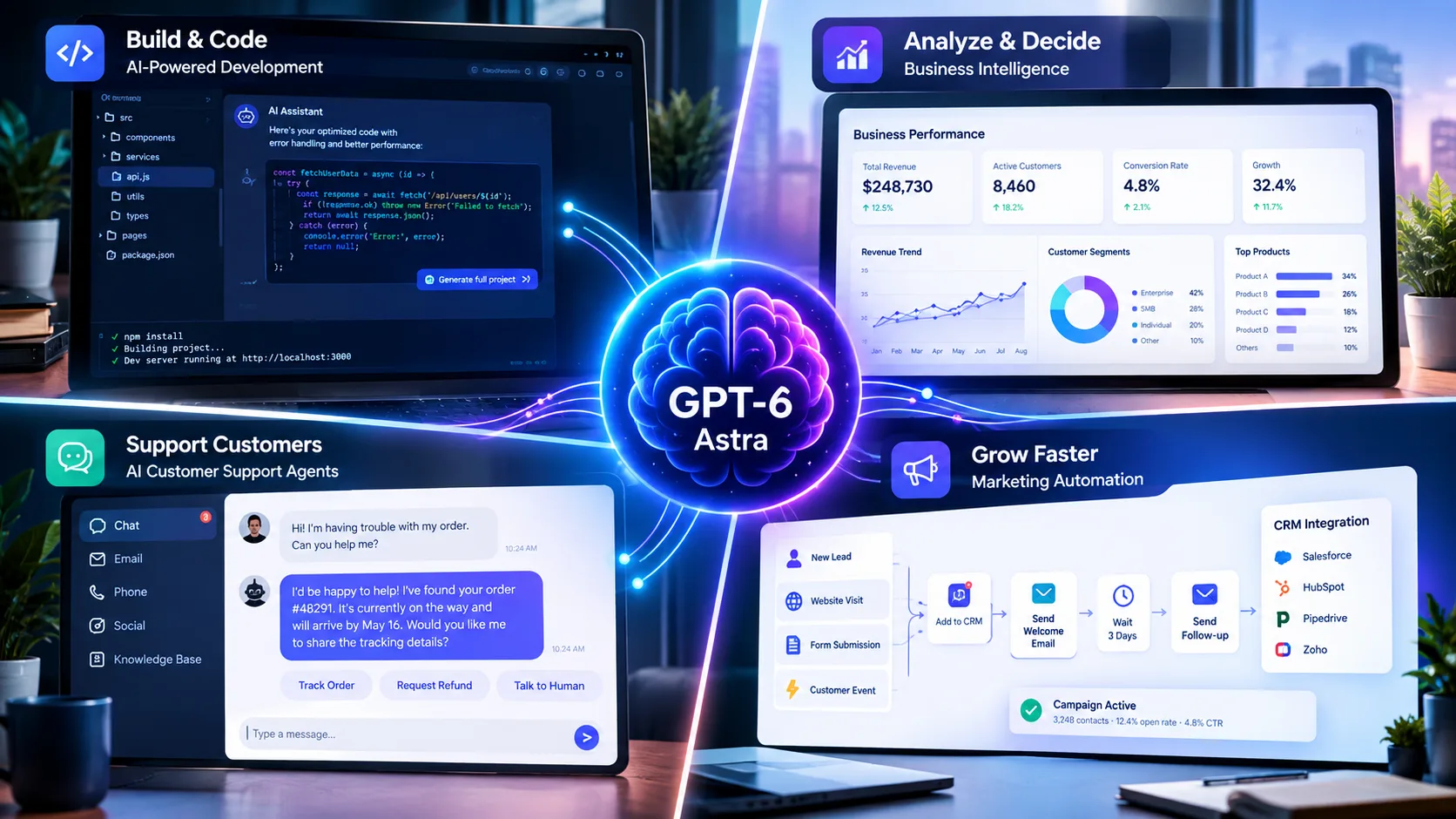
GPT-6 Astra is designed for harder end-to-end work involving reasoning, coding, research, computer use and multi-step workflows. OpenAI says Astra can work with browsers and professional software, create documents and spreadsheets, and continue adapting when requirements change.
So what can developers and businesses actually build with it? Let’s look at the practical possibilities.
Building Autonomous Research Agents
Imagine giving an AI researcher a topic and letting it handle the repetitive work.
A GPT-6 Astra research agent could:
- Gather information.
- Organize findings.
- Analyze the material.
- Create a report or document.
The important difference is that the agent can participate in a multi-step workflow, rather than simply answering one research question.
Customer-Support Agents
A customer-support agent could connect customer conversations with business systems.
For example:
Customer question → investigate issue → find relevant information → update customer record → respond
Human employees can then handle cases that actually require judgment.
Coding and Software-Development Agents
This is one of Astra’s strongest areas.
Developers can use it for:
- Code generation
- Debugging
- Software testing
- Repository analysis
- Frontend QA
- Terminal-based tasks
OpenAI’s developer documentation positions Astra for complex coding and computer-use workflows.
Think of it less like autocomplete and more like giving a developer an AI teammate that can work through several connected steps.
AI Sales Agents
A sales agent could automate parts of the journey from lead to CRM.
| Stage | Possible Agent Task |
|---|---|
| Lead arrives | Collect information |
| Qualification | Analyze requirements |
| Follow-up | Prepare communication |
| CRM | Update records |
| Handoff | Send qualified leads to sales |
The goal isn’t necessarily to replace the salesperson. It’s to remove repetitive work around the salesperson.
Marketing Automation Agents
Marketing teams could build workflows that connect research, content and campaign operations.
For example:
Research → campaign planning → content preparation → review → publishing workflow
Human approval can remain at important stages.
Data-Analysis Agents
Instead of manually moving between spreadsheets, databases and analysis tools, a data-analysis agent could coordinate the workflow:
Data → cleaning → analysis → visualization → report
Astra’s computer-use and professional-work capabilities make this type of workflow particularly interesting.
Business Intelligence Workflows
A business intelligence agent could help automate recurring reporting.
For example:
- Collect business data
- Analyze KPIs
- Identify changes
- Prepare reports
- Present findings
This turns a recurring reporting process into an AI workflow rather than a manual routine.
Content Research and Production Workflows
Content teams could connect research with production.
A possible workflow is:
Research → organize information → create draft → review → prepare for publishing
The agent can handle repetitive preparation while editors retain control over the final content.
E-Commerce Automation
E-commerce businesses could use agents for workflows involving:
- Product information
- Customer questions
- Inventory-related tasks
- Order-related workflows
- Store administration
The value comes from connecting several steps rather than automating only one action.
Internal Company Assistants
An internal assistant could help employees work with company information and software.
For example, it could assist with internal processes, documentation and repetitive administrative workflows while respecting company permissions.
Lead-Generation Workflows
Lead generation can become a connected workflow:
Prospect → qualification → CRM → sales handoff
Customer Onboarding Automation
Similarly, customer onboarding can connect:
New customer → setup tasks → documentation → follow-up
These are good examples of where automation becomes more useful when several systems are involved.
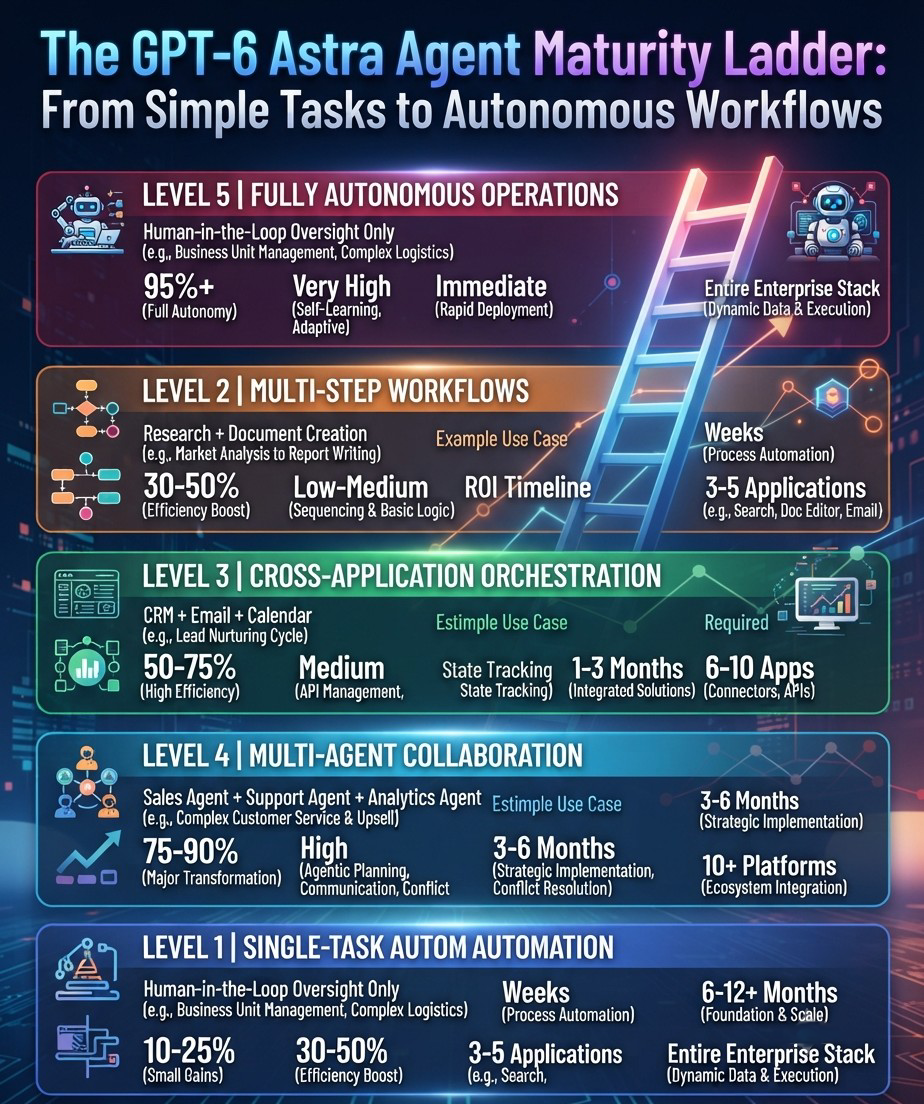
Multi-Agent Workflows
Some businesses may eventually use several specialized agents rather than one giant agent.
For example:
Research agent → sales agent → onboarding agent → analytics agent
The agents can perform different jobs while an orchestration layer coordinates the workflow.
OpenAI’s current developer guidance lists multi-agent orchestration among Astra’s supported capabilities.
Connecting Astra With APIs
Developers can connect Astra through the OpenAI API using the gpt-6-astra model.
Astra can also work with tools and structured outputs, allowing developers to create more controlled AI agent workflows.
Connecting Astra With SaaS Applications
The real power of an AI agent often appears when it can interact with the software a business already uses.
Depending on the implementation, Astra-based workflows can connect with CRM platforms, productivity software, analytics systems and other SaaS applications.
Astra for No-Code and Low-Code Automation
No-code and low-code automation can make AI agent workflows more accessible to business teams that don’t want to build every component from scratch.
The trade-off is that custom development generally provides more control and flexibility, while no-code tools can make simpler workflows faster to deploy.
Developer Tools and SDK Considerations
For developers, Astra offers a 1,050,000-token context window and supports reasoning levels from low through max.
That large context window can be useful for long coding sessions, complex research and workflows involving large amounts of information.
Cost Considerations
Current API pricing makes cost planning important, particularly for long-running AI agents and workflows that repeatedly use tools.
The better question isn’t simply “How expensive is Astra?”
Instead, ask:
How much valuable human work can this workflow complete for the cost?
Latency and Scalability
Businesses also need to consider how quickly an agent needs to respond and how many workflows must run simultaneously.
Real-time tasks may require different architecture from large batch-processing workloads. Caching, asynchronous processing and workload management can become important as deployments grow.
Security Requirements
More autonomy also means more responsibility.
Businesses should consider:
- Data protection
- Authentication
- Authorization
- Monitoring
- Audit logs
- Secure credential management
AI agents should not automatically receive unrestricted access to every business system.
Permission Management
A good starting point is the principle of least privilege.
In simple terms, an agent should receive only the permissions it actually needs to complete its job.
Different agents can also have different roles and access levels, while important actions can be logged for auditing and troubleshooting.
Human-in-the-Loop Architecture
Autonomous doesn’t have to mean completely unsupervised.
For important workflows, businesses can introduce human approval checkpoints before consequential actions are completed.
A useful rule is simple:
Let the agent automate the routine. Let humans control the consequential.
When Should You Use an Agent Instead of a Normal LLM?
| Normal LLM | AI Agent |
|---|---|
| One question | Multi-step task |
| Generates an answer | Takes actions |
| Limited tools | Multiple tools |
| Human drives workflow | Agent drives workflow |
| Simple tasks | Complex workflows |
If a task is basically “write this paragraph,” a normal LLM may be enough.
If it is “research this, analyze it, update these systems and prepare the final report,” an AI agent becomes much more interesting.
ROI Considerations
Ultimately, GPT-6 Astra should not be adopted simply because it is powerful.
Businesses should measure:
Time saved + work completed + quality improvement − AI and infrastructure costs = automation value
Start with one repetitive workflow, measure its results, and then expand.
Examples of Workflows Astra Could Automate
- Research workflow: Research a topic, organize findings and prepare a report.
- Sales workflow: Process a lead, qualify it and update the CRM.
- Customer-support workflow: Investigate a customer issue and prepare a response.
- Development workflow: Investigate a bug, modify code and run tests.
- Reporting workflow: Collect data, analyze KPIs and prepare a business report.
Final Thoughts
GPT-6 Astra makes the most sense when you stop thinking of AI as a chatbot and start thinking of it as a worker inside a workflow.
From research and coding to customer support, sales, analytics and multi-agent systems, the opportunity is not just generating better answers.
It’s getting AI to complete useful work across connected systems.