

AI agents can now do real business work. They research markets, build software, test products, prepare sales materials, and keep iterating toward a goal. That capability brings a worry that every CFO, CIO, and platform lead recognizes: what happens when an agent just keeps working, keeps calling models, keeps using tools, and keeps spending?
Replit’s Missions feature has a good answer. Instead of treating autonomy as all or nothing, it builds budget, permissions, and human approval into the mission itself. Agents can plan, build, test, and iterate, but only inside a financial and operational boundary you agreed to up front.
What you get is what enterprises have been asking for: delegated autonomy with an automated financial handbrake.
The Runaway Budget Problem
Traditional automation has a fairly predictable cost profile. A workflow runs, a job finishes, and finance reconciles the bill.
Agent workforces don’t behave that way.
Take an objective like “win our first 10 enterprise customers,” “improve product performance,” or “fix these 25 customer-reported issues.” To get there, an agent may need to research, reason, write, test, revise, call tools, and coordinate with other agents. Stronger models, longer context, parallel execution, and repeated improvement all push consumption up.
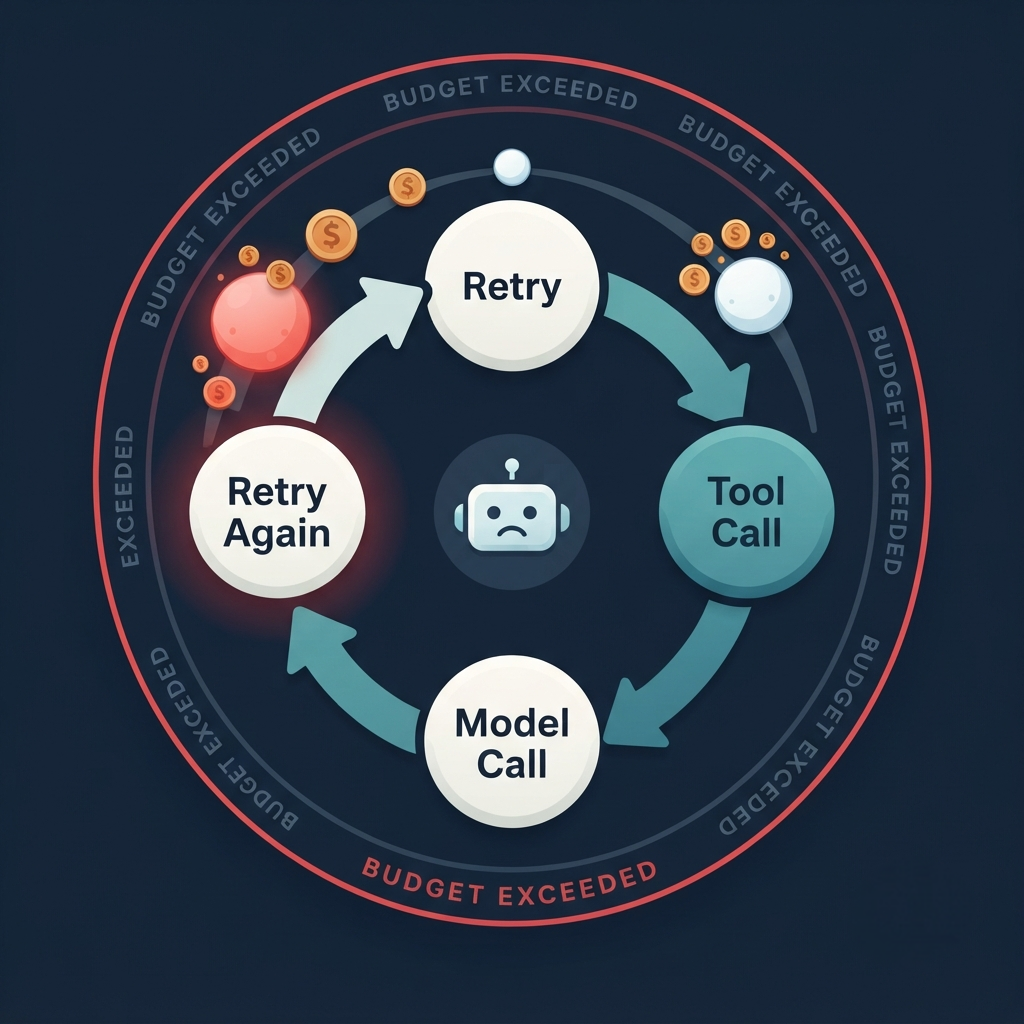
The real danger isn’t just that an agent spends too much. It’s that an agent can spend too much while chasing the wrong objective.
Picture an agent asked to improve conversion rates. It might test dozens of landing-page variations, rewrite copy over and over, call external APIs, generate assets, and run experiments. If the goal is vague, it may keep optimizing forever. If it falls into a retry loop, costs can pile up fast.
Replit acknowledges this risk directly. Its guidance suggests breaking big tasks into smaller goals, asking the agent to plan before it builds, and setting a usage limit so a loop can’t produce a huge bill.
Which points to the core insight: in an agentic system, cost control can’t be a reporting dashboard. It has to be a runtime control.
Replit’s Governance Model
Replit Missions turns an agent task into a governed contract. Before any work starts, the user and Replit settle on:
- The approach the agents will take.
- The outcomes that count as success.
- The maximum Replit AI usage budget.
- The actions that need approval.
- The actions the agents must never take.
That’s a long way from handing an agent a prompt and hoping for the best. It’s closer to writing a statement of work for autonomous software.
| Governance control | What it does | Why it matters |
|---|---|---|
| Budget | Sets a maximum Replit AI usage amount for the mission. | Creates a hard financial boundary |
| Success criteria | Defines measurable outcomes that count as completion. | Prevents agents from confusing activity with progress |
| Approval boundaries | Identifies actions requiring human sign-off. | Keeps consequential decisions with people |
| Prohibited actions | Specifies what the agent must never do. | Reduces the blast radius of mistakes |
| Mission contract | Records the goal, approach, criteria, budget, and boundaries before execution. | Creates a reviewable agreement |
Replit’s documentation is clear on the split: the budget is a maximum amount of AI usage, and the boundaries decide which actions need approval or are off limits entirely.
The $1,000 Handbrake
Replit’s own example makes this concrete. A team can cap a mission at $1,000 and require approval before the agent contacts prospects, shares a proposal, changes customer-facing sales materials, or makes product commitments.
That design splits work into two very different buckets:
- Low-risk execution: researching target accounts, analyzing public information, building a tailored demo, drafting outreach.
- High-consequence action: contacting a prospect, sending a proposal, offering a discount, publishing externally, or making a commercial commitment.
The agent handles the first bucket on its own. The second needs a human decision.
That’s what a “financial handbrake” means in practice. The agent is free to be ambitious. It just can’t turn that ambition into uncontrolled spending or irreversible business commitments.
Hard Caps, Not Just Alerts
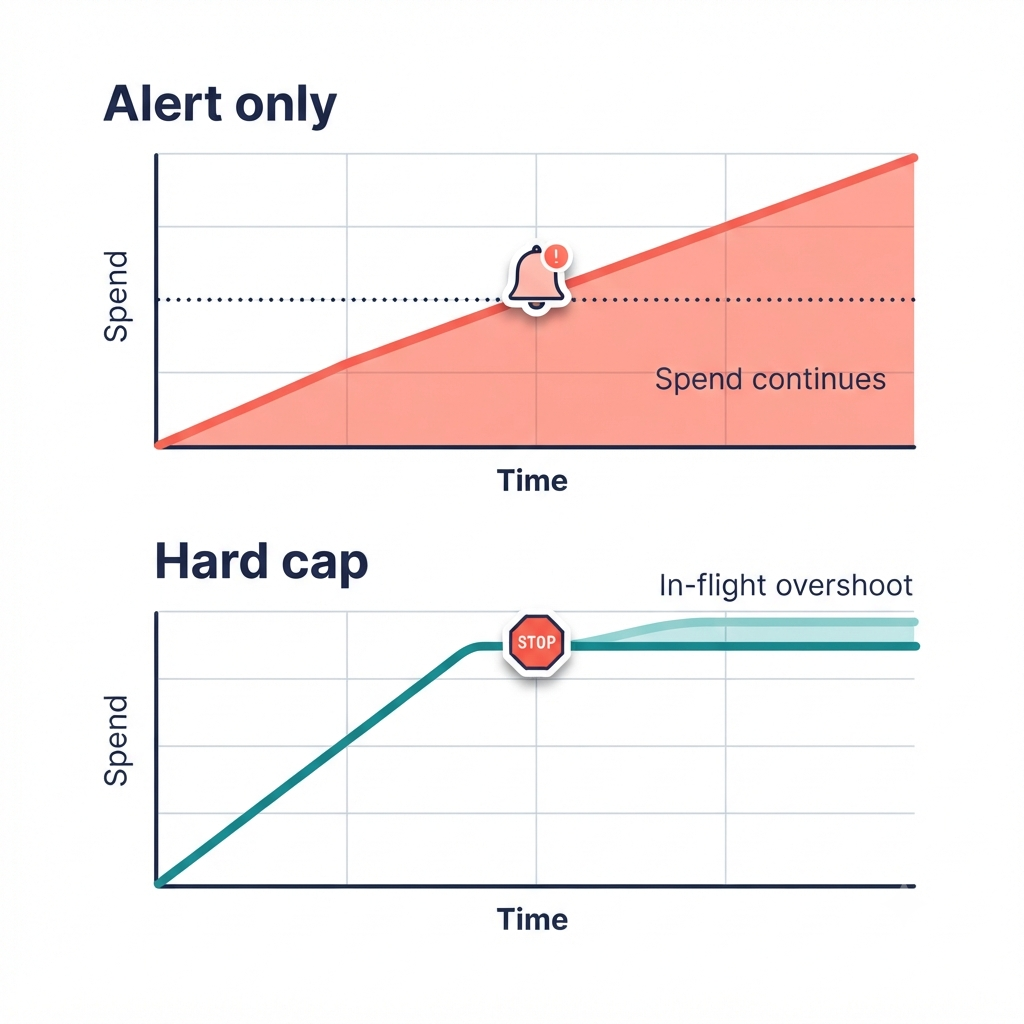
Plenty of AI platforms give you usage dashboards, and some add alerts. But an alert shows up after the money has already been spent.
A hard cap changes how you operate.
Replit says that once a usage limit is hit, usage-based services are blocked until the next billing cycle or until the limit is raised. Budgets have to be set in $500 increments.
That gives you a clear financial stop condition:
- The mission can’t quietly run past its approved exposure.
- Finance knows the maximum possible AI spend before work begins.
- A budget increase becomes a deliberate approval, not an accidental overage.
- Teams can treat agent work as a bounded investment instead of an open-ended expense.
Replit also supports usage alerts and budget limits meant to head off surprise charges.
One nuance is worth knowing. Replit notes that work already in progress can push AI spending slightly past the budget before things stop. So the cap is a strong control, but it isn’t an absolute promise that no extra cost will occur once the limit is reached.
That matters for planning. Build in a small operational buffer, and think of the cap as a stop condition rather than an exact invoice ceiling.
Human-in-the-Loop as a Risk Boundary
“Human in the loop” gets used as a vague reassurance. Replit makes it specific by tying approval to particular actions.
A handy rule of thumb: if an action can create an external obligation, expose sensitive data, alter production systems, or increase spend, it should require approval.
Some examples:
- Sending outreach to prospects or customers.
- Sharing proposals, contracts, or pricing.
- Publishing customer-facing content.
- Committing code to production.
- Making purchases.
- Offering discounts or entering commercial commitments.
- Increasing the mission budget.
- Granting access to a new connected service.
Replit’s product page says users can require approval before publishing and before any budget increase.
This makes human oversight a policy layer instead of a bottleneck. Agents keep doing the work that’s safe, reversible, and in scope. People step in only when the consequences get real.
Why Swarms Need Stronger Guardrails
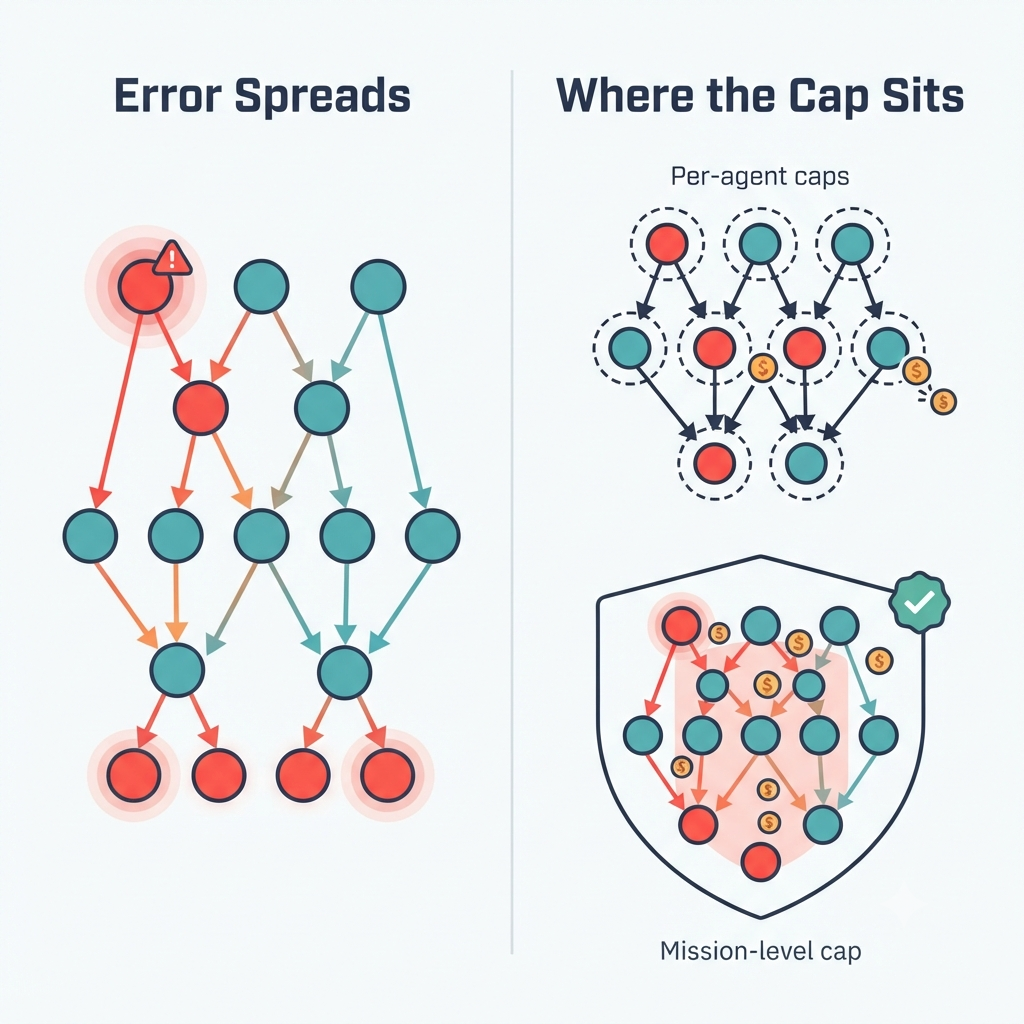
Agent swarms amplify both capability and risk.
Replit describes Missions as coordinating a swarm of agents that plan, build, test, and iterate toward a goal. In its enterprise-sales example, one agent might research buyers while another builds a demo. Once approved outreach goes out, the mission can analyze which accounts and messages lead to qualified conversations.
That parallelism is powerful, and without controls it’s financially risky.
A swarm can burn through budget faster than a single agent because several workstreams run at once. It can also create chains of dependency, where one agent’s research feeds another’s work, which feeds another’s output. A small mistake early on can spread through the whole mission.
Replit’s own benchmark shows the upside. On NumPy optimization tasks, a 16-agent swarm hit a 17x speedup and a 32-agent swarm hit 19x, compared with up to 4x for a single agent on its Auto (Max) configuration.
So the takeaway isn’t that swarms are inherently dangerous. It’s that parallel autonomy needs mission-level governance, not just per-agent limits.
The Mission Agreement: A New Enterprise Artifact
The most underrated piece of Replit’s approach might be the mission agreement itself.
Before execution, users review a contract covering the goal, approach, success criteria, budget, and boundaries. They can ask Replit to fix anything that’s missing or wrong before confirming and starting the mission.
That makes the agreement a working document with real governance value.
A solid enterprise mission agreement should answer these questions:
- What outcome are we buying?
- What does success measurably look like?
- What is the maximum acceptable spend?
- Which tools and data sources can the agent access?
- Which actions require approval?
- Which actions are prohibited?
- What trade-offs are allowed?
- Who approves exceptions and budget increases?
- What happens if the budget runs out before the outcome is reached?
On that last point, Replit says that if the budget is exhausted before the success criteria are met, work stops with the outcome unresolved.
That’s a mature principle. It stops the worst version of agent autonomy, where the system keeps spending on a goal that has already outrun its economic justification.
A Practical Example: Governed Go-to-Market
Here’s what a mission might look like.
Goal: Identify 25 qualified mid-market prospects and prepare personalized demo materials.
Mission agreement:
- Budget: $1,000 maximum AI usage.
- Allowed work: Research public company information, identify buying signals, build demo assets, draft outreach.
- Approval required: Contacting a prospect, sharing a proposal, offering a discount, or making a product commitment.
- Prohibited actions: Publishing externally, purchasing services, accessing customer data, or changing production systems.
- Success criteria: A qualified prospect list, demo materials aligned to the ideal customer profile, and no outreach sent without approval.
This follows the structure Replit describes. Agents research and build in parallel, while anything consequential, like outreach, sits behind a human approval gate.
The agent isn’t any less capable here. It’s just easier to deploy.
The CFO’s New Control Plane
For finance leaders, governing agents is turning into a control-plane problem.
The old model went like this:
- A team requests budget.
- Work gets done.
- Cloud and AI costs show up on a bill.
- Finance analyzes the variance.
The agent-native model looks different:
- The mission owner defines the outcome.
- Finance sets the maximum exposure.
- Security defines permitted tools and data access.
- The agent system executes within the contract.
- Approval gates capture consequential decisions.
- The audit trail records spend, decisions, and outcomes.
Replit’s Missions documentation says users can change the agreement as needs evolve, including the goal, success requirements, permissions, or budget.
That flexibility is handy, but it’s also a reason to be careful. A budget change shouldn’t be a casual prompt edit. It should be a controlled approval with an owner, a rationale, and an audit record.
What Enterprises Still Own
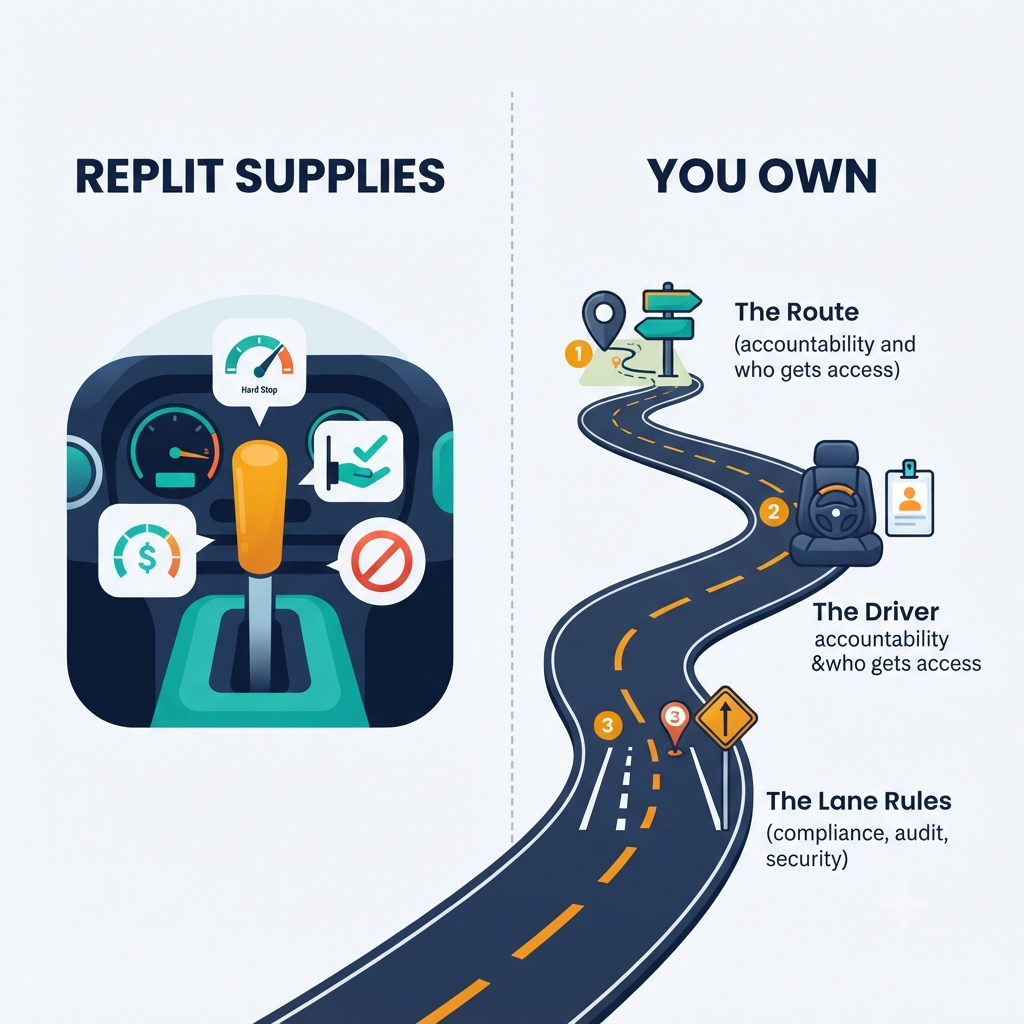
Replit’s model is a big step forward, but it doesn’t take responsibility off the enterprise.
Organizations still have to own:
- Data-access policy and connector permissions.
- Protection against prompt injection and data exfiltration.
- Model-selection and reasoning-effort policies.
- Compliance, retention, and audit requirements.
- Quality assurance for customer-facing or production-impacting outputs.
- Clear accountability when an agent makes a mistake.
- A formal process for budget increases and approval exceptions.
Replit points out that choosing a model or reasoning effort can change what a task costs, but those choices aren’t spending caps. Usage limits have to be set separately.
Put simply, Replit supplies the handbrake. The enterprise still decides where the road goes, who gets to drive, and what happens if the vehicle leaves the lane.
The Strategic Takeaway
The future of enterprise AI won’t be won by the most autonomous agents. It’ll be won by organizations that can hand off ambitious work without losing financial, operational, or reputational control.
Replit Missions shows what that looks like:
- A bounded objective.
- A hard budget cap.
- Explicit approval gates.
- Restricted tool access.
- Measurable success criteria.
- A reviewable mission contract.
This isn’t “set it and forget it” automation. It’s more useful than that: delegate boldly, spend precisely, and approve what matters.
The companies that adopt this mindset early won’t just avoid runaway token bills. They’ll open up a new way of operating, where small teams take on work that used to need large ones, and finance and security keep the controls they need to say yes with confidence.