

For a long time, AI-assisted coding has worked the same way. You give one agent a prompt, it writes some code, you look at the result, and you go around again. It works, and it has produced plenty of useful improvements. But it’s a one-path-at-a-time process, and that limit matters more than people tend to admit.
Replit’s recent agent-swarm results suggest a different approach. On 13 NumPy optimization tasks, Replit reported that a single agent reached a speedup of up to 4x, a 16-agent swarm reached 17x, and a 32-agent swarm reached 19x, all under its Auto (Max) configuration.
It would be easy to read that as “more agents, better results.” I think the more interesting point is that a swarm changes the search strategy. Instead of one agent testing one hypothesis after another, many agents can chase incompatible ideas at the same time: different algorithms, memory layouts, concurrency models, even different storage engines.
That’s why swarms may matter more for systems engineering than for everyday code generation.
The Single-Agent Bottleneck
The usual coding-agent loop looks like this:
propose → implement → test → revise → repeat
The agent starts with its own reading of the problem, picks an approach, writes it, checks the benchmark, and decides what to try next.
That’s a capable process, but it’s still one guided walk through a huge space of possible solutions. Say the agent’s first plan assumes a relational database. It will probably spend most of its time tuning queries, indexes, batching, and caching inside that assumption. It may never seriously ask whether a completely different architecture would do better.
So the bottleneck isn’t necessarily intelligence. It’s exploration bandwidth. One agent can follow one promising branch at a time, and the next idea waits until the first has been tested, refined, rejected, or dropped.
What a Swarm Actually Changes
A swarm isn’t just a handful of chat windows running side by side. When it’s built well, it’s a parallel search system.
Each agent takes a different optimization hypothesis:
| Optimization dimension | Examples explored in parallel |
|---|---|
| Algorithm | Vectorization, divide-and-conquer, caching, approximation |
| Data layout | Row-oriented versus column-oriented storage, batching, blocking |
| Memory access | Contiguous reads, reduced allocations, prefetch-friendly patterns |
| Concurrency | Worker pools, parallel loops, asynchronous pipelines |
| Storage engine | Relational database, columnar database, embedded database |
| Validation | Correctness tests, regression checks, performance reruns |
Replit describes its Missions swarm as a group of agents that plan, build, test, and iterate toward an outcome while sharing what they find along the way.
The value comes from diversity. One branch might keep the existing database and optimize around it. Another might try a columnar engine. A third might rebuild the ingestion path, and a fourth might dig into memory behavior. Then everything gets measured against the same objective, and the approaches that really work are kept.
The Benchmark Evidence
Replit’s scaling test is the clearest support for this argument. The company ran 13 representative NumPy optimization tasks and tracked how speedups changed as the number of agents grew.
| Configuration | Reported best speedup, Auto (Max) | Engineering interpretation |
|---|---|---|
| 1 agent | Up to 4x | A capable sequential optimizer can find meaningful gains |
| 16 agents | 17x | Parallel exploration finds substantially better implementations |
| 32 agents | 19x | Additional agents still help, but returns begin to flatten |
One caveat: these are Replit’s own numbers, not an independently replicated industry benchmark. Still, the pattern is worth paying attention to. Parallel exploration produced a far bigger gain than a single agent did.
What stands out most is the shape of the curve. Going from 1 agent to 16 took the best speedup from 4x to 17x. Going from 16 to 32 only moved it from 17x to 19x.
So doubling the swarm didn’t double the gain. The big architectural discoveries probably came early, and later agents mostly repeated work, polished existing winners, or wandered into less promising branches.
Why Parallel Exploration Wins
Optimization is a search problem
Optimizing software isn’t one well-defined task. It’s a search through a huge space of possible changes:
- Replace an algorithm.
- Change a data structure.
- Reorder loops.
- Introduce caching.
- Change serialization.
- Move computation closer to storage.
- Switch storage engines.
- Tune memory layout.
- Parallelize work.
- Reduce network round trips.
Some of these give small gains and some give huge ones. Some improve one metric while hurting another, and some only pay off under a particular workload.
A single agent searches this space in a line. A swarm searches it broadly and all at once.
Architectural diversity beats prompt polish
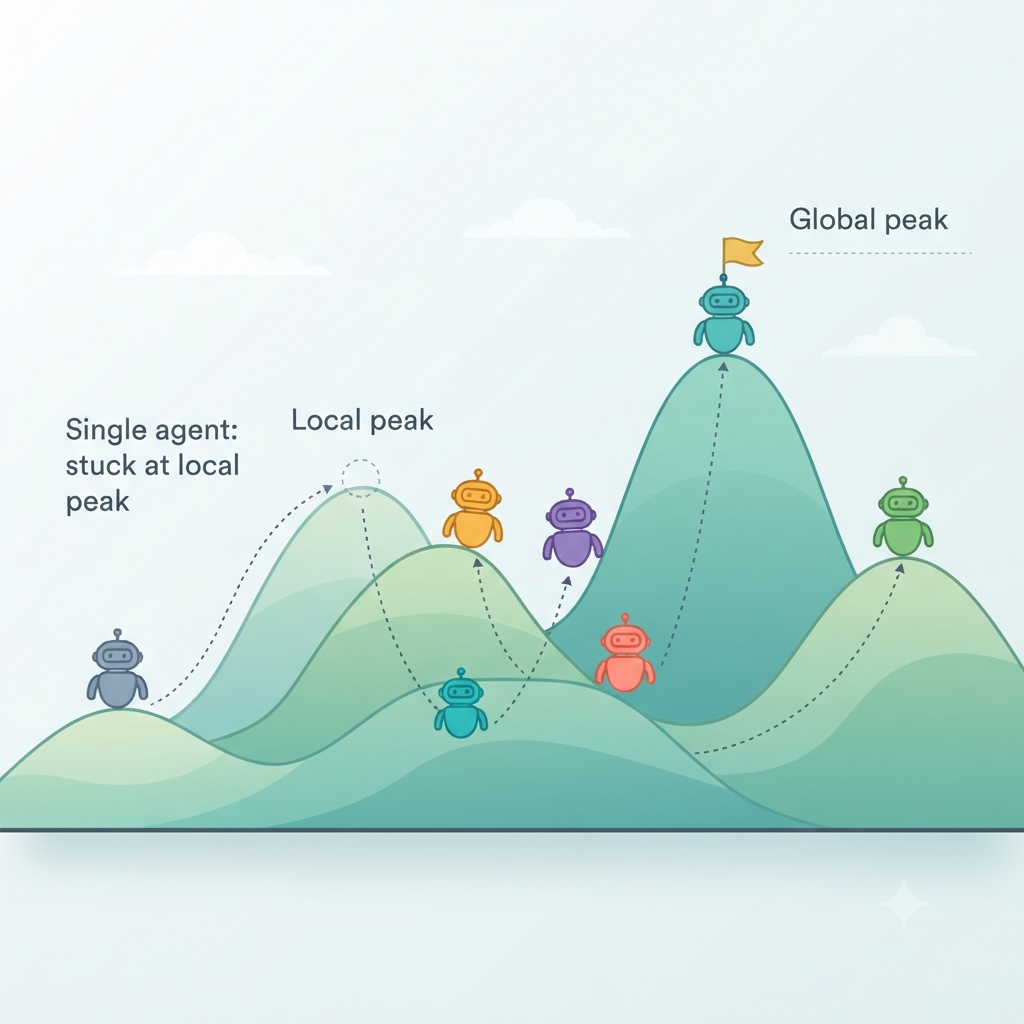
A better prompt can push an agent to consider more options, but it can’t fully pull the agent out of its starting frame. If the first plan assumes a relational database, the agent will likely optimize queries within that frame. If it assumes a single-process design, it’ll tune CPU usage without really considering a distributed setup.
A swarm can test conflicting assumptions side by side:
- Keep Postgres and optimize schema, indexes, batching, and queries.
- Evaluate ClickHouse for analytical workloads.
- Redesign the ingestion pipeline.
- Change memory allocation and access patterns.
- Explore a different concurrency model.
- Validate correctness and regression behavior.
That’s the real advantage. The system can compare fundamentally different architectures, not just tweaks of one.
Shared findings compound progress
Parallelism on its own isn’t enough. A useful swarm also has to share what it learns.
Picture it like this:
- Agent A finds that batched writes cut overhead.
- Agent B finds that a columnar layout speeds up analytical reads.
- Agent C combines both ideas and validates the result.
- Agent D stress-tests correctness under concurrent load.
It’s a lot like a parallel portfolio search: run a variety of strategies, share the evidence, and put more effort behind the ones that survive validation. The outcome can be better than the best single branch, because it can combine mechanisms discovered in different places.
The DataCat Case Study
Replit’s DataCat example shows how this plays out beyond a narrow benchmark.
Replit says it used Missions to build DataCat, an internal application-monitoring platform, in two days on a $3,000 budget. The platform included dashboards, alerts, application tracing, a monitoring agent, and tracing libraries.
What’s notable isn’t just that AI built a monitoring tool. It’s that the result was judged against real operational goals.
| Test | Reported result |
|---|---|
| Deliberate database-bug detection | Alert in 38 seconds, against a 60-second target |
| Sustained load | 26 million activity records and 4.4 million log entries over three hours, with zero reported data loss |
| Correctness and alert reliability | 51 of 51 checks passed |
| Node.js monitoring efficiency | 39% more requests handled with 51% less monitoring-related processor overhead |
| Storage architecture | Postgres and ClickHouse, versus SQLite in the comparison build |
The storage choice is the interesting part. DataCat used both Postgres and ClickHouse, while the comparison build made with Claude Code used SQLite. Replit also reported 49,000 traces per second with Postgres versus 9,800 for the comparison build, and 405,100 metric points per second versus 224,600.
None of that proves Postgres or ClickHouse is better in general. What it shows is that looking at several storage architectures can turn up a better fit for a specific workload.
Here the swarm wasn’t just optimizing a function. It was exploring a systems architecture: ingestion throughput, query latency, memory footprint, log searchability, reliability under load, and API compatibility.
What “19x” Does and Doesn’t Mean
The 19x figure is impressive, but it needs careful reading.
What it supports
On Replit’s 13 NumPy tasks, under its Auto (Max) configuration, a 32-agent swarm found substantially faster implementations than a single agent.
What it doesn’t prove
It doesn’t mean every task got 19x faster. It also doesn’t mean 32 agents will beat one agent by 19x in every codebase.
The result is tied to this workload: the benchmark tasks, the evaluation method, the model’s behavior, the tooling, and Replit’s particular swarm setup. And it doesn’t suggest swarms should just keep growing, since the jump from 16 to 32 agents was much smaller than the jump from 1 to 16.
A more accurate way to say it
Instead of:
“Multi-agent swarms are 19x better than single agents.”
try:
“On Replit’s NumPy optimization benchmark, parallel swarm exploration produced much larger reported speedups than single-agent exploration, with diminishing returns as swarm size increased.”
That’s the precise, defensible version.
The New Optimization Loop
Swarm-based optimization needs a different workflow than single-agent prompting:
- Define the objective: latency, throughput, memory, cost, accuracy, or reliability.
- Establish a correctness contract: tests, invariants, regression suites, and acceptance thresholds.
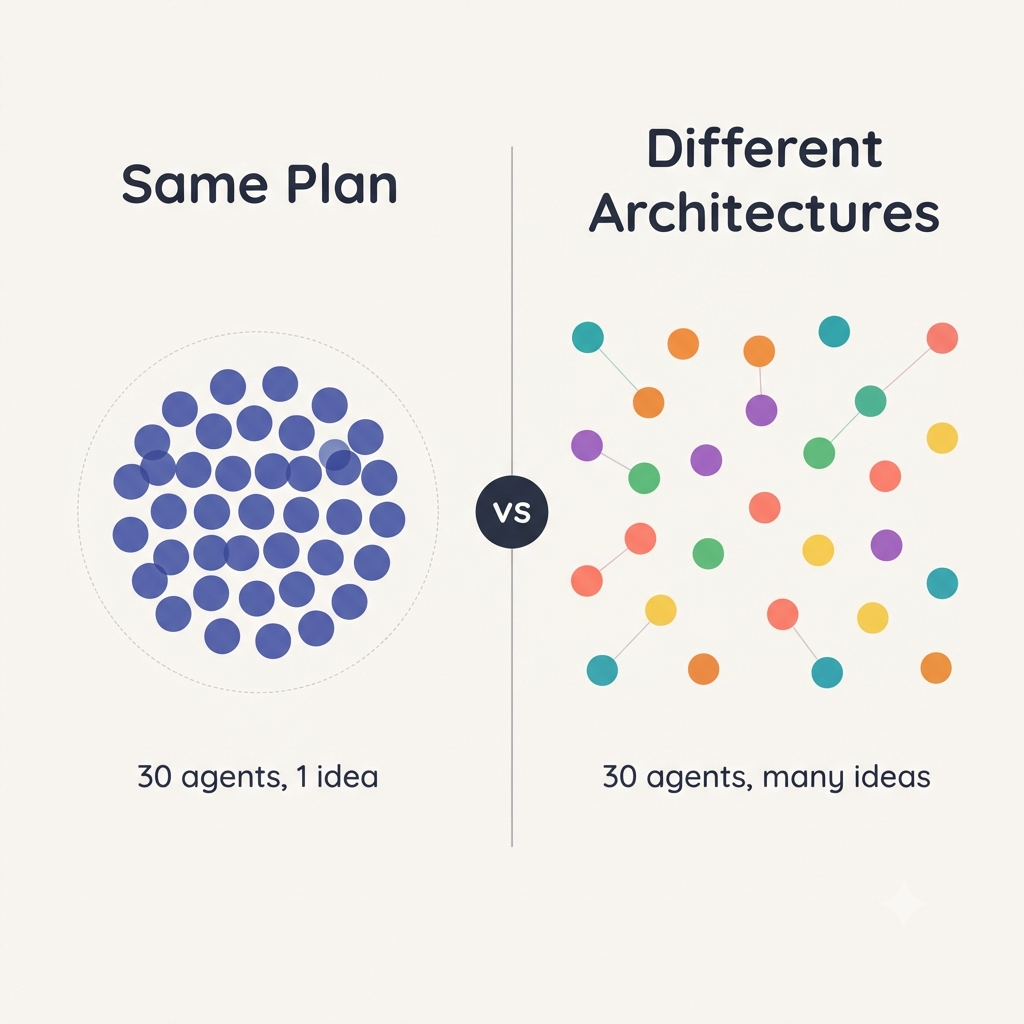
- Generate diverse hypotheses: don’t let every agent chase the same idea.
- Run candidates in parallel: benchmark under representative workloads.
- Share findings: capture the mechanisms, not just the winning code.
- Promote and combine winners: merge useful techniques across branches.
- Validate independently: rerun benchmarks, test edge cases, and reject unstable improvements.
- Stop on evidence: use budget, time, or performance-plateau criteria.
The core principle is simple: parallelism only pays off when the branches are truly diverse and the evaluation is rigorous.
Thirty agents following nearly the same plan will mostly duplicate work. Thirty agents following meaningfully different architectural ideas can uncover options a single sequential process would never reach.
Where Swarms Will Matter Most
Swarms should help most where the best architecture isn’t obvious up front:
- Performance optimization of hot code paths.
- Database and data-pipeline architecture.
- Migration from legacy systems.
- Infrastructure tuning.
- Compiler, runtime, and numerical-library optimization.
- Reliability engineering and failure diagnosis.
- Product experiments where several viable strategies need testing.
Replit positions Missions broadly: you define an outcome, set a budget and boundaries, and the swarm plans, builds, tests, and iterates toward it. That makes the technology relevant well beyond code generation. It becomes a way to explore engineering decisions under real constraints.
Risks and Engineering Discipline
The excitement shouldn’t hide the risks:
- False winners: A fast implementation may break on edge cases, concurrency, or production data.
- Benchmark overfitting: Agents may optimize the test instead of the system.
- Coordination overhead: Too many agents can duplicate work or produce conflicting changes.
- Cost scaling: More agents can mean more compute, more tool calls, and more to review.
- Security and permissions: Autonomous agents need explicit boundaries, especially when they can modify systems or contact customers.
- Opaque decision-making: Teams need inspectable artifacts, logs, diffs, and evaluation traces.
Replit tackles some of this with mission budgets, approval requirements, progress updates, and an independent AI judge that checks results against agreed success criteria.
Even so, human judgment stays essential. A swarm can find a promising architecture, but it can’t decide on its own whether that architecture is safe, maintainable, affordable, and right for the organization’s long-term needs.
The Real Shift
The swarm isn’t a bigger model. It’s a broader search strategy.
A single agent optimizes along one path. A multi-agent system can explore many architectural paths at once, share what works, drop what doesn’t, and validate the survivors.
That’s why a 32-agent swarm hitting 19x is interesting. Not because 32 is magically better than one, but because parallel exploration changes which parts of the solution space ever get considered. Replit’s benchmark suggests this can deliver major gains in optimization work, while also showing that returns taper as the swarm grows.
The next challenge isn’t adding more agents. It’s designing diverse hypotheses, trustworthy evaluations, and coordination systems that turn parallel exploration into reliable production improvements.