

AI coding agents ship features fast, but they can also wear down the boundaries that keep a codebase maintainable. A longer prompt won’t fix that. What works is making your architecture explicit, handing it to the agent as context, and checking every change against it automatically.
The invisible cost of fast code
Picture an AI agent building a new dashboard feature. It runs a database query straight from a React component, pulls in an internal method from another team’s module, and drops a helper file into the shared package. The feature works, the tests pass, and the pull request looks great.
And yet the architecture just got harder to change.
Architecture drift is the slow gap between the structure a team intended and the structure the code actually has. You see it in surprise dependencies, muddy responsibilities, circular imports, and business logic leaking into the wrong layers.
Agents can speed this up because they’re built to finish the task in front of them. They often don’t know, or can’t reliably remember, the system-wide rules that matter more than any single feature.
The core problem is that an agent can write code that is locally correct but violates global architectural intent. A UI component can fetch data from the database just fine. That doesn’t make it acceptable.
What architecture drift looks like
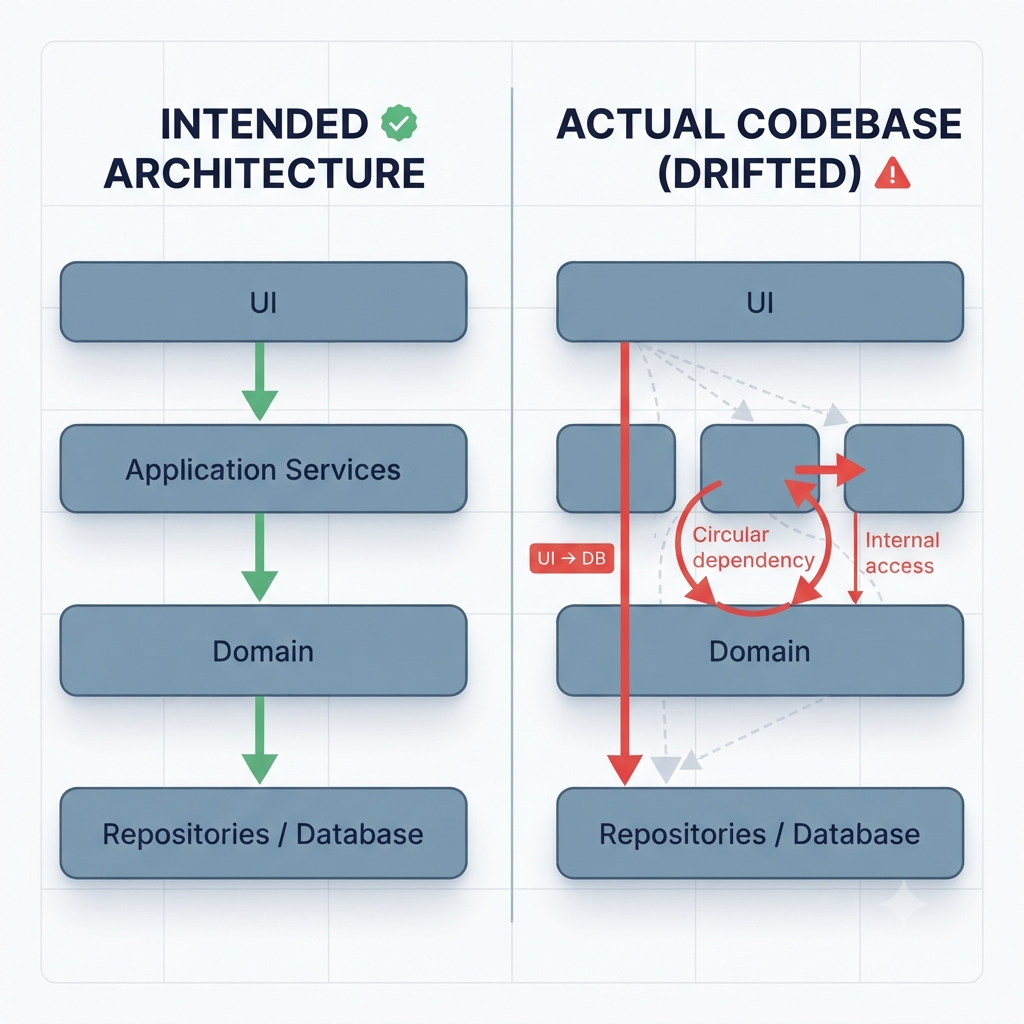
Drift rarely announces itself. It piles up through small changes that each seem reasonable on their own.
Some common examples:
- A frontend component imports a database client directly instead of calling an API or repository layer.
- A service reaches into another service’s internals instead of using its public interface.
- Business rules end up scattered across controllers, UI components, and infrastructure code.
- A shared library turns into a dumping ground for unrelated utilities.
- Two modules that were supposed to stay independent develop a circular dependency.
- An agent rebuilds an abstraction that already exists because it never found the original.
Each of these adds coupling. A change that should touch one component starts touching several, and future work gets slower, riskier, and more expensive.
The good news is that many of these problems can be caught before merge: cross-boundary calls, bypassed facades, forbidden imports, and new dependency cycles.
Why prompts and specs are not enough
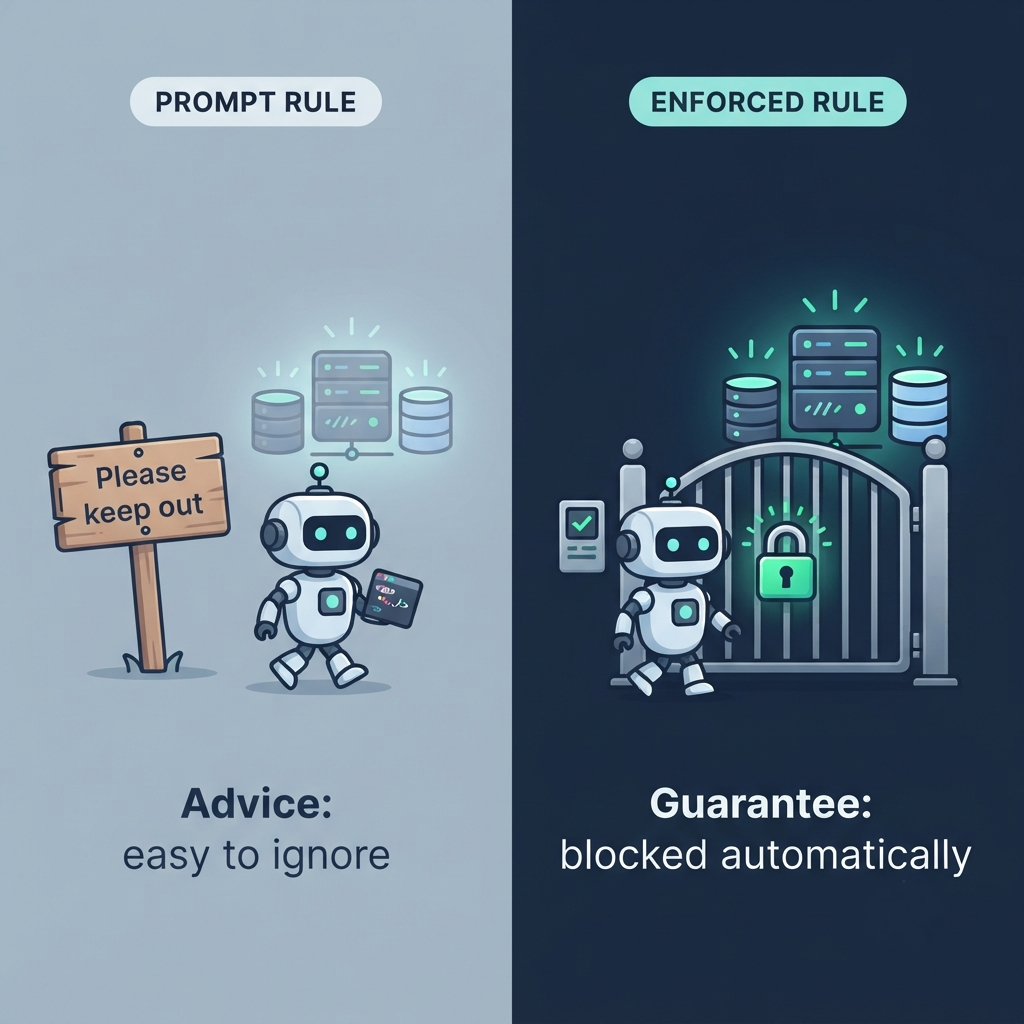
The usual first move is to put architecture rules in the agent’s prompt:
“Follow clean architecture.”
“Do not bypass the service layer.”
“Keep UI, business logic, and data access separated.”
That helps a little, but it isn’t a control system.
Prompts are advice. They get interpreted differently from run to run, forgotten between sessions, and drowned out in a big repository. A spec describes what you want but doesn’t build a wall around it. And human reviewers can’t carefully read every diff an agent produces.
Teams need two things:
- A floor: a limited set of valid building blocks, boundaries, and dependency directions.
- A gate: deterministic checks that test every proposed change against that floor.
Prompt-only rules tend to slip at repository scale. Executable, deterministic enforcement is what gives you a guarantee you can rely on.
The prevention model
Stopping drift means moving from architecture as documentation to architecture as enforcement.
| Stage | What it means | Example |
|---|---|---|
| Capture | Record architectural decisions and their rationale | “Domain logic must not depend on HTTP frameworks.” |
| Formalize | Express the rule in a machine-checkable form | “domain may not import infrastructure.” |
| Scope | State exactly where the rule applies | “Applies to src/domain/**; excludes generated code.” |
| Retrieve | Give the agent relevant rules before it plans or edits | Load rules for the affected package and dependency graph. |
| Enforce | Validate the proposed change automatically | Fail CI or block merge on a violation. |
| Reconcile | Change the rule deliberately when the architecture should change | Review and approve a documented exception. |
A rule with no defined scope is just documentation. A scoped rule that a tool can evaluate on its own is enforcement.
Make the intended architecture explicit
An agent can’t protect an architecture that nobody has written down. So start by stating it.
Create a lightweight “intended architecture” document. It doesn’t need every internal detail, only the boundaries that matter most.
Include:
- The major components or domains, such as
web,api,domain,infrastructure, andshared. - Which dependency directions are allowed and which are forbidden.
- Public interfaces and who owns what.
- Rules for data access, events, external services, and shared libraries.
- Known exceptions, with owners and review dates.
Modern tooling can generate a starting point from your existing dependency graph, but people should confirm the proposed components and relationships before they become policy. SonarQube, for instance, lets teams define the components they intend and the relationships they allow or forbid, then compares the real code against that model.
A simple version might look like this:
UI → Application services → Domain → Repositories

UI ✗→ Database
UI ✗→ External APIs
Domain ✗→ HTTP frameworks
Shared ✗→ Domain or Application
Now people and agents share one blueprint. It’s no longer “write clean code.” It’s “these dependencies are fine, and these are not.”
Give agents the right context
Prevention starts before any code is generated.
Before an agent makes a decision, it should have:
- The task and its acceptance criteria.
- The architectural rules that apply to the files it will change.
- A map of nearby components, interfaces, and ownership boundaries.
- Examples of correct patterns already in the repo.
- Forbidden dependencies and APIs.
- Relevant architectural decision records.
Don’t dump every architecture document into the context window. Pull the smallest useful slice: the decisions, dependency limits, ownership rules, and interfaces tied to the change being planned.
Giving an agent the architecture model while it plans can improve how well it respects layers, though results vary by model. That’s why context is prevention and deterministic enforcement is the guarantee.
Enforce rules in the workflow
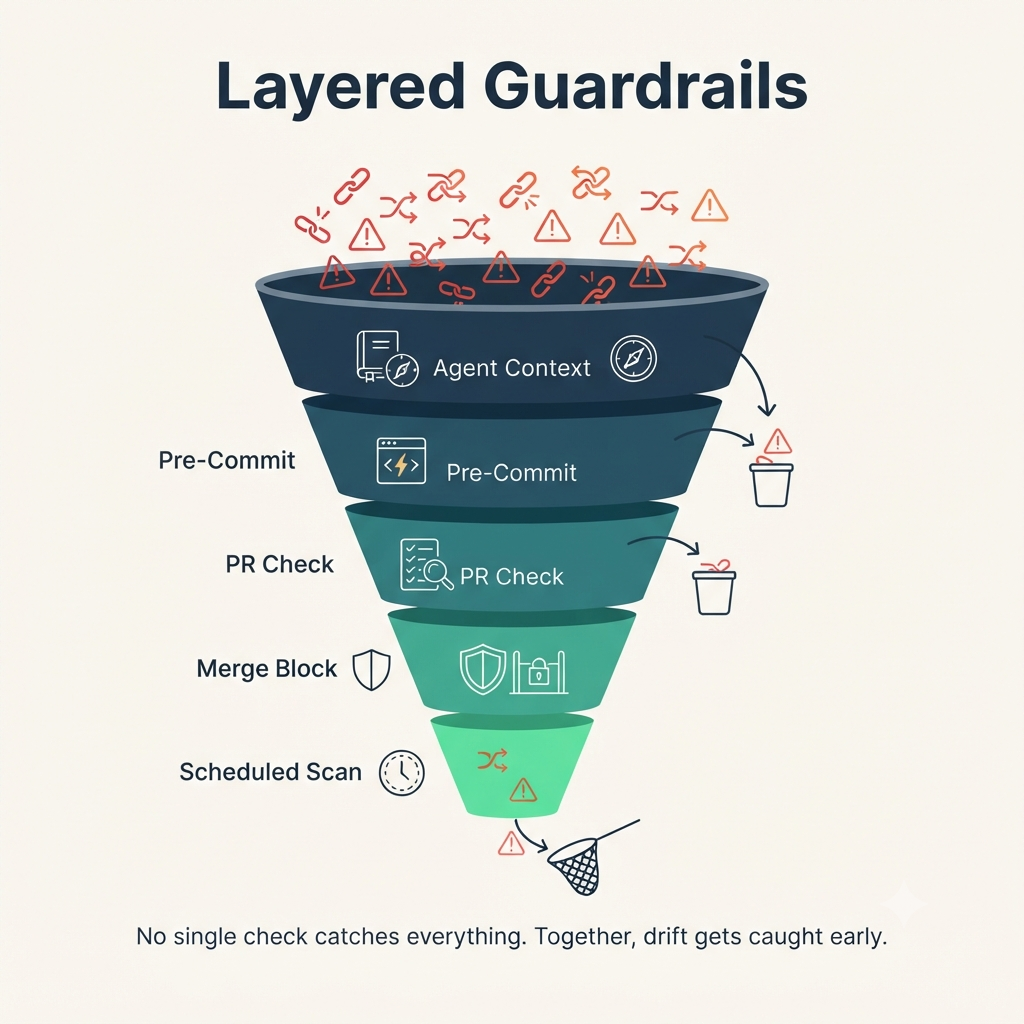
The strongest setups stack several guardrails. No single check has to catch everything. Together they make drift visible early and hard to merge.
- Agent-time guidance: Keep relevant rules and examples available while the agent plans and edits.
- Pre-commit checks: Run fast static analysis before anything is pushed.
- Pull-request checks: Make architecture validation part of the quality gate.
- Merge protection: Block the merge when a new violation appears, unless an approved exception covers it.
- Continuous detection: Run scheduled scans to find drift that slipped in through legacy code, generated files, or gaps in your rules.
Build these checks into your CI/CD pipeline so violations surface during development, not months later.
Begin with the boundaries that would hurt most to break. Protect payment-domain boundaries, public APIs, or a widely shared core library before you try to govern every directory. Treat today’s violations as a baseline: stop new ones right away, and pay down the old ones on a schedule.
Use the right kinds of checks
Good architecture checks answer narrow, practical questions.
| Check type | Question it answers | Example rule |
|---|---|---|
| Dependency rules | Can this module depend on that one? | UI cannot import the database layer |
| Layering rules | Does logic stay in the right layer? | Domain cannot depend on HTTP frameworks |
| Ownership rules | Who is allowed to change this area? | Payments changes require payments-team review |
| Interface rules | Is the approved abstraction being used? | External API calls must use the API client |
| Naming and placement rules | Is the new code in the right place? | New repositories belong in infrastructure/persistence |
| Change-scope rules | Is the change unexpectedly broad? | Flag large diffs or edits to protected paths |
One check might ask, “Does this change create a dependency from UI to the database?” Another might ask, “Does this change bypass the approved service interface?”
Keeping checks small makes failures easier to understand and fix. The agent gets a precise correction instead of a vague nudge to respect the architecture.
Handle exceptions without creating loopholes
Not every violation should be banned forever. A new integration, a performance need, or a product shift can legitimately call for an exception.
To keep exceptions from becoming loopholes:
- Require a written reason for every exception.
- Assign an owner who approves it.
- Set an expiry or review date.
- Track exceptions in version control.
- Keep them visible inside the rule set.
- Review them regularly and decide whether each should become policy or be removed.
Without this, you get the other failure mode: people quietly adding // eslint-disable comments, ignore paths, and one-off workarounds until the rule means nothing.
Measure drift, not just violations
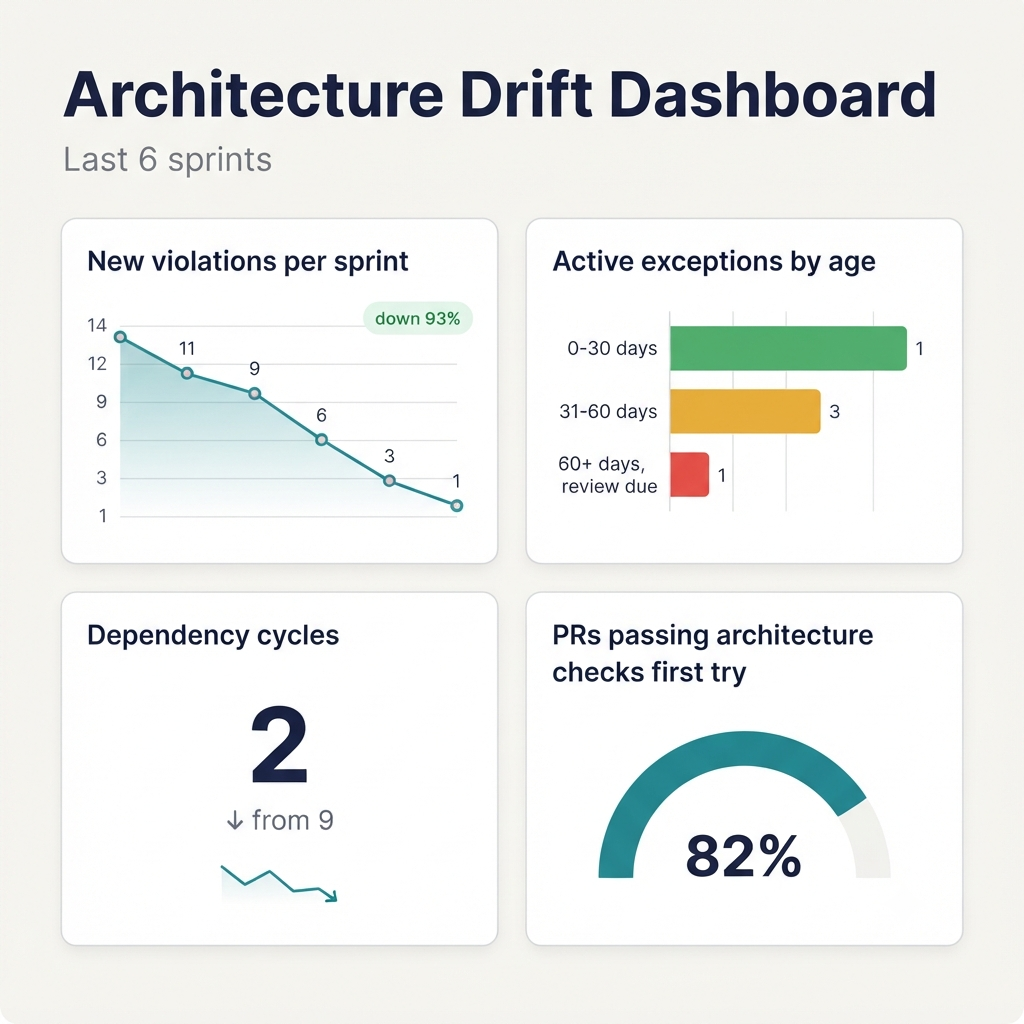
Pick metrics that show whether the system is getting easier or harder to change:
- New architecture violations per week or sprint.
- Share of pull requests that pass architecture checks on the first try.
- Number of active exceptions and how old they are.
- Dependency-cycle count and coupling between core modules.
- Time from detecting a violation to fixing it.
- Share of agent-generated changes that need architectural rework.
The goal isn’t zero exceptions. It’s an architecture that is controlled, visible, and improving.
A practical rollout plan
You don’t need to do everything at once. Here’s a realistic path:
- Weeks 1 to 2: Pick the three to five highest-risk boundaries, document the intended architecture, and choose one automated check.
- Weeks 3 to 4: Add the rules to the agent’s context, run checks locally before push, and baseline your existing violations.
- Month 2: Enforce on pull requests for new violations, set up an exception process, and expand into dependency and layering rules.
- Month 3: Add ownership, interface, and change-scope checks, measure drift, and tune the rules based on false positives and repeat agent mistakes.
Start small. A short list of rules that are actually enforced beats a giant rule set nobody maintains.
Common pitfalls
A few traps to watch for:
- Writing vague rules like “maintain clean architecture.”
- Encoding too many rules before you know which ones matter.
- Letting agents generate architecture rules without human confirmation.
- Allowing silent exceptions that hollow out your enforcement.
- Treating documentation as a substitute for executable checks.
- Assuming one huge prompt can replace context retrieval, tests, and CI.
- Optimizing only for feature speed while ignoring maintainability.
Architecture as a product constraint
AI coding agents need an architecture that is explicit, contextual, and enforceable. The workflow that holds up looks like this:
Intended architecture
→ Relevant rules delivered to the agent
→ Agent produces a change
→ Automated architecture validation
→ Human review for intent and exceptions
→ Merge only when the system remains coherent
Don’t ask your AI agent to remember your architecture. Make your architecture impossible to forget.