
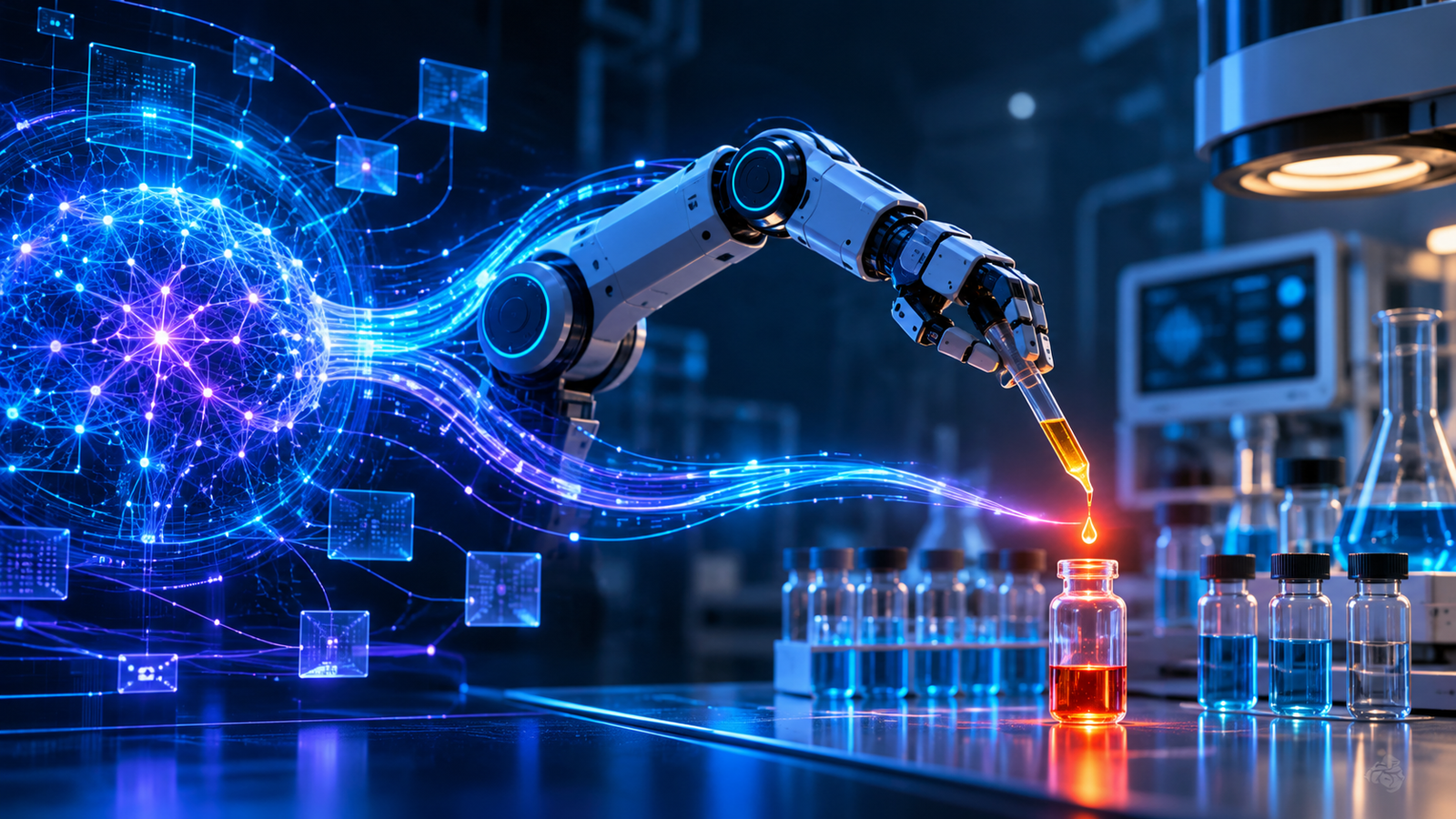
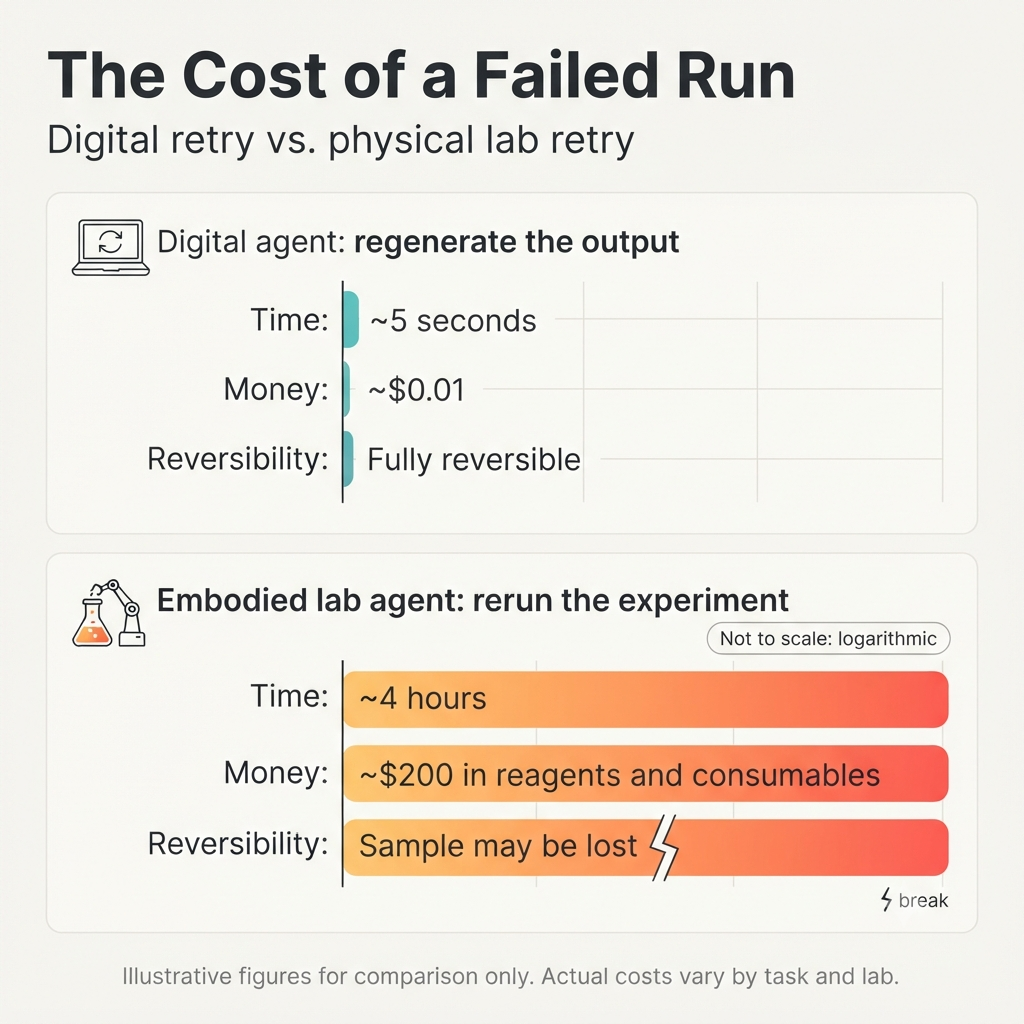
Most AI agents work in places where a mistake is annoying but not costly. If the code is wrong, they regenerate it. If the email reads badly, they rewrite it. If a query comes back empty, they run it again. Put that same agent in charge of a robot in a lab, though, and a wrong move has mass, chemistry, timing, and real consequences.
That’s why I think physical robotic actuation is the toughest test of agentic autonomy. It pushes AI past producing plans that sound plausible and makes it act safely in a world that doesn’t behave like a prompt-response loop. This is what separates embodied AI from the “disembodied” kind: it can perceive, decide, and act through a physical device in the real world.
The Agent That Can’t Afford to Hallucinate
Picture an AI agent running a wastewater-treatment experiment. It picks which samples to test, plans the order of measurements, tells a robotic system to prepare and analyze them, and uses the results to choose what to try next.
Now say it misreads a sensor or picks the wrong reagent volume.
In a digital workflow, you rerun the task. In the lab, you may have contaminated a sample, used up a scarce reagent, damaged an instrument, or produced a result that quietly misleads you. This is no longer a question of output quality. It’s a question of execution.
I think of this as the “physical drag” of embodied agency: every decision has to survive contact with matter. A hallucinated API call is a nuisance. A hallucinated robotic action can spill liquid, break glassware, or ruin an entire experiment.
The Disembodiment Problem
Today’s agents are good at symbolic work. They follow instructions, retrieve information, write code, use tools, and coordinate multi-step workflows. But most of that skill lives in digital sandboxes, where the environment is fairly predictable and mistakes can be undone.
Embodied agents live in a different reality.
- Their observations are noisy, partial, and delayed.
- Their actions have tolerances, calibration limits, and hardware constraints.
- Their environment keeps changing while they act.
- Their mistakes can be irreversible.
- Their feedback may only arrive after a physical process has already played out.
Embodied AI ties perception, learning, and execution to physical components so it can interact adaptively with the real world. Bolting a robot arm onto a language model doesn’t get you there. You need a system that can reason about physical state, work within mechanical limits, and change course when reality doesn’t match what it expected.
What “Agentic” Means in a Physical System
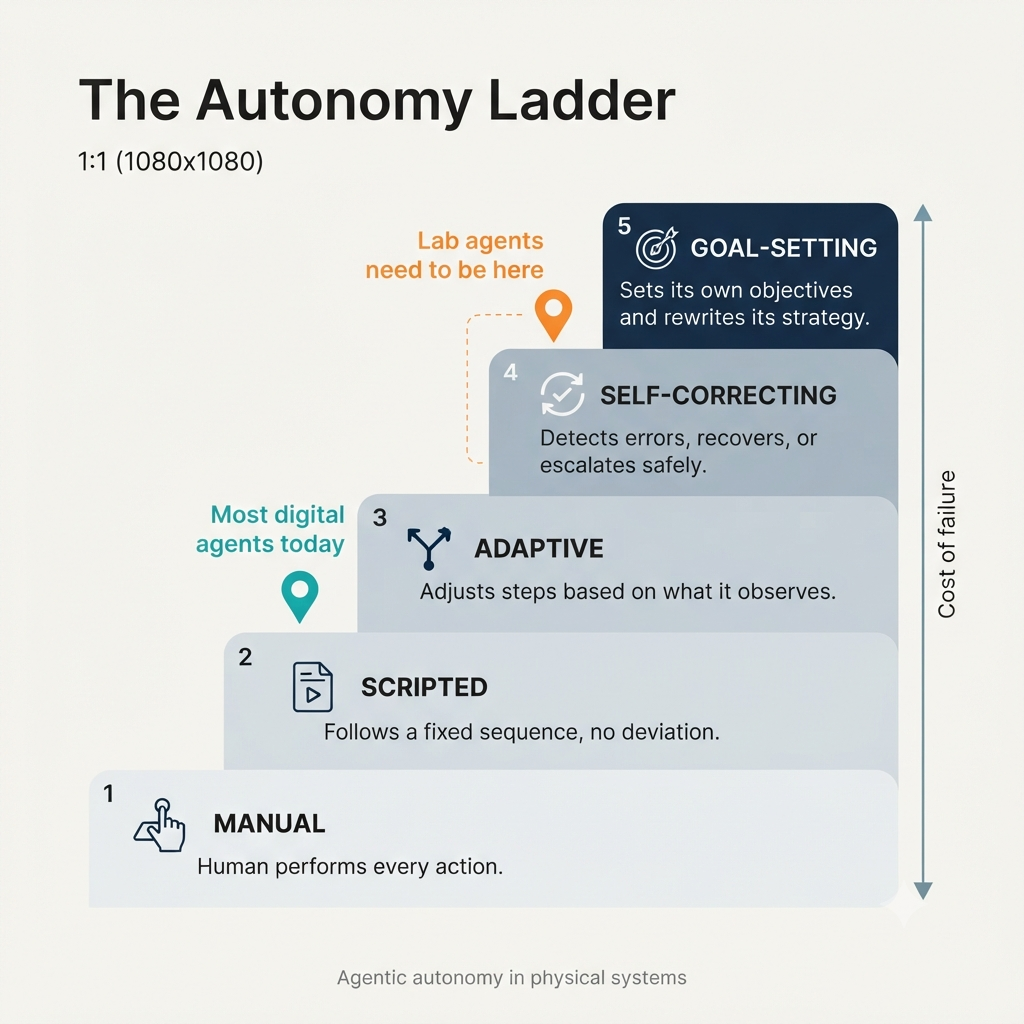
People throw the word agentic around loosely. A system that follows a fixed script is automated, and not necessarily agentic. A truly agentic system sets a goal, breaks it into actions, watches what happens, and adjusts its strategy when things are uncertain.
In a physical environment, meeting that definition gets a lot harder.
| Capability | Digital agent | Embodied agent |
|---|---|---|
| Planning | Produces a sequence of tool calls or steps | Plans actions constrained by physics, tools, and safety |
| Perception | Reads structured data or screen content | Interprets cameras, sensors, force feedback, and instrument states |
| Execution | Calls APIs or edits files | Moves motors, dispenses fluids, handles objects, operates instruments |
| Error handling | Retries or regenerates output | Detects faults, recovers safely, or escalates to a human |
| Cost of failure | Often low and reversible | Can involve contamination, damage, delay, or safety risk |
| Success measure | Task completion or output quality | Safe completion, physical validity, recovery, and provenance |
Recent research describes embodied manipulation as a closed loop. The agent has to understand instructions and context, make sense of multimodal sensory input, generate actions that fit the robot’s mechanics, and adjust both its thinking and its actions based on live feedback.
The Four Harsh Teachers of Physical Reality
The physical world teaches AI systems lessons that digital environments never will.
Noisy perception
A camera doesn’t hand over a clean object model. It sees changing light, reflections, shadows, occlusion, bubbles, and motion blur. A force sensor can tell you contact happened, but not why. So the agent has to reason under uncertainty instead of treating what it perceives as ground truth.
Non-deterministic materials
Chemistry, biology, and materials science don’t have the tidy determinism of software. Temperature, humidity, reagent age, viscosity, contamination, and mixing dynamics all shape the outcome. Two procedures that look identical on paper can give different results in practice.
Hardware execution loops
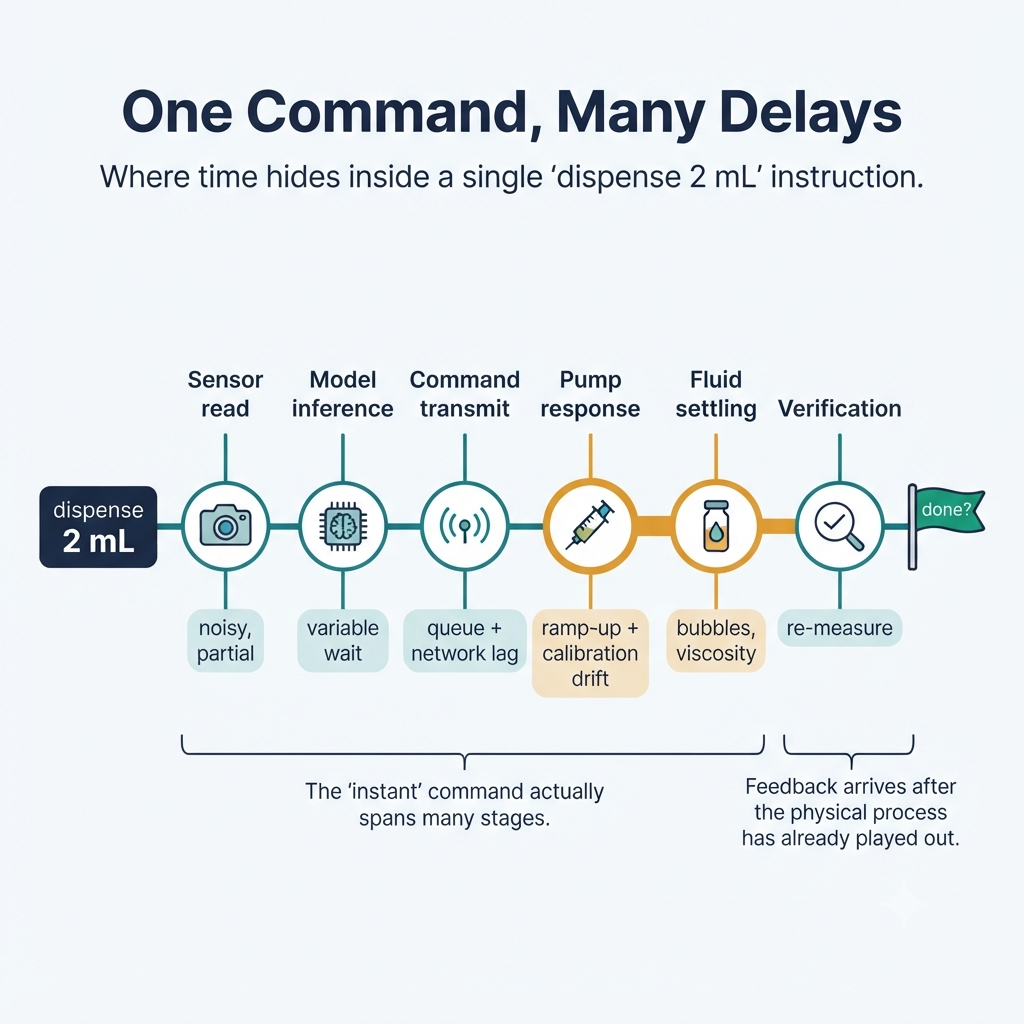
A plan that says “dispense 2 mL” hides a huge amount of work: pump calibration, tube positioning, fluid dynamics, air bubbles, tool alignment, timing, and failure detection. Physical AI also has to deal with perception latency, sensor noise, and actuation delays while it closes the loop between sensing and acting.
Irreversibility and safety
Some actions can’t be taken back. A spilled reagent, a broken vial, a cross-contaminated sample, or a damaged instrument carries a cost that rerunning a prompt won’t fix. That makes safety constraints, halt conditions, and human escalation core parts of the agent, not optional add-ons.
Why Labs Are the Ultimate Autonomy Test
Scientific labs are a brutal environment for embodied agents because they demand long-horizon reasoning and fine-grained physical execution at the same time.
An agent may need to:
- Interpret a broad research objective.
- Select an experimental procedure.
- Identify the correct instruments and materials.
- Plan a sequence of physical actions.
- Monitor sensor and instrument readings.
- Detect anomalies or failed steps.
- Revise the next action based on evidence.
- Maintain a record of what happened and why.
Embodied science systems need autonomy over long stretches of time. They have to plan under uncertainty and cost, change strategy when outcomes surprise them, and keep memory, provenance, monitoring, and recovery intact across experimental cycles.
That’s why a lab tells you more than a chatbot benchmark does. A benchmark asks whether the model can give a good answer. A lab asks whether the system can behave well when its answer changes the physical world.
The Architecture of an Embodied Agent
A credible embodied agent needs more than a reasoning model and a robot controller. It needs an architecture that links intention, perception, action, safety, and learning.
| Layer | Role | Physical-world challenge |
|---|---|---|
| Goal and reasoning | Interprets objectives and forms an approach | Must reason under incomplete information |
| World model | Represents objects, procedures, and expected effects | Must include physical constraints and changing conditions |
| Perception | Fuses visual, tactile, and instrument data | Must manage noise, latency, and ambiguity |
| Planning | Sequences actions and prepares contingencies | Must balance exploration, safety, time, and resources |
| Actuation | Converts intent into robot or instrument commands | Must respect kinematics, calibration, and hardware limits |
| Safety and governance | Enforces constraints and logs decisions | Must prevent irreversible harm and preserve auditability |
| Memory and learning | Improves future behavior from outcomes | Must distinguish real learning from noise or one-off anomalies |
One emerging design, the Embodied Science Agent, splits a digital cognitive core from an embodied control layer. The digital side handles memory-based reasoning and experiment optimization. The embodied side provides general-purpose instrument control. A unified interface keeps the two coordinated.
The key design principle isn’t “LLM plus robot.” It’s closed-loop coordination. Perception feeds reasoning, reasoning drives action, action changes the world, and the changed world produces new perception.
The Real Test Is Recovery, Not Perfection
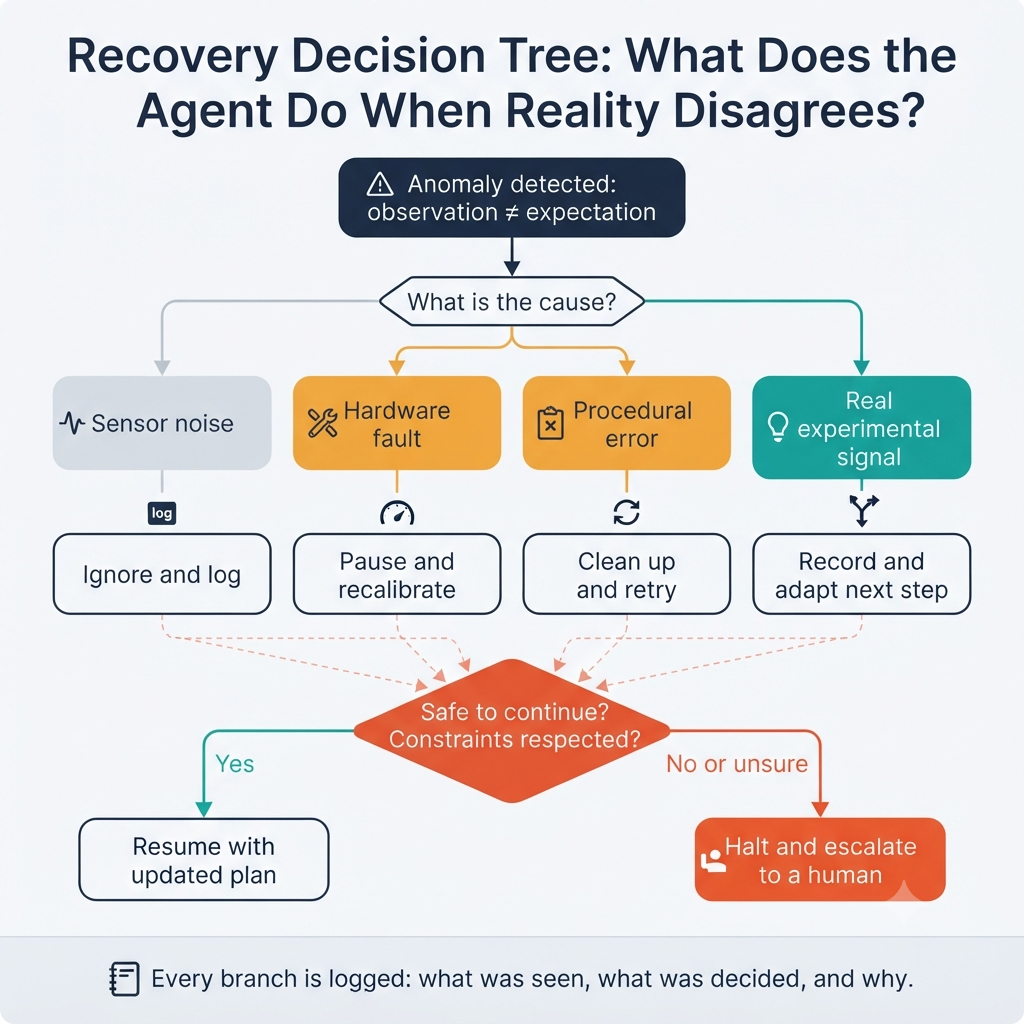
We shouldn’t judge physical autonomy by whether an agent runs a plan flawlessly on the first try. That almost never happens in the real world.
A better test is whether the agent can recover.
- Detect: Does it notice when what it observes differs from what it expected?
- Diagnose: Can it tell sensor noise from a hardware fault, a procedural mistake, or a real experimental signal?
- Recover: Can it pause, recalibrate, clean up, retry, or safely change course?
- Respect constraints: Can it refuse an unsafe action even when its own plan calls for it?
- Preserve provenance: Can it explain what it did, why, and based on what evidence?
- Generalize: Can it adapt to a new tool, layout, material, or task without being reprogrammed from scratch?
Agentic robot systems have to cope with partial observability and failures that come and go, and they can’t succeed only under clean demo conditions. Put simply, resilience is the real measure of autonomy, and flawless execution isn’t.
What Builders Should Change
For teams building these systems, embodiment shifts the engineering priorities.
- Design for the feedback loop, not the demo. The valuable system is the one that notices when things diverge and adapts safely.
- Treat physical constraints as reasoning inputs. Calibration ranges, tool availability, material compatibility, and safety envelopes should shape the plan from the start.
- Build escalation as a capability. Knowing when to stop is intelligence, not failure.
- Instrument everything. Logs should capture sensor readings, commands, outcomes, interventions, and the reasoning behind each decision.
- Evaluate recovery, not just completion. Track constraint violations, human interventions, sample integrity, recovery time, and safe-resolution rates.
- Keep humans meaningfully in the loop. Autonomy doesn’t mean removing oversight. It means focusing oversight where the consequences are highest.
“Isn’t This Just Robotics?”
It’s a fair question. Robotics has always dealt with control, sensing, and actuation, so what’s new?
What’s new is that general-purpose AI agents can now take part in adaptive experimental planning. They can take a high-level scientific goal, pick procedures, coordinate instruments, watch the results, and revise their strategy over a long horizon.
The novelty isn’t that a robot can move. It’s that an AI system can reason about why it should move, what the movement is supposed to achieve, and what to do when the physical world disagrees.
Recent research on adaptive AI agents ties experimental planning directly to robotic action. The agent uses information it derives itself to plan the robot’s actions in an experimental environment that keeps changing.
The Physical Drag Test
Here’s a simple test for the next generation of AI systems:
An AI system is truly agentic when its decisions must survive contact with matter: when a mistaken belief produces a measurable physical consequence, and the system must perceive, recover, and learn without breaking the world it is trying to understand.
The next frontier of AI won’t be defined only by better language generation or more tool calls. It will be defined by systems that can act carefully in a world that pushes back.
Digital agents can revise a mistake. Embodied agents have to survive one.