

Picture an AI agent on Black Friday. It has found the deal you wanted: a limited-stock television at a steep discount. It compares prices, drops the set into a cart, picks a delivery option and heads for checkout.
Then the door shuts.
You didn’t change your mind, and the TV hasn’t sold out. The merchant’s security system simply can’t tell whether this request comes from a legitimate assistant working for a real customer, or from a scraper, a scalper, a credential-stuffing operation or a DDoS bot.
That’s the quiet infrastructure problem sitting under agentic commerce. Before an AI can shop for anyone, it has to prove it isn’t malicious automation. Cloudflare and payment networks like Visa are now building that proof, using cryptographic identity to give trusted agents something like a passport before they reach the checkout.
The checkout door has a new bouncer
For decades, e-commerce security has rested on a simple idea: humans are welcome, suspicious automation is not. Merchants lean on bot detection, rate limiting, CAPTCHAs, device fingerprinting and fraud controls to protect their inventory, payment flows and customer accounts.
AI agents break that model. They browse, compare products, fill carts and may even complete purchases, and none of it looks like a typical human session. To a security system, a shopping agent can look a lot like a bot, because in a technical sense it is one.
Visa describes its Trusted Agent Protocol as a way to recognize trusted agents with commerce intent and tell them apart from rogue bots and malicious automation. So the real problem isn’t only whether shoppers will trust AI agents. It’s whether merchants can tell an authorized agent from a hostile one at the exact moment it matters most, which is checkout.
Why merchants can’t just “allow AI agents”
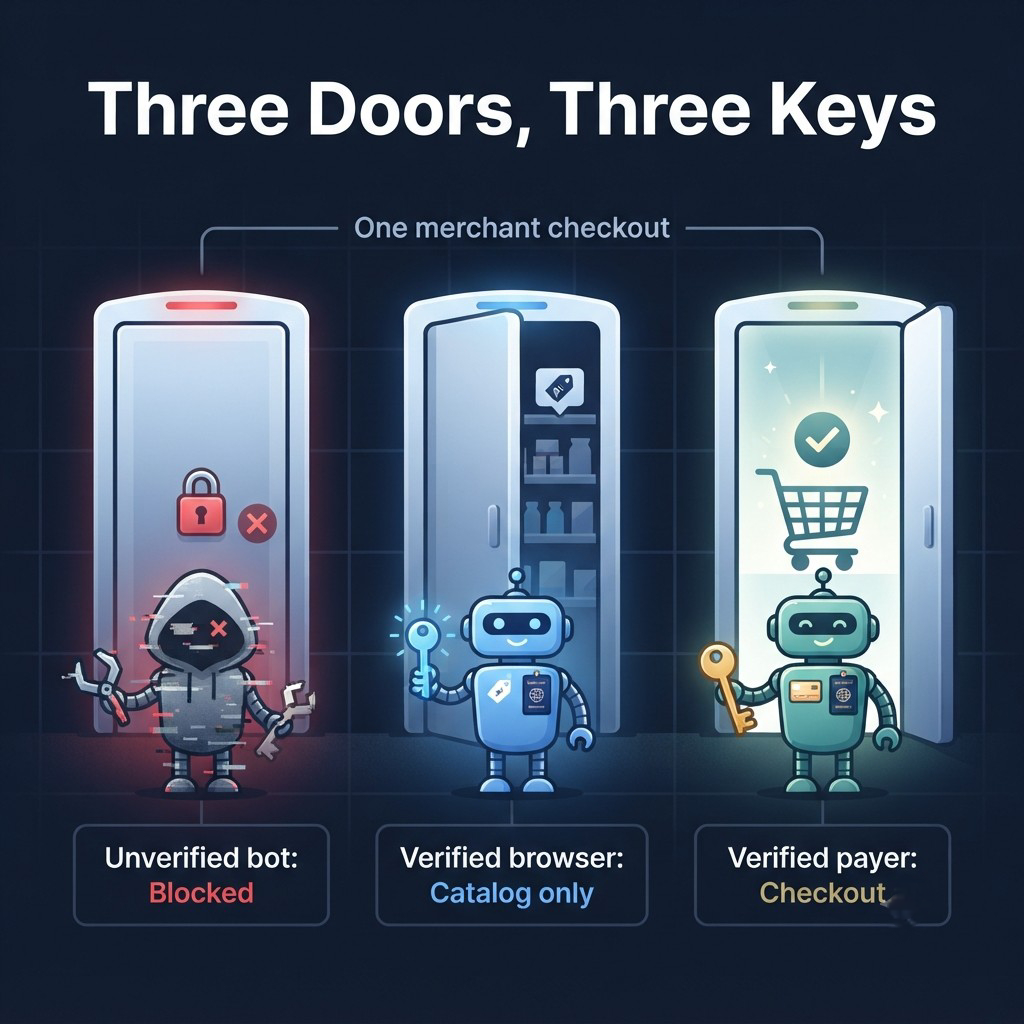
A blanket rule that lets every AI agent through would hand attackers an open door.
Black Friday makes automated traffic even more valuable to bad actors. Scrapers watch inventory and price changes. Scalpers try to grab limited stock. Fraudsters test stolen card details. Botnets can swamp a checkout system or game a promotion.
Cloudflare’s Bot Management already uses layered detection to produce a Bot Score, which lets merchants allow, block, challenge or rate limit traffic. But those tools were built for a web where the main question was whether a visitor looked human.
The question now is sharper: is this automated request authentic, authorized, and acting within its intended scope?
A legitimate agent may fire off lots of product requests in quick succession. It may not have a familiar browser fingerprint. It may run from cloud infrastructure instead of a consumer’s laptop. Every one of those traits can also describe a malicious bot, even when the agent is doing honest work for a real person.
So merchants need a way to make trust readable to their security systems.
The “agent passport”: what gets signed
The emerging answer is what you might call an agent passport, a set of cryptographically verifiable claims attached to an agent’s web requests.
Rather than just announcing “I’m a shopping agent,” the agent signs its HTTP requests. The merchant, or an edge network like Cloudflare, can then check that the signature came from the agent’s registered key.
Cloudflare’s Web Bot Auth approach uses HTTP Message Signatures so bots can authenticate themselves and customer origins can identify them. In practice, the agent shows proof of identity instead of a user-agent string anyone could fake.
| Claim | What it helps prevent |
|---|---|
| “I am Agent X, operated by Organization Y” | Anonymous scraping and impersonation |
| “This request was signed with Agent X’s private key” | Forged or tampered requests |
| “This signature is fresh” | Replay of old captured requests |
| “This nonce has not been used before” | Reuse of a legitimate signature |
| “I am browsing” versus “I am authorized to pay” | Browsing agents being treated as payment agents |
| “I am acting for this consumer with commerce intent” | Unauthorized agent transactions |
Visa’s Trusted Agent Protocol specification describes three separate signatures: one in the message header that lets the merchant recognize the agent, one in the request body that links to a signed consumer and device identity, and one tied to payment within the transaction flow.
That separation matters. A signed agent isn’t automatically allowed to buy anything. It first has to show what kind of access it holds: browsing, cart creation, starting checkout, or authorizing payment.
Inside the verification flow
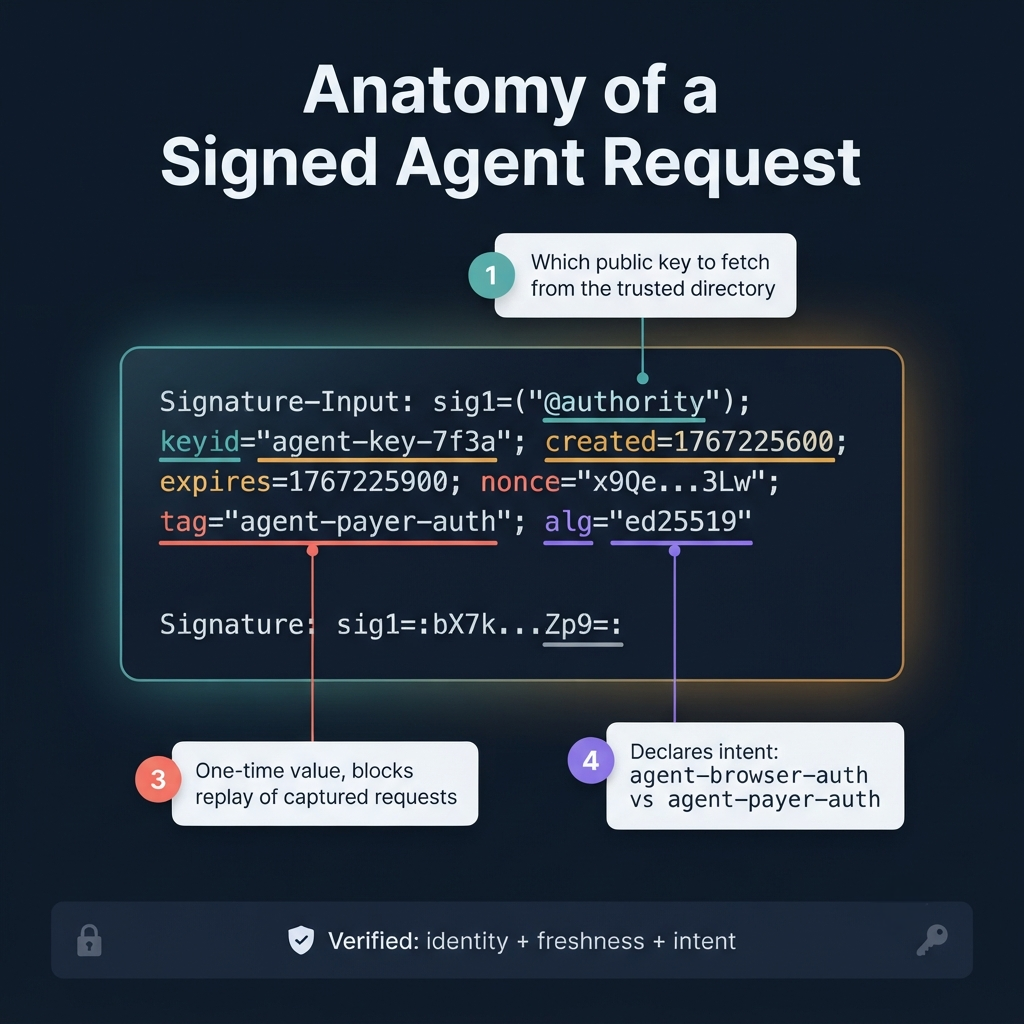
When a signed agent arrives at a merchant, the check feels less like a CAPTCHA and more like showing ID at a front desk.
- The agent signs the request. It attaches
Signature-InputandSignatureheaders using HTTP Message Signatures. - The verifier gets the public key. The merchant or edge network reads the
keyidfrom the signature metadata and fetches the matching public key from a trusted directory or well-known URL. - The verifier checks freshness. The current time has to fall inside the signature’s
createdandexpireswindow. - The verifier rejects replays. A nonce check makes sure a captured signature can’t simply be reused by an attacker.
- The verifier checks intent. Cloudflare describes protocol tags such as
agent-browser-authfor browsing andagent-payer-authfor payment. - The verifier validates the signature. It rebuilds the canonical signature base and runs Ed25519 verification.
- Policy decides what happens next. A verified browsing agent might be allowed to pull product information. A verified payment-capable agent might move on toward checkout, still subject to the merchant’s fraud, inventory and payment rules.
This is the real shift. Security systems stop asking whether the traffic looks human and start asking whether it can prove who it is, what it’s allowed to do, and whether that permission is still valid.
Why payment networks matter
Cloudflare can answer one important question: is this request really from the agent it claims to be?
Payment networks can answer another: should this agent be allowed to finish this purchase?
Cloudflare and Visa have worked together on the Trusted Agent Protocol, which lets payment networks plug into Web Bot Auth and gives merchants a way to enable agent traffic securely and selectively. Cloudflare also points out that Visa built the Trusted Agent Protocol while Mastercard built Agent Pay, and that both aim to help merchants separate approved agents from malicious bots.
Visa adds the commerce-specific layer. The protocol is meant to show that an agent is approved for a particular shopping mission, give consumers visibility, and let payment credentials pass through the merchant’s preferred checkout experience.
Put simply, cryptographic signing is the identity layer, and payment-network verification is the authorization and commerce layer.
Think of a visitor badge at a corporate office. The badge proves you are who you say you are. It doesn’t open every door, server room or finance system. What you can reach still depends on your role, your purpose and your permissions.
The Black Friday stress test
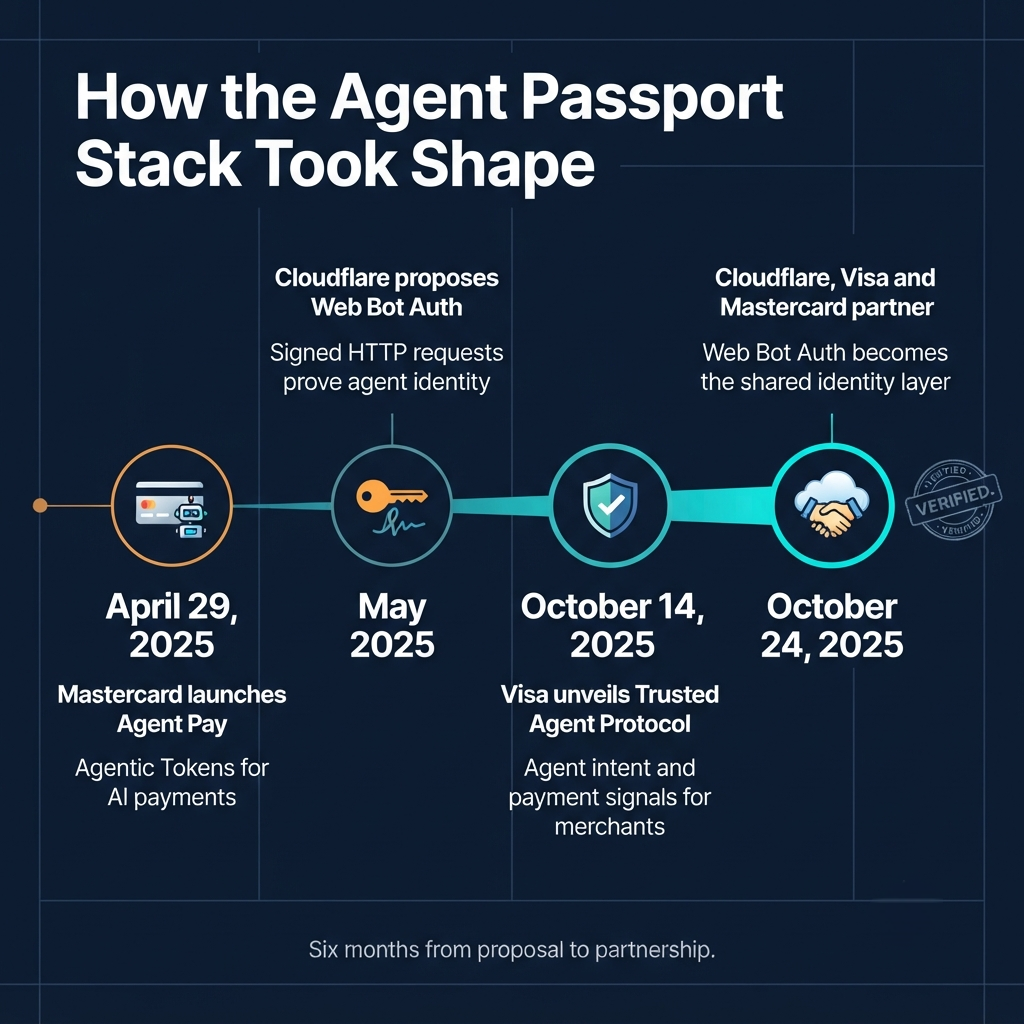
Black Friday is more than a shopping event. It’s a stress test for the whole agentic-commerce security stack.
- Traffic spikes make false positives expensive. Blocking a legitimate agent could mean losing a high-intent purchase.
- Bot pressure climbs as scrapers, scalpers and credential-stuffing crews go after limited stock and promotions.
- Checkout becomes the riskiest boundary, because identity, fraud controls, payment authorization and inventory all have to line up.
- Agent behavior is unfamiliar, so merchants need standard signals instead of trying to fingerprint every new AI product by hand.
Visa and its partners have positioned the Trusted Agent Protocol as an open framework built on existing web infrastructure, meant to support safe agent-driven checkout and separate legitimate agents from malicious ones.
That makes the holiday season a natural proving ground. If agents can be verified reliably at peak load, merchants may be more willing to let them operate the rest of the year. If verification falls over, agents could stay stuck behind the same bot walls built to protect stores from abuse.
What changes for merchants, agents and shoppers
| Stakeholder | What changes | Practical implication |
|---|---|---|
| Merchants | Can verify agent signatures and apply policy based on intent | Can allow trusted browsing while still blocking scrapers and abuse |
| AI-agent developers | Must manage keys, sign requests, and follow protocol rules | Agent identity becomes an engineering requirement, not a feature |
| Payment networks | Provide commerce identity, consent, and payment-context layers | Agents can connect to familiar checkout and payment rails |
| Edge and security providers | Verify signatures at scale before traffic reaches merchants | Bot defenses become identity-aware rather than behavior-only |
| Shoppers | May gain more transparent agent-mediated purchasing | The central issue becomes authorization and control, not blind trust |
Cloudflare says merchants can use its network to verify agents’ cryptographic signatures and confirm that interactions are legitimate. Visa’s model adds agent approval, consumer visibility and requirements for how payment details pass through.
For merchants, this opens up a more flexible policy model. They no longer have to pick between blocking all bots and allowing all automation. They can treat an unverified scraper, a verified browsing agent and a verified agent cleared to complete a purchase as three different things.
The unresolved questions
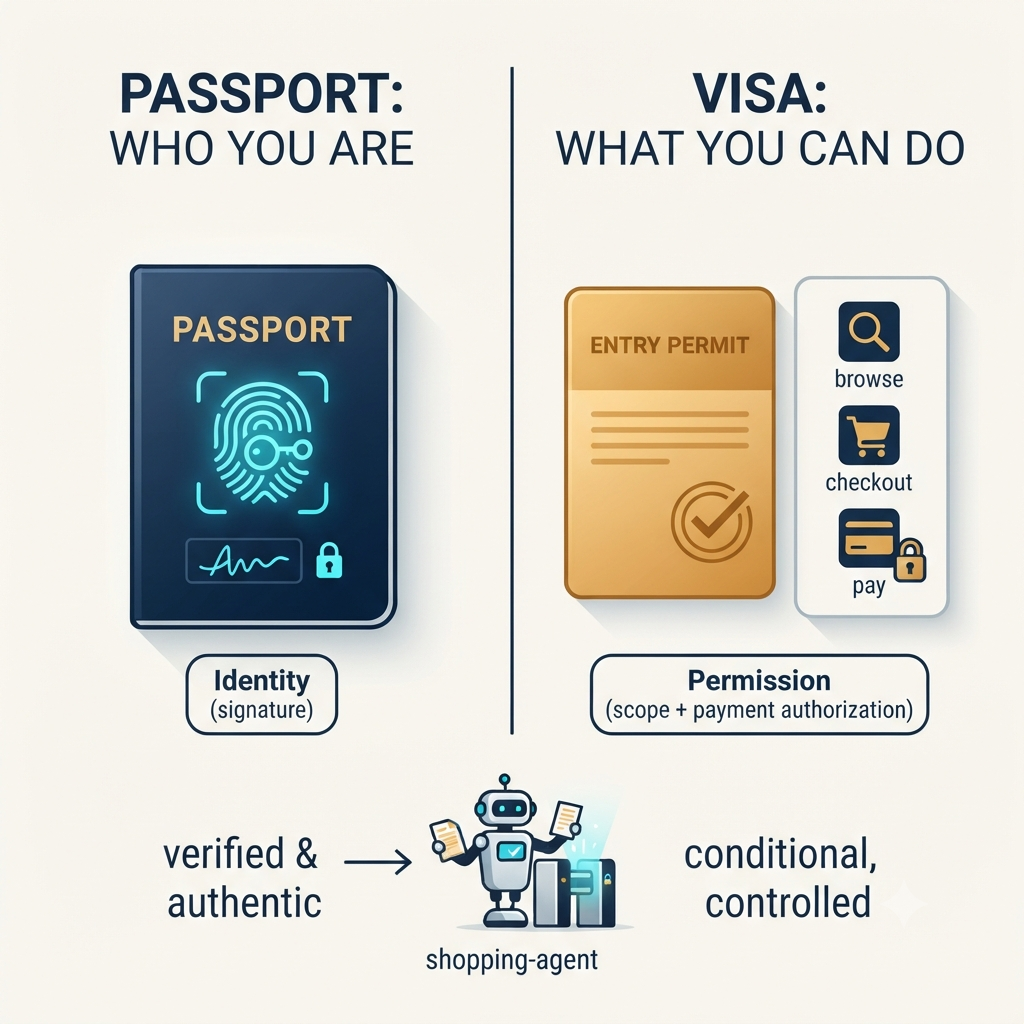
Cryptographic identity is necessary, but it doesn’t settle everything.
- Who is accountable when an agent makes a mistake? Responsibility could be shared among the consumer, the agent developer, the merchant and the payment network.
- Can a signed agent still misuse its access? Yes. A valid signature proves authenticity. It doesn’t prove the agent is staying within what the consumer intended.
- Will verification create new gatekeepers? Smaller agent developers may struggle with onboarding, key management and protocol compliance.
- What does “trusted” really mean? It should mean authenticated and authorized by policy, not automatically safe, unbiased or guaranteed to find the best price.
- Will merchants accept agent traffic at peak times? Security teams may stay cautious until there’s solid data on fraud, abuse and performance.
A signed agent solves impersonation. It doesn’t, on its own, solve authorization, accountability or abuse.
The new checkout requirement is proof, not permission
The future of agentic commerce won’t hinge only on whether shoppers like using AI assistants. It will hinge on whether merchants can safely tell a customer’s authorized agent from hostile automation.
The answer taking shape has several layers:
- Cryptographic agent identity at the network edge.
- Commerce intent and consumer linkage at the payment layer.
- Merchant policy at checkout.
- Fraud, inventory and payment controls on the transaction itself.
In that world, the first obstacle an AI shopper meets on Black Friday won’t be a product page. It will be a cryptographic verification check.
The agents that get through won’t be the ones that merely say they can be trusted. They’ll be the ones that can prove it, request by request and signature by signature, before anyone lets them past the merchant’s door.