

When a multi-agent system runs on your own infrastructure, nobody else is watching it. There is no vendor dashboard, no managed audit trail, no provider-side safety net. If an agent calls the wrong tool, leaks a customer record into a prompt, or confidently approves something it shouldn’t have, you will only know if you built a way to know.
That’s the real cost of sovereignty. Local compute gives you control over data, models, and boundaries. It also makes you responsible for seeing what happened, proving whether it worked, and showing that it was allowed. This article is about that responsibility: telemetry, evaluation, security enforcement, and governance for private multi-agent workflows.
A quick note on scope. This piece deliberately leaves out orchestration patterns, context and memory design, and inference tuning. Those have their own articles in this series. Here, observability is treated as the control plane: it won’t make your agents faster, but it makes performance, failures, security events, and accountability visible and governable.
1. Why observability is the sovereign control plane
In a cloud API setup, a lot of the operational burden sits with someone else. In a sovereign deployment it all lands on you, and the work comes down to three questions you need to be able to answer at any moment.
What happened? Every agent handoff, model call, tool invocation, and validation decision should be traceable.
Did it work? You need to measure both individual steps and the business outcome of the whole task.
Was it safe and permitted? You need to be able to show that sensitive data, tools, and decisions were handled under policy.
It helps to keep three ideas separate. Telemetry tells you what occurred. Evaluation tells you whether it was any good. Governance decides what must happen next. Teams that blur these end up with dashboards that look busy but can’t answer a regulator, an incident responder, or a skeptical executive.
Think of this article as the measurement and assurance layer wrapped around the optimization work covered in the pillar post. It doesn’t replace topology, context, or compute decisions. It tells you whether those decisions are paying off.
Key takeaway: In a sovereign deployment, observability is not a developer convenience. It is the operational evidence layer for performance, safety, and accountability.
2. The four-layer observability model
Before getting into specifics, it’s worth having a simple mental model. Observability for agent systems breaks into four connected layers.
| Layer | Question answered | Primary artifacts | Cluster 4 boundary |
|---|---|---|---|
| Tracing | Where did time, failures, and handoffs occur? | Trace, spans, span events | Focus on agent workflow visibility, not tracing setup |
| Metrics | Is the system healthy over time? | Latency, error, throughput, quality, cost proxies | Avoid GPU/inference tuning metrics |
| Evaluation | Was the output correct, useful, and safe? | Task outcomes, step scores, human review records | Avoid prompt-engineering guidance |
| Governance | Who may act, what was retained, and what requires review? | Policies, authorization decisions, audit logs | Avoid compliance legal advice |
The layers only work if they share a common correlation key. When something goes wrong, an operations team should be able to move from a failed task to the exact agent, tool call, policy decision, and output involved, without stitching together four unrelated systems by hand.
One more thing worth saying plainly: a green dashboard does not prove quality. A workflow can finish on time, with no errors, and still produce an answer that is wrong, unsafe, or non-compliant.
Here’s an example. A procurement agent completes its workflow cleanly. Weeks later, an audit reveals it selected a vendor tool it was never supposed to use. Tracing identifies the action. Evaluation scores the outcome. Governance determines whether the action should have been allowed in the first place. You need all three to close the loop.
Key takeaway: Build observability around four connected layers (trace, measure, evaluate, govern) rather than treating logs, dashboards, and audits as separate projects.
3. Designing agent traces without leaking the workload
A multi-agent workflow needs a trace structure that mirrors how the work actually happens. A practical hierarchy looks like this:
- Task trace: the user request or business workflow, from entry to final result.
- Agent span: one agent’s scoped responsibility, such as planner, researcher, extractor, reviewer, or executor.
- Model span: a specific inference request, including model identity, token usage, finish reason, and optional content attributes.
- Tool span: a discrete external action, such as a database lookup, document retrieval, API call, or system write.
- Policy/validation span: a permission check, a PII-masking event, a prompt-injection filter result, or a human-approval gate.
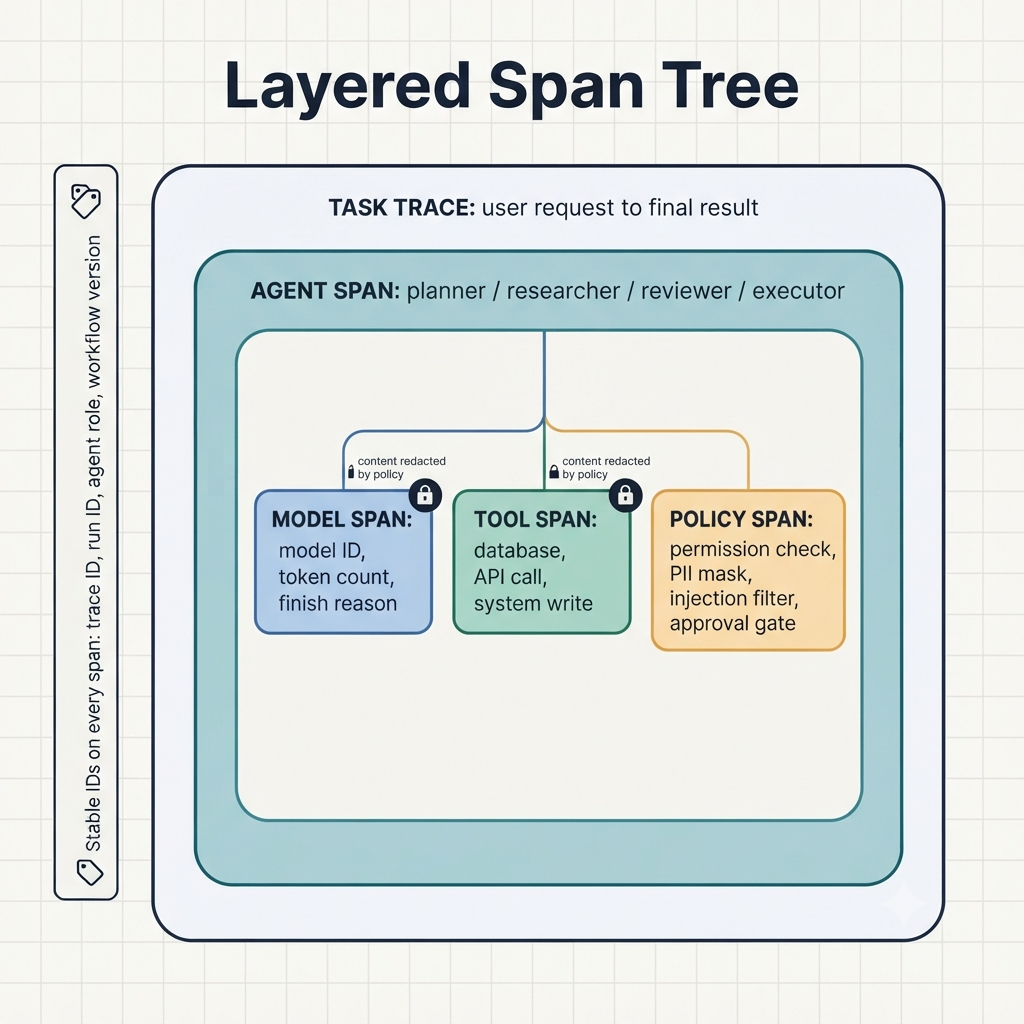
Every span should carry stable identifiers: trace ID, task or run ID, agent role, workflow version, model version, tool identity, and a request correlation ID. Without these, you can see that something happened but can’t tie it to a version of the system, which makes comparing behavior over time close to impossible.
The content-capture boundary
This is where many teams get into trouble. Full prompts and completions are enormously useful for debugging, and they are also some of the most sensitive data your system touches. OpenTelemetry’s GenAI conventions make this distinction explicit: model, token, and finish-reason attributes are one thing, while system instructions, input messages, output messages, tool calls, and tool results are optional content attributes you opt into.
A tiered capture policy keeps this manageable:
- Always capture: IDs, agent role, model and tool identity, status, duration, token counts, error class, and policy decision.
- Conditionally capture: redacted or sampled prompt and response content.
- Never capture by default: raw PII, credentials, customer records, proprietary documents, or unmasked tool payloads.
Notice what this section is not about. It covers what to record and how to protect it. Which tracing backend you pick and how you configure it is a separate decision.
Key takeaway: Trace the workflow’s decisions and actions, but make content capture a deliberate, redacted, policy-driven choice.
4. Span-level versus trace-level evaluation
The most common evaluation mistake in multi-agent systems is judging the whole workflow by one final answer. If the answer is wrong, you don’t know why. If it’s right, you don’t know whether it got there safely or by luck.
A better approach uses two views.
Span-level evaluation
This looks at individual steps inside the workflow:
- Tool-selection accuracy: Did the agent choose the correct tool and pass the correct arguments?
- Retrieval quality: Did it use relevant, authorized sources?
- Extraction fidelity: Did it preserve the required fields and avoid fabrication?
- Validation outcomes: Did a critic, schema check, policy check, or human reviewer accept or reject the output?
- Handoff quality: Did the downstream agent receive sufficient, unambiguous, authorized context?
Trace-level evaluation
This looks at the result of the whole task:
- Task completion rate: Did the workflow produce the requested deliverable?
- Correctness rate: Was the final output accurate against a known answer, a rubric, or an approved business rule?
- First-pass acceptance rate: How often did the workflow succeed without repair, retry, or human intervention?
- Escalation rate: How often did the system need a human decision?
- Recovery rate: Of the runs that failed, how many were safely corrected, retried, or escalated?
Both views matter because they fail independently. A single agent can have excellent local accuracy while the overall workflow fails from a bad handoff, a missing authorization, or a flawed final synthesis. The reverse happens too: a workflow can land on the right answer while one agent quietly misuses a tool along the way.
A simple way to think about the overall measure:
Task Success = Completion × Correctness × Policy Compliance
If any one of those is zero, the task didn’t succeed, no matter how good the other two look.
One last point that is easy to overlook. Quality metrics have to be versioned alongside the workflow, prompts, models, tools, and the evaluation rubric itself. Otherwise, a score from March and a score from June aren’t comparable, and your trend lines mean nothing.
Key takeaway: Measure every important agent action at the span level, but judge the system by trace-level business outcomes, not by vanity token or latency metrics alone.
5. The sovereign security boundary
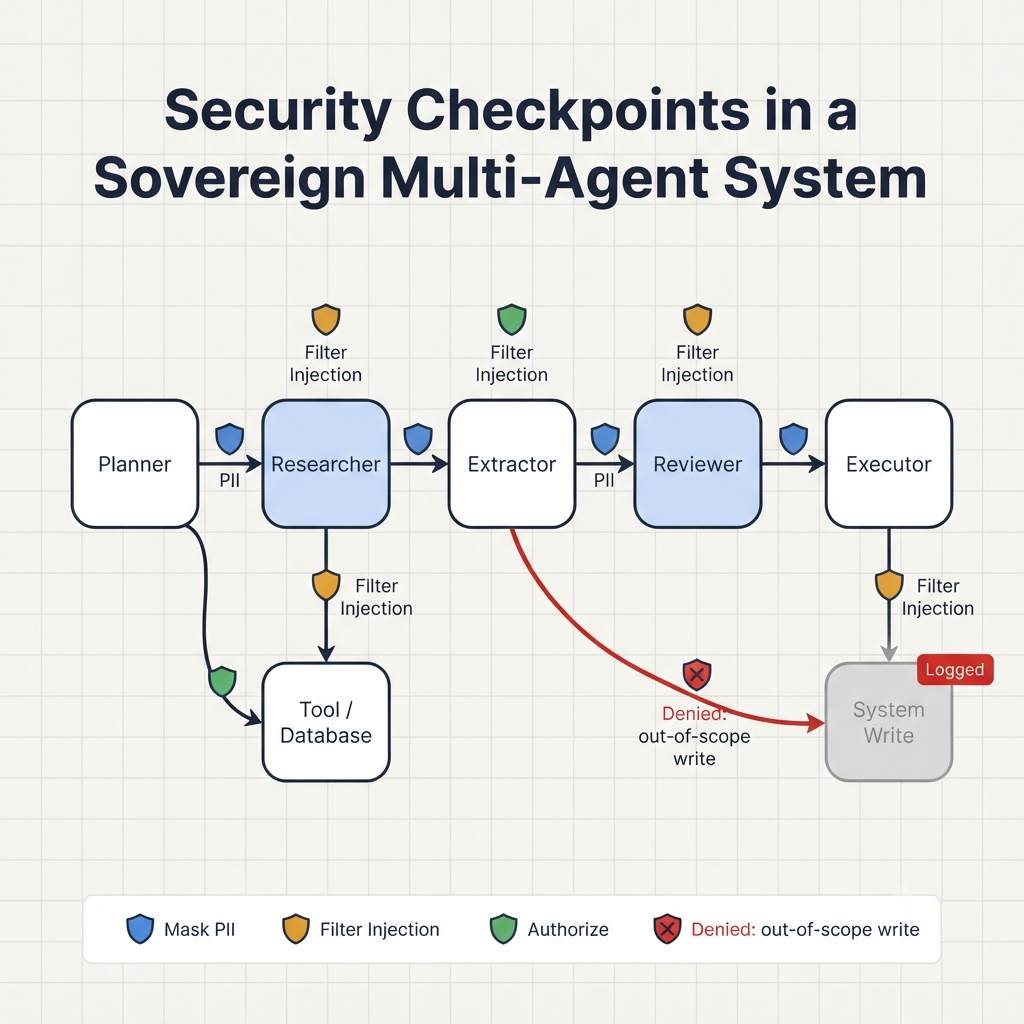
Running on private infrastructure is not a security strategy. It narrows the attack surface from the outside, but it does nothing about what agents do to each other, to your data, or to your systems once they are inside. The controls need to sit at the points where agents exchange data and take action.
Zero-trust agent authorization
The guiding model is zero trust applied to agents:
- Every agent has a distinct identity and a least-privilege role.
- Every tool call is authorized independently, even when a trusted orchestrator initiates it.
- Every handoff carries only the minimum data the next task requires.
- Every external action is logged with actor, intent, target, policy decision, and outcome.
Local PII masking at handoffs
Treat each agent boundary as a place where sensitive data can leak.
- Detect and redact direct identifiers before data crosses from one agent to another.
- Where downstream processing needs continuity without exposure, use tokenization or purpose-bound references instead of raw values.
- Keep an auditable mapping only where there is a documented business and legal purpose for it.
Prompt-injection filtering at handoff points
Anything the system didn’t write itself should be considered potentially adversarial: retrieved documents, user input, tool output.
- Screen for instruction-override attempts, hidden directives, unsafe tool requests, and exfiltration patterns.
- Record both the filter’s verdict and the action taken: block, sanitize, quarantine, escalate, or proceed.
Tool authorization
- Separate “can read” from “can write,” “can spend,” “can delete,” and “can approve.”
- Require explicit approval for irreversible or high-impact actions.
- Deny by default when an agent tries to use a tool outside its assigned scope.
Everything here is control design. Implementation code, schemas, and vendor-specific deployment steps are out of scope for this article.
Key takeaway: In sovereign multi-agent systems, security has to be enforced at handoffs and tool boundaries, not assumed because the infrastructure is private.
6. Audit logging that can survive scrutiny
At some point, someone will ask you to explain what an agent did and why. It might be an incident responder at 2 a.m., an internal auditor, or a regulator. The audit record is what you hand them, so it needs to be built for that moment, not retrofitted after it.
What a minimum audit event contains
- Who or what acted: agent identity, user identity, service identity.
- What it attempted: a model call, tool action, data access, approval, or policy decision.
- Why it was allowed or denied: the applicable policy, role, scope, and approval status.
- What changed: an input reference, output reference, system state, or external side effect.
- When and where: timestamp, environment, workflow version, and correlation ID.
Three kinds of records, three purposes
It’s useful to keep these distinct, because they have different audiences and retention needs.
- Operational logs support debugging and incident response.
- Security events capture authorization decisions, injection detections, policy violations, and access anomalies.
- Decision records hold the evidence needed to explain an automated decision and its inputs.
For high-impact decision records, use immutable or tamper-evident storage, with retention periods set by legal, contractual, and organizational requirements rather than by whatever your logging default happens to be.
What “meaningful explanation” means in practice
For applicable high-risk decisions, the organization should be able to explain the AI system’s role, the main elements of the decision, and the basis for the outcome. The EU AI Act includes a right to explanation for affected persons subject to certain high-risk AI decisions. In engineering terms, that means your decision records should let someone reconstruct the path from input to outcome in language a non-engineer can follow.
A caution: this section is an engineering checklist, not a legal manual. Have your legal and privacy teams validate it against your jurisdiction and use case.
Key takeaway: An audit log should reconstruct not only what an agent did, but also why it was permitted to do it and what evidence supported the final decision.
7. Governance roles, thresholds, and human oversight
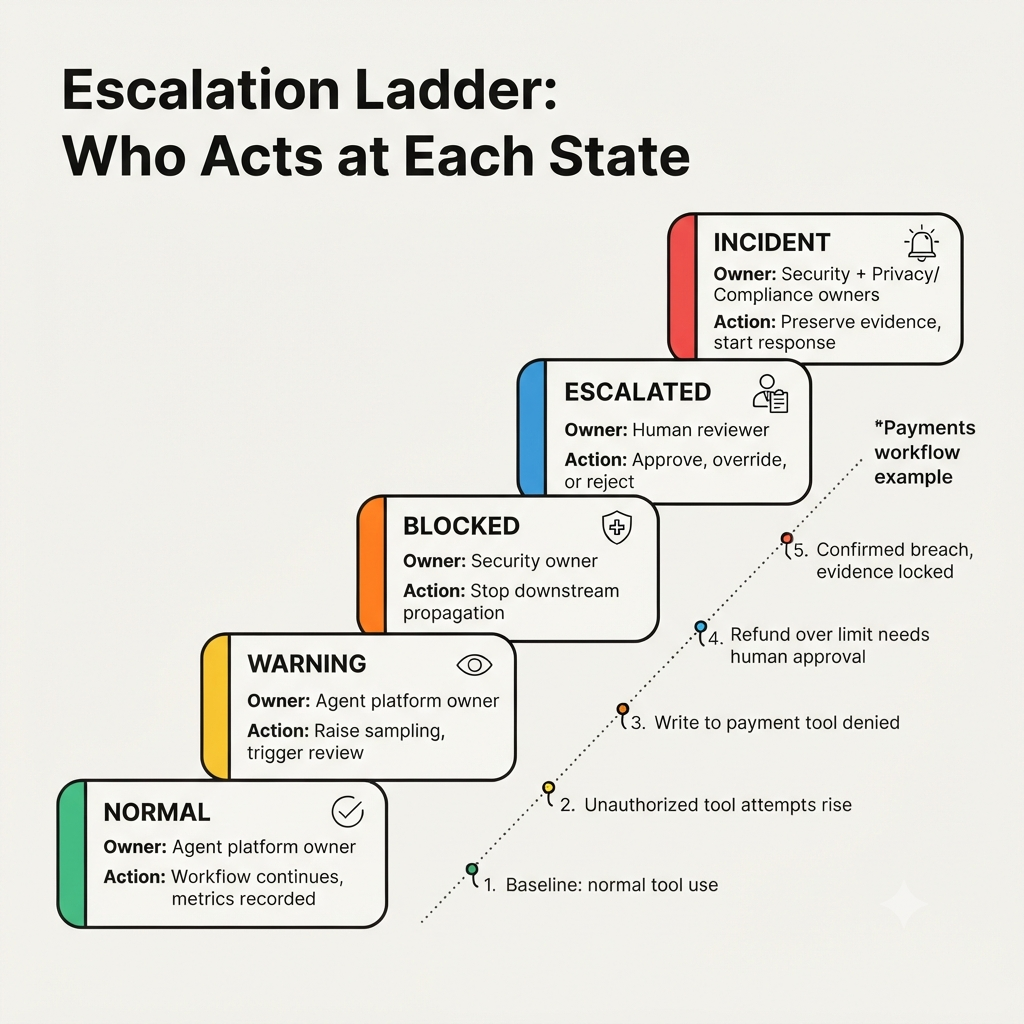
Metrics and logs don’t govern anything on their own. Governance starts when someone owns each signal and knows what to do when it moves.
A minimum role model
- Workflow owner: owns the business outcome and acceptance criteria.
- Agent platform owner: owns telemetry, evaluation, release health, and incident response.
- Security owner: owns identity, authorization, injection defenses, and data-handling controls.
- Privacy/compliance owner: owns data minimization, retention, audit requirements, and regulatory alignment.
- Human reviewer: owns exception handling, appeals, overrides, and high-risk approvals.
A threshold-based escalation model
Rather than treating everything as pass or fail, define a small number of states, each with a clear consequence:
- Normal: the automated workflow continues and metrics are recorded.
- Warning: a quality, security, or reliability signal crosses a threshold. Increase sampling or trigger a review.
- Blocked: a validation, authorization, or safety control fails. Stop downstream propagation.
- Escalated: a high-impact or ambiguous decision requires human approval.
- Incident: a confirmed policy breach, material error, or security event. Preserve evidence and start the response process.
Tie thresholds to business consequences, not generic model scores. A two-point dip in an abstract quality score means very little. A rise in unauthorized tool attempts on a payments workflow means a great deal.
This lines up with NIST’s AI Risk Management Framework guidance on monitoring: ongoing monitoring should surface performance degradation, adversarial activity, unexpected behavior, near-misses, and impacts, with clear roles and periodic review.
Key takeaway: Governance becomes operational when every metric has an owner, every threshold has an action, and every high-impact decision has an accountable human path.
8. A pragmatic rollout sequence
None of this needs to happen at once. Teams that try to build a complete observability program before they can operate the basics usually stall. A more realistic order:
- Establish the task contract. Define what “done correctly and safely” means for each workflow before measuring anything.
- Instrument the critical path. Trace agent handoffs, model calls, tool actions, and policy decisions, starting with the workflows that matter most.
- Separate operational and sensitive data. Apply redaction and minimization early, so you never build a habit of logging things you shouldn’t keep.
- Add span-level and trace-level evaluation. Start with a handful of metrics you can act on, and version them with the workflow.
- Enforce the security boundary. Put identity, tool authorization, PII masking, and injection filtering at handoffs, and log every decision they make.
- Name owners and thresholds. Assign each metric an owner and each threshold an action, then rehearse an incident once before you need one.
- Review and tighten. Use audit findings, near-misses, and escalations to refine thresholds and retention rules on a regular schedule.
Sovereign multi-agent systems give you something cloud APIs rarely do: full control. But control without visibility is just exposure. The teams that run these systems well treat observability as the thing that makes everything else trustworthy: the architecture, the context design, the compute choices. Measure what happened, judge whether it was good, and make sure someone is accountable for what comes next.