
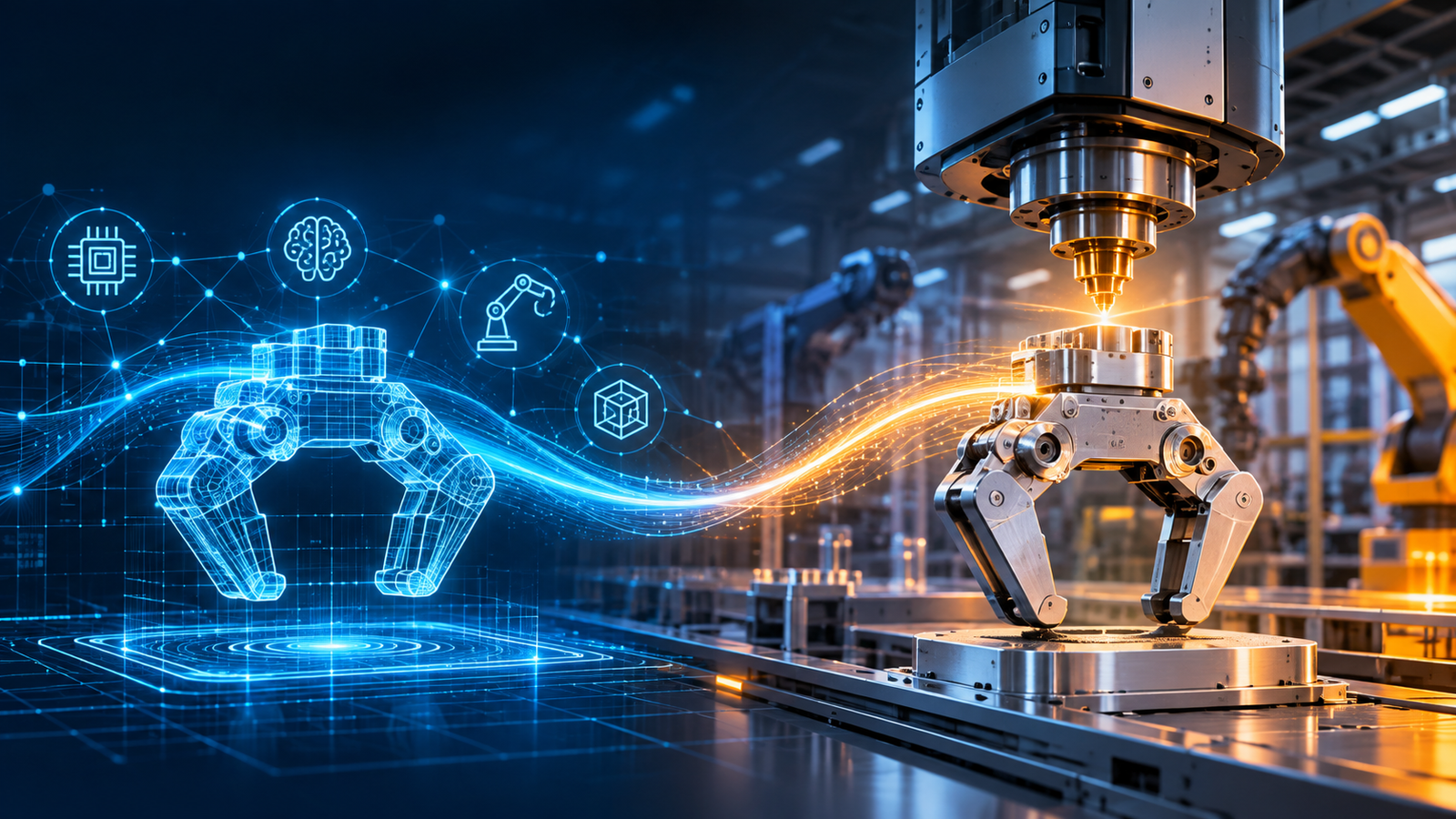
Picture a beautifully optimized, AI-generated gripper. Now picture the printer, fixtures, post-processing equipment, and downstream automation that can’t handle its geometry or material requirements. The gripper is worthless. Coming up with a clever design was never the hard part of manufacturing. The hard part is connecting that design intent to a machine that can actually build it, reliably, when you need it.
Siemens’ work with EOS and AM Solutions goes straight at that gap. At its Electronics Factory in Erlangen, the company is building an adaptive production cell meant to turn the output of agentic engineering into physical parts. It does this through one connected chain of additive manufacturing, automation, post-processing, and software.
The CAD File Is Not the Product
For years, “AI in manufacturing” has mostly meant one of two things. Either AI helps engineers design better products, or it optimizes an existing production line. Both are useful, but neither fixes the disconnect between the two.
A design agent can produce a geometry tuned to a robot’s task. The factory still has to work out how to fixture it, print it, handle it, support it, strip the supports, finish it, inspect it, and route it through production. If a human has to reinterpret the design by hand every time, the factory stays the bottleneck.
That’s why Siemens’ announcement stands out. It treats design and production as one continuous problem instead of two separate worlds. Its end-to-end Digital Thread links agentic, prompt-based engineering to an adaptive production environment, so the requirements for each individual product can travel from design all the way through manufacturing.
Design Freedom Meets Factory Rigidity
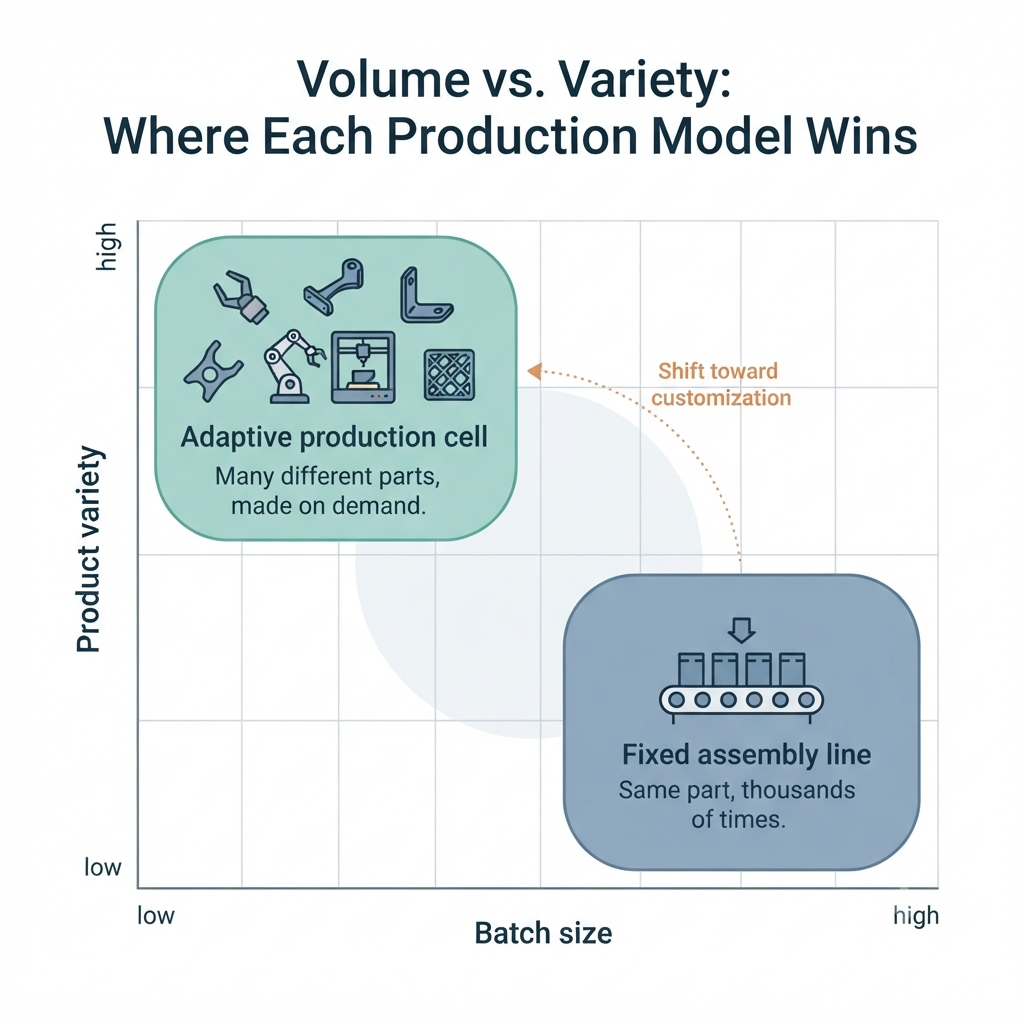
Traditional production assumes the product stays put. Fixed tooling, fixed process routes, fixed fixtures, and fixed quality checkpoints work great when you’re making the same part thousands or millions of times.
They fall apart when products become highly variable, customer-specific, or made in one-off batches.
- A conventional line is built for repetition, not variation.
- Custom parts often stall between design approval and manufacturability.
- Post-processing tends to be an afterthought instead of part of the production plan.
- Human planners have to manually turn design changes into machine instructions, fixtures, schedules, and quality controls.
You end up with a “last mile” problem. AI can speed up design, but the factory is still slow, rigid, and reliant on manual reconfiguration.
Additive manufacturing has always promised flexible, toolless production. But printing a part isn’t the same as producing one industrially. Siemens’ argument is that production has to become as adaptive as the design process that feeds it.
A Digital Thread That Ends in Metal
Siemens treats the factory as an extension of the engineering workflow, not a faraway destination where a finished CAD file gets sent.
Here’s how it works. An agentic AI workflow takes a high-level requirement, adapts a design, validates it virtually, and gets it ready for manufacturing. The adaptive production cell then picks up that manufacturing-ready intent and carries it out through additive manufacturing, automation, and post-processing.
The phrase to remember is dynamic digital thread. The same data that describes what the part has to do also tells the cell how to make it.
This matters because most digital thread initiatives stop at design data. Siemens is pushing the thread into the physical execution layer, where materials, robots, printers, post-processing systems, and production software all have to coordinate in real time.
Inside the Agentic Engineering Loop
Don’t imagine one giant AI that designs everything. This is a system of specialized agents, each in charge of one stage of the engineering process.
| Agent role | What it does | Why it matters |
|---|---|---|
| Requirements interpreter | Translates a task or object description into engineering constraints | Prevents a vague prompt from becoming an unusable part |
| Design adapter | Selects or modifies a candidate geometry | Balances function, manufacturability, and available production capability |
| Virtual validator | Runs simulation, checks constraints, and flags failures | Stops bad designs before they consume materials and machine time |
| Manufacturing preparer | Produces build-ready data, process parameters, and production instructions | Bridges design intent and physical execution |
| Human supervisor | Reviews exceptions, approves critical decisions, and retains accountability | Keeps autonomy useful without making it unaccountable |
In the workflow Siemens demonstrated, an AI agent handles everything from design adaptation and virtual validation through to manufacturing preparation.
The Demo That Makes It Real: Robot Grippers
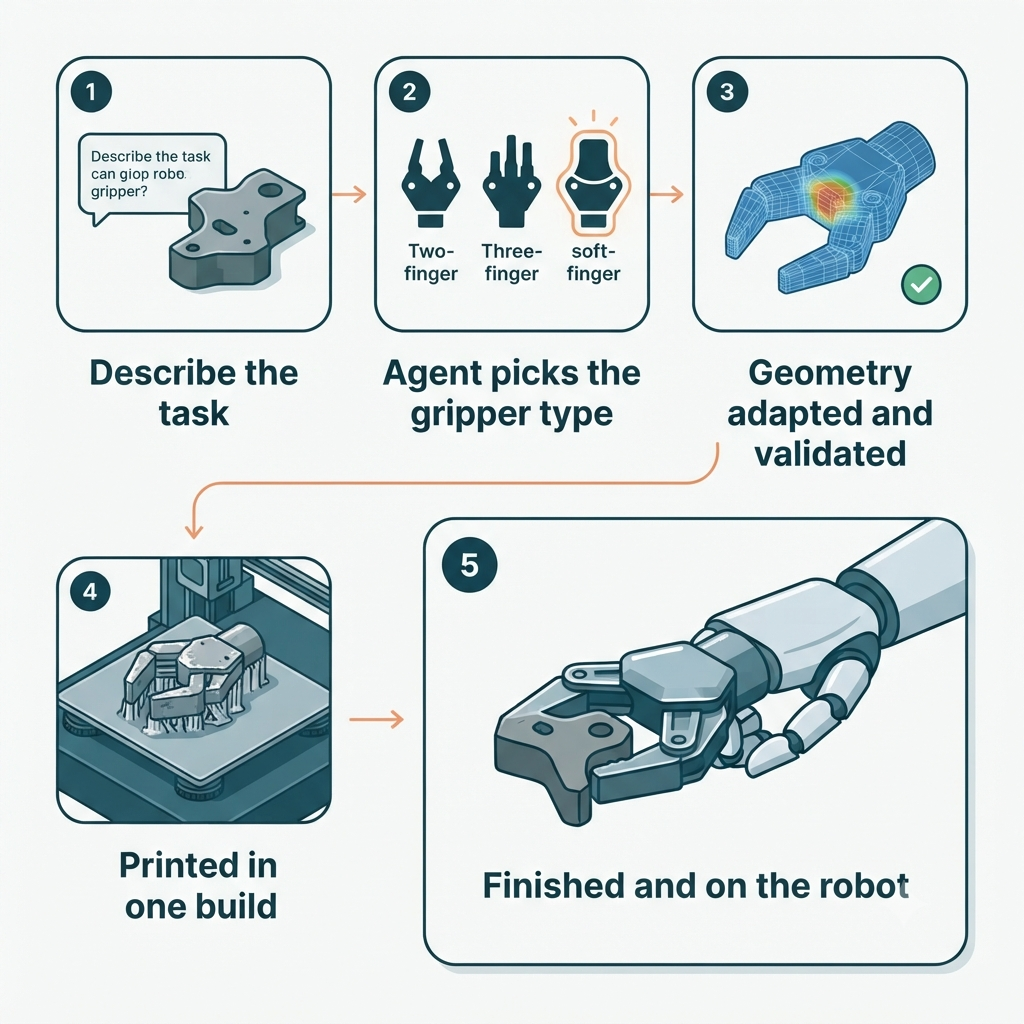
The most concrete use case is a gripper for a humanoid robot. A robot might need to grasp something with a particular shape, weight, or fragility, or something with special handling needs. Instead of stocking a warehouse full of specialized grippers, the system can generate and produce one that fits the task.
Working with AGIBOT, Siemens showed how a user can describe the object to be handled and the job to be done. The agentic workflow then picks a suitable gripper type and adapts its geometry in Siemens Designcenter. From there it simulates the result, validates the robot interface and handling behavior, and prepares the data for additive manufacturing.
That makes the abstract idea of a digital thread easy to picture:
Give the system a task: pick up this irregular component. It designs the grip, validates the geometry, prepares the build, prints it, finishes it, and delivers a gripper ready for the robot.
What matters here isn’t that an AI made a gripper. It’s that the gripper arrived ready to enter a production system.
What Makes the Production Cell Adaptive
An adaptive cell is more than a 3D printer with a robot arm parked next to it. It’s a coordinated production environment that can respond to changes in the part, the order, the material, and the process requirements.
Siemens is developing the Erlangen cell with EOS and AM Solutions, bringing additive manufacturing, automation, post-processing, and software together in one integrated process chain.
The physical loop
- Design handoff: The agent delivers a validated, manufacturing-ready design and process intent.
- Cell interpretation: The production system translates that intent into machine-level actions.
- Additive build: EOS 3D printing produces the geometry without needing a new fixed tool for every variant.
- Automated transfer: Robotics move the part through the cell instead of relying on manual handling.
- Post-processing: AM Solutions’ equipment finishes the part so it’s functional, not just printable.
- Feedback capture: Build, handling, and post-processing data flow back into the digital thread and improve the next iteration.
The cell doesn’t just print a file. It manages the part’s whole journey from digital specification to finished component, and that’s the real difference.
Post-Processing Is the Missing Plot Twist
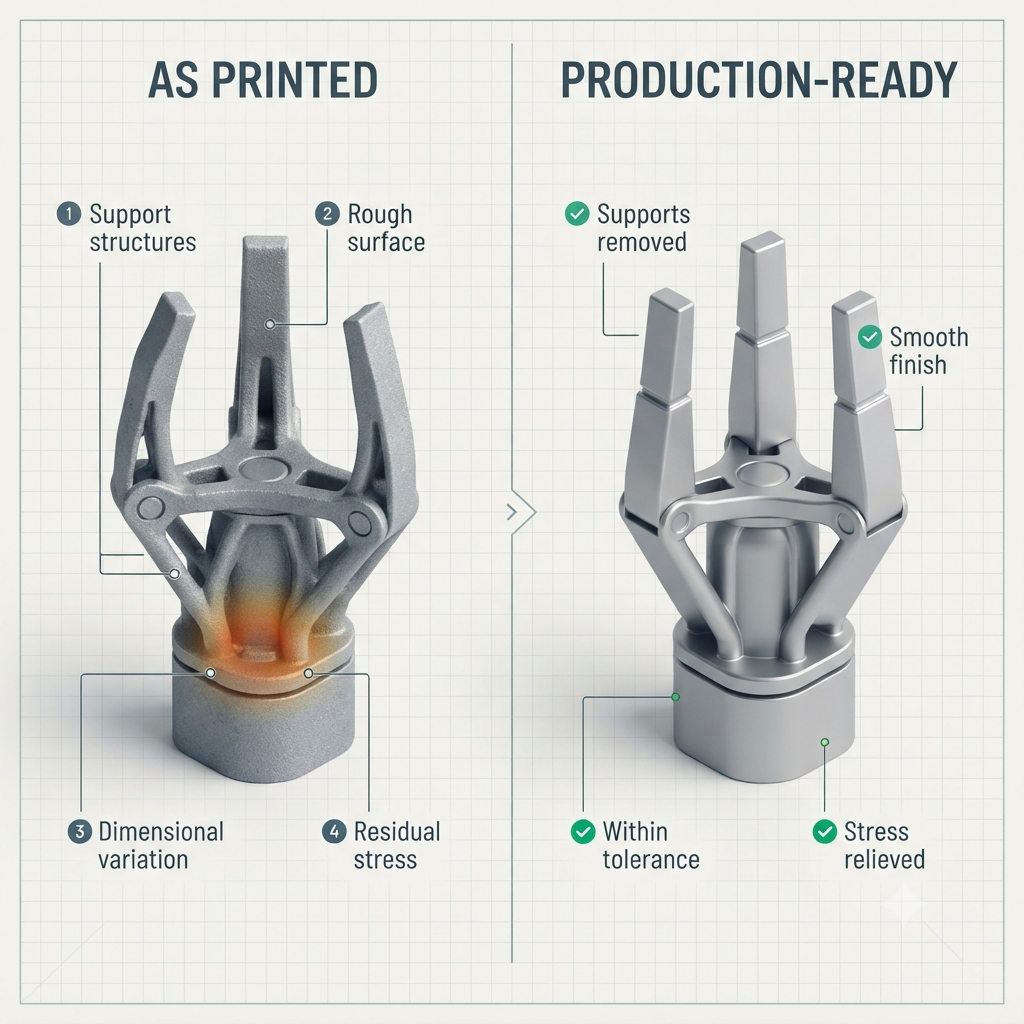
Most additive-manufacturing stories end at the print bed. In real factories, that’s often exactly where the trouble starts.
A printed gripper may come out with support structures, rough surfaces, dimensional variation, residual stress, or features that need finishing before it can go on a robot. If post-processing can’t adapt automatically, the “one-off custom part” turns into a manual exception, and the promised speed vanishes.
AM Solutions puts post-processing at the center of the integrated process chain. Its position is that industrializing additive manufacturing doesn’t end with printing. Only when the downstream steps are seamlessly integrated can additive components be made efficiently and reproduced at scale.
It’s the unglamorous stage, but it’s where digital manufacturing either becomes production-ready or stays a demo.
The Real Innovation: Reconfiguration, Not Just Generation
The headline shouldn’t be “AI designs parts.” It should be that AI-designed variation becomes executable production variation.
| Fixed assembly line | Adaptive production cell |
|---|---|
| Optimized for high-volume, low-variation output | Optimized for variable, on-demand output |
| Product changes require tooling and process redesign | Product variation can flow through an integrated AM and automation chain |
| CAD is a handoff artifact | Design data is an executable production instruction |
| Post-processing is manual or disconnected | Post-processing is planned into the production route |
| Humans coordinate every exception | Agents orchestrate routine steps; humans govern exceptions |
It’s a move from computer-aided design to agent-orchestrated production.
Siemens describes this as the step from connected and automated factories to intelligent, adaptive manufacturing. In that model, the production system stops being a fixed sequence of machines. It becomes a configurable layer of capability that responds to whatever is being made.
Where Humans Still Matter
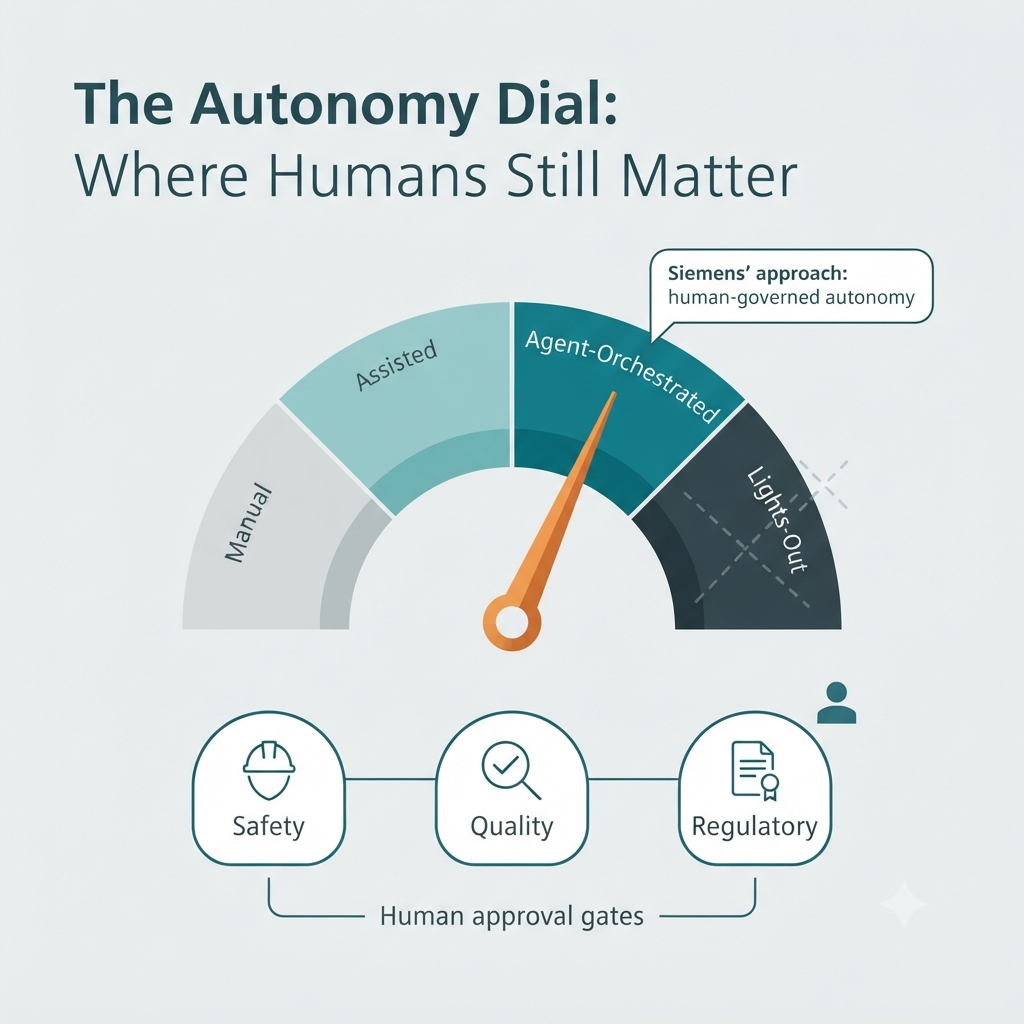
The version of this story worth believing isn’t about “lights-out factories.” It’s about human-governed autonomy.
Agents can break a goal into pieces, coordinate specialized tasks, and run multi-step workflows. Humans are still essential for safety, quality accountability, handling exceptions, and any decision with business or regulatory consequences.
Siemens itself names quality, traceability, security, and human responsibility as key requirements for industrial deployment.
A simple way to think about it:
- Agents take on the repeatable coordination work.
- Humans set the boundaries, approve the risk, and step in when reality disagrees with the model.
- The factory becomes adaptive without becoming unaccountable.
Why Erlangen Matters
Erlangen isn’t a generic proof-of-concept lab. It’s Siemens’ Electronics Factory, a live manufacturing site that produces power electronics and factory control systems.
That changes what the test is. Nobody’s asking whether AI can make a nice render or a one-off prototype. The question is whether an adaptive cell can work within the constraints of a real factory: traceability, quality, uptime, safety, scheduling, material availability, and integration with existing systems.
Siemens already uses AI and digital twins to speed up production ramp-up and make production planning more adaptive. The Erlangen initiative takes that same logic from planning into the physical production of variable components.
From Production Lines to Production Systems
At a deeper level, the factory is turning into a software-defined system. Rather than programming a line around one product, manufacturers could define a capability space (materials, machines, fixtures, post-processing routes, quality rules) and let an orchestration layer pick and configure a workable path.
That doesn’t mean every factory fills up with general-purpose robots overnight. But it does point to a new production architecture:
- Design agents turn requirements into validated, manufacturable intent.
- Digital twins test the plan before any physical resources are committed.
- Adaptive cells carry out variable production without needing a new fixed line.
- Closed-loop data turns every build into feedback for the next one.
Siemens stresses that integrated software and data chains link design and simulation with manufacturing preparation, production, and operations. Industrial AI can tap into that data and connect the individual steps across the whole process.
Also Read: Siemens’ MCP Move Shows AI Agents Are Becoming Industrial CAD Engineers
Siemens isn’t just using AI to design parts faster. It’s building the manufacturing infrastructure that lets an AI-designed part become a production instruction, without chaining the factory to yesterday’s product.
The fixed assembly line won’t disappear because AI can dream up new geometries. It’ll disappear when factories can reconfigure themselves around those geometries.
That’s what closing the loop really looks like: from a prompt, to a validated design, to a printed part, to a finished component, and back into a production system that learns from every build.