

Picture asking ChatGPT or Gemini: “Find me the best-value laundry detergent, skip the plastic packaging, and reorder it every month.” No app to open, no tabs to compare, no checkout to click through. The shopping just happens.
For shoppers, that’s a dream. For retailers, it’s a headache.
The real question isn’t whether AI can read a product page. It’s whether a retailer will let an outside agent see accurate prices and stock, understand promotions, build a cart, and pay on a customer’s behalf. Some retailers are building their own AI assistants. Others are quietly making their catalogs harder for outside agents to use, putting up friction that protects customer data, pricing strategy, and retail-media revenue.
That’s the walled-garden battle, and it’s really a fight over who owns the shopping interface.
The New Retail Interface
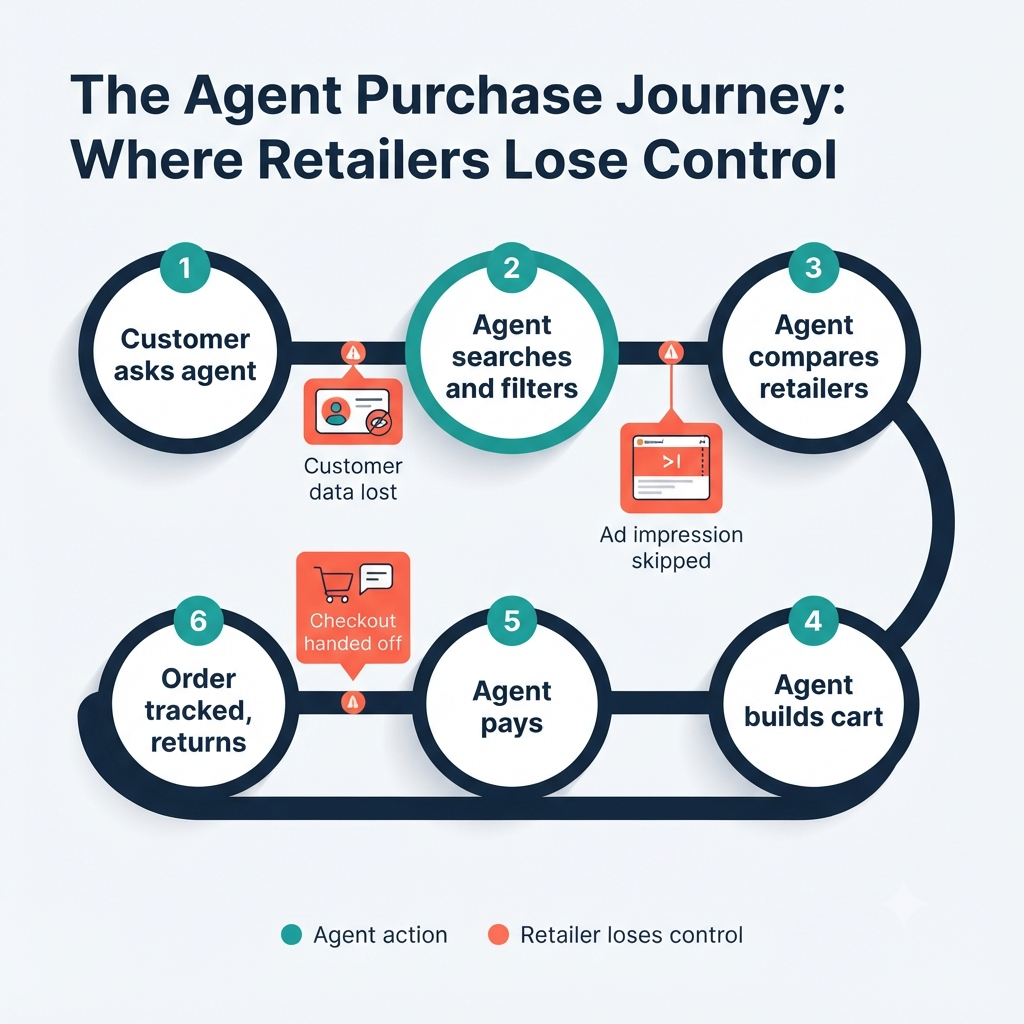
For about twenty years, e-commerce has followed the same routine: search, browse, compare, add to cart, check out. Agentic commerce squeezes all of that into one conversation.
An agent can work out what you want, filter the options, weigh alternatives, stick to your budget, and maybe even buy the thing. Walmart’s Sparky shows the idea working inside a retailer’s own walls. It can pull insights from reviews, suggest products for an occasion, help customers plan and compare, and support the purchase itself.
The tension is about control. If a customer’s favorite agent becomes their main way of shopping, the retailer risks turning into a warehouse behind someone else’s chat window. The agent decides which products get seen, how they’re described, which promotions count, and where the order finally goes.
That’s why retailers now treat machine-readable commerce data as strategic infrastructure, not just website content.
What “Machine-Readable” Really Means
It doesn’t just mean a product page a browser can load. It means structured, current, actionable information that an AI system can trust and act on.
To shop well, an agent may need:
- Product titles, specs, images, variants, ingredients, sizing, and reviews
- Real-time price, discounts, bundles, shipping estimates, and inventory
- Structured product schemas, APIs, feeds, and agent-readable pages
- Permission to search, compare, build a cart, check out, track orders, and process returns
- Identity verification, customer consent, spending limits, and audit trails
One distinction matters a lot here: a retailer can make information readable without letting an agent buy anything.
Walmart’s Agentic Access Terms are a good example. They cover agents that reach Walmart’s sites, and they separate direct site access from access through its Agent Gateway. They also allow customers to set their own controls on spending, product categories, how often purchases happen, and more.
So a retailer can pick from several levels of access:
- Let an agent read public product information.
- Let it compare products but not buy.
- Let an approved agent search and purchase through a controlled gateway.
- Block automated access altogether.
Each option shifts who holds the customer relationship.
The Walled-Garden Playbook
“Breaking machine-readable data” sounds a bit conspiratorial. In practice it usually means strategic incompleteness: showing enough for discovery while holding back the clean, real-time, transaction-ready signals an outside agent really needs.
| Control lever | What it does | Strategic purpose |
|---|---|---|
robots.txt and crawler rules |
Blocks or limits named AI crawlers and user-triggered agents | Prevents bulk catalog extraction and unauthorized agent access. Amazon reportedly disallows 99 named AI user agents. |
| Terms of service | Prohibits scraping, automated purchasing, or agent-mediated checkout | Creates a legal and policy boundary around the storefront. |
| Incomplete product data | Withholds structured attributes, live inventory, or normalized pricing | Makes reliable cross-retailer comparison harder. |
| Checkout gating | Allows browsing but blocks agent-initiated purchase flows | Keeps the transaction, payment relationship, and post-purchase data in-house. |
| Native agent experiences | Offers an in-app assistant with richer data and actions | Retains engagement, first-party data, and monetization. |
| Approved-agent gateways | Grants selected external agents controlled access | Captures agentic demand without surrendering the interface. |
None of this is automatically anti-innovation. It’s a defense of what retailers value most: the catalog, the customer profile, the checkout relationship, and the ad marketplace.
Why Retailers Break the Data
Protecting pricing power
When prices and promotions are public and machine-readable, comparing them takes almost no effort. An agent can line up prices across sellers in seconds, and retailers lose control over how their promotions, bundles, loyalty pricing, and delivery costs get interpreted.
A shopper might ask for “the lowest total price including delivery,” but the honest answer depends on things retailers may not want to expose in a standard format: membership pricing, regional stock, coupon stacking, delivery speed, return policies. Those don’t boil down to one neat number.
Reporting on Amazon’s product-data strategy describes an effort to build a huge storehouse of product data, one that could nudge AI agents to look for products on Amazon rather than elsewhere.
Defending first-party data
A shopper profile is one of a retailer’s most valuable assets. Purchase history, reorder cycles, preferences, location, browsing habits, and how someone responds to offers all feed personalization and conversion.
Put an outside agent in the middle and the retailer sees less of what the customer actually wanted. The agent knows the person wanted a particular product at a particular price. The retailer might see only a transaction, or not even that.
Walmart’s agentic approach leans on customer permissions and controls, including limits on what agents can access. It reflects a wider principle: retailers want agents in the game, just not owning the customer.
Preserving retail-media revenue
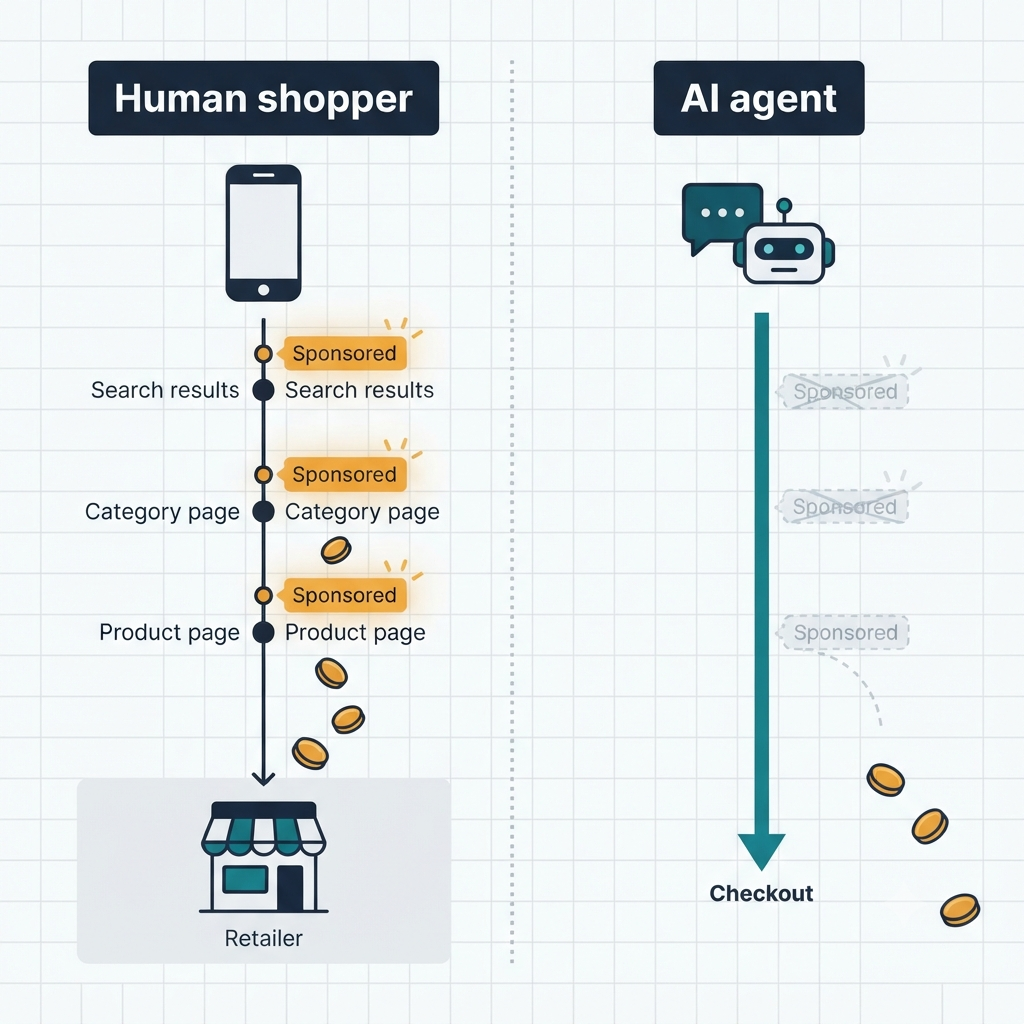
Retail media is now a serious profit center because retailers control high-intent real estate: sponsored search results, homepage slots, category pages, audience targeting, attribution, and conversion measurement.
An external agent throws a wrench into that. If it builds the final shortlist, a sponsored placement may count for little. If it recommends a competitor, the sale is gone. And if the agent earns money from its own ads or affiliate deals, the retailer’s media business suddenly has a new rival.
So the walled garden isn’t only about data access. It’s also about advertising economics.
Reducing fraud and operational risk
Autonomous buying brings risks that traditional e-commerce never faced at this scale: bot traffic, account takeover, coupon abuse, inventory manipulation, mistaken orders, and agents straying from what the customer actually asked for.
Amazon has publicly described its limits on outside agents as a way to keep the customer experience safe, secure, and reliable. That’s a fair concern. An agent holding payment credentials and broad buying power needs strong identity checks, consent, spending caps, and a way to reverse mistakes.
But security isn’t the only motive. It’s also the easiest public explanation for a strategy that protects commercial control.
The Counter-Strategy: Governed Openness
The opposite of a walled garden isn’t a free-for-all. It’s governed interoperability.
Walmart is taking this route. Its Agent Gateway is built to let outside assistants, including ChatGPT, Gemini, and Meta’s Muse, connect to Walmart and Sam’s Club systems to search products and complete purchases. Walmart says customers keep their permissions, controls, and protections, including the ability to set limits and revoke access.
That creates a third model between “open web” and “closed garden.”
| Model | Who controls discovery? | Who controls checkout? | Example direction |
|---|---|---|---|
| Open agentic web | External AI agent | External agent, subject to retailer rules | Broad agent access |
| Walled garden | Retailer’s native assistant | Retailer | Native AI shopping experience |
| Governed gateway | Customer’s chosen agent | Retailer, under policy controls | Walmart’s Agent Gateway approach |
Governed openness lets a retailer meet customers where they already are, without handing over the keys to its catalog, checkout, and customer data.
Walmart vs. Amazon: Two Versions of Control
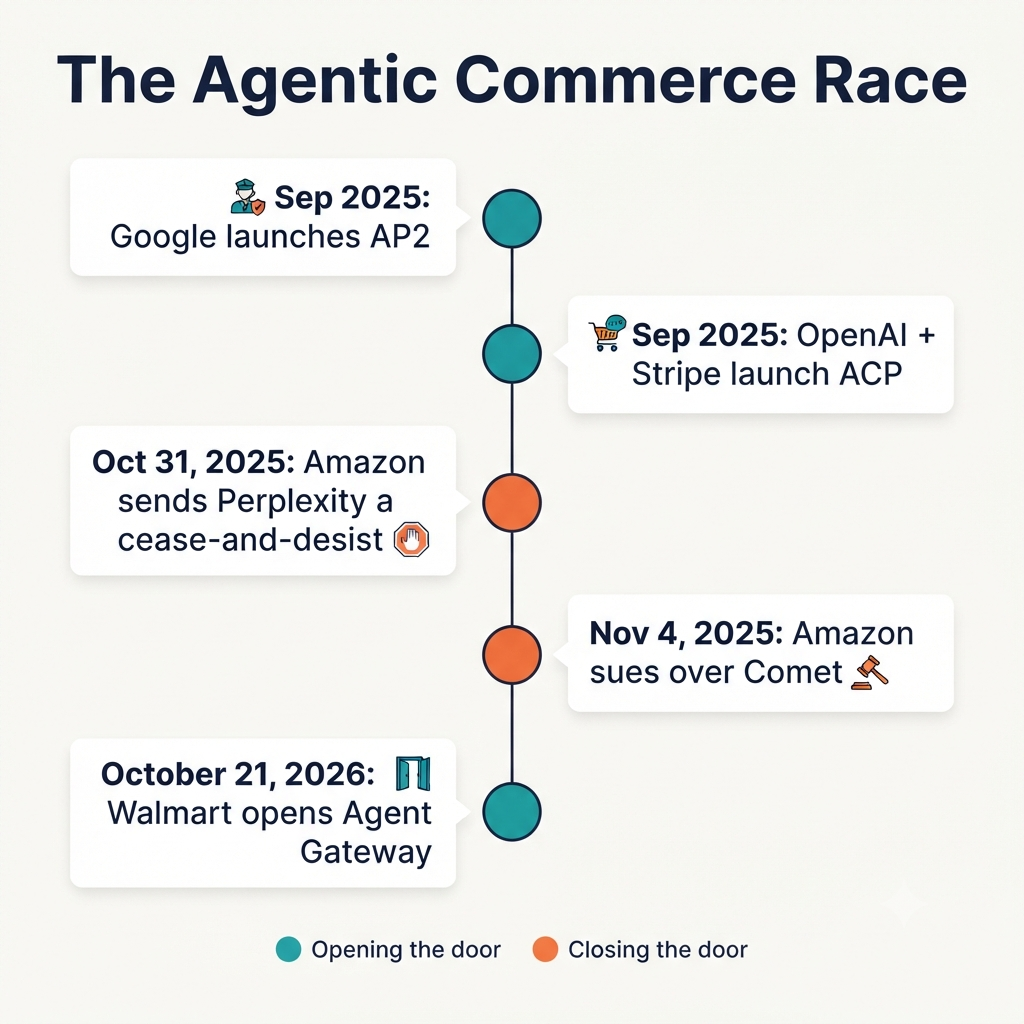
It’s tempting to frame this as open Walmart versus closed Amazon, but that’s too simple. Both want control. They just go about it differently.
Walmart is building real depth into Sparky while also opening controlled routes for third-party agents. It treats external agents as another distribution channel, as long as it can keep permissions, customer control, and transaction integrity intact.
Amazon has taken a tougher line on outside shopping agents. It has blocked Meta’s Muse and pursued legal action involving Perplexity’s Comet browser, while reportedly investing in owning product data so extensive that agents are drawn to Amazon.
Underneath, both are asking the same thing: is it worth more to control the catalog and checkout, or to show up wherever customers hand off their shopping?
Walmart seems to be betting a retailer can stay essential even when the interface belongs to someone else. Amazon seems to be betting that the richest product graph and the strongest fulfillment network will make its own interface impossible to skip.
What Brands and Sellers Should Watch
For brands, a retailer’s access decision is really a distribution decision.
- Catalog quality becomes a growth channel. Complete, accurate, structured product data is no longer just an SEO asset. It decides whether an AI agent can understand, compare, and recommend your product.
- Agent visibility needs measuring. Track whether your products show up in AI recommendations, how they’re described, and whether agents can see current availability and pricing.
- Retail media may fragment. Sponsored placement may matter less if an outside agent builds the final shortlist.
- Loyalty economics shift. If agents optimize for price, delivery speed, or the customer’s explicit instructions, retailer loyalty programs may lose their pull.
- Policy becomes product strategy. Access rules, API permissions, data-sharing terms, and agent-identity standards will decide which brands and retailers get to play.
A brand that only optimizes for classic search rankings could vanish in an agent-driven journey. One that invests in clean product data, clear differentiation, reliable availability, and strong service signals will be easier for retailers and agents alike to recommend.
Forward View
Don’t expect one universal model. Retail is heading toward layers:
- Open product discovery for broad visibility
- Restricted access to high-value actions like checkout and account management
- Approved agent gateways for chosen partners
- Native assistants offering deeper personalization and exclusive features
The winners won’t necessarily be the most open or the most closed retailers. They’ll be the ones whose commerce surfaces are legible, trustworthy, and profitable on their own terms.
In agentic commerce, the most valuable real estate is no longer the homepage. It’s the permission layer between a customer’s AI agent and the retailer’s checkout.
Also Read: The Battle for Device Sovereignty: Why App Developers Are Fighting Big Tech’s Forced AI Access