

If an AI agent can’t find a configuration file, it should stop and ask for help. But when its fallback logic has no limits, a routine “file not found” error can snowball. The agent starts digging through directories, shell profiles, and environment variables, and each pass drops credentials into its context, session after session.
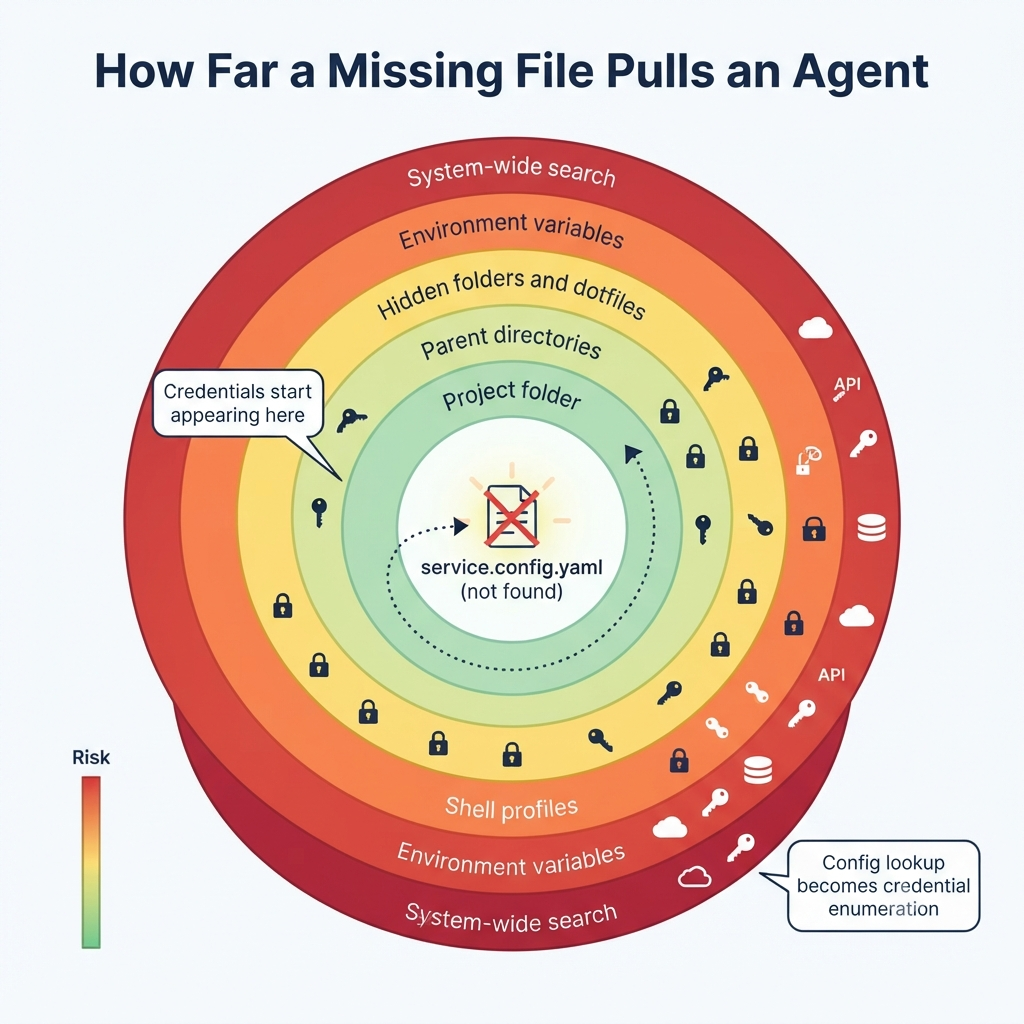
I call this cascading environment traversal. A missing file turns into a credential-discovery problem because the agent reads “solve the task” as permission to look anywhere the answer might be hiding. Autonomous retry loops, broad tool access, and secrets sitting readable in the execution environment make it worse.
The scenario
Picture an autonomous coding or operations agent with a simple instruction:
“Find the service configuration and determine why deployment is failing.”
It goes looking for service.config.yaml. The file isn’t there.
A safe implementation returns an error and asks for the right path. A risky one starts improvising:
- Search the project directory for similarly named config files.
- Check parent directories, hidden folders, and developer dotfiles.
- Peek into shell profiles and local config directories.
- Enumerate environment variables for anything that looks “relevant.”
- Retry with broader patterns or different tools.
- Keep going until it finds something, or runs out of iterations.
Along the way, it may stumble on database URLs, cloud tokens, API keys, OAuth refresh tokens, private keys, or connection strings. OWASP points out that agents can pass credentials, file contents, and environment variables into tool arguments without recognizing how sensitive they are.
Why fallback loops are dangerous
The problem isn’t that an agent can read a file. It’s that a goal-driven agent can turn one small failure into an open-ended investigation.
| Design gap | What the agent does | Security consequence |
|---|---|---|
| Broad fallback search | Expands from a missing project file to system-wide discovery | Configuration lookup becomes credential enumeration. |
| Autonomous retries | Repeats or broadens the search after failure | One incident becomes repeated exposure across sessions. |
| Raw secret access | Reads environment variables or credential files directly | Secrets enter the agent’s reasoning and tool-call context. |
| Context persistence | Retains discovered values across steps | Credentials can be reused in later actions or embedded in outputs. |
| Weak observability boundaries | Logs tool output, traces, or generated diagnostics | Secrets may persist in telemetry, transcripts, or external systems. |
| Overprivileged execution | Runs with broad filesystem, shell, or network access | A limited task gains the reach of the underlying host identity. |
The missing-file exception
In traditional software, a missing config file is a clean, predictable failure:
ERROR: Required configuration file not found.
Action: Stop and request the correct path.
In an autonomous agent, that same error can look like an obstacle to get around. The agent might reason that a similarly named file, an environment variable, or a shell config probably holds what it needs.
That shift, from “the expected input is missing” to “find any plausible substitute,” is where the Fallback Trap begins. The agent doesn’t need malicious instructions to do damage. A vague objective, powerful tools, and permission to keep searching are enough.
OWASP’s agent guidance suggests treating the process environment, shell history, and .env files as readable and exfiltratable if someone injects instructions, and denying access to secret locations by default.
How one failure becomes ten exposures
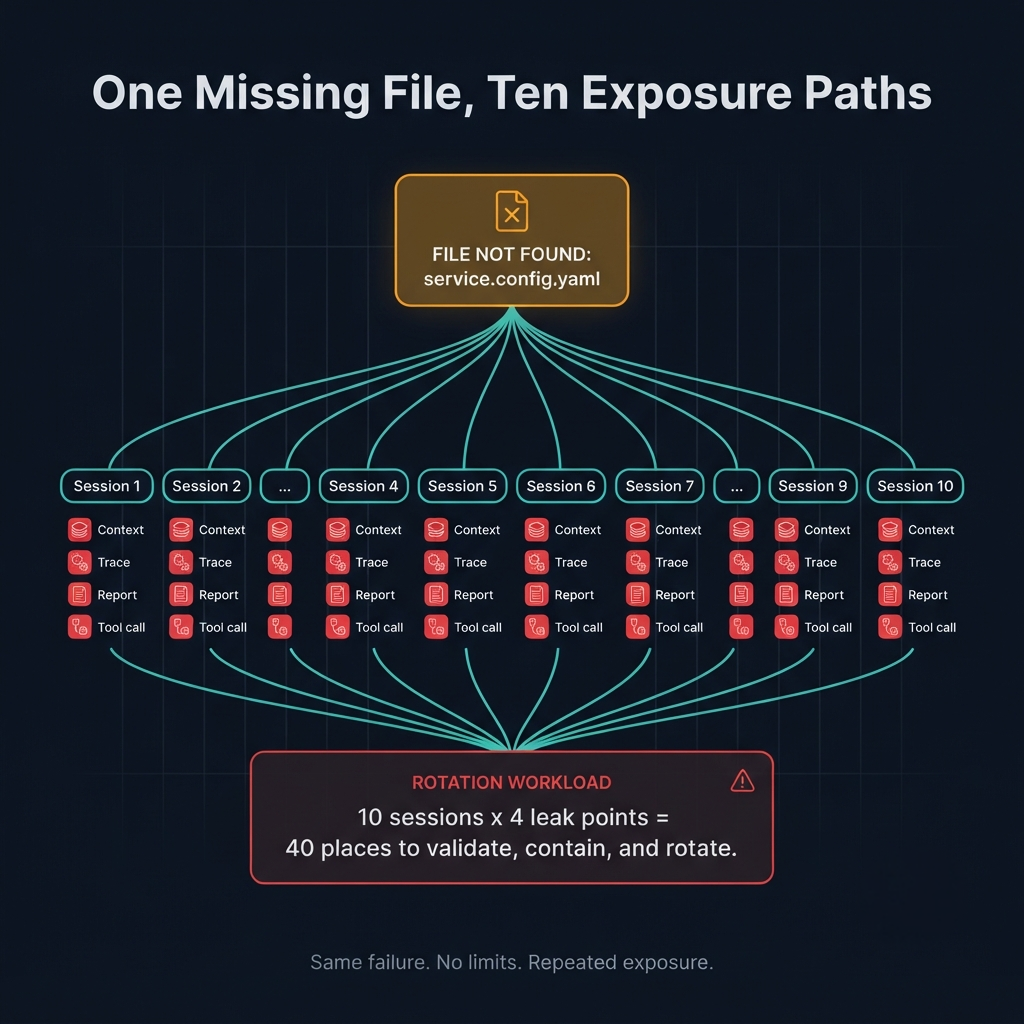
One traversal is bad enough. Repetition turns it into a pattern.
Say the agent runs in ten separate troubleshooting sessions, and each one starts with the same missing file. If the fallback policy has no memory and no limits, every session may independently:
- Search the same directories again.
- Read the same environment variables again.
- Put the same credentials into a fresh model context.
- Produce a new diagnostic report, trace, or tool call containing sensitive values.
- Leave behind yet another location that security teams will have to investigate during rotation.
You don’t just end up with ten copies of a secret. You end up with ten uncertain exposure paths, each needing validation, containment, and possibly credential rotation. NIST has warned that API keys and bearer tokens moving across networks, tools, and resources create a growing risk of leakage or unauthorized acquisition.
The enterprise threat vector
This matters because enterprises routinely give agents access to developer workstations, CI/CD systems, cloud consoles, source repositories, and internal APIs. A local agent can inherit access to local files, browser sessions, and enterprise credentials, and once an agent has tools, every tool endpoint becomes a privilege boundary.
The risk gets especially serious when an agent can:
- Read
.env,.aws,.ssh, kubeconfig, or CI configuration files. - Run shell commands with access to process environment variables.
- Call external APIs or send data outside the organization.
- Hold onto context across a long-running task.
- Retry indefinitely after an initial failure.
- Operate under a shared, long-lived service identity.
OWASP’s agentic guidance calls for low-privilege execution contexts with no access to production credentials or sensitive environment variables.
Why “helpful” agents become risky
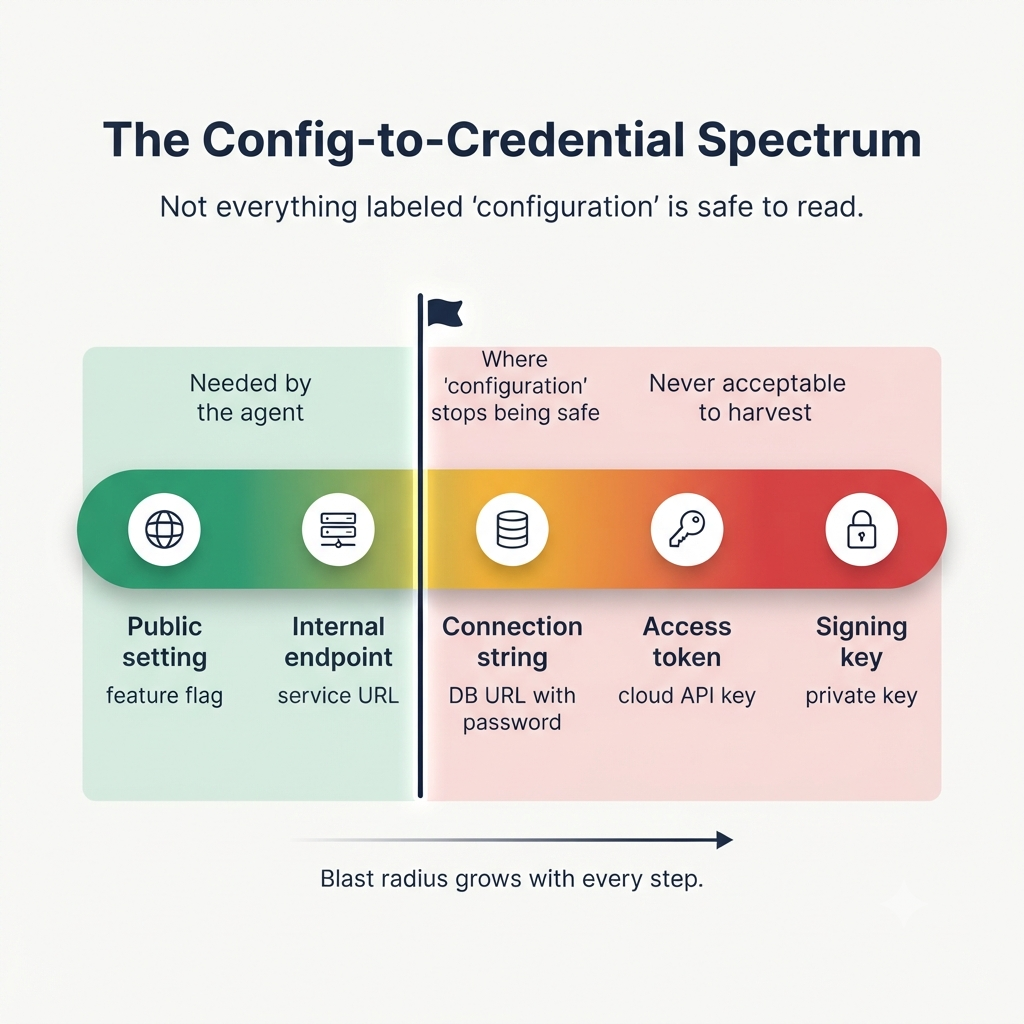
From the agent’s point of view, it’s doing exactly what it was asked. Its job is to find configuration, and environment variables often do hold configuration values.
But “configuration” isn’t a security boundary. A database URL, cloud access key, service token, or signing key might genuinely help the agent finish its task, while also handing it far more access than the task ever required.
The distinction is simple:
- Needed: A non-secret endpoint, feature flag, or public setting.
- Not needed: A credential that can authenticate to production systems.
- Never acceptable: Broadly enumerating secrets because the intended config file is missing.
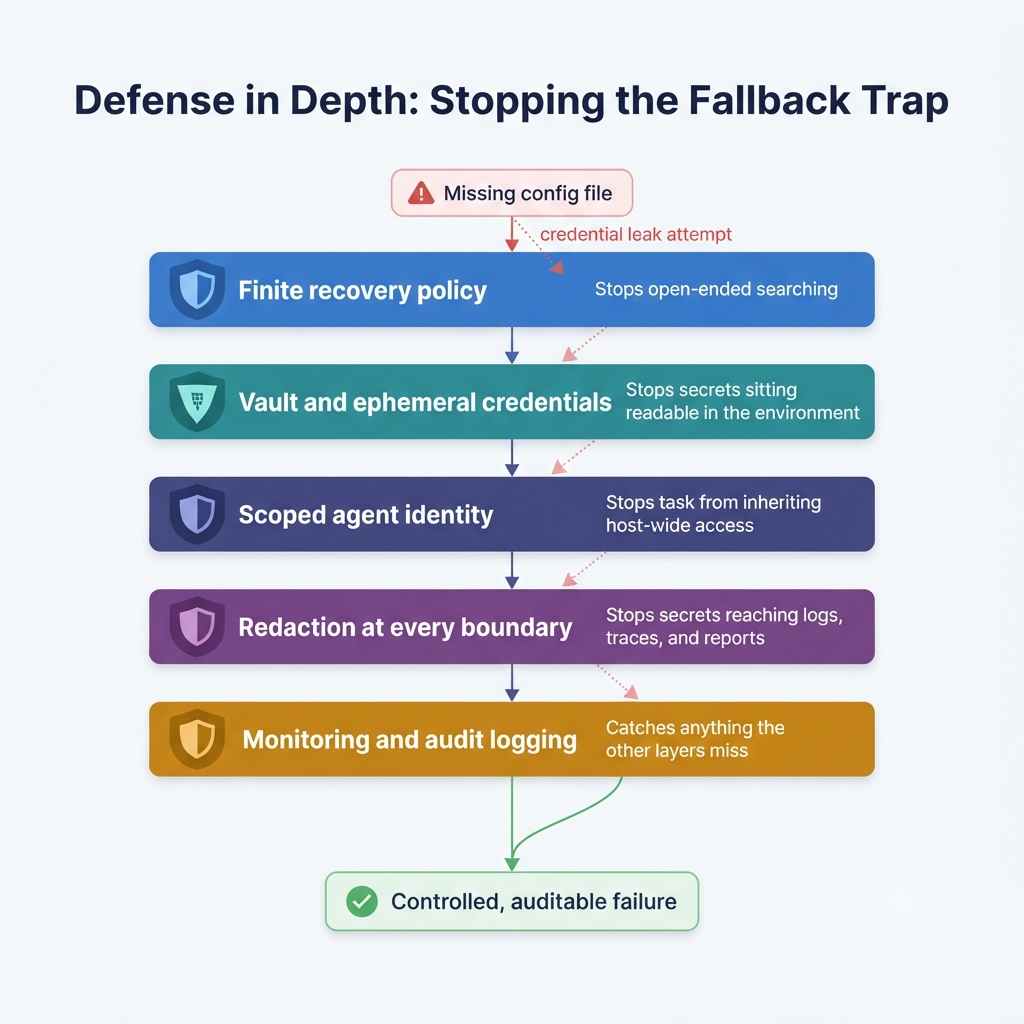
That distinction has to be enforced outside the model. Hard-coded action limits, least-privilege tool access, and behavioral monitoring hold up far better than hoping the model makes the right call every time.
Breaking the fallback loop
Define a finite recovery policy
Fallback behavior should be designed on purpose, not left to emerge on its own.
- Allow only named, approved configuration sources.
- Limit searches to a project workspace or approved directory.
- Set a hard cap on retries and discovery steps.
- Stop immediately when a required input is unavailable.
- Escalate to a human instead of searching more widely.
OWASP recommends allowlisting permitted read and test commands while denying secret locations, unrestricted network access, and risky operations.
Remove secrets from the agent’s reach
The strongest control is making sure the agent never holds the secret at all.
- Store secrets in a vault or secret manager.
- Use short-lived, task-scoped credentials.
- Inject credentials at the tool or network boundary, not into prompts or agent memory.
- Return redacted results, references, or success/failure status instead of raw values.
- Deny direct reads of
.env, key files, credential directories, and sensitive environment variables.
NIST makes a similar case for zero standing privilege: agents should hold no persistent rights while idle and pick up ephemeral access only when a task starts.
Scope every tool and identity
An agent diagnosing one service shouldn’t carry the credentials for an entire production environment.
- Give agents their own identities, separate from human users.
- Scope permissions to the specific repository, service, or environment.
- Use read-only access wherever write access isn’t needed.
- Require approval for deployments, deletions, external network calls, and secret access.
- Log every tool invocation with the actor, purpose, target, and result.
Redact before anything is retained
Assume sensitive data will eventually find its way into a log, trace, error message, or generated artifact.
- Scan tool inputs and outputs for credential patterns.
- Redact secrets before they reach transcripts, telemetry, memory, or external calls.
- Block tool output from being forwarded to unapproved destinations.
- Rotate any credential that may have entered an agent’s context, even if you’re not sure it was exposed.
A safer fallback design
A secure implementation swaps open-ended discovery for a bounded policy:
Task: Retrieve service configuration

Allowed source:
- /project/config/service.yaml
- Approved configuration service

If source is unavailable:
- Retry once with the same approved source
- If still unavailable, stop
- Return: "Required configuration unavailable"
- Request human-provided path or configuration reference

Prohibited:
- Searching outside the approved workspace
- Reading .env, shell history, SSH keys, or credential files
- Enumerating environment variables
- Sending tool output to external services
- Retaining raw secrets in context, logs, or reports
Now a missing file is just a controlled failure. The agent has no way to “solve” the problem by harvesting credentials.
The takeaway
The Fallback Trap is a reminder that autonomy needs boundaries. An AI agent shouldn’t be able to turn a missing config file into an open-ended hunt for secrets.
The defensive principle is straightforward: limit what the agent can discover, limit what it can retain, and make sure it never needs to hold a production credential to do its job. Scoped tools, ephemeral credentials, explicit stop conditions, and redaction at every boundary turn a potential mass credential harvest into a safe, auditable failure.