
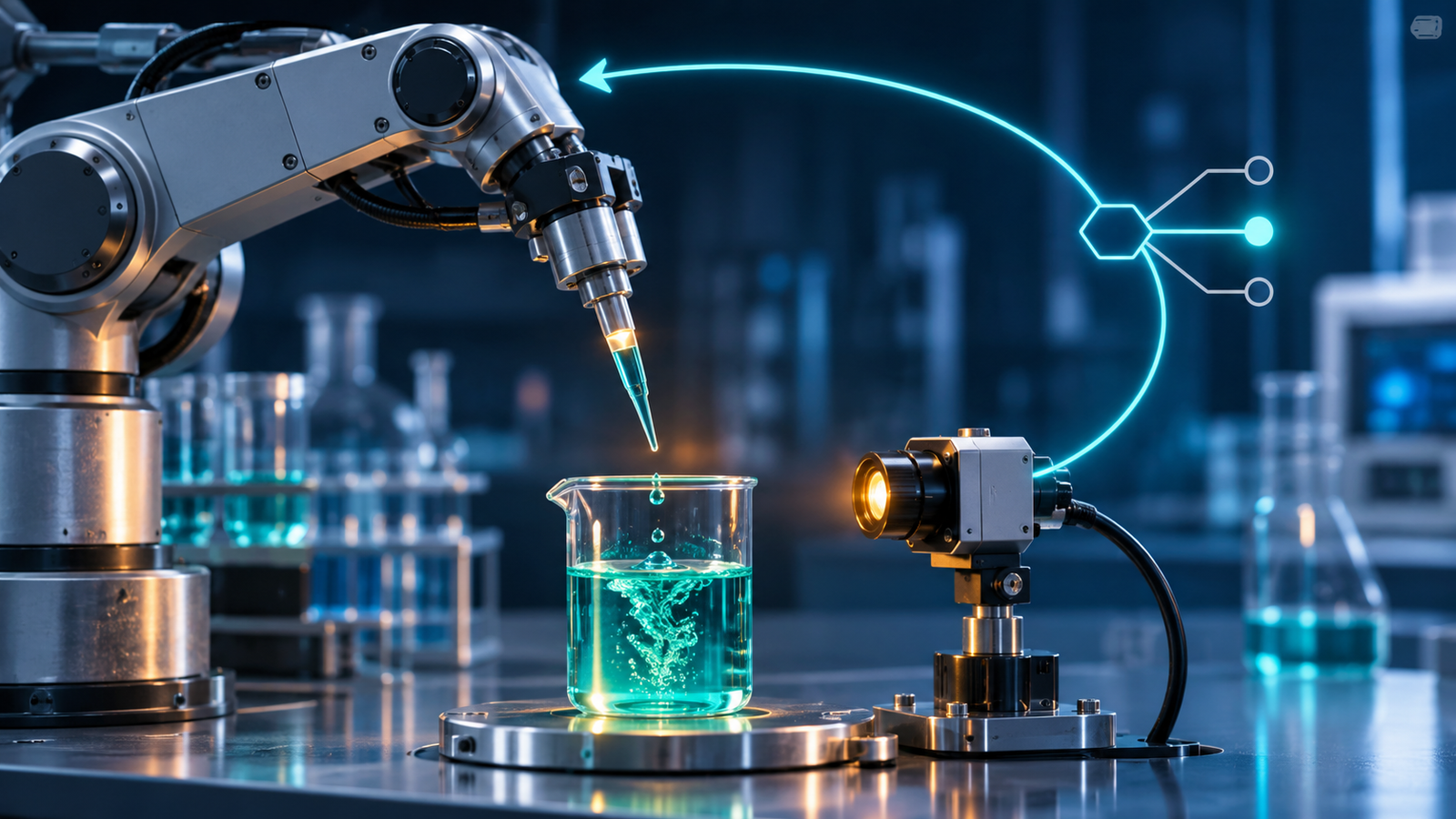
For most of modern science, experiments have followed the same rhythm. You design a test, run it, wait for results, analyze the data, tweak the plan, and go around again. That rhythm is starting to break. Adaptive AI agents are closing the gap between “what just happened?” and “what should we try next?” They do it with a continuous physical feedback loop, where sensors, models, and robots learn from reality while the experiment is still running.
This isn’t just automation. A robot can run a fixed protocol faster than a person can. An adaptive AI agent can decide what the next protocol should be, based on what the physical system just showed it. In autonomous materials research, a system called AMASE already links live experiments with computational predictions through Bayesian active learning, so each result shapes the next action without a human stepping in.
The Experiment That Never Really Ends
Picture a materials lab hunting for the best formulation for a new coating, catalyst, or treatment process. In the traditional setup, a scientist might define 50 candidate conditions, run them in batches over several weeks, analyze the outcomes, and only then decide which direction deserves a closer look.
Now picture this instead:
- A sensor picks up an unexpected change in how a fluid behaves.
- The AI model updates its understanding of the system.
- It works out which experiment would be the most informative next step.
- It tells a robotic system to change the formulation or operating condition.
- The new result comes in.
- The loop starts over.
The experiment no longer stops once a sample is measured. It turns into an ongoing conversation between an algorithm and the physical world.
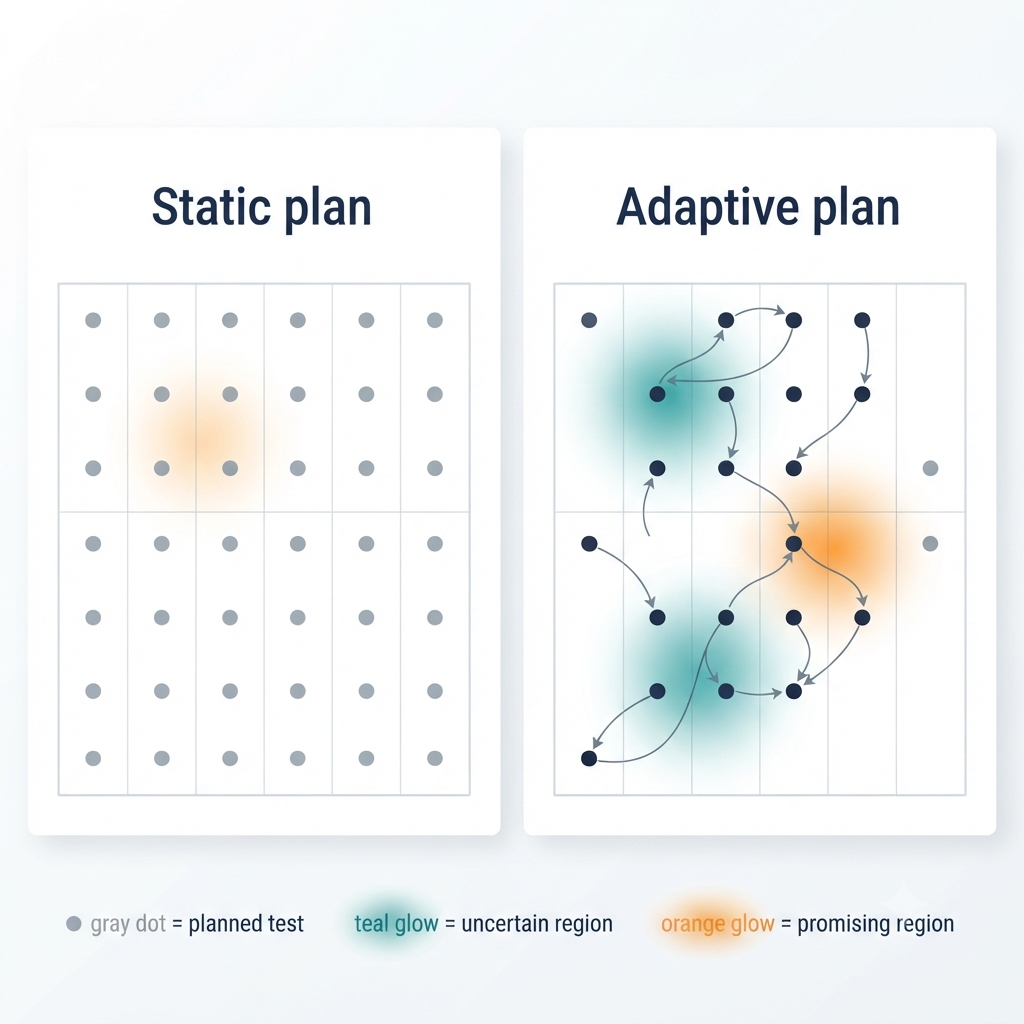
That’s the core shift. Static experimentation asks what happens when we run a planned test. Closed-loop adaptive design asks what the most valuable thing to do next is, given what reality just told us.
What Static Optimization Gets Wrong
Static optimization isn’t useless. It’s disciplined and easy to interpret, and it often makes sense when a system is well understood and the search space is small. But it treats an experiment as a string of separate questions.
| Element | Static experimentation | Closed-loop adaptive design |
|---|---|---|
| Experiment plan | Fixed before testing begins | Revised after every result |
| Decision-maker | Human scientist between runs | AI agent within the loop |
| Data use | Retrospective analysis | Immediate model updating |
| Physical execution | Manual work or pre-scripted robotics | Dynamic, evolving robotic instructions |
| Failure | A delay or wasted trial | A signal that reshapes the next action |
| Goal | Find a good result eventually | Maximize learning and performance per experiment |
The problem with static optimization isn’t accuracy. It’s informational efficiency. A fixed plan can burn time on conditions the model already expects to fail, while the most uncertain regions of the design space, which may also be the most valuable, go untouched.
In a static campaign, a failed experiment is usually just a cost. In an adaptive loop, a failure can be a very informative data point, as long as the system can interpret it and act on it quickly.
The Closed Loop: Sense, Hypothesize, Act, Learn
“Closed loop” can sound abstract, but the mechanism is simple. The system cycles through six stages:
- Sense: Sensors capture real-time signals such as pressure, temperature, chemical concentration, flow rate, optical properties, viscosity, or process output.
- Interpret: The AI model turns raw measurements into a working picture of the system.
- Hypothesize: The agent proposes possible next moves, like adjusting a dose, changing flow, altering temperature, modifying mixing, or trying a new formulation.
- Select: Active-learning methods pick the action most likely to cut uncertainty or improve performance.
- Act: A robotic system carries out the refined physical protocol.
- Learn: The new result updates the model, its uncertainty estimates, and the next hypothesis.
The key point is that the robot isn’t the intelligence here. The robot executes. The agent decides.
A conventional robotic lab follows a script: add reagent A, mix for 10 minutes, measure the output, move on to the next predefined condition. An adaptive agent asks something different: given the uncertainty in my current model, which physical intervention will teach me the most?
Bayesian active learning fits this role well because it uses uncertainty to guide which experiment to run. Instead of just predicting an outcome, it finds the experiment that would most improve the model’s understanding of the system.
Why “Real Time” Changes the Science
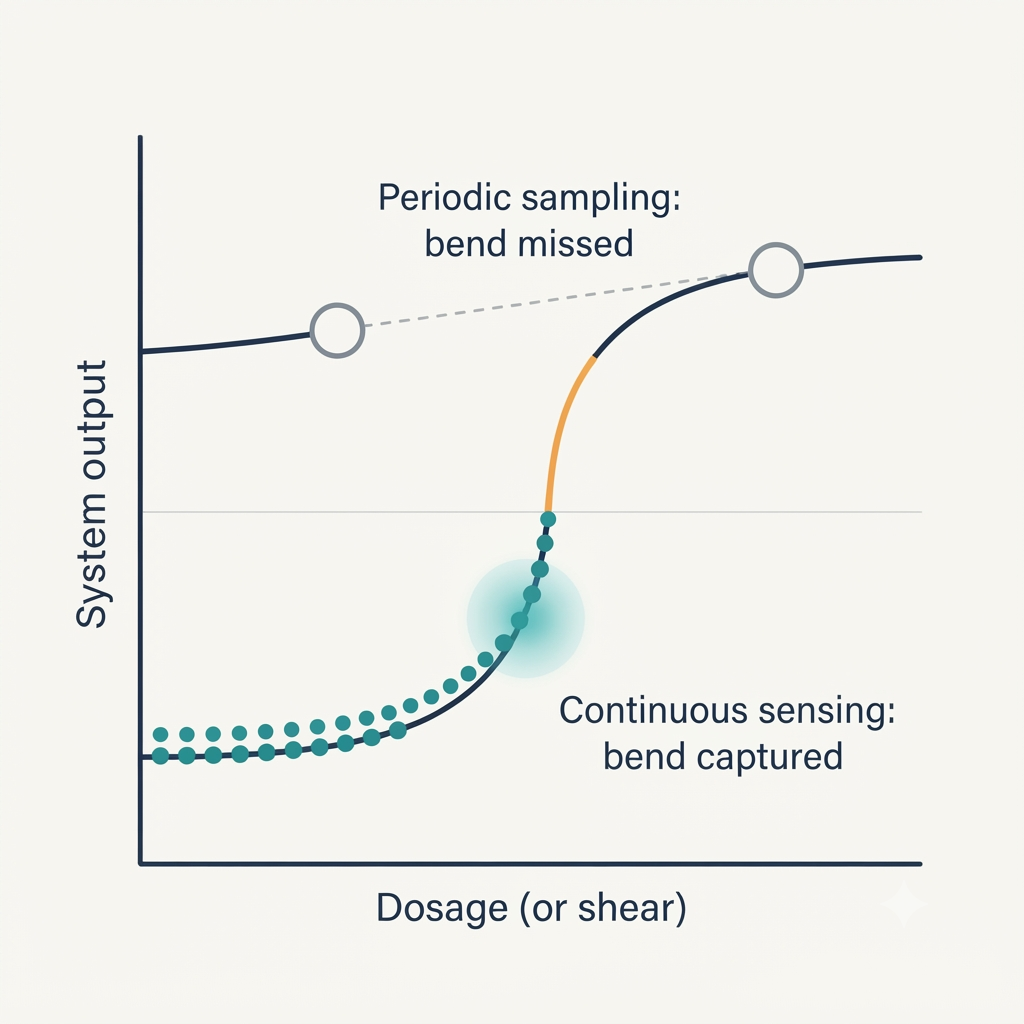
Static testing assumes the system you’re studying can sit still and wait. Closed-loop design assumes the opposite: the most useful knowledge may only show up while the system is being nudged and watched in real time.
This matters a lot in fluid-based systems. A small change in dosage, shear, residence time, temperature, mixing energy, or contaminant load can have nonlinear effects. In a conventional workflow, you might not discover those effects until the whole campaign is over. In an adaptive system, they feed straight back in.
Think of static optimization as navigating with a map printed before the trip. Closed-loop experimentation is navigating with a live sensor feed, with the route recalculated every time conditions change.
The result isn’t only faster discovery. It’s a different kind of discovery, because the experiment itself adapts.
The AI Agent Is Not Just a Robot Controller
It’s tempting to describe these systems as “robots running experiments,” but that undersells what’s happening. There are really three layers:
- Robotic execution carries out an instruction: dispense, mix, move, measure, or adjust a physical parameter.
- Static optimization chooses among predefined options using a fixed objective.
- Adaptive AI agency decides what to test, why to test it, what remains uncertain, and how the next physical action should change.
The agent’s real contribution is making decisions under uncertainty. It has to balance competing pressures:
- Exploit a configuration that already looks promising.
- Explore an uncertain region that might hold a breakthrough.
- Avoid actions that are unsafe, unstable, or physically infeasible.
- Optimize several objectives at once, such as performance, cost, energy use, and reliability.
That’s why the agent can’t just chase the best result so far. If it always picks what looks best from limited data, it may miss a better solution sitting in an underexplored corner of the design space.
The most effective systems aren’t merely greedy. They’re curious in a controlled, purposeful way.
Wastewater Treatment as the Proof Case
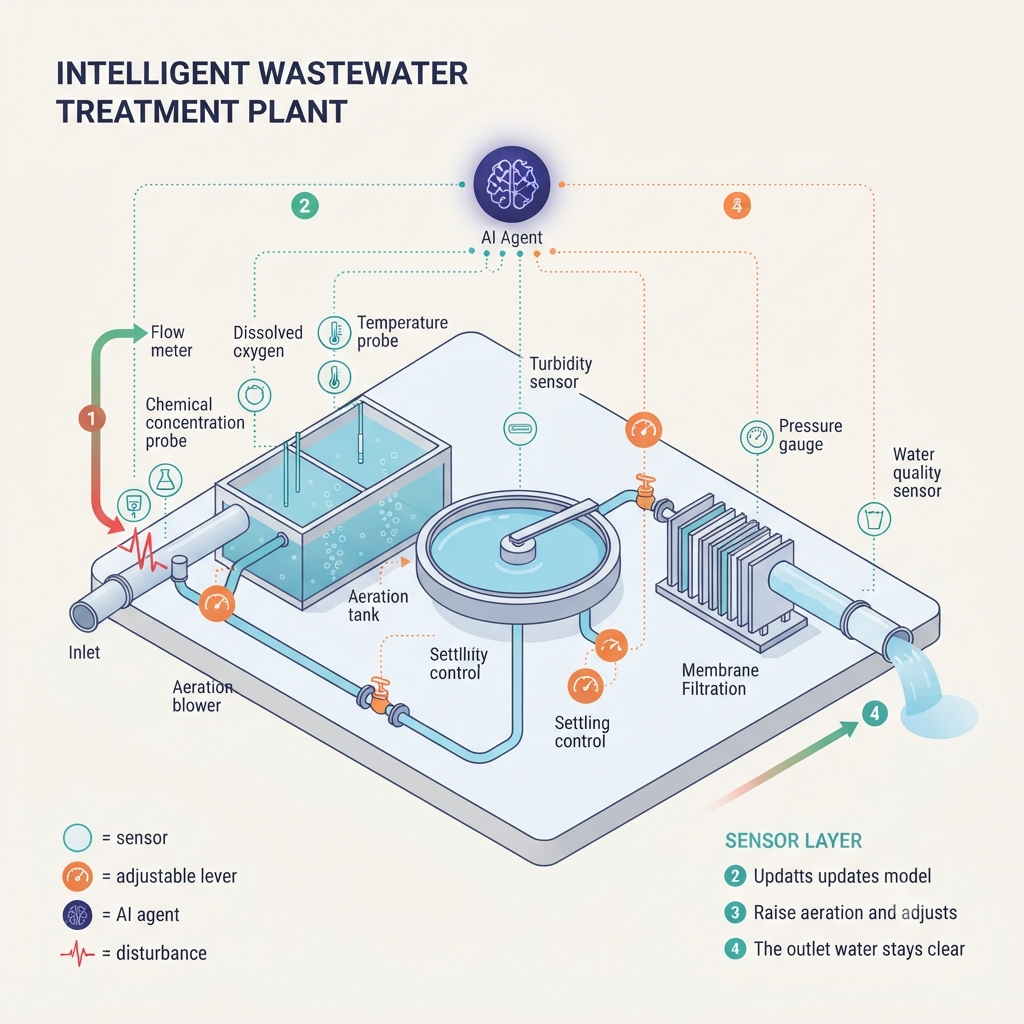
Wastewater treatment is a natural fit for closed-loop adaptive design. It’s dynamic, full of sensors, and bound by real operating conditions. A treatment plant isn’t a fixed system. It responds constantly to changes in influent composition, flow rate, temperature, microbial activity, and chemistry.
An adaptive agent could adjust things like:
- Aeration intensity and timing.
- Chemical dosing.
- Sludge recirculation.
- Hydraulic loading.
- Membrane operation.
- Settling and clarification parameters.
Machine-learning-based model predictive control has already been used in a full-scale municipal plant to estimate key process variables and work out how much aeration is needed for efficient, economical nutrient removal. More broadly, machine-learning and deep-learning-based predictive control can capture nonlinear behavior and automatically adjust control variables to improve stability and efficiency.
But the more interesting version goes beyond prediction. Instead of recommending settings based on historical data, the agent watches the plant’s live response, updates its process model, and issues the next control action. The treatment system becomes an experimental apparatus that keeps learning.
Say a change in aeration causes an unexpected drop in treatment performance. The agent doesn’t wait for the next scheduled review. It notes the deviation, updates its model, weighs alternative interventions, and adjusts the process within its approved limits.
That’s the difference between monitoring a plant and running a living experiment inside it.
What Collapses: Months, Not Just Minutes
The popular line is that AI makes experiments faster. That’s true, but it misses the bigger change. The real savings aren’t inside each experiment. They’re in the gaps between experiments:
- Running the test.
- Understanding the result.
- Deciding what to do next.
- Reconfiguring the physical setup.
- Starting the next run.
In a human-directed workflow, those steps can be separated by hours, days, or weeks. In a closed-loop system, they blend into one continuous cycle.
AMASE, for example, demonstrated real-time, autonomous, iterative interaction between experiments and computational models. Each experimental iteration fed updated phase information into a prediction, and that prediction determined the next experiment. Its developers reported a sixfold reduction in overall experimentation time.
That doesn’t mean every field will see a sixfold improvement. But it shows the structural point: AI doesn’t just speed up each experiment, it shrinks the dead time between them.
The New Role of the Scientist
None of this spells the end of scientists. It shifts where their attention goes. Humans remain essential for:
- Defining objectives and constraints.
- Deciding what counts as success.
- Setting safety, ethical, and regulatory boundaries.
- Interpreting anomalous results.
- Designing the physical apparatus and sensor strategy.
- Questioning whether the agent is optimizing the right thing.
The scientist moves from protocol executor to objective designer, validator, and exception handler. The agent handles the fast, repetitive iteration. The human handles intent, accountability, and judgment.
This matters because an AI system will optimize exactly what it’s told to optimize, and can still land on a poor scientific or operational outcome. If the objective is badly defined, the agent might cut costs while degrading effluent quality, or maximize throughput while creating instability downstream.
The human role doesn’t shrink. It becomes more consequential.
The Hard Part: Trusting a Loop That Changes Itself
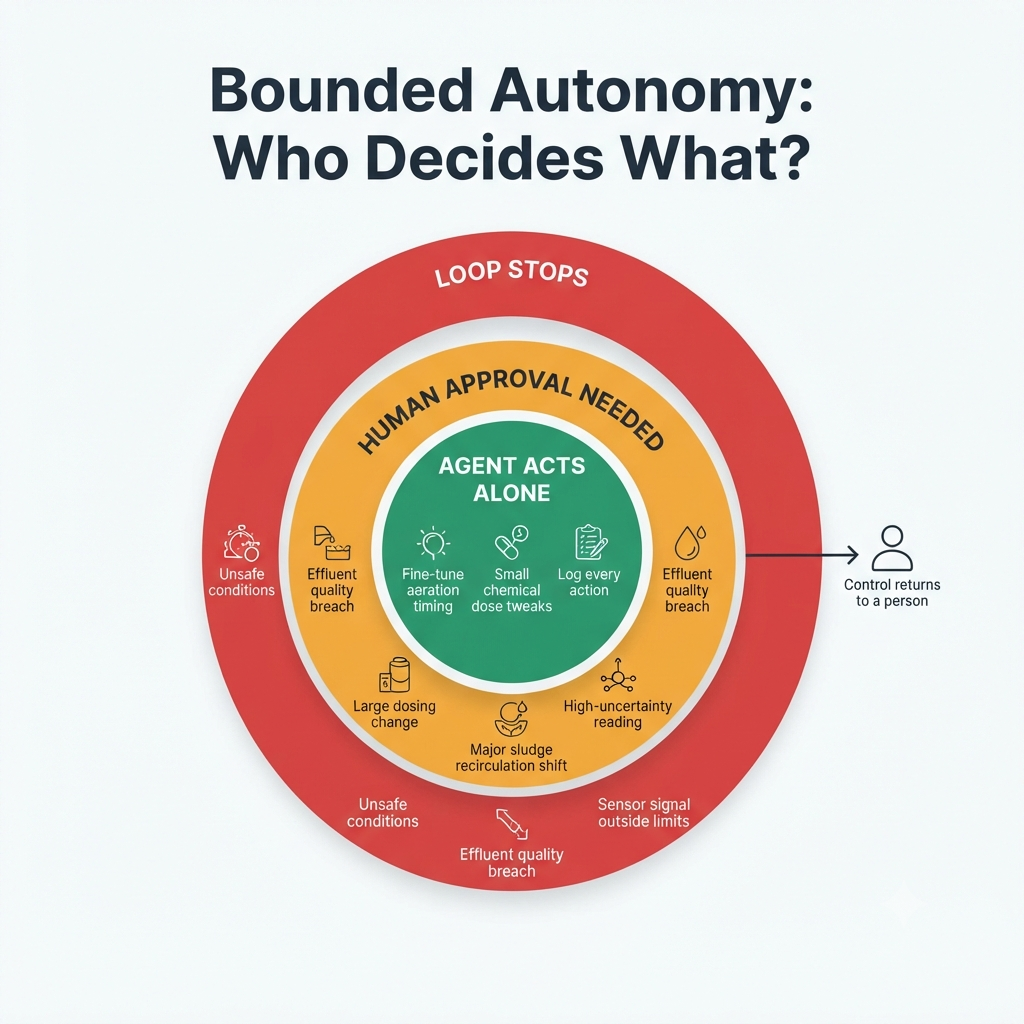
Adaptive experimentation raises an obvious question: should an AI agent be allowed to change a physical process on its own?
The answer isn’t unrestricted autonomy. It’s bounded autonomy. A responsible closed-loop system needs:
- Strict operating envelopes and physical constraints.
- Fail-safes that stop the loop when conditions turn unsafe.
- Human approval thresholds for high-impact actions.
- Auditable logs showing why the agent chose each action.
- Validation against known operating conditions.
- Clear escalation rules for when uncertainty gets too high.
The danger isn’t that the system adapts. It’s that it adapts toward the wrong objective, reacts to noisy signals, or mistakes short-term fluctuations for real trends.
A well-designed system has to tell noise from signal. It needs to know when to act right away, when to wait for more evidence, and when to hand control back to a person.
The Shift in R&D Infrastructure
The lab of the future won’t be defined by having more robots. It will be defined by a new architecture:
- Continuous sensing rather than periodic sampling.
- Models that update during the experiment, not after it.
- Robotics that receive evolving instructions, not fixed recipes.
- Decision systems that quantify uncertainty.
- Human interfaces built for oversight, approval, and exception handling.
In this model, the lab becomes a physical learning system, a place where apparatus, algorithm, and objective evolve together.
The most advanced labs won’t ask, “How many experiments can we run?” They’ll ask, “How much useful knowledge can we get out of every physical action?”
From Testing Reality to Conversing With It
Static experimentation treats reality as something to question through a predetermined sequence of tests. Closed-loop adaptive design treats reality as an active participant in the research.
The AI agent doesn’t just run experiments. It listens to the physical response, revises its hypothesis, and changes the next action to match.
That’s the real transformation. The lab stops being a place where experiments are performed. It becomes a system that learns while it experiments.