

AI agents shouldn’t inherit a developer’s broad standing privileges. They need their own short-lived, task-scoped machine identities. Once an autonomous agent gets a developer’s environment, credentials, and tool access, it becomes a privileged proxy, and it can move sensitive company data well beyond anything its owner intended.
To be clear, agents aren’t inherently unsafe. The trouble is that most enterprise IAM systems were built for named humans and fairly stable service accounts. They weren’t built for software that can reason, hold onto context, call tools and third-party services, and keep running around the clock across systems.
The Privilege Nobody Assigned
Say a developer asks an internal coding agent to figure out why a deployment failed. To be useful, the agent gets access to the developer’s repository, CI/CD variables, cloud console session, internal APIs, ticketing system, and secrets manager.
The agent spots a configuration issue, reads a log file, pulls an API key out of an environment variable, and sends a debugging summary to a third-party model endpoint. Nothing looks odd in the developer’s access logs. The account was authorized, the repo was accessible, and the model endpoint may even be on the approved list.
Still, one question goes unanswered: which agent did this, under whose delegated authority, for which task, with which permissions, and what data left the enterprise boundary?
Traditional IAM often can’t say. It knows a human authenticated. It knows a service account touched a resource. What it doesn’t know is that an autonomous agent stitched those permissions together, carried sensitive context through a long session, and sent part of it to an outside service.
Non-Human Identity Sprawl
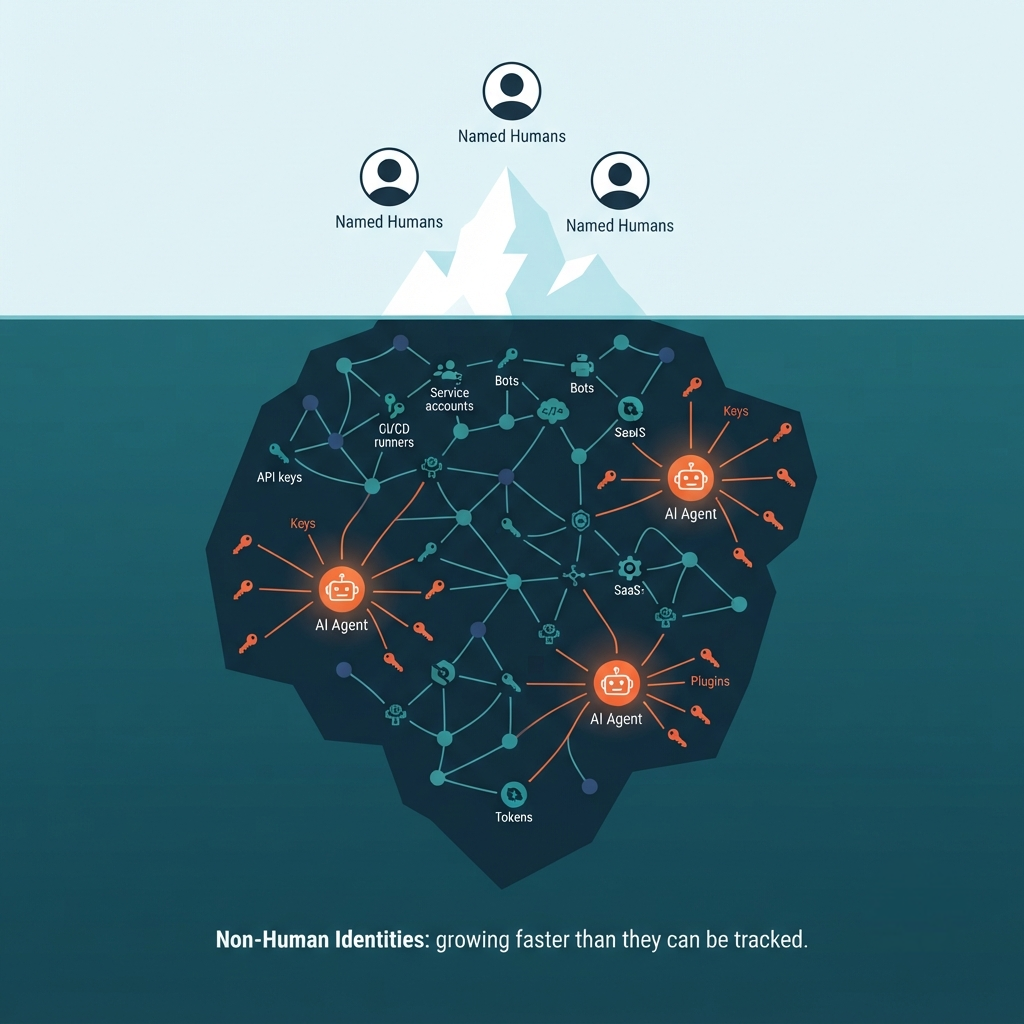
Non-human identities already cover service accounts, API keys, containers, CI/CD runners, workloads, SaaS integrations, and automation jobs. AI agents add something heavier: identity-bearing software that can plan, choose tools, and act with little human supervision.
| Legacy identity | Typical access pattern | Why it breaks down for AI agents |
|---|---|---|
| Human developer | Named user, MFA, broad role-based access | An agent may inherit standing access and act beyond the human’s direct supervision |
| Service account | Long-lived key, fixed permissions, shared across systems | Broad static privileges create a large blast radius and obscure attribution |
| AI agent | Dynamic tasks, multiple tools, external calls, long sessions | Requires a distinct identity, task-scoped delegation, ephemeral credentials, and auditability |
The underlying problem is non-human identity sprawl. Organizations pile up credentials, tokens, integrations, and service accounts faster than they can inventory, scope, rotate, or revoke them. Agents make this worse, since every new agent, plugin, connector, or tool integration can open another path to sensitive systems.
The Architectural Failure
It starts with a convenient assumption: “The agent works on behalf of a developer, so give it the developer’s access.”
That doesn’t hold up for long.
Developers need broad access because humans investigate unfamiliar problems, jump between contexts, troubleshoot production, and make judgment calls. An agent working on a narrow task doesn’t need all that. But if you hand it the developer’s whole environment, it gets the developer’s reach without the developer’s judgment, accountability, or session limits.
Shared credentials create silent delegation
When an agent runs on a developer’s browser session, personal access token, cloud credentials, or a shared service account, IAM sees one principal, not two actors. That causes a few problems:
- The agent’s actions get attributed to the human, even if the human never did them.
- The agent may keep access after the task is finished.
- Security teams can’t tell developer activity from agent activity.
- A compromised agent harness, a malicious tool, or a prompt-injected instruction can turn legitimate access into an exfiltration path.
- Long-lived credentials stay usable long after the original task ended.
CERT-EU advises organizations to keep long-lived API keys and other secrets out of agent-readable environment variables and files, and to use short-lived, narrowly scoped credentials instead.
Why “Agent as Developer” Breaks IAM
Traditional IAM bakes in assumptions that don’t carry over to autonomous agents.
Humans are supervised; agents run at machine speed
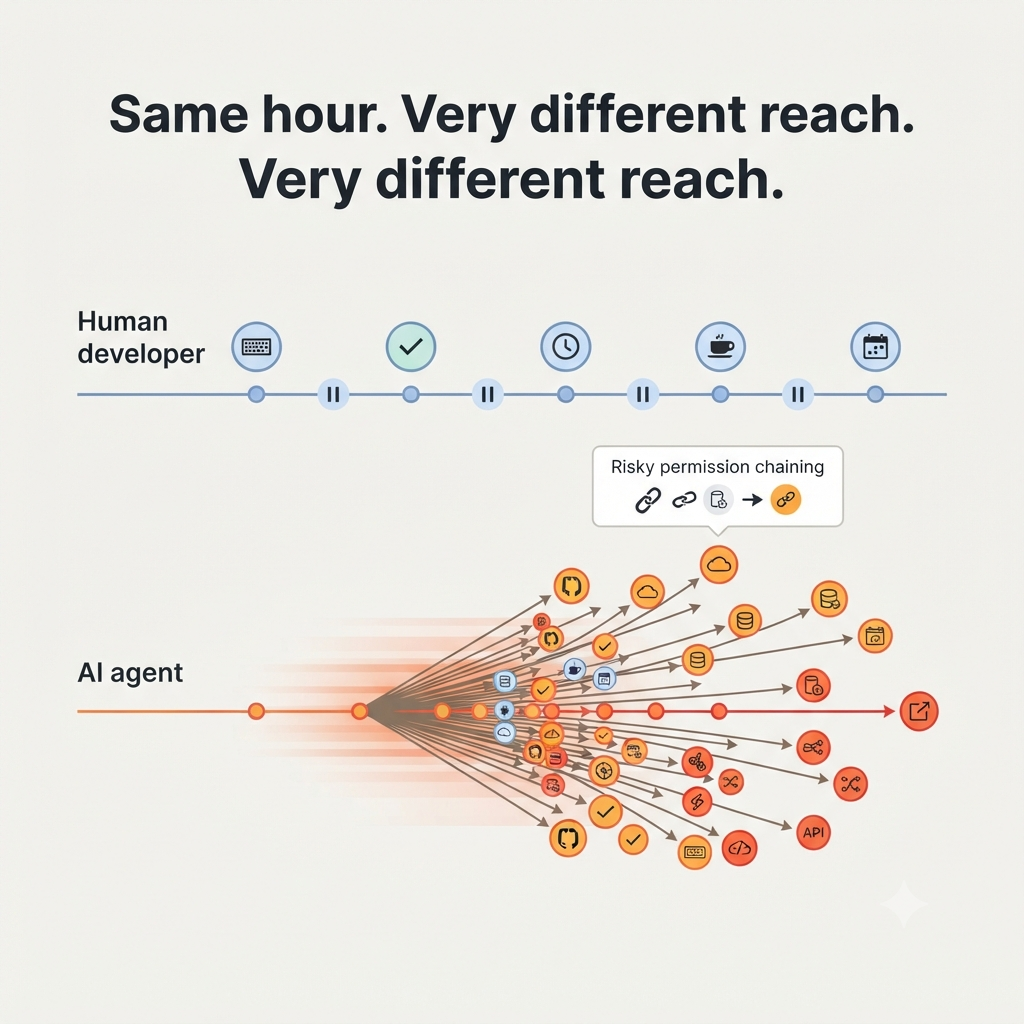
A developer may have broad permissions, but their actions are limited by attention, working hours, approvals, and organizational context. An agent can fire off lots of actions quickly, across many systems, without stopping to wonder whether a particular combination of permissions makes sense.
That speed makes broad standing access especially risky. A permission that looks harmless alone can become dangerous once the agent chains it with another permission, tool, or external endpoint.
Agents combine permissions in unexpected ways
Picture an agent with three individually reasonable capabilities:
- Read access to a source-code repository
- Access to a cloud secrets manager
- Permission to call an external LLM API
Each one is defensible for a developer workflow. Together they form a path from internal source code and secrets to a third-party endpoint.
So least privilege can’t stop at login. It has to hold across the whole chain: agent identity, delegated authority, task, tool, resource, data classification, and outbound destination. AWS’s guidance on agent identity stresses task-scoped roles, permission boundaries, time-bounded credentials, automatic secret rotation, and audit trails that can’t be disowned.
Long sessions multiply exposure
A multi-week agent session is nothing like a short human work session. Over that time the agent may collect repository context, configuration details, incident data, credentials, and internal docs.
If it can read secrets and talk to an external model endpoint, every later interaction is another chance for sensitive information to leave. The danger isn’t one bad prompt. It’s persistent privilege paired with repeated external calls.
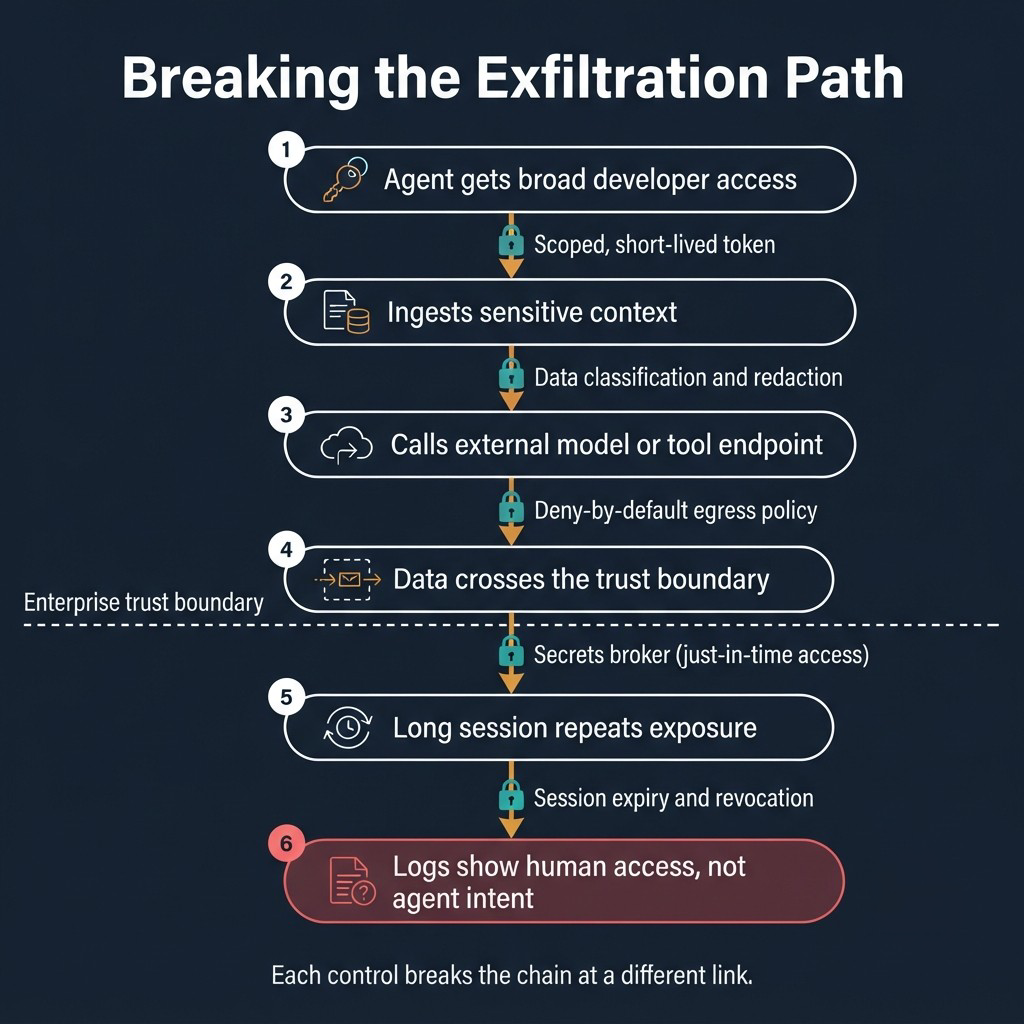
The Exfiltration Path
You can think of the risk as a chain:
- An agent receives broad developer access.
- It ingests sensitive context: source code, configuration, logs, tickets, cloud metadata, or secrets.
- It calls an external model or tool endpoint.
- Sensitive data leaves the trust boundary through a prompt, attachment, retrieval result, or tool payload.
- The long-lived session makes repeated exposure more likely.
- Audit logs show approved human access, but nothing clear about the agent’s intent, scope, or data boundary.
Egress controls help, but they won’t solve it alone. If the destination is approved, or the sensitive data rides inside otherwise legitimate traffic, a network control may let it through. Identity, authorization, data classification, and destination controls need to work together.
The core IAM failure is this: the enterprise authorized a human, but never explicitly authorized the agent as its own delegated actor.
What Good Agent IAM Looks Like
Secure agent access means treating agents as first-class non-human identities, not as extensions of a developer’s account.
Give every agent its own identity
Each agent needs a distinct identity, an owner, a purpose, a lifecycle, and its own audit trail. Security teams should be able to answer:
- Which agent is this?
- Who owns it?
- What business function does it serve?
- What systems can it access?
- What external endpoints can it contact?
- When should its access expire?
Use task-scoped authorization
An agent shouldn’t get “developer access.” It should get permission to do a specific task against a defined set of resources.
An agent investigating a failed deployment, for instance, might need read access to one repository, logs from one service, and permission to query a monitoring system. It doesn’t need production database admin rights, every secret in the vault, or the ability to deploy arbitrary code.
Issue short-lived credentials
Static API keys, long-lived cloud credentials, and reusable OAuth tokens are a poor fit for agent workflows. Agents should get ephemeral credentials that expire on their own and are tied to one task, resource, and audience.
For high-risk operations, short lifetimes matter even more. Practical OAuth guidance recommends time-bound scopes and short-lived tokens for sensitive actions.
Delegate authority explicitly
Rather than sharing a password, browser session, or personal token, a human should hand an agent limited authority through a controlled OAuth-style flow. The delegation should spell out:
- The agent identity
- The human approver
- The permitted task
- The resources and tools involved
- The permitted external destinations
- The expiration time
- The actions that need step-up approval
That gives you a clean chain of accountability. The human delegated a limited mandate, the agent acted within it, and the platform recorded both.
Isolate secrets from the agent
Agents shouldn’t hold raw secrets in memory, environment variables, local files, or browser sessions. A secrets broker or workload identity system can provide just-in-time access only when a specific tool call needs it.
The agent gets the minimum it needs for the immediate operation, then loses it. That makes compromising the agent less valuable and leaves less data to exfiltrate.
A Practical Reference Architecture
A secure agent setup should follow a consistent flow:
- Human requests a task. For example: “Investigate the failed deployment in Service X.”
- Policy engine evaluates the request. It checks task type, environment, data classification, resource sensitivity, and risk.
- Identity broker issues an ephemeral token. The token is scoped to the specific repositories, logs, APIs, and tools the task requires.
- Agent executes through a tool gateway. Every tool call is authorized, logged, rate-limited, and policy-checked.
- Secret broker provides just-in-time access. The agent never receives a reusable credential.
- Egress policy validates the destination. Only approved model endpoints are allowed, and sensitive fields are redacted, tokenized, or blocked.
- Session expires. The token and permissions vanish, but the audit record stays.
This swaps implicit inheritance for explicit delegation. It also gives security teams what they need during an incident: which agent acted, which human approved it, what task it performed, which tools it used, which resources it touched, and where it sent data.
Controls That Reduce Risk
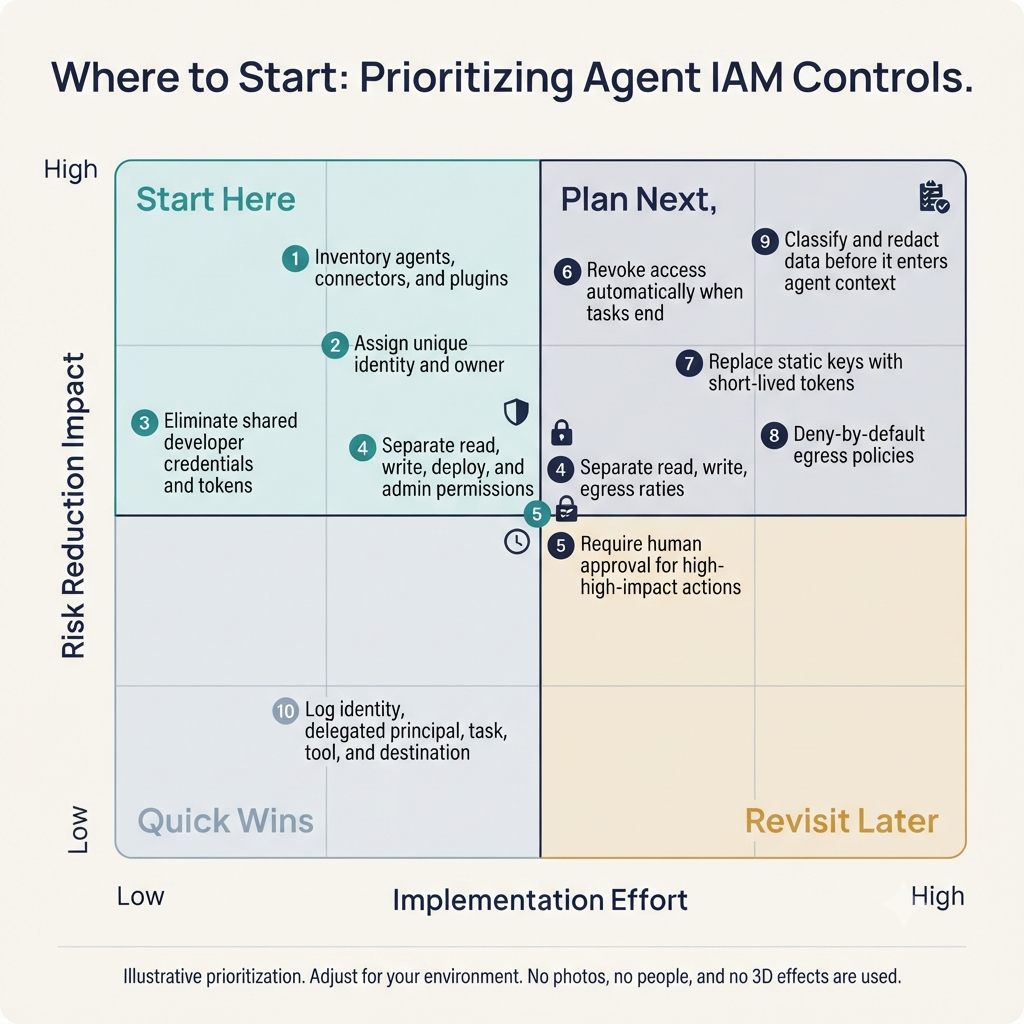
You can start with practical controls now, without waiting for agent-security standards to mature.
- Inventory every AI agent, connector, plugin, and tool integration.
- Assign each agent a unique managed identity and an accountable owner.
- Eliminate shared developer credentials, browser sessions, and personal access tokens for agent use.
- Replace static keys with workload identity federation or short-lived tokens where the platform supports them.
- Apply deny-by-default network and API egress policies for agent traffic.
- Classify data before it enters an agent’s context, and block or redact secrets, credentials, PII, and production data.
- Separate read, write, deploy, and administrative permissions.
- Require human approval for irreversible or high-impact actions.
- Log agent identity, delegated principal, task, tool call, resource, token scope, and external destination.
- Revoke access automatically when a task ends, an agent is decommissioned, or anomalous behavior shows up.
Security guidance is increasingly landing in the same place: zero standing privileges, short-lived tokens, delegated authority, lifecycle management, and auditability.
Metrics Security Leaders Should Track
IAM teams should measure whether agent access is actually shrinking, not just whether agents are being used.
- Percentage of agents using unique managed identities rather than shared credentials
- Percentage of agent credentials that are short-lived rather than static
- Number of agents with standing production privileges
- Mean time to revoke agent access after task completion or offboarding
- Percentage of external model calls covered by approved egress policy
- Percentage of high-risk agent actions requiring human approval
- Number of secrets accessible to each agent before and after least-privilege redesign
- Coverage of agent action logs across identity, tool, data, and network layers
Tracking these turns “agent security” from a vague worry into a real IAM program.
Agents Need Identity, Not Inheritance
The dangerous privilege isn’t the agent’s intelligence. It’s the developer access it inherited.
An AI agent shouldn’t operate as a shadow copy of a human developer. It should get a narrowly scoped, revocable mandate to finish one task, and then lose it.
An AI agent should not inherit a developer’s identity. It should receive a narrowly scoped, revocable mandate to complete one task, then lose it.
The organizations that do well with agentic AI won’t be the ones that give agents the widest access. They’ll be the ones that make autonomy fit with enterprise accountability: explicit delegation, minimal privilege, ephemeral credentials, controlled egress, and complete auditability.