

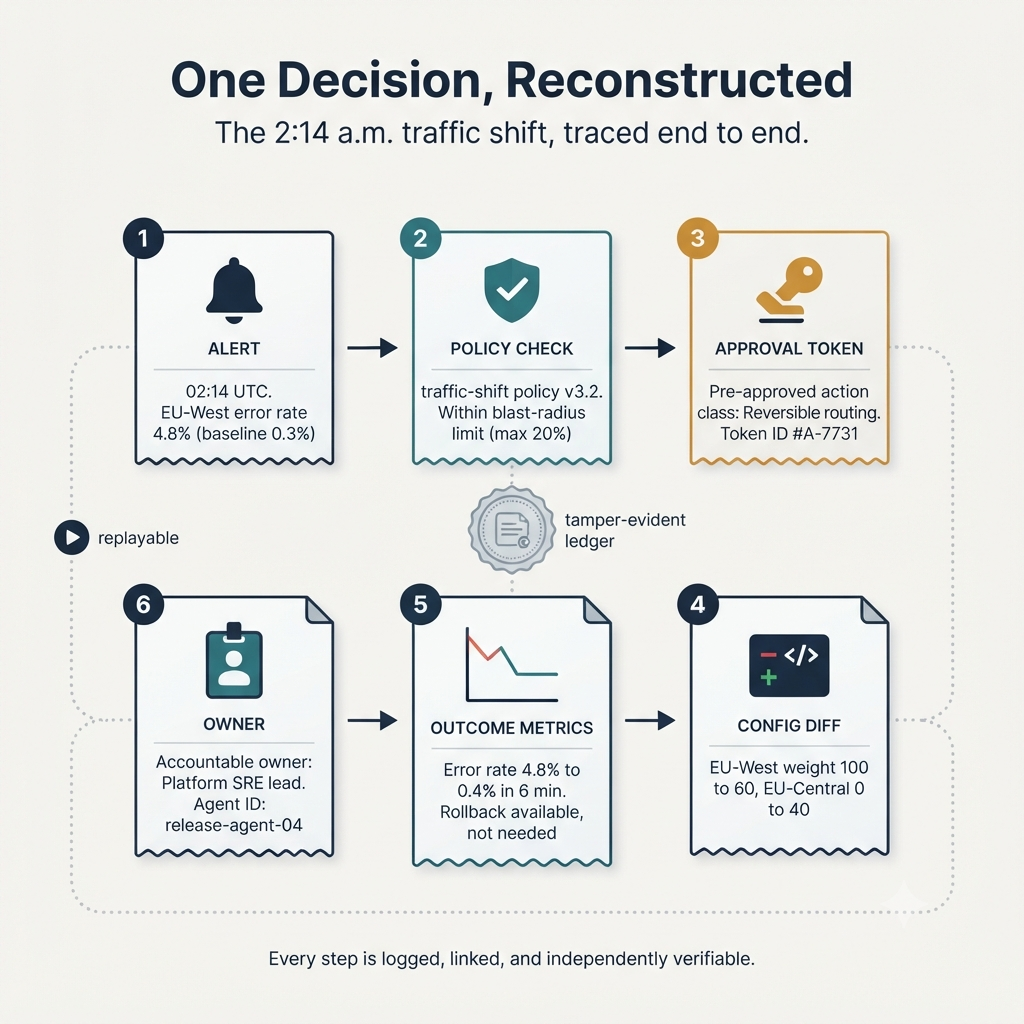
It’s 2:14 a.m. An AI release agent notices error rates climbing in one region. It decides traffic should move, edits a load-balancing config, pushes the change, and pings the on-call team on Slack.
By morning the incident is over. Then compliance asks the question nobody wants to answer: who authorized the agent to make a production-routing decision, and who would have been accountable if it had taken customers down?
Companies are starting to give AI agents real privileges in software delivery. Agents read telemetry, dig into failures, propose fixes, open pull requests, deploy changes, and modify infrastructure. That makes them “first-class citizens” in the release workflow. The law doesn’t see it that way. An agent can have operational authority without legal personhood, without accountability, and without any ability to accept consequences.
The risk isn’t that agents get too capable. It’s that organizations hand over production authority before building the governance needed to control, explain, and defend what the agents do.
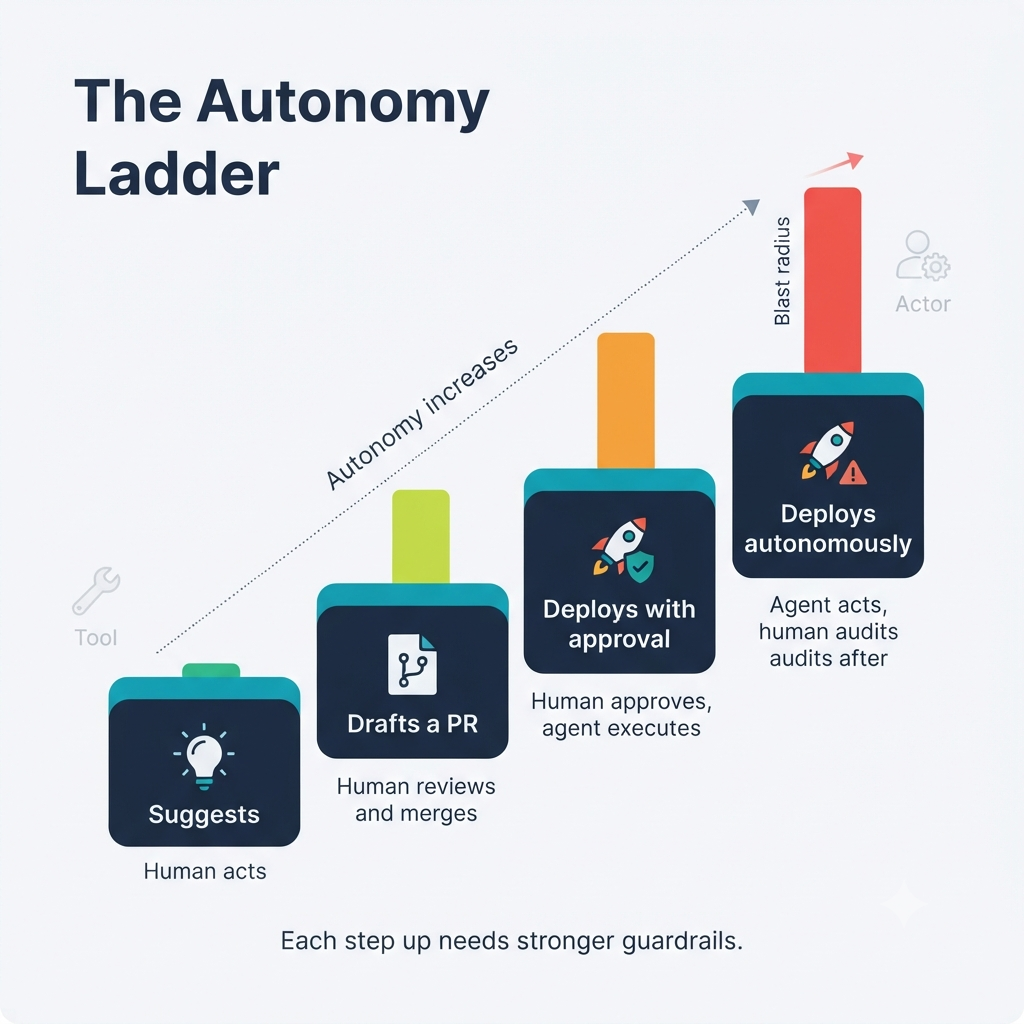
From tool to actor
Traditional DevOps assumes a human starts every change. A developer commits, a reviewer approves, a release manager signs off, an on-call engineer responds. Every step leaves behind an identity, an approval, and a person who can be asked, “Why did you do that?”
Agents break that model because they can chain actions on their own:
- Detect an anomaly in observability data.
- Interpret the likely cause.
- Pick a remediation strategy.
- Change infrastructure or application configuration.
- Trigger a deployment or traffic shift.
- Check the result and report back.
That’s not a code-completion tool anymore. It’s an operational actor that can affect production.
But you can’t fire it, sue it, fine it, depose it, or hold it personally liable. It can’t sign a change advisory board record, accept responsibility for a data breach, or testify about its intent. The result is an accountability vacuum: the system has agency, and the enterprise still owns every consequence.
The auditability paradox
The core tension is simple:
The more autonomous an agent becomes, the more valuable it is. The more valuable it becomes, the more rigorously its actions must be auditable. And the more rigorously it must be audited, the more its autonomy must be constrained.
So auditability isn’t a compliance checkbox you bolt on after launch. It’s the gate that decides whether enterprises can adopt agents at all.
NIST’s AI Risk Management Framework asks whether organizations have auditability mechanisms: traceability of the development process, logging of AI-system processes and outcomes, and documentation of impacts. It also treats human oversight as a defined, assessed, and documented organizational process.
Put plainly, an agent that can’t explain what it did, under what authority, with what information, and with what result isn’t enterprise-ready, however impressive its technical performance.
What “first-class citizen” should mean
Calling an agent a “first-class citizen” is fine if it means the agent has a governed identity and controlled permissions. It gets dangerous if it implies the agent has the same standing as a human employee.
| Capability | Responsible interpretation | Risky interpretation |
|---|---|---|
| Identity | Unique, attributable service identity with scoped credentials | Shared bot account with broad production access |
| Authority | narrowly scoped permissions for defined actions | Unrestricted deployment or infrastructure control |
| Decision-making | Bounded policies, guardrails, and escalation rules | Opaque autonomous judgment in high-impact paths |
| Evidence | Immutable, queryable decision and action records | Basic deployment event log only |
| Accountability | Named human owner for each agent and action class | “The AI did it” as an explanation |
| Reversibility | Tested rollback and containment paths | Irreversible production changes |
An agent can have an identity, credentials, and workflow privileges. It shouldn’t be treated as an employee, a signatory, or an accountable decision-maker.
That’s because “first-class citizen” is an architectural metaphor, not a legal category. The agent can take part in the workflow. A human still has to own the governance around it.
The chain-of-custody problem
When an agent makes a real-time routing decision, a basic deployment log won’t cut it. A line reading “configuration changed” can’t answer what an auditor, regulator, customer, or court will ask.
A defensible chain of custody should capture:
- Trigger: The alert, telemetry signal, user request, scheduled task, or event that started the action.
- Context: The relevant metrics, logs, configuration state, service dependencies, model version, and policy version.
- Reasoning: The agent’s rationale, confidence, the constraints it checked, the alternatives it considered, and its decision boundary.
- Authorization: The permission, policy, approval workflow, or human sign-off that allowed the action.
- Action: The exact change, target system, artifact version, configuration diff, and execution time.
- Outcome: How the service behaved afterward, including errors, latency, customer impact, and validation results.
- Reversibility: The rollback path, whether it was available, and whether anyone used it.
- Human linkage: The accountable engineer, service owner, approver, on-call responder, or risk owner.
The point isn’t just to record that something happened. It’s to make the event reconstructable:
Why did the agent act, under what authority, using what information, with what impact, and who was responsible for supervising it?
Without that, a company defending an autonomous production decision is left with scraps: a deployment event, a chat message, and someone’s memory of what happened.
Regulatory pressure is rising
Each compliance regime comes at this differently, but they all land in the same place: you have to be able to show control over systems that touch sensitive data, financial reporting, safety, or critical operations.
SOX
If you’re subject to Sarbanes-Oxley, an AI agent that can change production systems has to fit inside your existing change-management controls. That means documented authorization, segregation of duties, access restrictions, testing evidence, and proof that changes were approved and traceable.
An agent that can both propose and deploy a change with no independent check creates a segregation-of-duties problem. Automation isn’t banned. It just has to preserve the control objectives the regulation exists to protect.
HIPAA
The HIPAA Security Rule requires technical policies and procedures so that only authorized people can access electronic protected health information, plus mechanisms to record and examine activity in systems that contain or use ePHI.
That matters for any agent working near clinical systems, patient records, claims workflows, or healthcare infrastructure. An agent can’t become an uncontrolled path to ePHI. Its access should be scoped, logged, monitored, and open to review.
Recent federal rulemaking discussion also notes that records of system activity can include audit trails, event logs, access reports, and security-incident tracking, and that reviewing them regularly helps catch unusual activity.
ISO-aligned management systems
ISO-aligned security and quality systems run on documented policies, defined responsibilities, controlled changes, incident response, and evidence that controls worked as intended. An AI agent adds a new kind of actor to all of that.
If you can’t show who configured the agent, what it was allowed to do, when it acted, whether the action was authorized, and how the outcome was verified, the control may exist on paper and still fail in practice.
EU AI Act
The EU AI Act puts heavy weight on traceability, logging, documentation, and human oversight for high-risk AI systems. The European Commission lists activity logging, to ensure traceable results, among the obligations for high-risk systems.
The AI Act Service Desk also names human oversight and automatically generated logs as central requirements, and says providers of high-risk systems must keep those logs for at least six months unless other law requires longer.
That doesn’t make every internal deployment agent a high-risk system. But companies can’t assume agent autonomy sits outside AI governance. The more consequential the decisions, the more likely regulators and auditors will take an interest.
Who is liable when the agent fails?
It’s the most common question and the most misunderstood: if the agent causes an outage, a data exposure, or a compliance violation, who’s liable?
Rarely the agent.
- The enterprise or deployer generally stays accountable for the system it runs, the permissions it granted, the policies it configured, and the oversight it failed to maintain.
- The vendor or model provider may face contractual, security, warranty, or product-liability exposure, depending on the agreement, the product’s role, and the jurisdiction.
- The human owner or approver may bear internal responsibility if they approved unsafe policies, ignored alerts, bypassed controls, or let oversight lapse.
- The agent is part of the enterprise’s controlled system. It isn’t a legal person and can’t bear liability on its own.
So the practical risk isn’t that liability somehow slides over to the AI vendor. It’s that after an incident, a company may find it can’t show who was responsible for the agent’s authority, decisions, and production impact.
Human-on-the-loop, not human-in-the-loop
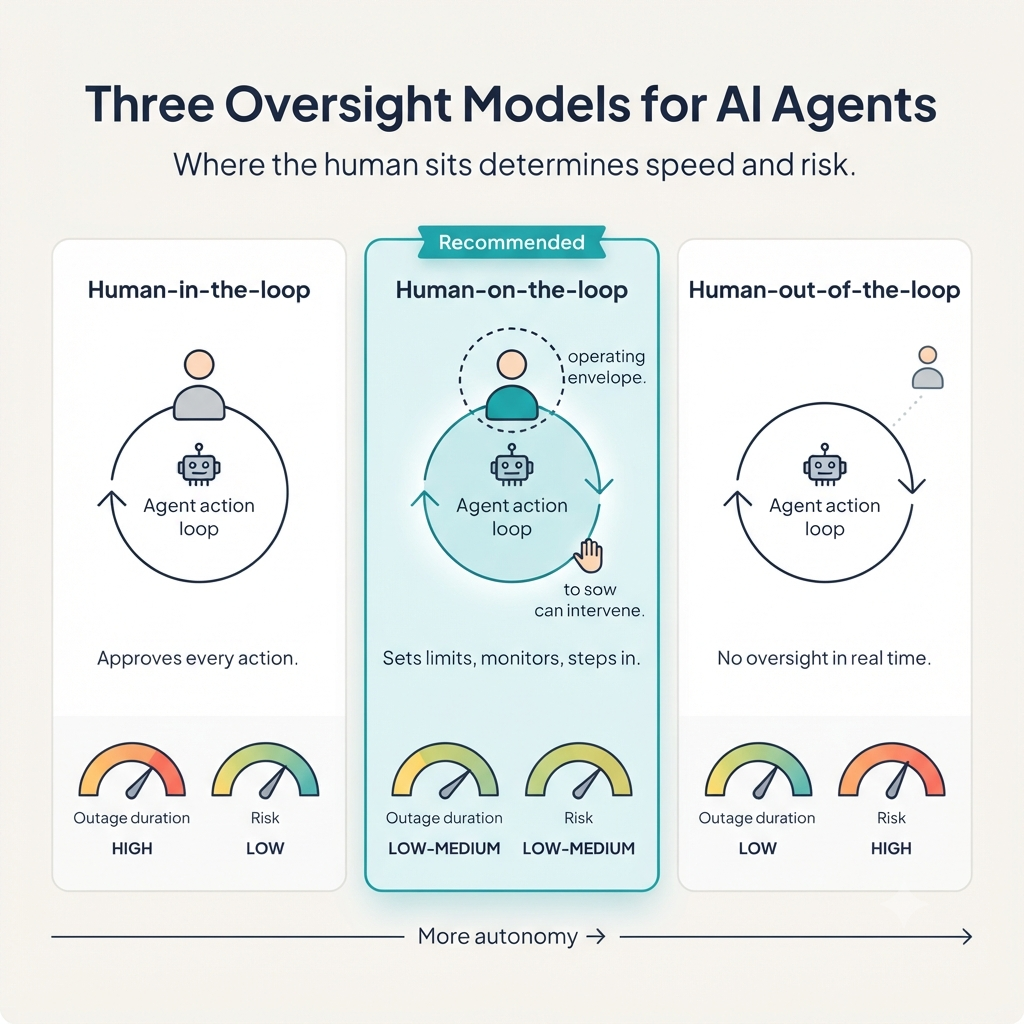
“Human in the loop” is often too slow for real-time operations. If a service is failing, waiting for a person to approve every routing tweak can drag the outage out.
“Human out of the loop” is too risky for consequential actions. An agent shouldn’t decide on its own to reroute traffic, change authentication controls, deploy to production, delete data, or alter a regulated workflow without limits.
The better model is human-on-the-loop. Humans set the operating envelope, approve high-risk classes of action, watch outcomes, investigate exceptions, and keep the ability to step in.
| Action class | Example | Required control |
|---|---|---|
| Low impact | Summarize logs, draft a runbook, recommend a fix | Automated logging and periodic review |
| Medium impact | Restart a noncritical service, scale a workload, open a remediation PR | Policy guardrails, rate limits, notifications |
| High impact | Change traffic routing, deploy to production, alter security settings | Preapproved boundaries, reversible action, approval or immediate escalation |
| Regulated or irreversible | Delete data, modify PHI systems, change financial controls | Human approval, dual control, immutable evidence |
The EU AI Act’s human-oversight guidance says oversight should be assigned to people with the right competence, training, authority, and support. That carries over well to agent governance. Oversight can’t be a dashboard widget if nobody has the authority or the ability to act on what it shows.
Design principles for accountable agents
Treat agent autonomy as a privilege granted by policy, not a default feature of the platform.
- Least-privilege agency: Scope each agent to specific repositories, environments, services, and actions.
- Separation of duties: Don’t let one agent propose, approve, deploy, and validate the same change.
- Policy-as-code: Encode permitted actions, blast-radius limits, maintenance windows, environment restrictions, and escalation rules.
- Immutable evidence: Use append-only, tamper-evident logs, and keep the decision context, not just execution events.
- Decision receipts: Capture the prompt or trigger, model and policy versions, inputs, outputs, approvals, and the resulting change.
- Reversibility by default: Require rollback plans, canary deployments, and automatic containment for high-risk actions.
- Named accountability: Give every agent, workflow, and action class a human owner with real authority.
- Independent verification: Let security, compliance, and internal audit reconstruct decisions without leaning only on the agent’s own explanation.
That last one matters most. An agent’s explanation is useful evidence, but it shouldn’t be the only evidence. The policy engine, approval service, deployment platform, observability data, and access-control records all need to back it up.
A practical reference architecture
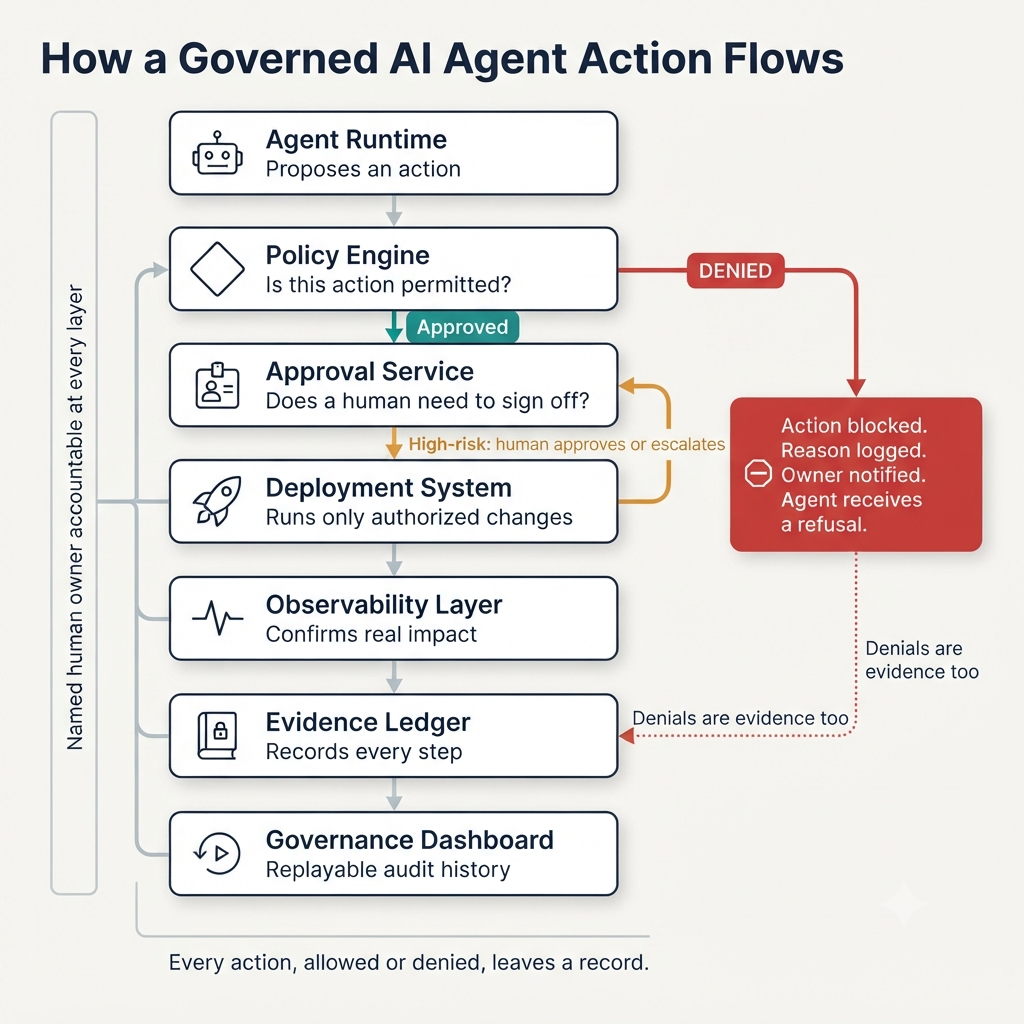
A responsible agent deployment has seven connected layers:
- Agent runtime executes the task.
- Policy engine checks whether the requested action is permitted.
- Approval service decides whether a human needs to sign off.
- Evidence ledger records the full chain of decision and action.
- Deployment system runs only authorized, validated changes.
- Observability layer confirms the actual production impact.
- Governance dashboard gives audit, security, and risk teams a replayable history.
This turns “the agent acted” into something you can actually defend:
This authorized policy, invoked by this accountable owner, caused this reversible change, evidenced by this immutable record.
That sentence is what separates an AI agent from an uncontrolled automation risk.
Won’t auditability slow agents down?
Fair objection. If every action needs manual approval, most of the value of autonomy disappears. Engineers will route around the control, or never adopt the agent.
But auditability doesn’t mean slowing every decision. It means risk-tiered autonomy:
- Automate low-risk paths.
- Constrain medium-risk paths with guardrails and monitoring.
- Require human control for high-consequence or irreversible actions.
- Keep evidence for every action, whatever its risk level.
Done well, auditability can make agents faster in practice. The system knows what it’s allowed to do, acts within those limits, and can prove afterward that it stayed inside them.
Accountability is the product feature
Enterprises don’t need AI agents to become employees. They need them to be governable actors: powerful enough to act, constrained enough to be safe, and well-evidenced enough to be trusted.
The winning enterprise agent platform won’t be the one that hands agents the most permissions. It’ll be the one that can answer, within minutes:
- What did the agent do?
- Why did it do it?
- Under whose authority?
- With what information?
- What was the impact?
- How was it reversed?
- Who is accountable?
Auditability is quickly becoming the measure of whether an AI agent can graduate from impressive demo to production system. NIST treats auditability and traceability as core mechanisms for trustworthy AI, and the EU AI Act ties high-risk deployment to logging, documentation, and human oversight.
The paradox is real. Enterprises have to give agents enough autonomy to create value, but not so much that no human can explain, control, or defend what happened.
Enterprises do not need AI agents to be employees. They need them to be governable actors—able to act, constrained by policy, and accountable through evidence.