
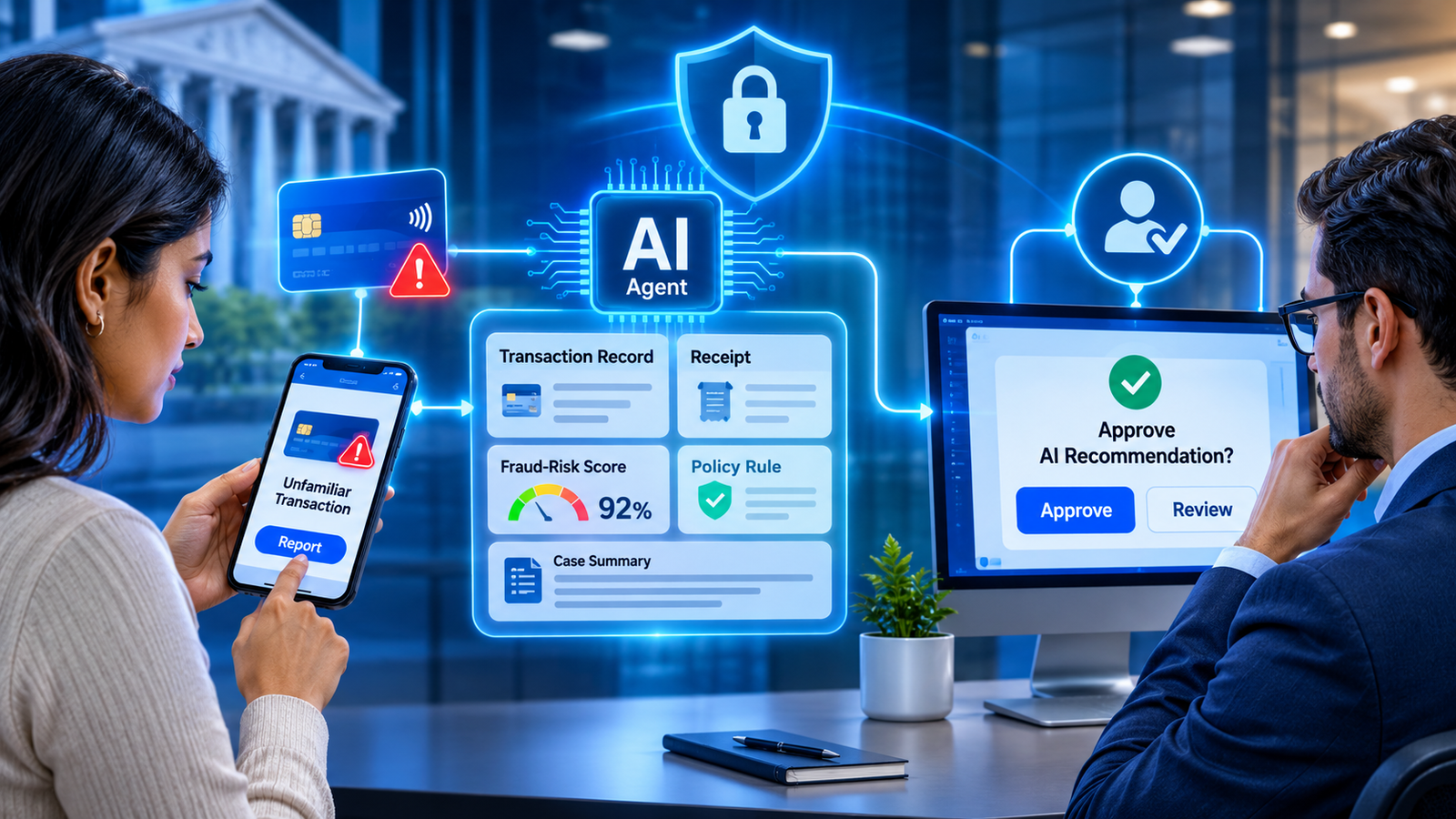
Picture a customer scrolling through their card statement and spotting a charge they don’t recognize. They call the bank, and what should be a quick fix turns into a long, tangled journey. Their case bounces between contact-centre agents, fraud teams, card networks, merchants, and back-office staff, and the customer keeps repeating the same story.
AI agents are starting to change that. They won’t replace dispute teams, but they can run much of the legwork: sorting cases, gathering evidence, checking policy rules, drafting customer updates, and passing along only the cases that truly need a person’s judgment. The goal isn’t “let AI decide everything.” It’s faster resolution, inside clear limits, with strong controls and a full paper trail.
What Is an AI Agent?
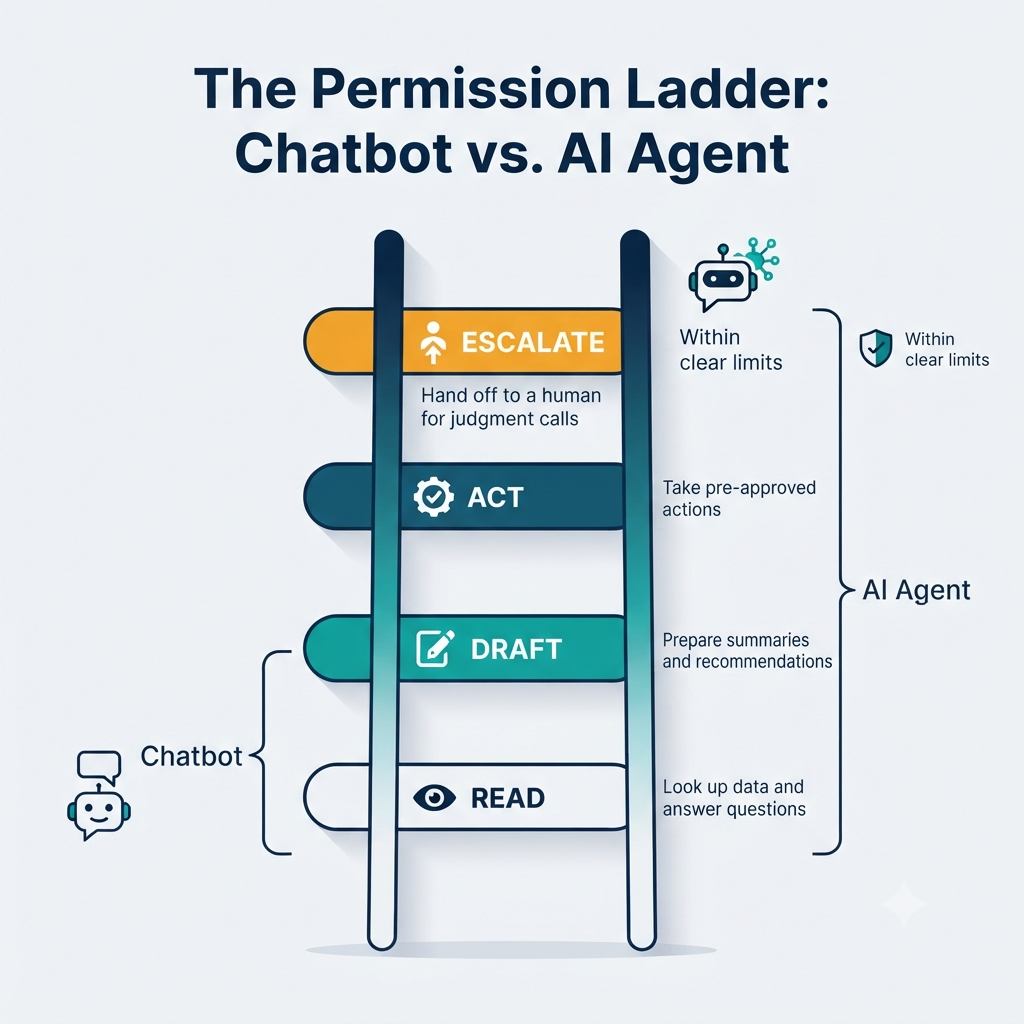
A chatbot mostly answers questions or collects information. An AI agent does more. It can work out what the customer is asking for, pull the right data, check it against defined policies, take actions it has been permitted to take, and hand the case to a human when things go beyond its remit.
Inside a bank, an agent typically works alongside:
- Core banking and card-management systems
- Fraud-detection and risk-scoring models
- Document-processing tools for receipts and statements
- Workflow and case-management platforms
- Customer-communication channels
- Human dispute and fraud specialists
The difference is easy to see in practice. A chatbot might explain how to file a dispute. An agent can verify the customer, look up the transaction, ask for missing evidence, open a structured case, suggest an outcome, and keep the customer updated, all while leaving the big decisions to people.
Where Agents Fit in the Dispute Lifecycle
The real value of agents comes from smoothing the handoffs between steps, not from bolting a chat feature onto customer service.
| Stage | What the AI agent can do | Human role |
|---|---|---|
| Intake and triage | Understand the issue, ask clarifying questions, and classify it as fraud, scam, billing error, dispute, or inconclusive. | Review unusual, ambiguous, or high-risk cases |
| Evidence gathering | Retrieve transaction details, account history, receipts, merchant data, chat logs, and attachments; summarize the case file. | Validate evidence quality and completeness |
| Policy and eligibility checks | Apply dispute rules, network rules, time limits, and fraud indicators to identify likely outcomes. | Approve exceptions and high-value cases |
| Decision support | Recommend provisional credit, rejection, chargeback, reimbursement, or further investigation. | Own final consequential decisions |
| Customer communication | Draft clear, empathetic updates and explain the next steps. | Review sensitive or regulated communications |
| Resolution and follow-up | Update case status, trigger authorized refunds, and notify the customer. | Audit outcomes and quality-assure decisions |
Seen this way, a dispute stops being a pile of disconnected tasks and becomes one governed workflow. The agent keeps information moving, while people stay responsible for judgment calls, exceptions, and fairness to the customer.
A Practical Workflow Example
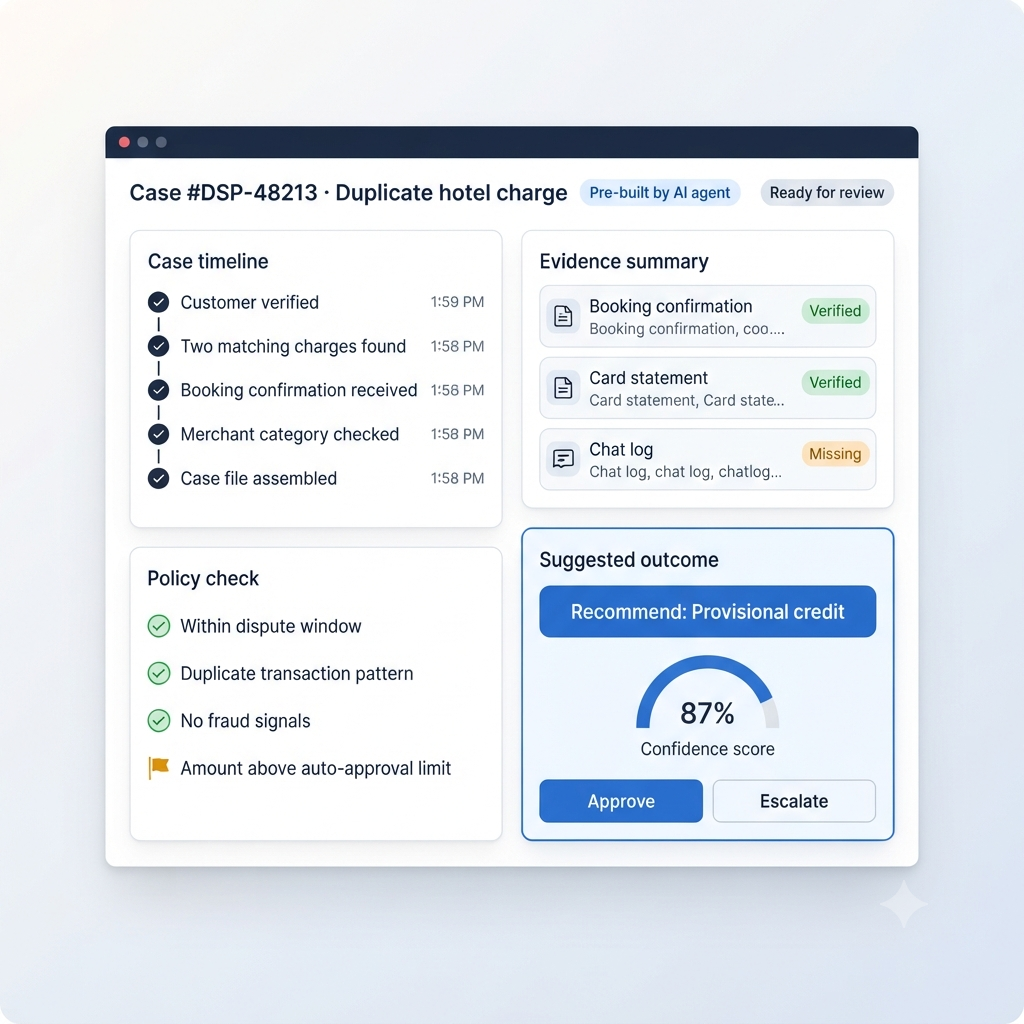
Say a customer writes in: “I was charged twice for a hotel booking.”
- The agent verifies who they are and pulls up the relevant transactions.
- It spots the duplicate charge and asks for missing context, like a booking confirmation or earlier messages with the merchant.
- It checks the dispute policy, the transaction timeline, any fraud signals, and the merchant category.
- It opens a structured case and suggests an outcome, such as provisional credit, a follow-up with the merchant, or further investigation.
- If the amount, risk score, or an exception rule calls for it, a human case handler reviews the recommendation.
- The agent sends the approved update to the customer and follows the case through to closure.
This reflects how real deployments work: agentic systems review disputes and attachments, choose from a set of defined outcomes, and carry out reimbursement and communication steps when appropriate. MONETA Bank, for instance, reported cutting payment-card dispute handling time from around 16 hours to about 30 minutes with an agentic AI solution.
What Banks Gain
Faster resolution
Disputes usually mean juggling several systems, reviewing evidence by hand, and chasing the customer for more information. Agents can shrink that effort by building the case file, checking the rules, and preparing a recommendation before a specialist even opens the case. MONETA Bank’s drop from roughly 16 hours to 30 minutes shows how big the improvement can be.
Less operational effort
When agents handle the repetitive work of intake, evidence collection, case prep, and status updates, dispute teams can spend their time on complex cases, fraud investigations, and conversations that need empathy or judgment. One credit-card dispute programme reported a 60% cut in manual effort and $2.4 million in savings.
Better routing
Getting a case to the right place early is one of the quickest wins available. An LLM-powered triage agent can hold a multi-turn conversation, ask targeted questions, and sort cases into fraud, scam, dispute, or inconclusive. In reported testing, this approach improved classification accuracy by 30.6% compared with a legacy baseline.
A better customer experience
Customers can describe the problem in their own words instead of fighting through rigid menus. The agent asks only what it needs to move the case forward, offers proactive status updates, and spares customers from repeating themselves to every department.
More consistent handling
Policy-guided workflows can cut down on variation in how similar cases are judged. Rather than leaning only on one handler’s interpretation, the agent applies approved rules and shows the evidence behind its recommendation.
The Risks Banks Must Manage
AI agents bring real operational and regulatory risks. Banks should treat them as high-stakes systems, not everyday productivity tools.
- Wrong decisions: An agent might mistake a scam for a dispute, recommend a refund the customer isn’t eligible for, or miss an exception that needs human review.
- Fraud exploitation: Bad actors may try to manipulate conversational agents, impersonate customers, or submit fabricated evidence.
- Bias and inconsistency: Training data, policy interpretation, and language differences can lead to uneven outcomes across customer groups.
- Privacy and data security: Agents often need access to sensitive transaction, identity, communication, and account data.
- Accountability: The bank stays responsible for regulatory compliance, customer treatment, and dispute outcomes, even when an AI system helps along the way.
The guiding principle is simple: automate the work, but not the accountability.
Governance and Human-in-the-Loop Design
Any credible rollout starts with clear boundaries around what the agent can do without sign-off.
- Spell out exactly which actions the agent may take on its own, such as opening a case, requesting documents, or drafting a response.
- Require human approval for provisional credits, high-value disputes, fraud-flagged cases, and policy exceptions.
- Keep complete audit trails covering inputs, retrieved evidence, summaries of the model’s reasoning, recommended decisions, approvals, and final outcomes.
- Have the agent pull from approved policy sources instead of letting it improvise answers.
- Test with adversarial scenarios, edge cases, multilingual queries, and vulnerable-customer situations.
- After launch, keep watching accuracy, escalation rates, reversal rates, customer complaints, and fairness metrics.
Research on triage agents underlines why guardrails matter in customer-facing banking: the agent clarifies the issue and routes the case, but its recommendations stay under policy-guided controls.
Implementation Roadmap
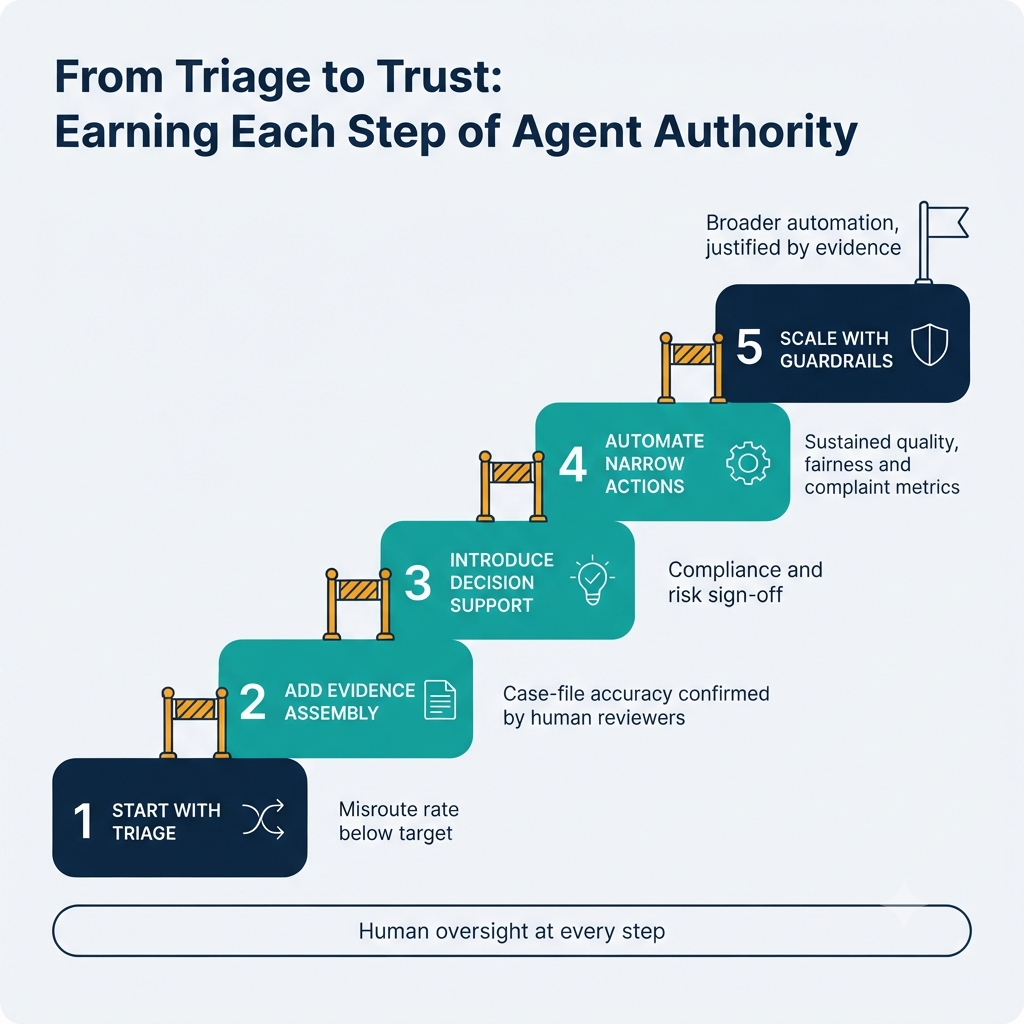
Banks shouldn’t try to automate everything from day one. It’s wiser to widen the agent’s authority step by step.
- Start with triage. Let the agent classify and route disputes, but keep it away from financial decisions.
- Add evidence assembly. Have it summarize documents, pull transaction context, and prepare a case file for a human.
- Introduce decision support. Generate recommendations with confidence scores and mandatory review thresholds.
- Automate narrow actions. Allow limited tasks like creating cases, updating statuses, and sending approved customer messages.
- Scale with guardrails. Expand authority only once performance data, compliance review, and customer outcomes back it up.
A staged approach lowers risk while still delivering value early. It also builds the evidence you’ll need to justify broader automation later.
What Good Looks Like
Cost reduction alone is a poor measure of success. A mature AI-agent dispute programme should improve both operations and customer outcomes.
- Shorter time to first response and to final resolution
- Higher first-contact resolution for straightforward disputes
- Lower manual handling effort without hurting decision quality
- Fewer misrouted or reopened cases
- Strong auditability and explainable recommendations
- Better customer satisfaction, especially in fraud and financial-hardship situations
The best programmes treat dispute resolution as a matter of trust. A fast refund is great, but customers also need to understand what happened, what evidence was weighed, and what comes next.
Also Read: How to Prevent Architecture Drift in AI Coding Agents
AI agents add the most value in bank dispute resolution when they act as governed operational partners, not autonomous judges. The strongest model blends conversational intake, automated evidence gathering, policy-guided recommendations, human oversight, and clear communication with the customer.
Banks that strike this balance can shorten cycle times and reduce manual effort while keeping the control, fairness, and accountability that disputes demand.
Next Steps
- See how agentic AI can reduce dispute cycle times without weakening controls.
- Download the AI dispute-resolution readiness checklist.
- Talk to our team about designing a human-in-the-loop dispute workflow.