
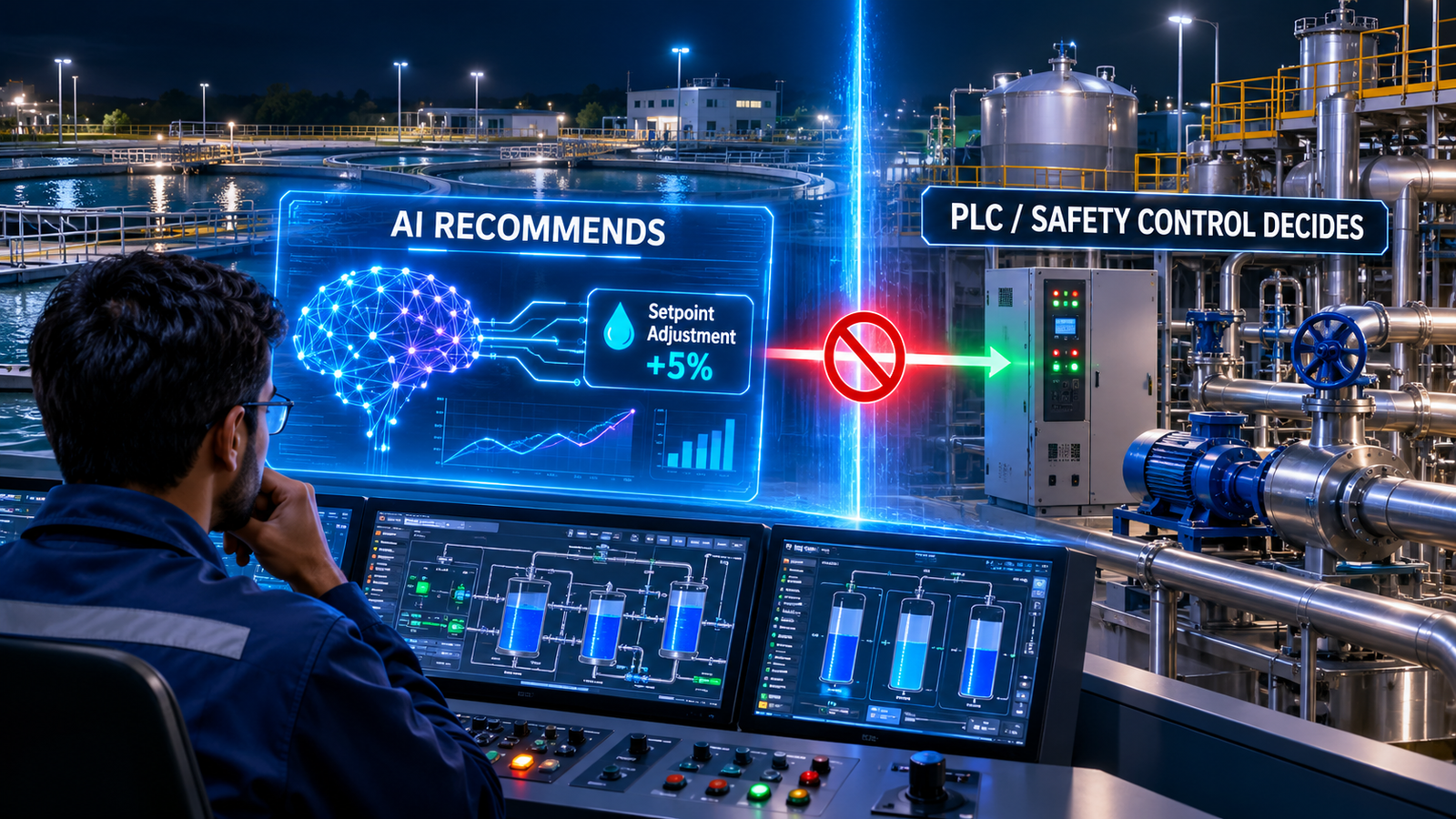
AI can make industrial infrastructure a lot smarter, but only if it never gets unconditional authority over pumps, valves, and chemical dosing systems. The safe setup is a hierarchy. The AI proposes, deterministic control checks the proposal, and independent safety systems keep the final power to stop anything unsafe.
The dangerous fantasy of full autonomy
Picture an AI agent watching a wastewater treatment plant at 2 a.m. It spots a surge in influent, figures the biological treatment is about to fall behind, and decides to raise polymer dosing, adjust a valve, and reshuffle the pump sequence.
In a naive “AI runs the plant” setup, that recommendation turns straight into a command to physical equipment. But a confident prediction isn’t a safety case. The model might misread a sensor, hit a rare operating condition it has never seen, get fed corrupted data, or chase one objective while quietly breaking another.
In water infrastructure, the stakes are concrete. Wrong chemical dosing can hurt public health, put discharge compliance at risk, damage equipment, and harm the environment. That’s why chemical-dosing commands are a textbook example of actions that need strict authorization and safety clearance.
So the real question isn’t whether AI belongs in industrial operations. It’s this: what stops a confident, adaptive system from making a physically catastrophic decision?
Why “smart” is not “safe”
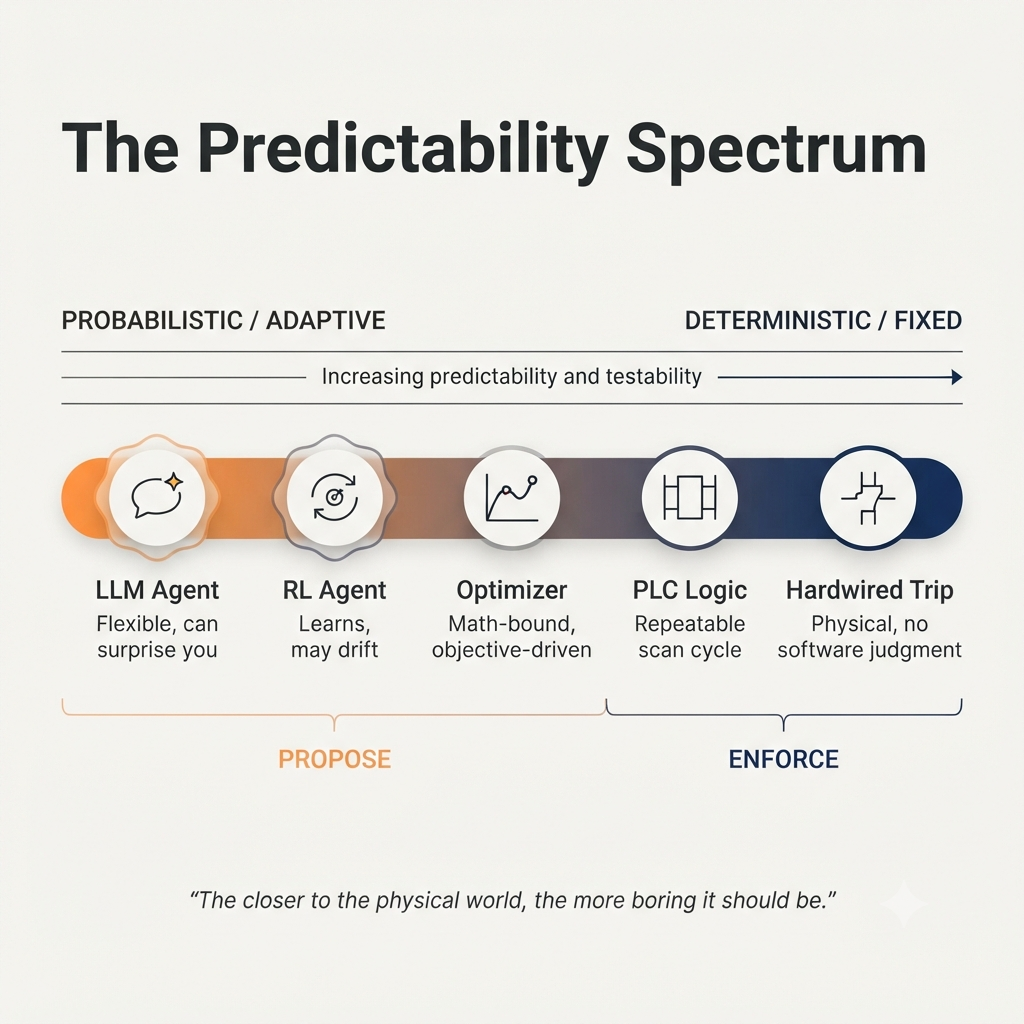
AI systems and industrial control systems are built to optimize for very different things.
| AI agent behavior | Industrial safety requirement |
|---|---|
| Probabilistic and adaptive | Deterministic and repeatable |
| Optimizes objectives and trade-offs | Preserves hard safety constraints |
| Can generate novel plans | Must reject unvalidated or unsafe actions |
| Can fail subtly or unpredictably | Must fail predictably into a safe state |
| Learns and changes over time | Requires versioned, validated control logic |
| Produces explanations and confidence scores | Requires auditable evidence and certified protection |
A large language model or reinforcement-learning agent can be great at spotting patterns, forming hypotheses, and coordinating complicated workflows. None of that makes it a sensible replacement for a PLC running a safety interlock.
At the boundary with the physical world, you want a different kind of intelligence: predictable, testable, and able to act on its own when everything else has failed. NIST makes a similar point, describing industrial control systems (SCADA, distributed control systems, PLCs) as having their own performance, reliability, and safety requirements.
An agent that can propose anything must not be able to command everything.
The hierarchy: who owns which decision?
The answer isn’t to slow AI down or keep it out of operations. It’s to hand out authority on purpose, layer by layer.
| Layer | Typical owner | Responsibility |
|---|---|---|
| Enterprise and planning | Business systems, planners | Production targets, budgets, compliance goals |
| AI orchestration and agent layer | AI agent, optimizer, human supervisor | Diagnose conditions, propose strategies, generate setpoints |
| SCADA and supervisory control | SCADA, HMI, historians | Visualization, alarms, workflow enforcement, operator approval |
| Basic control | PLCs, RTUs, DCS | Real-time loops, sequencing, interlocks, local fallback |
| Safety layer | Safety instrumented system, hardwired protections | Independent trips, shutdowns, isolation, and mitigation |
This lines up with how industrial automation is already organized. AI sits near the supervisory and optimization layers, while PLCs and RTUs keep handling local automation and real-time control.
A handy rule of thumb:
AI writes the intention. SCADA validates the intent. The PLC executes only what is permitted. The safety system stops what becomes unsafe.
Industrial AI orchestration platforms are moving toward this pattern. They coordinate models, people, and automation using hierarchical state machines, controlled rollouts, and traceability. The AI layer ends up as a policy and decision gateway, not something that drives actuators directly.
The control interface: where autonomy ends
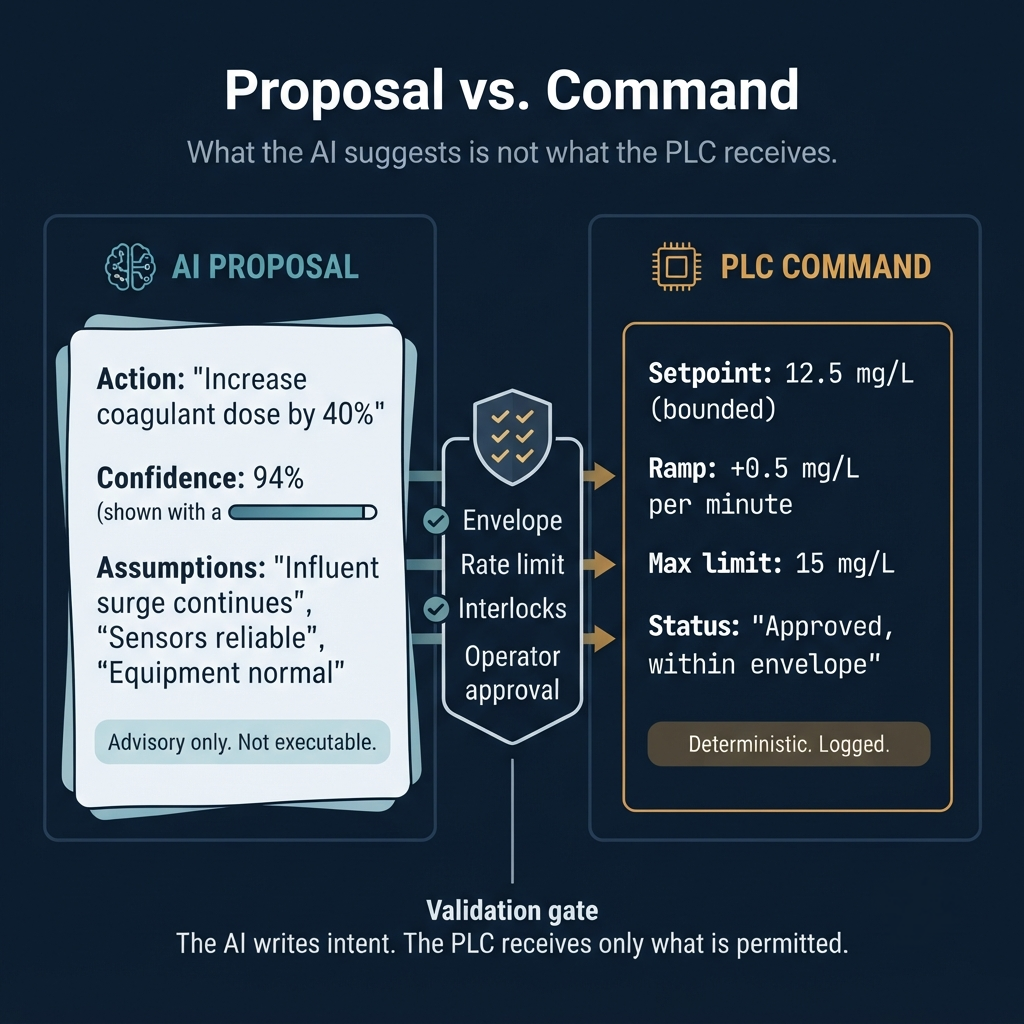
The most important design choice in an AI-enabled plant is where you draw the line between the agent and the actuator.
On the allowed side, the agent can read process telemetry, alarms, equipment states, and historical data. It can detect anomalies, forecast risks, and find ways to optimize. It can recommend operating modes, setpoints, and maintenance work, and draft experiment plans inside pre-approved operating envelopes. For exceptional or high-consequence actions, it can ask for approval, and it should always be able to explain its recommendation, including its confidence, assumptions, and constraints.
On the off-limits side, it should never write raw PLC registers or actuator commands directly. It shouldn’t bypass interlocks, alarms, or safety-rated logic, or override emergency stops and safety instrumented functions. It shouldn’t change safety limits, alarm thresholds, or control philosophy while the plant is running. And it shouldn’t keep acting on its own when connectivity, model health, or data quality starts to degrade.
This boundary changes what the AI is: instead of a possible source of uncontrolled commands, it becomes a governed source of operational insight. The agent can still be very capable. It just can’t touch the physical world without going through validation, permissions, and deterministic control logic.
Guardrails that make autonomy survivable
A guardrail can’t be a prompt that tells the model to be careful. It has to be enforced by the architecture itself.
Here’s what that looks like in practice:
- Setpoint envelopes: The AI can only adjust variables within ranges engineers have approved.
- Rate limits: No sudden jumps in pump speed, valve position, or chemical dose.
- State awareness: Every proposed command gets checked against current equipment state, operating mode, and active interlocks.
- Permission tiers: Low-risk optimization can run automatically, while high-risk actions need explicit human sign-off.
- Interlocks: Logical and physical conditions block unsafe combinations of actions.
- Fail-safe behavior: If communication drops or data turns invalid, PLCs fall back to local control or a last-known-safe state.
- Heartbeats and watchdogs: If the AI system stops sending a healthy heartbeat, the PLC assumes the agent is gone and falls back safely.
- Audit trails: Every recommendation, approval, override, rejection, and executed command gets logged.
Underneath all of this is the principle of least privilege. Give the AI the data it needs to reason, but only a narrow, validated path to influence physical operations.
Independent protection: the safety system cannot be the AI
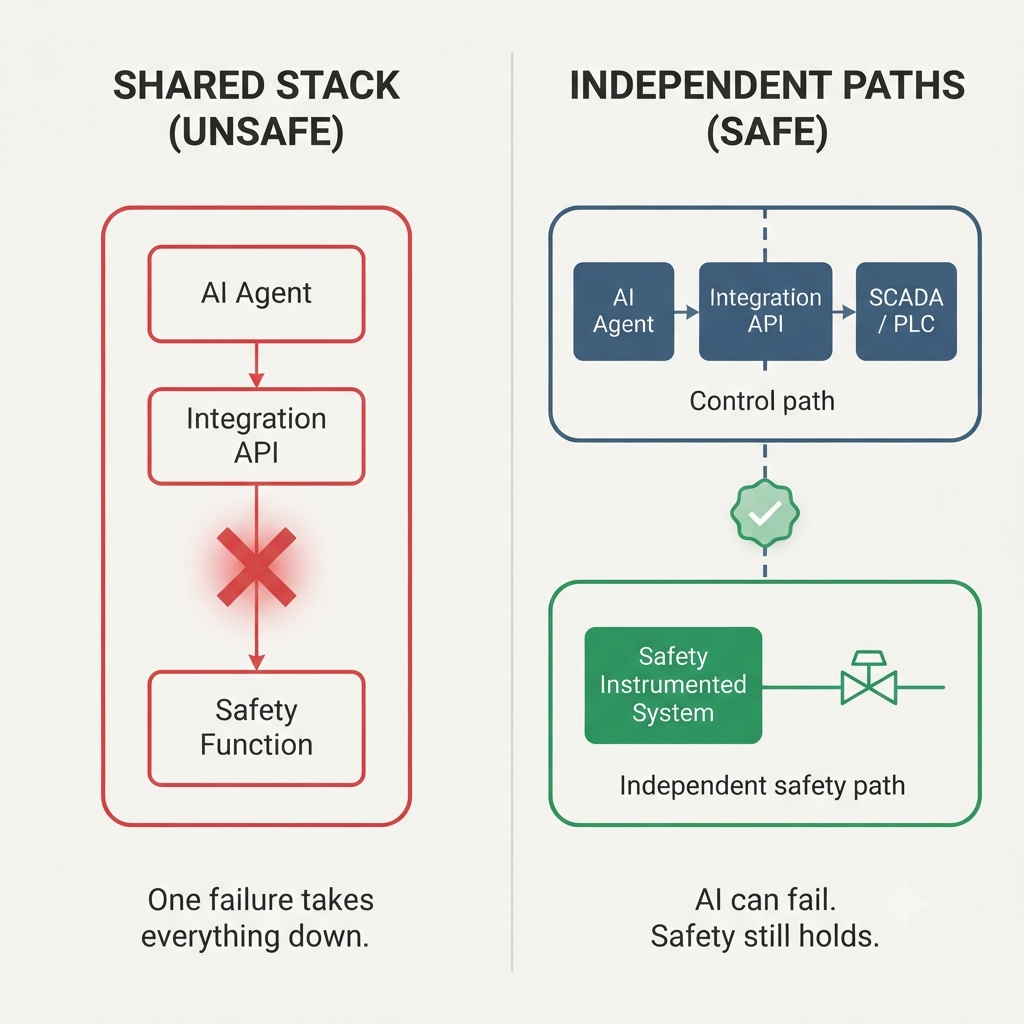
A common mistake is putting the AI agent, its integration layer, and the safety function in the same software stack. That creates a shared failure mode. If the model, the API, the network path, or the orchestration service goes down, the safety function can go down with it.
Safety instrumented systems exist to prevent exactly that coupling. IEC 61511 sets out requirements for specifying, designing, installing, operating, and maintaining them so they can be trusted to reach or hold a safe process state.
A well-built protection architecture keeps these pieces separate:
- Basic process control: The PLC or DCS keeps normal operation running.
- Alarms and operator response: People get alerted when conditions call for intervention.
- Safety instrumented system: Dedicated logic takes the process to a safe state when predetermined conditions are violated.
- Physical mitigation: Relief, containment, isolation, and similar measures limit the damage if prevention fails.
A safety function should be specific, independent, dependable, and auditable. It shouldn’t rely on an AI model being online, reading the context correctly, or making a good judgment call.
The last line of defense should be boring, deterministic, and independent.
Wastewater case study: chemical dosing
Back to our wastewater plant. The AI agent sees influent load climbing, treatment performance slipping, and a forecast of continued high flow. It proposes raising the coagulant dose to improve solids separation.
In a safe architecture, here’s how it plays out:
- The agent detects the abnormal conditions and drafts a dose adjustment.
- The orchestration layer checks the proposal against approved operating envelopes, chemical inventory, equipment status, and interlocks.
- SCADA shows the recommendation to an operator, or allows a bounded automatic adjustment within a tightly defined range.
- The PLC applies the change through its existing control loop, subject to rate limits and local safety logic.
- If downstream residuals, flow, pressure, or equipment health break a safety rule, the PLC or safety system steps in on its own.
- If the AI connection fails, the PLC goes back to its standard local control strategy instead of waiting for the agent to recover.
The AI improves the plan. It doesn’t own the physics.
That difference matters because the plant needs to keep running safely even when the AI is wrong, compromised, unavailable, or in the middle of an update.
Human authority: approval is a control feature
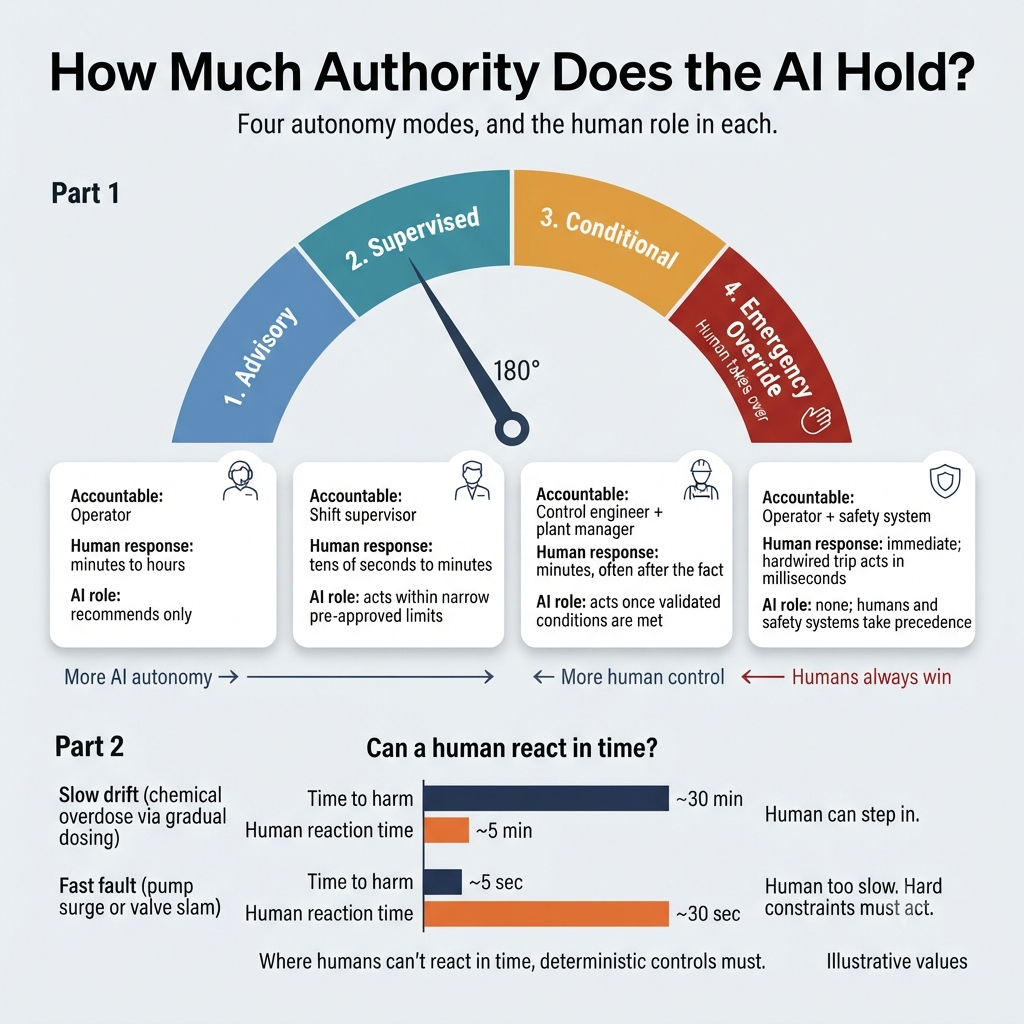
People often treat human approval as friction in autonomous systems. In high-consequence infrastructure, it’s a deliberate control boundary.
A mature deployment separates a few modes:
- Advisory mode: The AI recommends, and humans decide.
- Supervised autonomy: The AI acts only within narrow, pre-approved limits.
- Conditional autonomy: The AI acts automatically, but only once validated conditions are met.
- Emergency override: Humans and safety systems always take precedence, no exceptions.
“Human-in-the-loop” isn’t enough if a person can’t realistically step in on time. A stronger design is human-on-the-loop with hard physical constraints. People supervise, set policy, investigate anomalies, and keep override authority, while deterministic controls block dangerous actions no matter what the AI proposes.
Security, trust, and auditability
You can’t design safety boundaries and cybersecurity boundaries separately. An AI system with too much access to control infrastructure is both an operational risk and a security risk.
NIST guidance stresses layered network topologies for industrial control systems, with the most critical communications running in the most secure and reliable layer. Its OT security guidance also focuses on protecting the availability, integrity, and safety requirements that are specific to operational technology.
Practical steps include:
- Segmenting the network between IT, edge AI, SCADA, and control layers
- Giving AI services and integration gateways least-privilege access
- Using signed configurations and version-controlled control logic
- Applying role-based permissions to AI-initiated actions
- Tracking model provenance, validation, and rollback procedures
- Keeping tamper-evident logs of every command and approval
- Red-teaming for adversarial inputs, sensor spoofing, and command injection
You should be able to trace any AI recommendation from raw sensor data, to the proposed action, to the validation result, to the human decision, to the final physical outcome.
The real future: constrained autonomy
The future of industrial AI doesn’t belong to the system with the most direct control. It belongs to the one that knows exactly where its authority ends.
Hierarchical agent control lets AI do what it’s good at: watching complexity, spotting patterns, coordinating decisions, and suggesting better ways to run things. Meanwhile PLCs, SCADA systems, and safety instrumented systems do their job of enforcing physical reality.
The point isn’t to take humans or deterministic control out of infrastructure. It’s to get more operational intelligence without making the blast radius of a failure any bigger.
AI should generate intent. Deterministic control should grant permission. Safety systems should retain the final word.