

For years, AI has helped us decide what to buy. Now it’s starting to do the buying. When agents act for consumers and businesses, tokenization is what lets those delegated payments stay safe, controlled, and recognizable to everyone involved. The big payment networks are already laying this groundwork with agent-specific tokens, verified agent identity, user consent, authentication, and spend controls.
AI Is Becoming a Buyer
Picture asking an AI assistant to reorder your household essentials, find the cheapest decent flight within a budget, or handle your company’s recurring supply purchases. The agent compares options, checks the policies, picks a merchant, and pays. Often you never type a card number.
That changes payments at a basic level. Checkout was built for a person clicking “Pay.” Agentic commerce needs a system that can answer a harder question: which authorized agent is spending, on whose behalf, within what limits, and what proves the owner agreed to it?
Visa and Mastercard are answering by stretching infrastructure they already run (tokenization, authentication, risk controls, network-level trust) to cover agent-led transactions. Visa’s Intelligent Commerce Connect, for instance, bundles secure payment initiation, tokenization, spend controls, and authentication into one integration.
What Is Agentic Commerce?
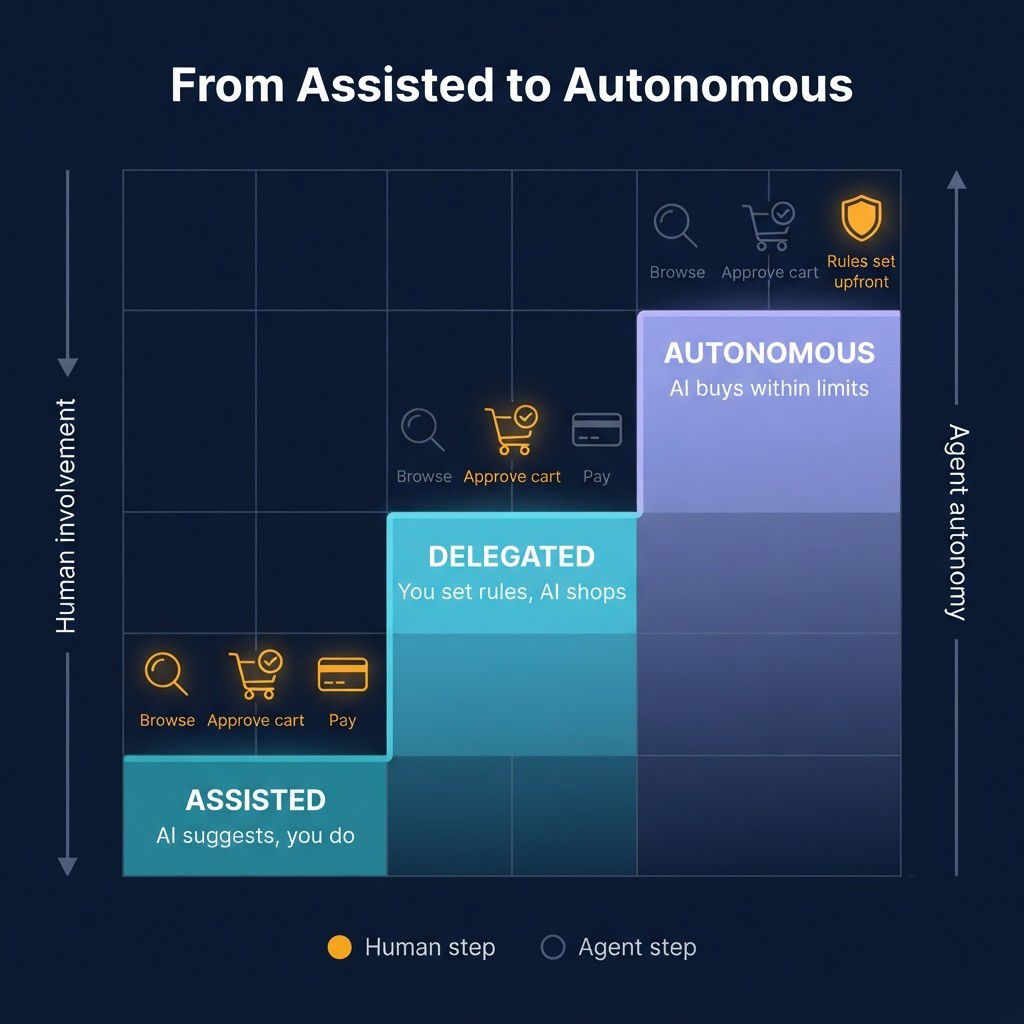
Agentic commerce means an AI agent handles commercial tasks for a person or an organization. That could be searching, comparing, negotiating, buying, managing subscriptions, or paying invoices.
It’s not the same as AI-assisted shopping. In assisted shopping, you still look over the options and complete checkout yourself. In agent-initiated commerce, the agent may carry out part or all of the transaction using permissions you gave it.
Think of a shopping agent that restocks groceries inside a monthly budget, a travel agent that books a refundable hotel only after checking your preferences, a subscription manager that cancels services you don’t use, a procurement agent that orders approved supplies from preferred vendors, or a finance agent that pays invoices according to company approval rules.
What matters isn’t whether AI touches the purchase journey. It’s whether the agent can start or finish a payment. Once it can, you need new answers for identity, consent, authorization, fraud prevention, and disputes, and standard e-commerce checkout was never designed to supply them.
What Is AI Tokenization?
Ordinary tokenization swaps a sensitive payment credential, like a card’s primary account number, for a stand-in token. The merchant can process the payment without ever storing or seeing the real number.
Agentic tokenization takes that further. The token is tied not just to your payment method but to the specific agent, what that agent is allowed to do, the context of the transaction, and your authorization.
Mastercard calls its version Agentic Tokens. They’re issued to registered, verified AI agents and work like a digital licence to spend, standing in for the card number while carrying agent-specific controls and authentication.
Here’s the flow in simple terms. You, or your business, authorize an agent and link a payment method. The credential gets tokenized. The agent uses a scoped token instead of raw card details. The merchant, issuer, and network can all see that an authorized agent started the transaction. And the payment is governed by limits, merchant restrictions, category rules, expiry dates, and approval requirements.
So the agent never gets a full copy of your financial identity. It gets a narrow, traceable permission to act.
Why Tokenization Matters
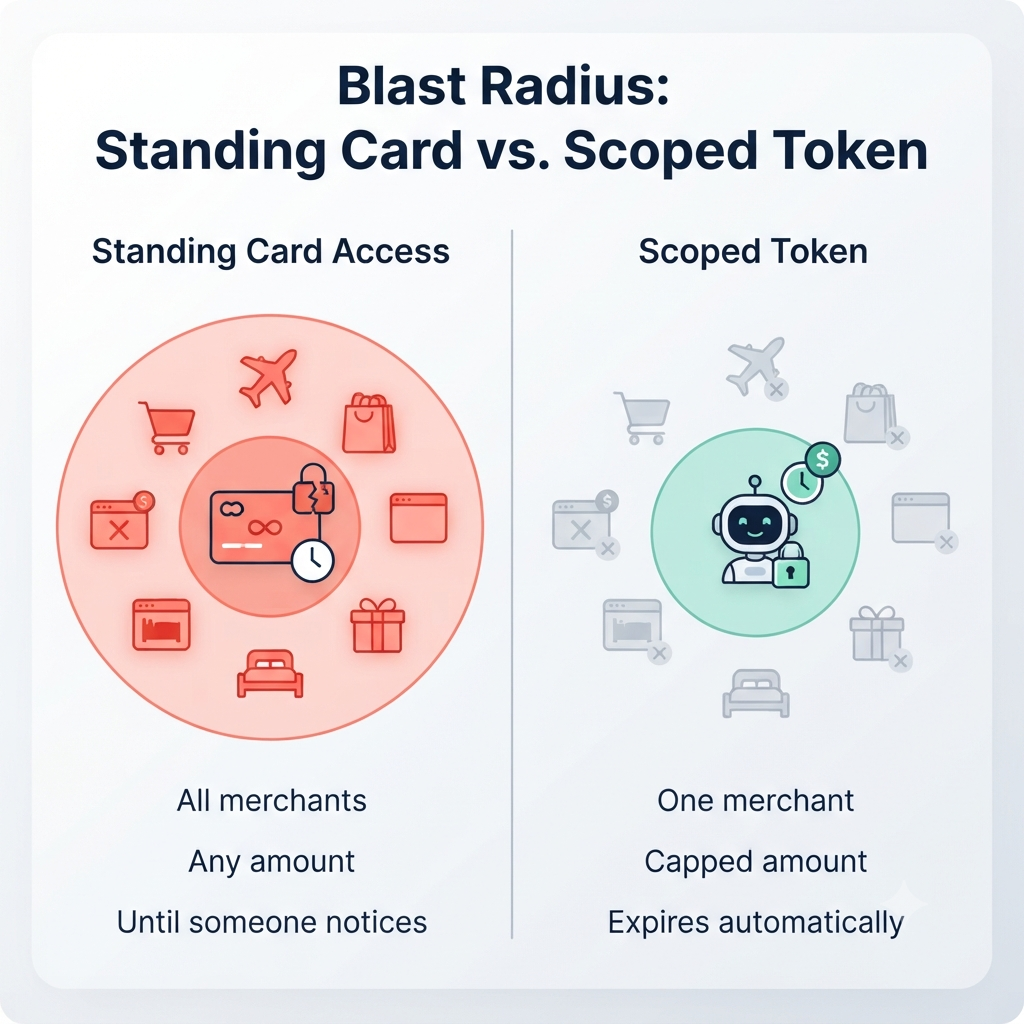
Tokenization solves a handful of problems that get urgent the moment agents can transact on their own.
| Agentic-commerce challenge | What tokenization enables |
|---|---|
| Agents may initiate payments without a human present | A tokenized credential can be used under defined permissions rather than exposing raw card data. |
| Consumers need proof of what they authorized | Tokenization can be paired with consent, intent verification, authentication, and transaction records. |
| Merchants need to distinguish legitimate agents from bots or fraudsters | Agent identity, network tokens, and risk signals make agent-led transactions recognizable and governable. |
| Issuers need stronger fraud and spend controls | Tokens can support limits, authentication, and controls tailored to agent-initiated activity. |
| Businesses need auditability | Tokenized transactions can create clearer records of who initiated the payment, under what authorization, and within what scope. |
The biggest payoff is least-privilege payments. Rather than handing an agent standing access to a card, you give it something small and revocable: spend up to this amount, at these merchants, for this purpose, during this window.
Enterprise security teams are moving the same way, giving agents short-lived, task-scoped identities instead of a developer’s broad standing privileges.
The New Trust Stack
Tokenization is necessary, but it can’t carry the whole load. A trustworthy agentic payment system stacks several layers on top of each other.
Tokenized credentials replace exposed payment details with network or merchant tokens. Agent identity verifies the agent and separates it from an unknown bot. Consent and intent capture what the person or business actually authorized. Authentication confirms the human behind it, using passkeys or biometrics when it makes sense. Spend controls set transaction limits, merchant restrictions, category rules, and approval thresholds. Risk and fraud signals weigh behavior, device, merchant, and agent-level risk. And auditability preserves the evidence of authorization, agent actions, and context, which is what you’ll need when something goes wrong.
Mastercard frames this as a five-part trust framework: identity, intent, controls, trusted execution, and intelligence. The aim is to verify the agent, prove what the user approved, secure the transaction, catch fraud, and support dispute resolution.
If you want one line to remember: tokenization protects the credential, agent identity proves who is acting, consent proves what was authorized, and controls limit what can happen.
How the Ecosystem Changes
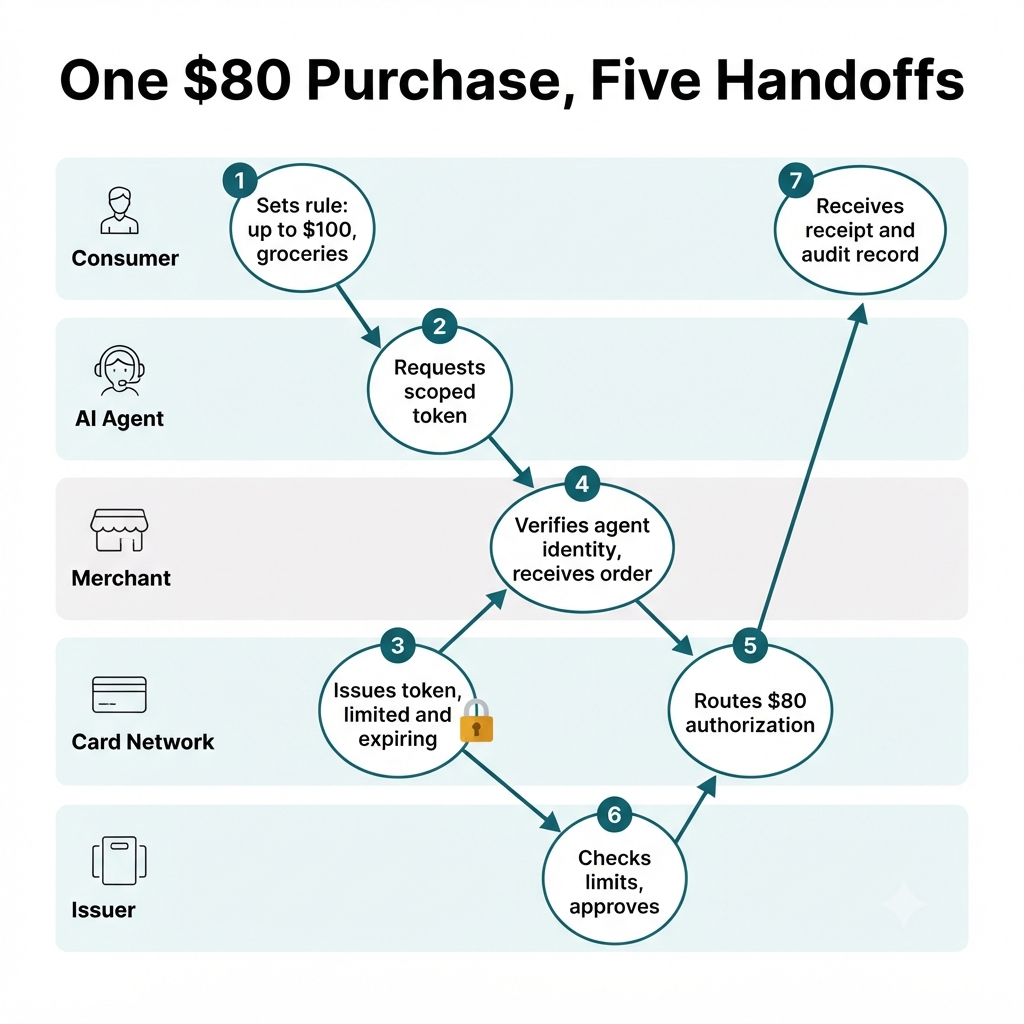
No single company will build this alone. It takes coordinated change across consumers, merchants, banks, AI platforms, and payment networks.
Consumers and businesses
People will need clearer ways to delegate buying power. Instead of just saving a card, they might set rules like these: allow grocery purchases up to $150 a week, allow hotel bookings only at preferred chains, require approval above $500, allow software renewals but block new subscriptions, and cut off the agent’s access the moment a trip or project ends. Controls like these turn agents from opaque middlemen into governed payment actors.
Merchants
Merchants will have to recognize agent traffic, offer agent-friendly checkout, and publish product, pricing, availability, return, and policy details in machine-readable form. They’ll also have to handle new fraud, chargeback, and dispute questions as agents become a real source of orders.
Banks and issuers
Issuers will shift from card-level controls to agent-level controls. That means verifying agent identity, managing token lifecycles, judging authorization scope, and making real-time risk calls based on how the agent behaves and what the transaction looks like.
AI platforms and agent builders
Agent providers need to integrate payment APIs responsibly, get explicit consent, keep a record of where actions came from, and avoid becoming an unmonitored layer sitting between consumers and merchants. It won’t be enough to show that an agent can pay. They’ll have to show it’s authorized to.
Payment networks and processors
Networks and processors will extend existing rails with agentic tokens, agent identity, authentication, risk signals, and standards for agent-led transactions. Visa positions Intelligent Commerce Connect as an orchestration layer for agent-initiated payments, pulling together tokenization, authentication, payment initiation, spend controls, and PCI compliance management.
What Changes at Checkout
Checkout probably won’t vanish. It’ll just become less visible.
Conversational commerce will replace many checkout pages, since an agent may finish most of the journey before a traditional checkout screen ever appears. Card-on-file will give way to agent-on-file, where you authorize an agent to use a tokenized credential inside set boundaries. One-time approval will turn into policy-based approval, with standing rules like automatic yes for small purchases and a manual check for travel or big-ticket items. And trust will move from being merchant-centric to spanning the whole ecosystem: consumer, agent, merchant, issuer, network, and payment provider.
Mastercard’s Verifiable Intent approach aims to create an auditable record tying an agent’s action back to explicit consumer authorization. That matters because “buy this for me” is rarely precise enough for an autonomous system to act on safely.
Risks and Open Questions
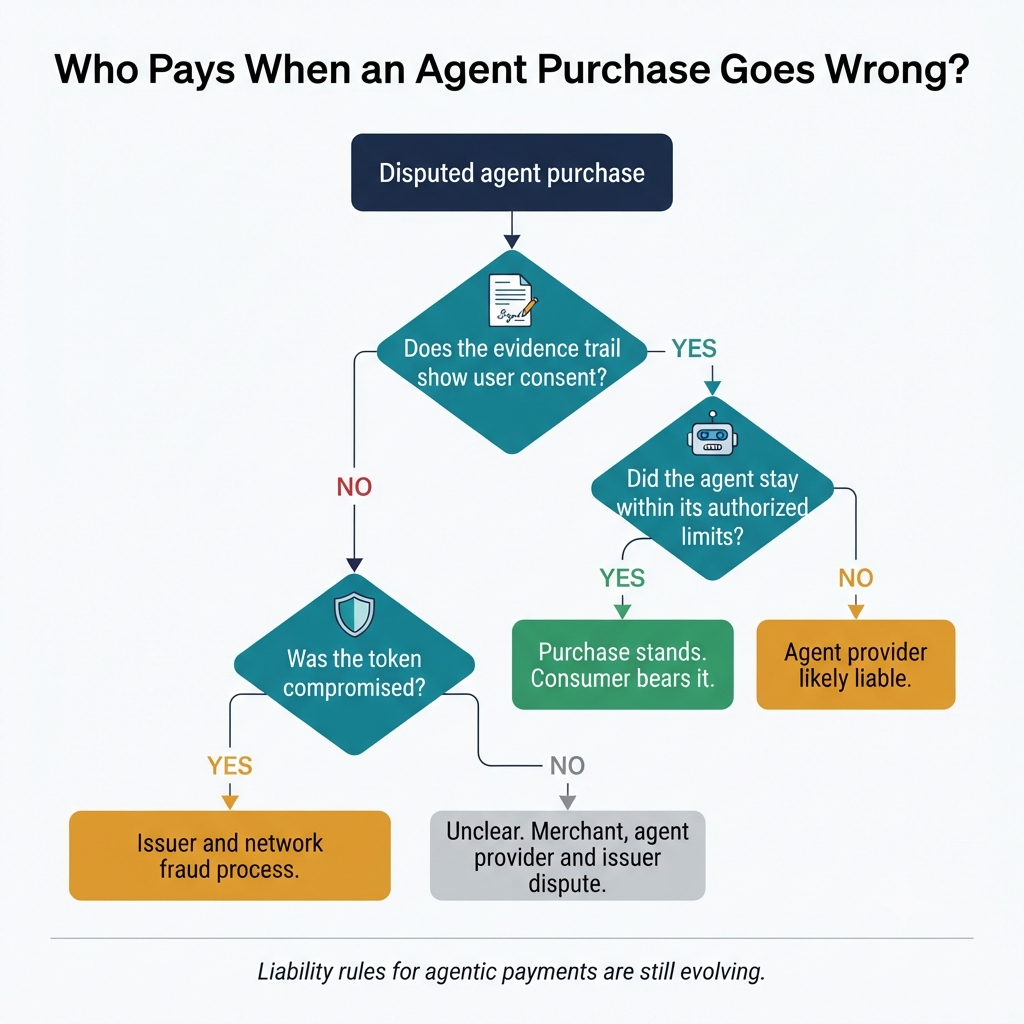
None of this comes free of risk.
Prompt injection is one. A malicious instruction hidden in a webpage, email, or product listing could push an agent into a purchase nobody intended. Consent can also be fuzzy: “handle my shopping” says nothing about which merchants, how much, how often, or which categories. Fraud will likely shift too, away from stolen card numbers and toward compromised agent accounts, impersonated agents, or manipulated purchase intent.
Liability is another open question. If an agent makes a mistaken or unauthorized purchase, the consumer, the agent provider, the merchant, the issuer, and the network could all end up pointing at each other. Banks already know how tangled that can get, and AI agents are starting to take over parts of bank dispute resolution so customers don’t have to repeat their story to every team. Merchants may lose sight of why an agent chose a product or how it weighed the alternatives. And new costs will probably appear for agent identity, tokenization, orchestration, trust verification, and agent-specific processing.
Because of all this, governance has to be a product requirement from the start, not a compliance patch added later. Every agentic payment experience should have clear authorization boundaries, transaction evidence, a path to a human when needed, and an easy way to revoke access.
What the Future Looks Like
Near term
In the near term, expect agent-assisted checkout with tokenized credentials, stronger authentication, and consumer-defined spend controls. Early adoption should come in areas with clear rules and repeat purchases: travel, subscriptions, replenishment, and B2B procurement. Merchants who get their catalogs, policies, and checkout flows ready for agents will be better placed in this new channel.
Longer term
Further out, agents may negotiate terms, maintain lists of preferred merchants, run conditional payments, and manage complicated procurement workflows. Mastercard has described a longer-term idea of verifiable “promise-to-pay” artifacts, which would commit an agent to a future or conditional payment with auditable proof.
B2B may turn out to be the biggest opportunity. Procurement agents could work within approval hierarchies, vendor policies, budget limits, and reconciliation requirements, which are exactly the areas where auditability and control matter as much as convenience.
Practical Takeaways
For merchants: make product, pricing, availability, returns, and policy information machine-readable, and get ready to identify and serve trusted agents.
For banks and issuers: build risk models that understand agents, strengthen token controls, and treat agent identity as a new fraud and authorization signal.
For AI product teams: build consent, limits, audit trails, and revocation into the agent experience from day one.
For payment providers: position tokenization as the bridge between today’s payment infrastructure and autonomous commerce.
For consumers: expect finer-grained permissions. Instead of just “save card,” you’ll be asked to allow this agent to spend up to this amount, at these merchants, for this purpose.
The future of agentic commerce depends less on whether AI can make a payment and more on whether everyone involved can trust who started it, what it was allowed to do, and how it can be controlled or reversed.
Tokenization is likely to become a foundation of that trust, working alongside agent identity, consent, authentication, spend controls, and auditable transaction records. The winners in agentic commerce won’t just be the companies that let AI pay. They’ll be the ones that make AI-powered payments safe, accountable, and trustworthy at scale.