

AI agents can handle money safely, but only when four things are in place: a verifiable identity, tightly scoped permissions, payment limits enforced by the system, and a full audit trail. It’s not enough for a language model to simply decide a payment is a good idea. The emerging approach splits the agent’s decision from the payment system’s execution, and uses cryptographic mandates to prove what a human actually authorized.
When AI Can Act, Not Just Advise
An AI agent is software that can take a goal, plan the steps, use tools, and finish multi-step tasks without much hand-holding. In finance, that’s a big deal. An agent could compare suppliers, check an invoice, send the payment, reconcile it, and let the finance team know when it’s done.
But payments aren’t like other digital tasks. They’re often irreversible, heavily regulated, and a magnet for fraud. One bad call by an agent can move real money, leak sensitive data, or start a messy argument over who’s liable.
So here’s the premise this whole post rests on: an agent shouldn’t be trusted with money just because it’s smart. It has to be authorized, limited, watched, and auditable. Most payment systems already require that a payment trace back to an instruction from the account holder or someone legally acting for them. Agents don’t get a free pass on that.
What “Autonomous” Really Means in Payments
Autonomous doesn’t mean an AI gets the keys to the company bank account. In practice, the amount of freedom an agent gets should depend on the risk, the value, how often the transaction repeats, and how much trust has been built.
| Level | How it works | Example |
|---|---|---|
| Assisted | The AI recommends a transaction, but a human approves it | An agent drafts a supplier payment and the finance manager clicks “approve” |
| Semi-autonomous | The agent initiates payment within pre-approved rules; humans approve exceptions | It pays recurring invoices below a set threshold but escalates a new vendor |
| Autonomous | The agent executes eligible transactions independently, within a signed mandate and hard controls | It pays a verified, recurring supplier invoice below an approved limit |
Picture an accounts-payable agent. A $1,200 invoice arrives from a long-standing supplier. The vendor, amount, invoice number, and payment terms all match what’s been approved, so the agent pays it. Now say a $75,000 invoice shows up from a vendor it’s never seen, or someone asks to change the beneficiary’s bank account. The agent should stop right there and ask a person.
That’s how you keep the efficiency without turning every payment into an unsupervised AI judgment call.
The Trust Gap: Why Login Security Is Not Enough
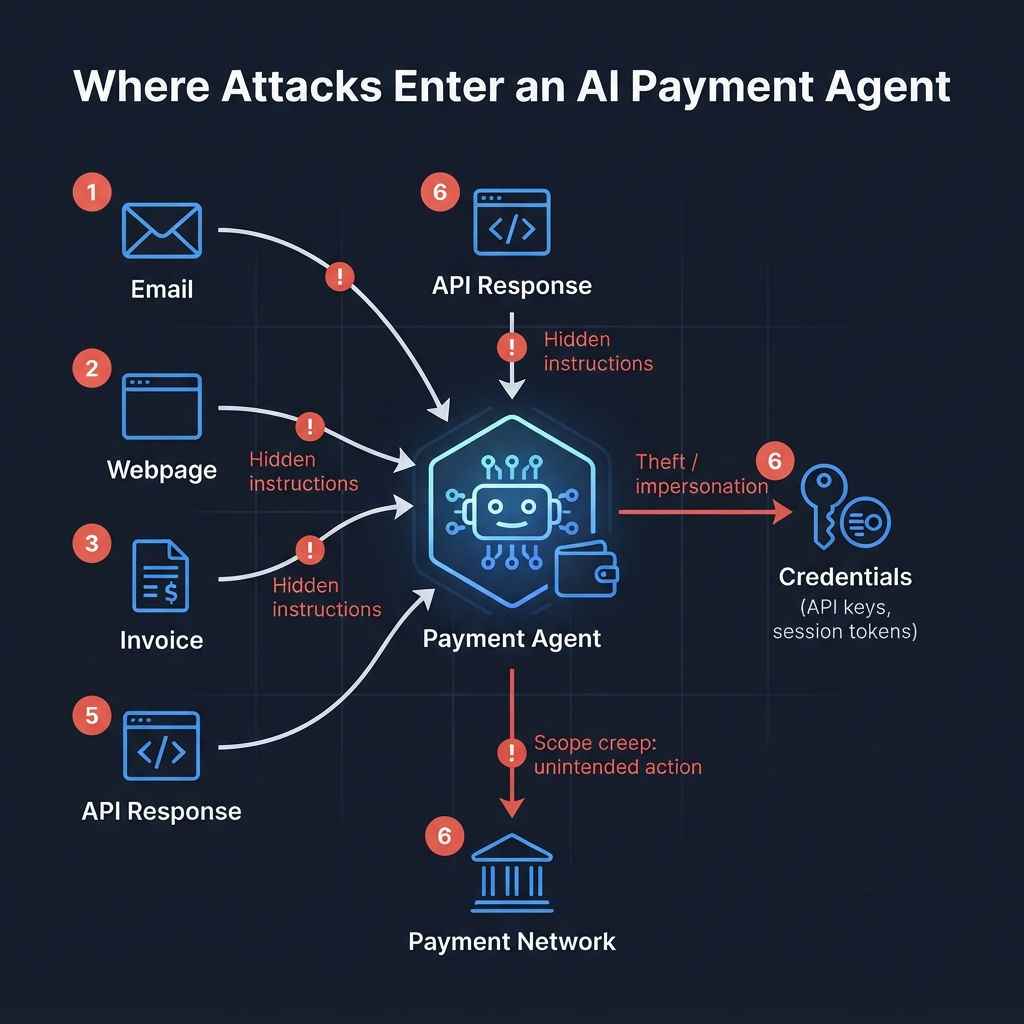
Traditional payment security asks one question: did the right person log in? With agents, the question gets sharper. Did the right agent, acting for the right principal, have permission to make this exact transaction?
The difference matters because an agent is a new player sitting between the user and the payment network. It may hold credentials, browse merchant sites, read instructions, call APIs, and kick off payments. If it gets compromised, tricked, or left too loosely constrained, normal account security might not stop a bad transaction.
Here are the main risks:
- Prompt injection: A malicious webpage, email, invoice, or API response tries to steer the agent into doing something it shouldn’t.
- Credential compromise: Stolen API keys, session tokens, or agent credentials let an attacker pose as the agent.
- Agent impersonation: A fake system pretends to be a trusted agent to get payment approved.
- Scope creep: An agent set up to pay utility bills starts trying to move funds, change beneficiaries, or buy things it was never meant to.
- Fake merchants and invoices: A convincing but fraudulent request slips past the agent.
- Opaque decisions: If the agent can’t explain why it made a payment, investigations and compliance reviews turn painful.
- Unclear liability: When something goes wrong, is it the user, the agent’s developer, the merchant, the bank, or the card network who eats the loss?
The answer isn’t to ban agents from transacting. It’s to make what they’re allowed to do explicit, verifiable, and enforceable.
The Core Security Architecture
Secure agentic payments need several layers working together. No single control, whether a password, an API key, or a line in a prompt, can carry the load alone.
| Layer | Purpose | Examples |
|---|---|---|
| Agent identity | Prove which agent is acting | Cryptographic agent credentials, workload identity, verified agent registration |
| Principal binding | Link the agent to the person or business it represents | Delegated authority, customer identity verification |
| Mandate | Define exactly what the agent may do | Scope, merchant, amount, currency, frequency, expiry, and conditions |
| Policy enforcement | Stop unauthorized actions before execution | Independent policy engine, spending caps, allowlists, velocity limits |
| Transaction verification | Validate payment details | Merchant verification, invoice validation, amount and beneficiary checks |
| Continuous monitoring | Detect abuse and anomalies | Behavioral analytics, fraud scoring, anomaly detection |
| Auditability | Enable investigation and accountability | Immutable logs, signed events, traceable approvals |
The IMF frames agentic payments around intent, authorization, and settlement, and stresses traceability, explainability, and cybersecurity. One of its sharpest points is the need to reconcile an AI’s probabilistic behavior with the strict, deterministic rules that authorization requires.
Visa takes a similar view. It describes agent-initiated payments as needing agent verification, tokenization, authentication, spending controls, and fraud monitoring, with tokens tied to the agent, the party it represents, and the conditions it’s allowed to transact under.
Verifiable Mandates: The Agent’s Permission Slip
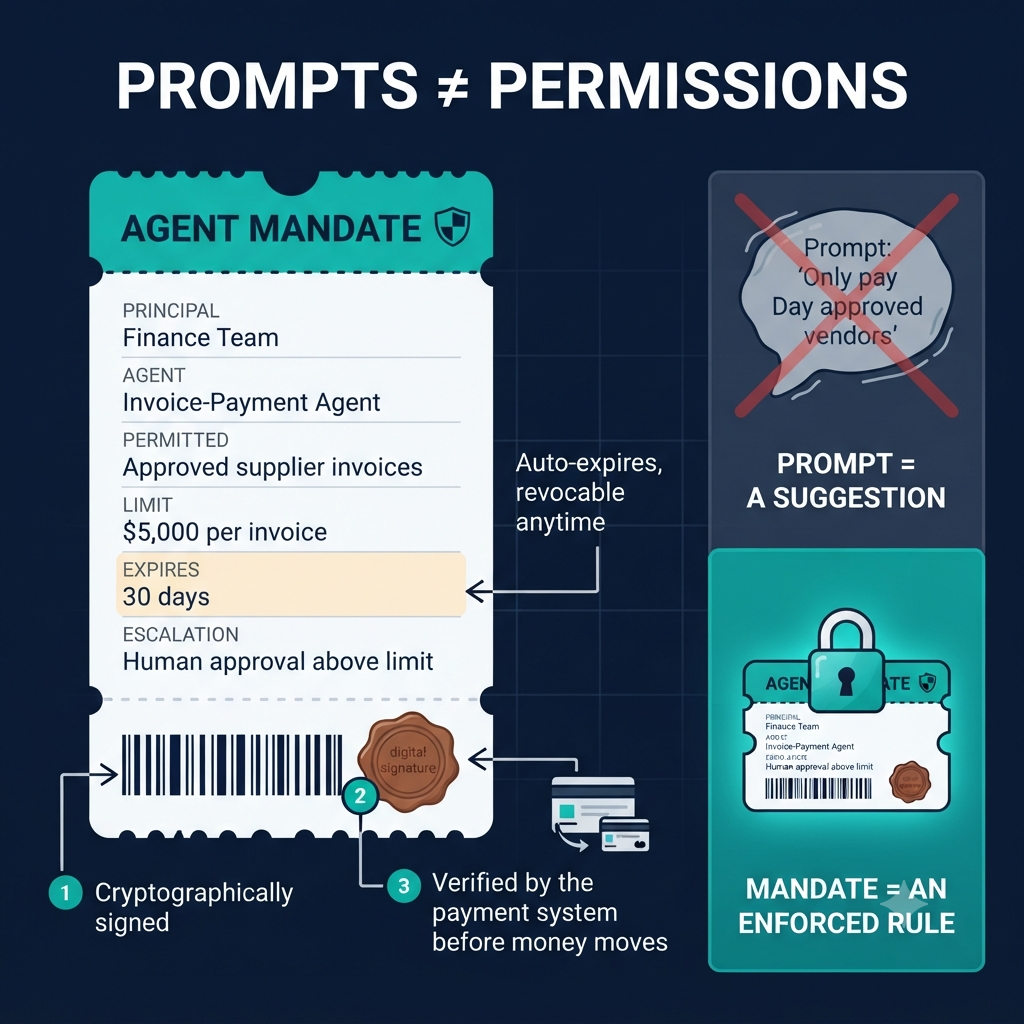
A mandate is a cryptographically verifiable record of what a person or business has authorized an agent to do. Think of it as the agent’s permission slip, except it’s enforced by the payment infrastructure rather than just written into a prompt.
A solid mandate spells out:
- Principal: who the agent is acting for
- Agent: which verified agent may act
- Permission: what kind of transaction is allowed
- Merchant or beneficiary: where money may go
- Limits: the maximum per transaction and per period
- Currency and geography: which currencies and jurisdictions are allowed
- Frequency: how often the agent can transact
- Expiry: when the mandate ends
- Conditions: when a human must approve or extra verification kicks in
Here’s what one might look like for a finance team:
- Principal: Finance team at Company X
- Agent: Invoice-payment agent
- Permission: Pay approved supplier invoices
- Limits: Maximum $5,000 per invoice; $20,000 per day
- Restrictions: Approved vendors only; no new beneficiaries; no cross-border payments
- Expiry: 30 days
- Escalation: Human approval required above $5,000 or for a new vendor
The key idea is that prompts are not permissions. A prompt can nudge an agent’s behavior, but it can’t guarantee anything. The wallet, bank, card network, or payment provider has to check and enforce the mandate before a single dollar moves.
Authentication and Authorization for Agents
Agents need a new kind of identity check, often called Know Your Agent, or KYA. Banks already verify their customers. In the same way, the payment ecosystem needs to verify the agent itself, who it works for, where its software came from, and what it’s permitted to do.
Strong authentication still matters too. Passkeys, biometrics, and step-up checks can tie a human’s approval to the specifics of a transaction, like the merchant, the amount, and the payment method. Visa describes Payment Passkeys as a way to authenticate the consumer when an agent-bound token is created and when formal payment instructions need confirming.
Tokenization is another foundation. Rather than handing an agent a raw card number or bank login, the payment system issues a token tied to a specific agent, merchant context, and use case. Visa says its agent tokens are locked by default and only unlocked for an authorized purpose, backed by passkeys and real-time fraud monitoring.
A few new protocols and standards are starting to formalize all this:
- AP2 (Agentic Payment Protocol): coordinates agents, merchants, wallets, and payment providers around verifiable user authorization.
- Verifiable Intent: binds transaction details and payment intent into signed evidence.
- x402: lets payment requirements live inside ordinary HTTP requests.
- MCP and A2A: help agents reach tools and work across different vendors.
Execution Flow: From Request to Settlement
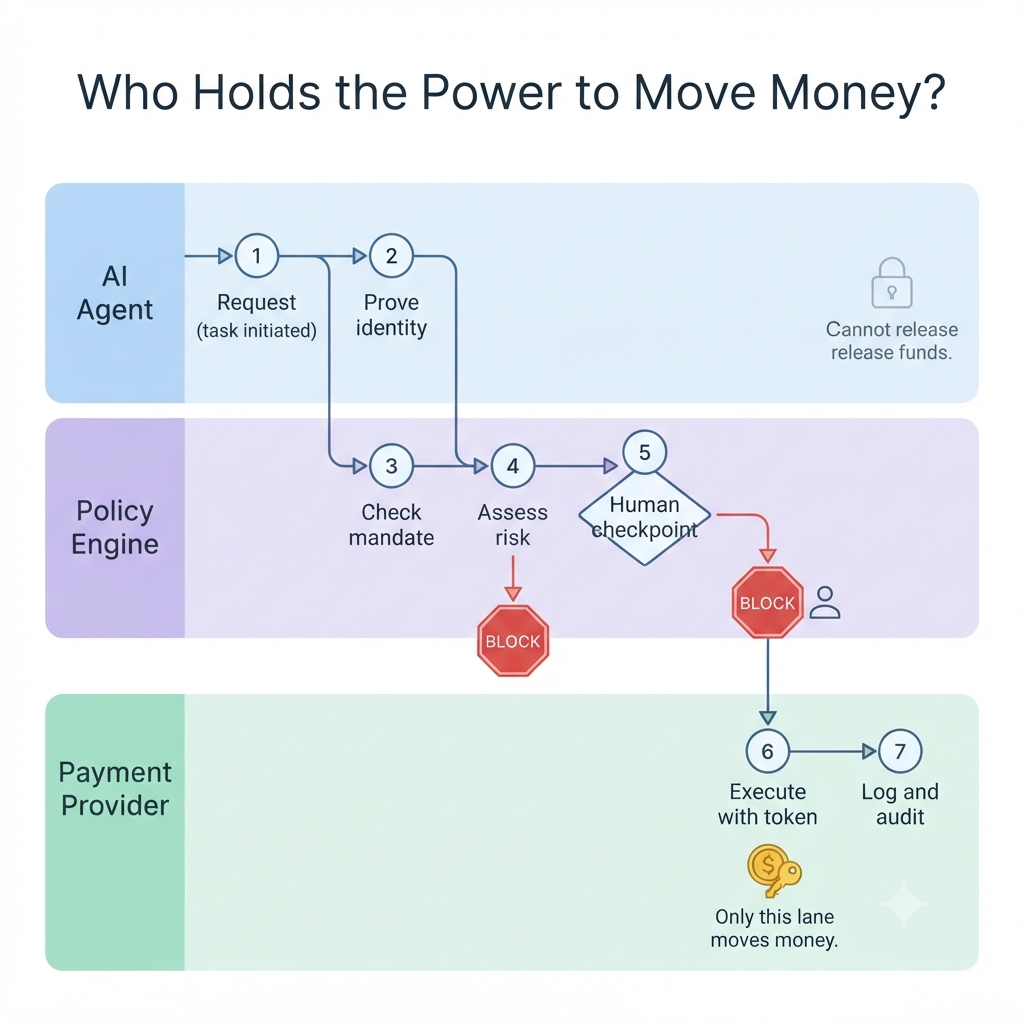
A secure transaction should follow a controlled path. The agent shouldn’t be the one moving the money directly.
- Task initiation: A user or business system asks the agent to do something financial, like paying an approved supplier invoice.
- Identity check: The agent proves who it is and that it has authority to act for the principal.
- Mandate validation: A policy engine checks the proposed action against the signed mandate, covering amount, merchant, frequency, expiry, and restrictions.
- Risk assessment: The system looks at merchant reputation, transaction patterns, amount, destination, device signals, and fraud indicators.
- Human checkpoint: Depending on policy and risk, the payment goes through automatically, waits for confirmation, or gets blocked.
- Secure execution: The payment provider carries out the transaction using tokenized credentials and its own institutional controls.
- Receipt and audit: Everything gets logged: the mandate, the decision, the transaction details, approvals, policy checks, and the outcome, all in a tamper-resistant trail.
This design leaves the agent in charge of orchestration and decision support, while the payment provider retains control over whether money actually moves.
Human-in-the-Loop: Autonomy With Accountability
Autonomy works best in tiers, not as an all-or-nothing switch. Low-risk, repetitive, pre-approved payments can run on their own. High-value, unusual, first-time, or cross-border transactions deserve a human look.
Good systems also plan for when things go wrong. That means clear escalation paths, the ability to revoke an agent’s access quickly, and a kill switch that stops activity immediately. Regulators and payment leaders keep returning to the same three worries: authentication, liability, and fraud. Whoever solves those will shape how agentic commerce develops.
Real-World Signals
This isn’t purely theoretical anymore. A few early examples:
- J.P. Morgan and Hyundai Card ran a proof of concept showing signed mandates, verified identity, institutional controls, and auditability for agent-to-agent commerce.
- Visa, Bill, and Billtrust ran a live pilot where authenticated agents completed buyer-approved business invoice payments across buyer and supplier systems.
- Mastercard demonstrated an authenticated agentic transaction using tokenization and authentication.
Taken together, these suggest secure agentic payments are moving out of the idea stage and into controlled pilots. Governance and interoperability, though, are still works in progress.
Risks That Still Need Answers
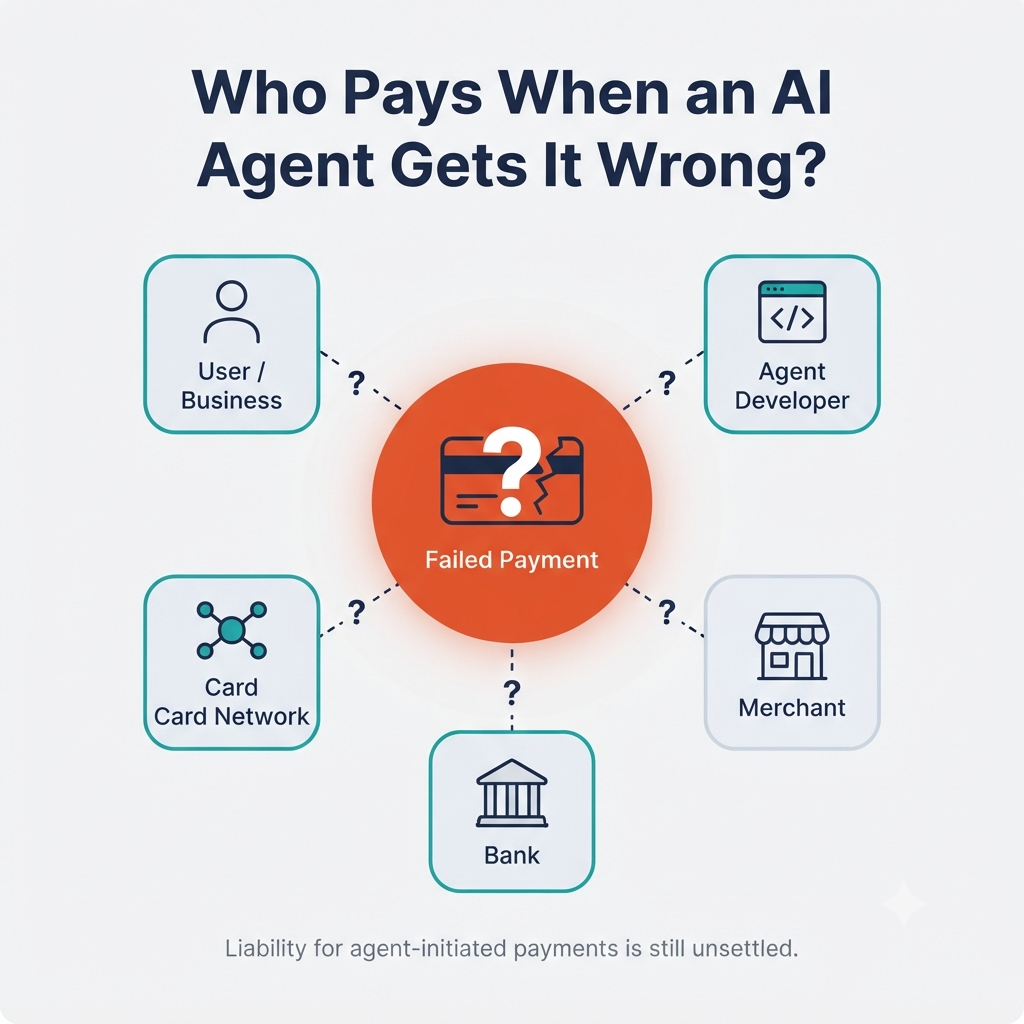
Plenty of hard questions remain open:
- Liability: If an authorized agent makes a mistaken or fraudulent payment, who covers the loss? The user, the developer, the merchant, the bank, or the network?
- Fraud: Agents can be targeted through prompt injection, malicious merchants, fake invoices, or compromised integrations.
- Correlated behavior: If lots of agents run on similar models or rules, they might all react the same way at once, amplifying risk across markets or payment systems.
- Privacy: Agents may need access to sensitive financial data, which makes data minimization and purpose limits essential.
- Regulatory uncertainty: Existing rules on payments, consumer protection, fraud, and data may need updating for transactions an agent starts.
A Practical Deployment Checklist
If you’re building or adopting agentic payments, start here:
- Give the agent its own dedicated identity. Never share a human’s raw credentials with it.
- Issue short-lived, revocable mandates tied to a single purpose.
- Enforce hard limits in the payment platform, not just in the agent’s prompt.
- Keep approved lists of merchants and beneficiaries.
- Require step-up authentication for high-risk transactions.
- Log every decision, approval, policy check, and payment event.
- Watch for unusual behavior, and make revoking access fast.
- Keep the AI decision layer separate from the payment-execution layer.
Secure Autonomy Is Designed, Not Assumed
The future of agentic finance depends less on making agents more capable and more on making their authority precise, verifiable, revocable, and auditable. Capability is the easy part. Trust is the hard part.
The winning model won’t be “AI agents with access to money.” It’ll be AI agents working inside a trust framework that can prove exactly what they were allowed to do.