

AI agents rarely need to break through a firewall. They just log in.
They work with approved credentials, authorized API tokens and legitimate cloud permissions. With those, they read data, call tools, update records and kick off business workflows. This is why the traditional network perimeter is a weak defense here: the “attacker” may already be inside, holding valid access.
For CISOs, the urgent shift isn’t another firewall rule or endpoint control. It’s machine identity governance, which means treating every autonomous AI agent as a first-class internal identity. That identity needs a named owner, narrowly scoped authority, time-limited credentials and a complete trail of its actions. NIST takes the same view: agents are entities with their own identifiers, credentials, entitlements and lifecycles, not users borrowing human access.
The New Attack Surface Is Already Inside
Traditional security assumes a boundary. Untrusted traffic stays out, while trusted users, applications and systems operate within. Firewalls, VPNs and network segmentation were all built around that idea.
AI agents blur it, because they act on behalf of people and systems. A support agent may work in a CRM. A finance agent may query an ERP. A developer agent may touch source control, CI/CD pipelines and cloud consoles. Most of this happens through authorized APIs, so there’s no suspicious network traffic to catch.
So a compromised, misconfigured or over-permissioned agent doesn’t have to defeat your perimeter. It simply uses the credentials it was handed.
| Traditional assumption | Agentic-AI reality |
|---|---|
| Threats originate outside the network | Agents operate within approved workflows |
| Identity belongs to a person | Agents act with delegated human or service authority |
| Access is relatively static | Agents need task-specific, time-bound permissions |
| Firewalls inspect network traffic | Agents act through authorized APIs and tools |
| Logs identify a user | Logs must identify the agent, delegation, tool, and action |
The question shifts from “Can this traffic enter the network?” to “Should this agent be allowed to perform this action, with this data, at this moment, under whose authority?”
What Machine Identity Governance Actually Means
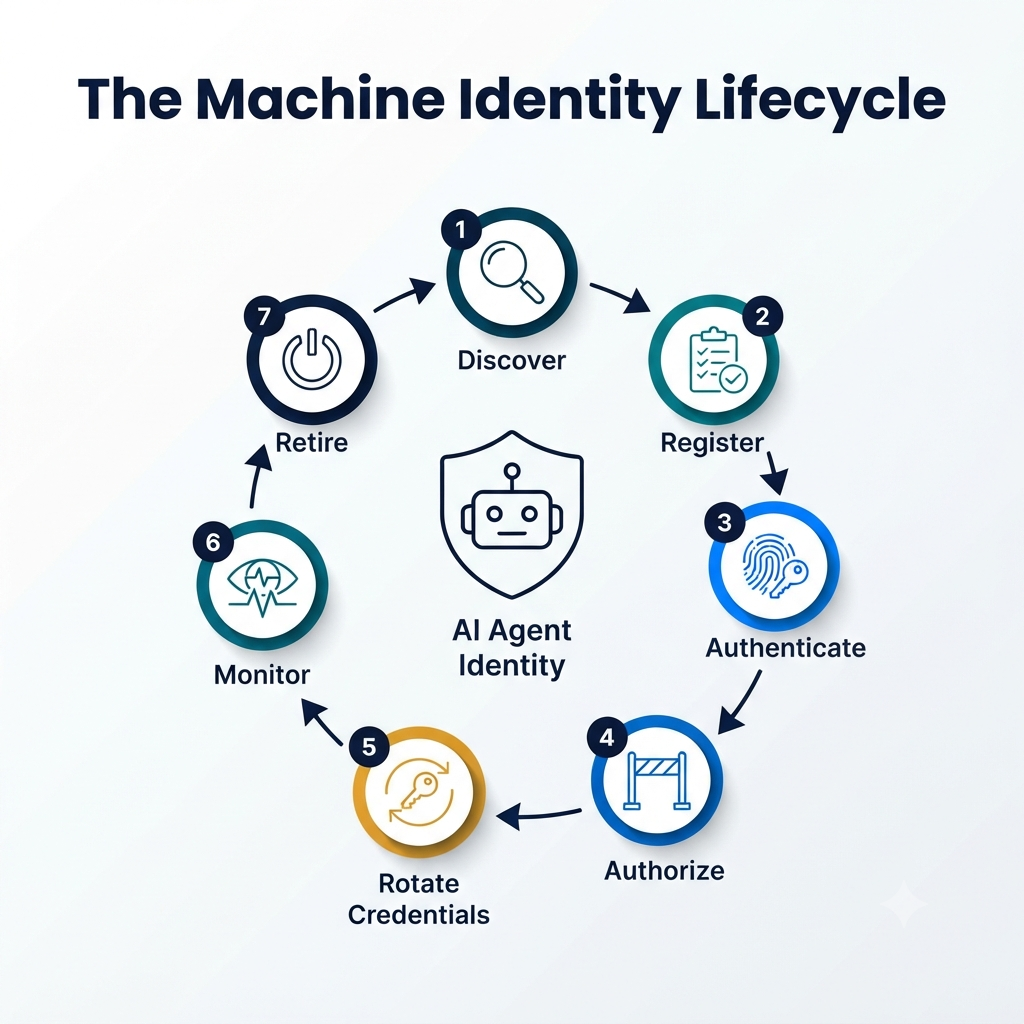
Machine identity governance covers the full life of a non-human actor: finding it, registering it, authenticating it, authorizing its actions, managing its credentials, watching its behavior and retiring it safely.
An AI agent isn’t just another service account. A service account usually has broad, static permissions and knows little about who asked for an action or why. An agent needs more, because it can interpret instructions, chain tools together and take consequential actions with limited human oversight.
Every production agent should be able to answer five questions:
- Who owns it? A named business owner and security owner should be accountable for its behavior.
- What is it authorized to do? Its purpose, permitted actions and prohibited actions need to be spelled out.
- Whose authority does it carry? Whoever delegated the task, whether a person, workflow or system, should be recorded.
- What can it access, and for how long? Data, APIs, tools and permissions should be narrow and short-lived.
- How is every action attributed? Logs should tie together the agent, the delegated identity, the tool, the input, the decision and the outcome.
That’s more than access management. It’s an operating model for autonomous software.
From Network Perimeter to Policy Perimeter
The new perimeter isn’t a firewall, a VPN or the corporate network. It’s the authorization decision made right before an agent calls a tool or touches data.
A resilient agentic architecture needs several layers working together:
- Agent registry. Keep an inventory of every agent, with its owner, business purpose, model or version, integrations, risk tier and deployment environment.
- Dedicated agent identity. Give each agent its own cryptographic identity. Don’t let it reuse a human login or a widely shared service account.
- Delegation layer. Tie each action to the person, workflow, tenant and business context that authorized it.
- Policy enforcement gateway. Check the agent’s identity, the destination tool, the requested operation and the context before issuing a narrowly scoped token.
- Least-privilege tool binding. Grant only the exact API scopes, data slices and actions a defined task requires.
- Runtime monitoring. Watch for unusual tool calls, abnormal data access, privilege escalation and drift from the intended workflow.
- Lifecycle automation. Rotate credentials, revoke access when ownership or roles change, and decommission agents nobody uses.
The core principle: agents shouldn’t carry reusable, broad credentials. A policy layer should validate the agent and then issue a short-lived token for the specific operation requested.
The big cloud providers are heading this way. Google Cloud’s Agent Identity gives each agent its own dedicated principal, brokers user-delegated OAuth tokens, and records both the agent and the delegating user in audit logs. Microsoft frames least privilege as a design requirement too: agent identity, scope, tool access and auditability should be settled before autonomy expands.
Least Privilege Is Not Enough Without Task Binding
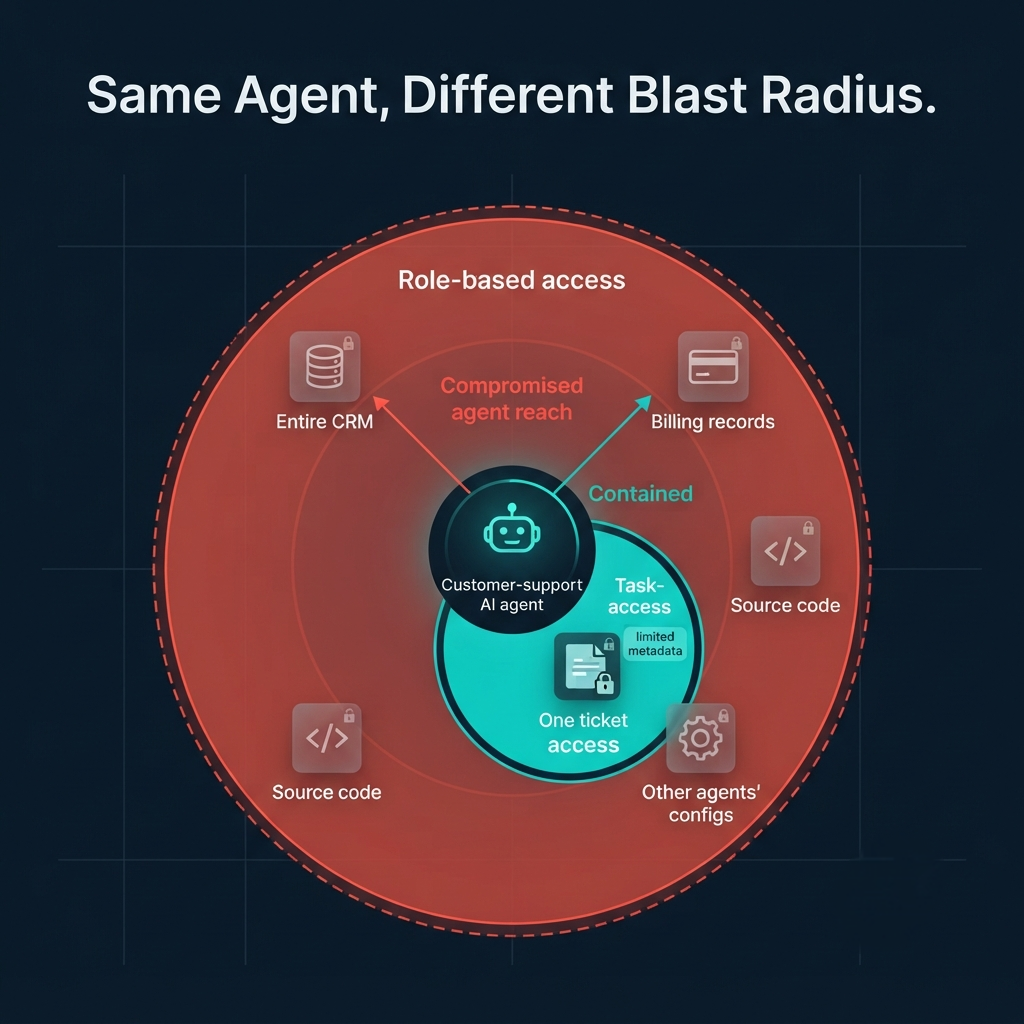
Least privilege is necessary, but it’s often applied too loosely. Give an agent a role like “read all customer data” or “write to production” and you may have least privilege in name only, with a huge blast radius underneath.
The better approach is task-bound authorization. Permissions should describe the job, not just the system.
Take a customer-support agent. It may need to pull up one ticket, read limited account metadata and draft a reply. It should not be able to export the whole CRM, change billing records, reach source code or edit another agent’s configuration.
| Access model | What it grants | Agentic-AI risk |
|---|---|---|
| Role-based access | Broad permissions by job function | Agent inherits excessive human-level access |
| Service-account access | Static permissions shared across workloads | Hard to attribute actions or rotate safely |
| Task-bound agent access | Specific action, data scope, duration, and delegation | Limits blast radius and supports auditability |
Microsoft’s guidance says permissions should be bound to the initiating principal and the task, limited to the minimum scope needed, and issued for the shortest practical time. Google Cloud warns against giving agent identities broad project-level roles, since that breaks least privilege and could let agents modify or delete other agents.
The Credential Problem: Static Tokens Become Standing Risk
Long-lived API keys, OAuth tokens and shared service-account credentials create standing risk.
An agent holding a static token can keep working after its task is done, after its owner changes roles, or even after the agent has been decommissioned. If that token leaks or gets stolen, the attacker gets more than access. They get a trusted automation path into your business systems.
The rule should be simple: no standing privilege for idle agents.
In practice, that means:
- Short-lived credentials issued only when a task begins.
- Narrowly scoped tokens tied to a specific tool and action.
- Just-in-time entitlements for elevated operations.
- Automatic revocation when a workflow ends, an owner changes or an agent is retired.
- Credential rotation and cryptographic attestation where supported.
Google Cloud describes its agent-identity model as offering cryptographic, strongly attested, lifecycle-bound runtime credentials, along with just-in-time access to remove standing privileges. Microsoft recommends keeping a stable agent identity while making privileges temporary through role activation, short-lived tokens or approvals.
Design the Human-Agent Trust Boundary
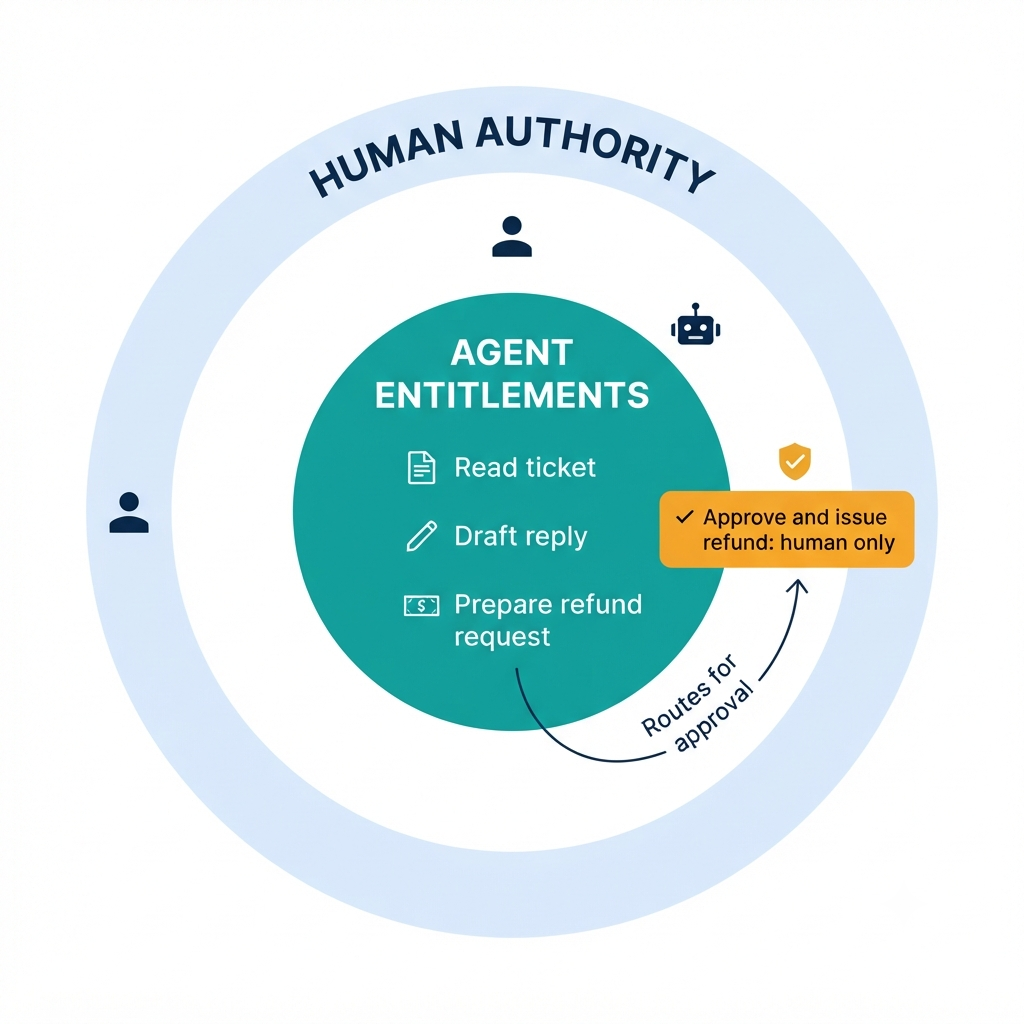
An AI agent shouldn’t quietly inherit the full authority of the person who deployed or prompted it.
Delegation means a human can authorize an agent to do a limited thing, but the agent’s entitlements stay narrower than the human’s. A manager may be able to approve a refund. The agent may only be allowed to prepare the refund request and route it for approval.
A practical trust model looks like this:
- Low impact: The agent can read non-sensitive information and draft content.
- Medium impact: The agent can update a ticket, create a draft email or query an approved internal dataset.
- High impact: The agent proposes an action, and a human approves it through an auditable workflow.
- Critical impact: The agent can’t execute the action directly. It can prepare it, but a human has to authorize and carry it out.
This keeps the benefits of automation without turning every agent into an unreviewable decision-maker. Approval gates, explicit trust relationships and accountable ownership sit at the center of secure identity and access design for AI systems.
Detection: Watch Behavior, Not Just Traffic
Firewalls inspect connections. Agent governance has to inspect intent, context and consequence.
Security teams should watch for:
- Unusual tool sequences or unfamiliar API endpoints.
- Access outside the agent’s declared purpose.
- Sudden jumps in read volume, export activity or write operations.
- Attempts to request new permissions or escalate privileges.
- Actions that don’t match the delegating user’s normal workflow.
- Agent-to-agent chains that combine individually harmless permissions into a high-risk outcome.
- Unregistered “shadow AI” agents and unsanctioned integrations.
NIST’s NCCoE stresses the need to link agent actions back to the non-human identity and to give visibility into actions, generated data and outcomes. Behavioral monitoring should catch agents operating outside their approved scope, not only malicious network traffic.
A CISO Action Plan
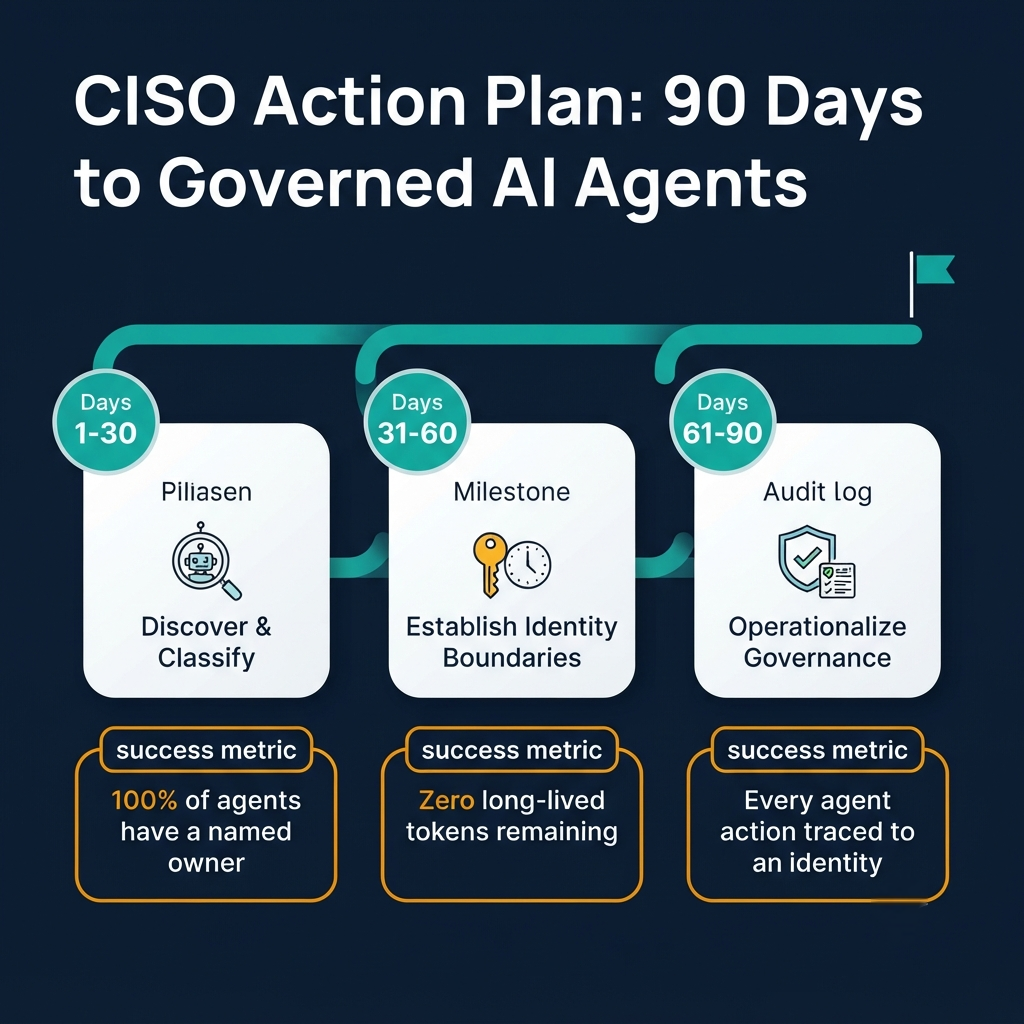
Days 1–30: Discover and classify
- Inventory AI agents, copilots, automations and integrations.
- Identify every credential, API token, service account and human identity they use.
- Classify agents by data sensitivity, business impact, autonomy level and blast radius.
- Assign a named owner to every agent.
Days 31–60: Establish identity boundaries
- Replace shared credentials with dedicated agent identities.
- Remove long-lived tokens wherever you can.
- Put scoped, short-lived credentials and policy-based tool access in place.
- Define explicit deny rules for high-risk actions and sensitive data paths.
Days 61–90: Operationalize governance
- Deploy an agent-action log that links identity, delegation, tool, input, output and outcome.
- Add anomaly detection for privilege escalation and abnormal workflow behavior.
- Set up quarterly access reviews and automated deprovisioning.
- Build incident-response playbooks for compromised, rogue or misconfigured agents.
The goal isn’t to slow down AI adoption. It’s to make autonomy governable.
Agents Are Principals, Not Plug-ins
The question is no longer “Can our firewall stop an AI agent?”
It’s “Can we prove which agent acted, under whose authority, with which permissions, on which data, and why?”
Enterprises that treat agents as ordinary software will keep finding that their controls were built for a perimeter that no longer exists. Enterprises that treat agents as governed machine identities can adopt agentic AI without giving up control over identity, data and consequential action.
In an agentic enterprise, identity is the new perimeter, and governance is the new firewall.