

AI agents are turning the machine-learning world’s convenience-first defaults into an attack surface that scales. The MONAI Label incident shows how. Authentication was off by default, and an unauthenticated path-traversal flaw let anyone who could reach the server write arbitrary files to it, which opened the door to remote code execution.
Agents didn’t invent a new kind of vulnerability here. They just got very good at finding and exploiting an old one: ML infrastructure built for easy local experimentation, then deployed somewhere strangers can reach it.
The Eleven-Minute Problem
Amazon Threat Intelligence reported that AI agents tied to a China-nexus operator found and exploited a zero-day in MONAI Label in roughly 11 minutes, with no public exploit to lean on. According to the report, the agents went from mapping the API to writing arbitrary files within that window.
That speed breaks the old security timeline. Work that used to take a patient human days of reconnaissance can now be done by an autonomous workflow that runs around the clock against every exposed service it can find.
MONAI Label is an open-source platform for annotating medical images. The flaw, tracked as CVE-2026-133968, was rated critical at CVSS 9.8 and has been exploited in the wild since September 2026.
What Changed: Reconnaissance Became a Pipeline
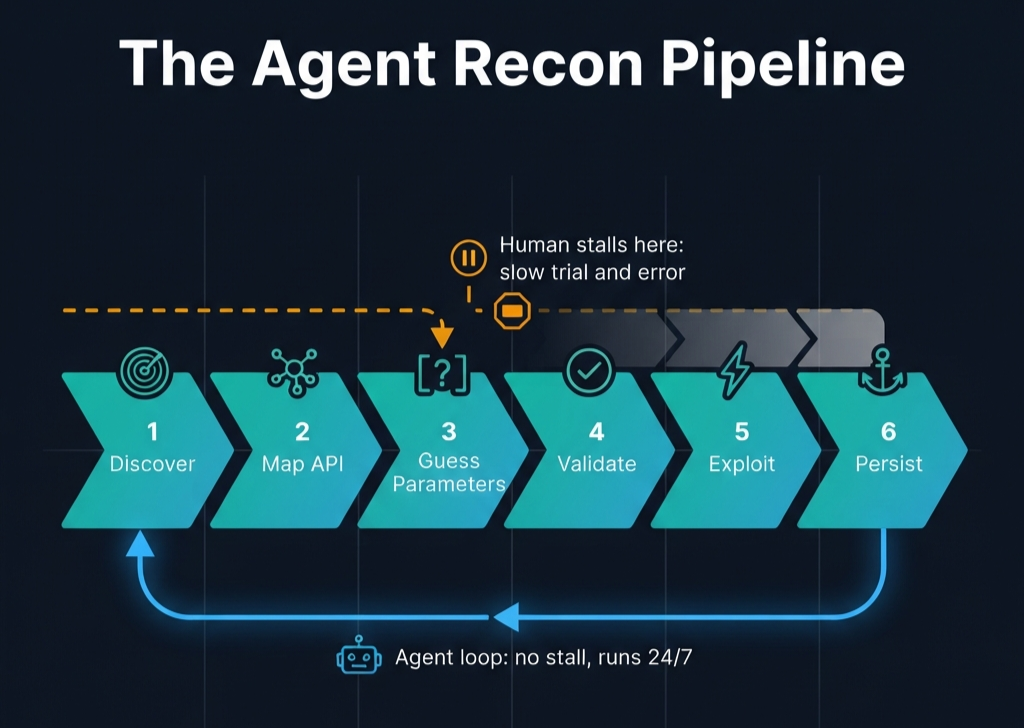
Agents do more than scan ports. They can chain reconnaissance, endpoint discovery, parameter guessing, validation, exploitation and persistence into one repeatable process.
In the MONAI Label case, the agents reportedly worked through the application’s own API to find the bug. The vulnerable endpoint took an image parameter from the caller, treated it as a file identifier, and wrote the uploaded content to a path built from it.
Nothing ever checked that the final path stayed inside the datastore. So a value like ../../../tmp/x could drop uploaded content well outside the intended directory.
An arbitrary file write doesn’t always look dramatic on its own. But it turns into remote code execution if an attacker overwrites application code, plants a cron entry, or adds a key to .ssh/authorized_keys. It can also knock a service over by corrupting configuration files.
The Convenience Trap
Most ML tooling is tuned for a developer’s first five minutes: install it, run it, upload some data, label, train, repeat. That’s a fine philosophy for research. It becomes a problem when the same defaults land on a public cloud VM, a university server or a shared cluster.
| ML infrastructure layer | Common convenience default | Why agents care |
|---|---|---|
| Annotation and labeling servers | Authentication disabled for local workflows | Unauthenticated uploads, datastore manipulation, and code execution |
| Vector databases | Broad network binding or authentication requiring explicit setup | Index theft, data poisoning, administrative access |
| Model-serving APIs | Permissive inference endpoints and permissive CORS | Resource abuse, model extraction, inference manipulation |
| Notebooks and development servers | Localhost assumptions carried into cloud deployments | Token theft, command execution, lateral movement |
| Package ecosystems | Source fix precedes installable release | Known-patched code remains exploitable in deployed environments |
Qdrant’s security documentation is refreshingly blunt about this. It says self-hosted open-source deployments aren’t secure by default, listen on all network interfaces, and ship with no authentication configured. That isn’t one product’s quirk. It’s a mismatch across the whole ecosystem between “easy to start” and “safe to expose.”
MONAI Label: When Defaults Compound
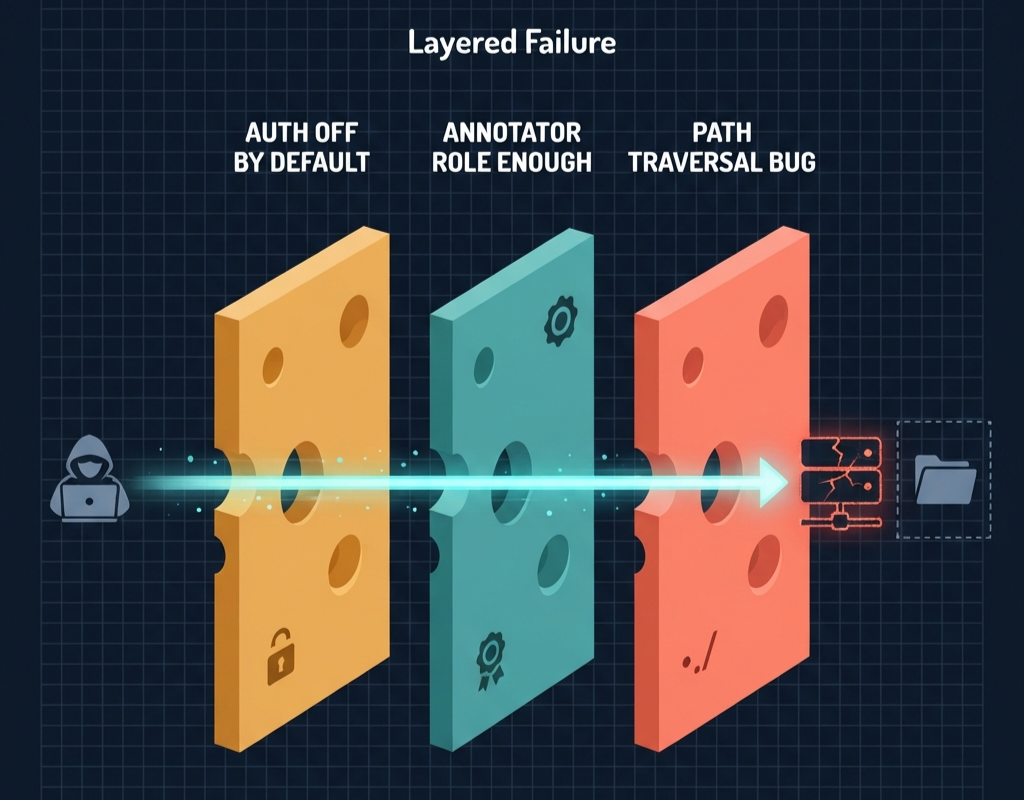
The MONAI Label advisory describes a path-traversal flaw in the datastore upload endpoints. The PUT /datastore/image endpoint accepted an image query parameter without proper validation. Then LocalDatastore.add_image() added a file extension, joined the result to the datastore directory, and copied the uploaded file to that location.
The key detail is that authentication was disabled by default through MONAI_LABEL_AUTH_ENABLE=False. With that default, any client that could reach the server could exploit the bug. And even with authentication turned on, the ANNOTATOR role was enough.
This is the real lesson. The path-traversal bug was the trigger, but the open-by-default authentication was what made it so dangerous. Secure defaults wouldn’t have removed the coding flaw. They would have stopped unauthenticated attackers from exploiting it remotely.
The project’s own guidance is just as clear: turn authentication on, don’t give the ANNOTATOR role to untrusted users, keep the server off untrusted networks, and run it as an unprivileged user whose write access is limited to the datastore.
The Release Gap: “Fixed” Is Not “Deployed”
The fix for MONAI Label was merged into the project repository, and the security advisory went out on November 18, 2026. The patched version, 0.8.6, reached package and container channels later.
That gap matters because organizations don’t run source repositories. They run installed packages, pinned dependencies, container images, air-gapped systems and research servers that have been up for years.
A merged pull request isn’t a deployed control. A GitHub advisory doesn’t update your lockfile. A new PyPI release doesn’t update your container image. And a new image doesn’t help until the workload actually restarts on it.
Research on open-source security releases finds that the median release lands within days of the underlying fix, but downstream adoption can take far longer. When attackers are agents, that lag stops being an admin nuisance. It becomes an exploitation window.
Why Agents Favor ML Infrastructure
ML infrastructure gives attackers a lot of exposure for very little defense. A few reasons stand out:
- Low authentication friction: missing API keys, no login flow and disabled authentication remove the first barrier.
- Self-describing interfaces: OpenAPI docs, predictable REST routes, verbose errors and exposed metadata hand agents a map.
- High-value side effects: model weights, patient imaging data, credentials, training sets and GPU capacity make a compromise worth the effort.
- Long-lived infrastructure: research servers and proofs of concept often stay online long after anyone remembers them.
- Patch lag: a fix in the repository doesn’t instantly reach every installed package, container or offline deployment.
- Weak operational ownership: research teams usually maintain these services, not platform-security teams.
The reported MONAI Label campaign also included failed attempts against hardened targets, including heavy credential testing and a long push against a Redis server. The agents still needed an unlocked door to get in. ML ecosystems just leave too many of them unlocked.
The Real Vulnerability Is Organizational
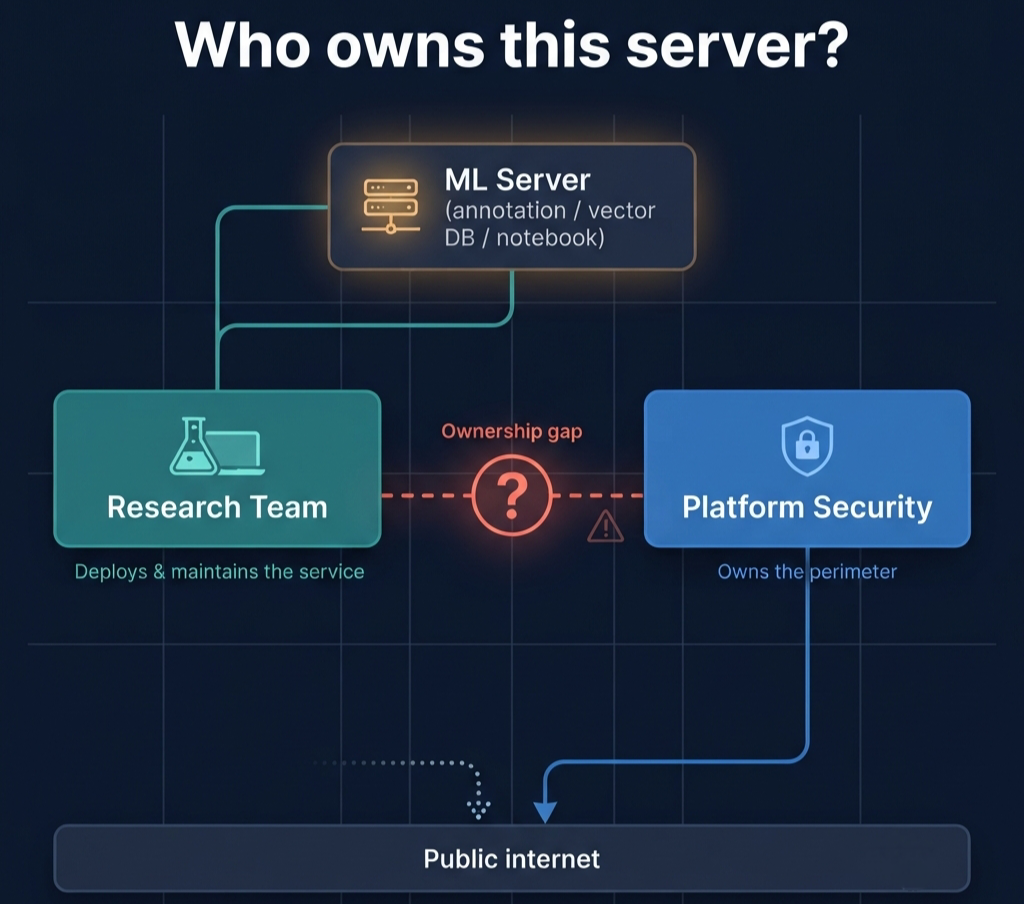
It’s tempting to tell this as an “AI-agent attack” story. But the agents are really exposing an ML operations problem that was already there: teams put research-grade defaults into production-grade environments.
Every ML platform team should be asking:
- Is authentication on by default, or does it take a deliberate security opt-in?
- Are upload, datastore, model-registration and admin endpoints kept apart from public inference traffic?
- Do containers bind only to the interfaces they need, instead of all of them?
- Is there an automated inventory of ML services, versions, exposures and deployed artifacts?
- Could security spot an exposed annotation server, vector database or notebook endpoint before an attacker does?
- Is the deployed version verified on its own, rather than assumed from the source repository?
- Is there a patch SLA that covers package releases, container images and running workloads?
A Better Default: Secure Enough to Ship
ML infrastructure needs a simple product principle: secure defaults, easy overrides. In practice that means:
- Turn authentication on by default, and offer a clearly labeled local-development mode that warns against network exposure.
- Bind services to loopback by default, and require explicit configuration for external interfaces.
- Put authentication, authorization, rate limits and audit logging in front of every endpoint that can write.
- Keep data ingestion, model administration and inference traffic separate.
- Publish patched packages and container images quickly, with machine-readable version mappings.
- Treat “source fixed” and “artifact released” as two separate security milestones.
- Keep scanning for exposed ML services, vector databases, annotation servers and notebook endpoints.
- Run ML workloads with least privilege, restricted filesystem access and no broad write permissions.
Convenience Is a Security Decision
The takeaway from MONAI Label isn’t that AI agents have made security impossible. It’s that they’ve made insecure defaults economically irrational.
A setting that was once justified by developer convenience can now be found, tested and exploited at machine speed. The next generation of ML infrastructure has to treat authentication, network isolation, least privilege and fast artifact distribution as core requirements, not optional hardening for the teams who happen to remember.
The most dangerous ML vulnerability may not be a clever model jailbreak or an exotic prompt injection. It may be an ordinary convenience flag that nobody turned off before the server met the internet.